
Global Hypoactive Sexual Desire Disorder Market
 |
Author:
Disha B
|
Pages:
250
|
Author:
Disha B
|
Pages:
250
Global Hypoactive Sexual Desire Disorder Market Size, Share, and COVID-19 Impact Analysis, By Drug Type (Bupropion, Flibanserin, Bremelanotide, Testosterone, and Others), By Route of Administration (Oral, Parenteral, and Others), and By Region (North America, Europe, Asia-Pacific, Latin America, Middle East, and Africa), Analysis and Forecast 2025-2035
CAGR
4.25%
REVENUE 2024
USD Billion 2.55
FORECAST 2035
USD Billion 4.03
REPORT COVERAGE
Global
Global Hypoactive Sexual Desire Disorder Market Size Insights Forecasts to 2035
- The Global Hypoactive Sexual Desire Disorder Market Size Was Estimated at USD 2.55 Billion in 2024
- The Market Size is Expected to Grow at a CAGR of around 4.25 % from 2025 to 2035
- The Worldwide Hypoactive Sexual Desire Disorder Market Size is Expected to Reach USD 4.03 Billion by 2035
- North America is expected to grow the fastest during the forecast period.
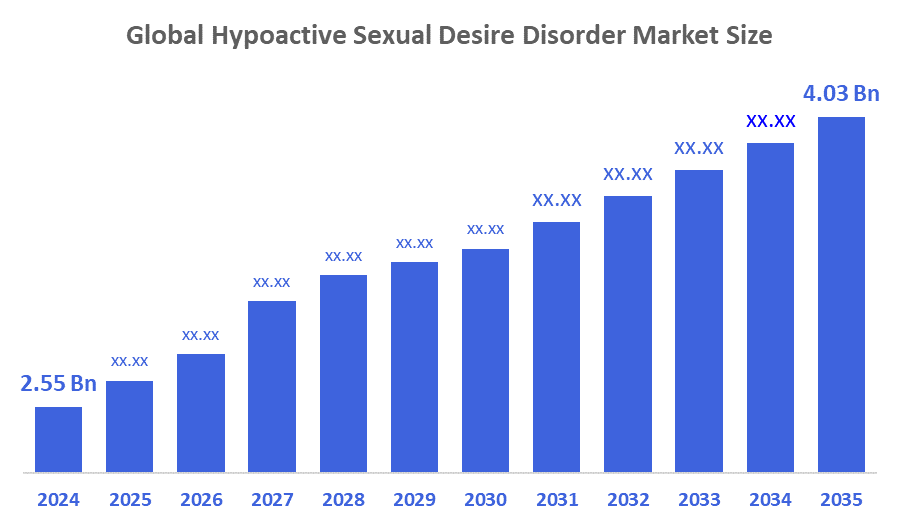
According to a research report published by Decisions Advisors and Consulting, the global hypoactive sexual desire disorder market size was worth around USD 2.55 billion in 2024 and is predicted to grow to around USD 4.03 billion by 2035 with a compound annual growth rate (CAGR) of 4.25 % from 2025 to 2035. The growing awareness among consumers about hypoactive sexual desire disorder (HSDD) and its increasing prevalence in women is helping to boost the market. Ongoing improvements in treatment options, extensive research, better healthcare infrastructure, supportive government initiatives, and improved access to new therapies also play important roles in this growth.
Market Overview
The worldwide hypoactive sexual desire disorder (HSDD) market refers to the part of the healthcare and pharmaceutical industry that deals with diagnosing, managing, and treating ongoing low sexual desire that leads to distress or relationship issues. Hypoactive sexual desire disorder (HSDD) is currently rising among adult women. It is marked by low self-confidence and a weaker connection with partners. Conditions like kidney failure, liver disease, hormonal imbalances, diabetes, and substance abuse, including alcoholism, can lead to HSDD. The growing number of working women and their busy schedules often contribute to low libido, increasing the need for HSDD treatment. Symptoms of hypoactive sexual desire disorder include fewer spontaneous sexual thoughts or fantasies, reduced response to stimulation, difficulty maintaining interest during sex, and a lack of desire to start sexual activity. Women with this disorder may also steer clear of situations that might lead to sex.
Increased investment in research and development is helping to create new therapies that work better and are safer. Additionally, the treatment market for hypoactive sexual desire disorder is seeing new opportunities, such as mergers and acquisitions among pharmaceutical companies aiming to expand their reach and broaden their product lines.
Freya Pharma Solutions secured US $5 million in funding to initiate a pivotal Phase 3 clinical trial of its Lybrido™ therapy, targeting female sexual interest/arousal disorder (FSIAD). This milestone positions Lybrido as one of the most advanced candidates in the sexual dysfunction therapeutics pipeline, moving beyond exploratory studies into late-stage validation.
Report Coverage
This research report categorizes the hypoactive sexual desire disorder market based on various segments and regions, forecasts revenue growth, and analyses trends in each submarket. The report analyses the key growth drivers, opportunities, and challenges influencing the hypoactive sexual desire disorder market. Recent market developments and competitive strategies, such as expansion, product launch, development, partnership, merger, and acquisition, have been included to draw the competitive landscape in the market. The report strategically identifies and profiles the key market players and analyses their core competencies in each sub-segment of the hypoactive sexual desire disorder market.
Driving Factors
The hypoactive sexual desire disorder therapeutics market offers several strong chances for growth and innovation. A key opportunity is the ongoing growth of the therapeutic pipeline, which includes many new drugs in different stages of clinical development. Progress in neurobiology, endocrinology, and pharmacology is helping to discover new drug targets and ways drugs work, leading to more effective and personalised treatments. The use of digital health technologies, like telemedicine and mobile health apps, provides additional chances to improve patient engagement, adherence, and outcomes. Pharmaceutical companies that focus on research and development, build partnerships, and embrace digital change are positioned to take advantage of these trends and boost market growth. Another significant opportunity in the HSDD therapeutics market is the growing emphasis on patient-centred care and holistic approaches to sexual health. Increasing awareness of the psychological, relational, and sociocultural aspects of HSDD has resulted in the creation of treatment models that blend medication, therapy, and lifestyle changes. Healthcare providers who use integrated care plans and work with mental health professionals, sex therapists, and patient advocacy groups can provide more complete and effective solutions for HSDD.
MINDCURE launched the “Desire Project”, an initiative exploring MDMA-assisted psychotherapy as a treatment for female Hypoactive Sexual Desire Disorder (HSDD). This approach represents a novel intersection of psychedelic medicine and sexual health, aiming to address unmet needs where traditional pharmacological options have struggled.
Restraining Factors
The HSDD therapeutics market faces several barriers. These include stigma, cultural taboos, underdiagnosis, safety and side-effect concerns, regulatory hurdles, pricing pressures, and reimbursement challenges.
Market Segmentation
The hypoactive sexual desire disorder market share is classified into drug type and route of administration.
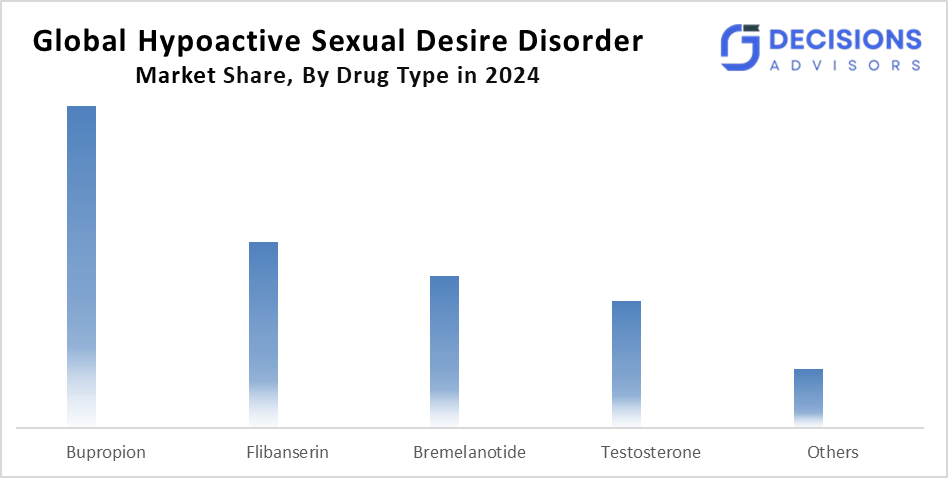
- The bupropion segment accounted for the largest market share in 2024 and is projected to grow at a remarkable CAGR over the forecast period.
Based on the drug type, the hypoactive sexual desire disorder market is divided into bupropion, flibanserin, bremelanotide, testosterone, and others. Among these, the bupropion segment accounted for the largest market share in 2024 and is projected to grow at a remarkable CAGR over the forecast period. The demand for bupropion in the HSDD treatment market is driven by its proven effectiveness, good safety record, and off-label use. Originally an antidepressant, bupropion has been effective in improving sexual desire and arousal, making it a popular choice among healthcare providers.
- The oral segment accounted for the highest market revenue in 2024 and is anticipated to grow at a substantial CAGR during the forecast period.
Based on the route of administration, the hypoactive sexual desire disorder market is segmented into oral, parenteral, and others. Among these, the oral segment accounted for the highest market revenue in 2024 and is anticipated to grow at a substantial CAGR during the forecast period. The oral route of administration has the largest share in the hypoactive sexual desire disorder (HSDD) market. Patients prefer it for its convenience. The availability of oral drugs like flibanserin (Addyi) also plays a strong role in oral formulations like Lybrido.
Regional Segment Analysis of the Hypoactive Sexual Desire Disorder Market
- North America (U.S., Canada, Mexico)
- Europe (Germany, France, U.K., Italy, Spain, Rest of Europe)
- Asia-Pacific (China, Japan, India, Rest of APAC)
- South America (Brazil and the Rest of South America)
- The Middle East and Africa (UAE, South Africa, Rest of MEA)
Asia Pacific is anticipated to hold the largest share of the hypoactive sexual desire disorder market over the predicted timeframe.
Asia Pacific is anticipated to hold the largest share of the hypoactive sexual desire disorder market over the predicted timeframe. The Asia Pacific regional market for HSDD is boosting due to rapid urbanisation, rising disposable incomes, and better access to healthcare services, which are fueling market expansion in countries like China, Japan, India, and South Korea. The increasing prevalence of sexual health disorders, along with a greater willingness to discuss and seek treatment for HSDD, is likely to increase demand for therapeutics in this area. Government efforts to promote sexual health education and the entry of international pharmaceutical companies are also helping the market grow.
North America is expected to grow at a rapid CAGR in the hypoactive sexual desire disorder market during the forecast period. North America leads the market due to its strong healthcare infrastructure, high awareness, and better diagnostic capabilities. This results in more frequent identification and treatment of hypoactive sexual desire disorder (HSDD). Moreover, the regional market has many pharmaceutical companies that develop and market HSDD treatments, ensuring early access to new therapies. Additionally, a proactive approach to sexual health, backed by educational campaigns and solid insurance coverage, helps patients access necessary treatments. Furthermore, significant investment in research and development drives innovation, which further contributes to recent developments in the HSDD treatment market.
Competitive Analysis:
The report offers the appropriate analysis of the key organisations/companies involved within the hypoactive sexual desire disorder market, along with a comparative evaluation primarily based on their product offering, business overviews, geographic presence, enterprise strategies, segment market share, and SWOT analysis. The report also provides an elaborative analysis focusing on the current news and developments of the companies, which includes product development, innovations, joint ventures, partnerships, mergers & acquisitions, strategic alliances, and others. This allows for the evaluation of the overall competition within the market.
List of Key Companies
- Allergan Plc
- AMAG Pharmaceuticals, Inc.
- Emotional Brain BV
- Endoceutics, Inc.
- GlaxoSmithKline Plc
- Ovoca Bio Plc
- Palatin Technologies, Inc.
- Pivot Pharmaceuticals, Inc.
- S1 Biopharma, Inc.
- Sprout Pharmaceuticals, Inc.
- Others
Key Target Audience
- Market Players
- Investors
- End-users
- Government Authorities
- Consulting and Research Firm
- Venture capitalists
- Value-Added Resellers (VARs)
Recent Development
- In December 2025, the FDA approved flibanserin for the treatment of hypoactive sexual desire disorder (HSDD) in postmenopausal women. This approval marked a milestone as flibanserin (marketed as Addyi) became the first medication specifically indicated for HSDD.
Market Segment
This study forecasts revenue at global, regional, and country levels from 2020 to 2035. Decisions Advisors has segmented the hypoactive sexual desire disorder market based on the below-mentioned segments:
Global Hypoactive Sexual Desire Disorder Market, By Drug Type
- Bupropion
- Flibanserin
- Bremelanotide
- Testosterone
- Others
Global Hypoactive Sexual Desire Disorder Market, By Route of Administration
- Oral
- Parenteral
- Others
Global Hypoactive Sexual Desire Disorder Market, By Regional Analysis
- North America
- US
- Canada
- Mexico
- Europe
- Germany
- UK
- France
- Italy
- Spain
- Russia
- Rest of Europe
- Asia Pacific
- China
- Japan
- India
- South Korea
- Australia
- Rest of Asia Pacific
- South America
- Brazil
- Argentina
- Rest of South America
- Middle East & Africa
- UAE
- Saudi Arabia
- Qatar
- South Africa
- Rest of the Middle East & Africa
Frequently Asked Questions (FAQ)
- What is Hypoactive Sexual Desire Disorder (HSDD)?
HSDD is a condition marked by persistently low sexual desire causing distress, often linked to hormonal imbalances, stress, or health issues like diabetes.?
- What causes HSDD?
Common causes include busy lifestyles among working women, medical conditions (e.g., kidney failure, alcoholism), hormonal changes, and psychological factors like low self-confidence.?
- What are the main treatments for HSDD?
Treatments include FDA-approved drugs like flibanserin (Addyi), bremelanotide (Vyleesi), bupropion, and testosterone, alongside therapy and lifestyle changes.?
- What is the market size and growth forecast?
The global HSDD market was USD 2.55 billion in 2024 and is projected to reach USD 4.03 billion by 2035, growing at a 4.25% CAGR.?
- Which drug type leads the market?
Bupropion holds the largest share due to its effectiveness and off-label use in boosting desire, with oral routes preferred for convenience.?
- What recent investments occurred in HSDD treatments?
Freya Pharma Solutions (now Arletta) raised US$5 million for Phase 3 trials of Lybrido, a promising on-demand therapy.?
- Which region dominates the HSDD market?
Asia Pacific holds the largest share due to urbanisation and healthcare access, while North America grows fastest with strong infrastructure.?
- What are the key challenges in the HSDD market?
Barriers include stigma, underdiagnosis, side effects, regulatory hurdles, and reimbursement issues, despite growing awareness.?
Check Licence
Choose the plan that fits you best: Single User, Multi-User, or Enterprise solutions tailored for your needs.
We Have You Covered
- 24/7 Analyst Support
- Clients Across the Globe
- Tailored Insights
- Technology Tracking
- Competitive Intelligence
- Custom Research
- Syndicated Market Studies
- Market Overview
- Market Segmentation
- Growth Drivers
- Market Opportunities
- Regulatory Insights
- Innovation & Sustainability
Report Details
| Scope | Global |
| Pages | 250 |
| Delivery | PDF & Excel via Email |
| Language | English |
| Release | Feb 2026 |
| Access | Download from this page |