
Global Image Guided Surgery Devices Market
 |
Pages:
240
|
Pages:
240
Global Image Guided Surgery Devices Market Size, Share, and COVID-19 Impact Analysis, By Device Type (Computed Tomography (CT), Scanners Ultrasound Systems Magnetic Resonance Imaging (MRI), Endoscopes, X-ray Fluoroscopy, Position Emitted Tomography (PET), and Single Photon Emission Computed Tomography (SPECT)), By Application (Cardiac Surgery, Neurosurgery, Orthopaedic Surgery, Urology Gastroenterology, Oncology Surgery, and Other Applications), By End User (Hospitals, Ambulatory Surgery Centres, Clinics, Research and Academic Institutions), and By Region (North America, Europe, Asia-Pacific, Latin America, Middle East, and Africa), Analysis and Forecast 2025-2035
REPORT COVERAGE
Global
Global Image Guided Surgery Devices Market Size Insights Forecasts to 2035
- The Global Image Guided Surgery Devices Market Size Was Estimated at USD 5.18 Billion in 2024
- The Market Size is Expected to Grow at a CAGR of around 5.71 % from 2025 to 2035
- The Worldwide Image Guided Surgery Devices Market Size is Expected to Reach USD 9.54 Billion by 2035
- North America is expected to grow the fastest during the forecast period.
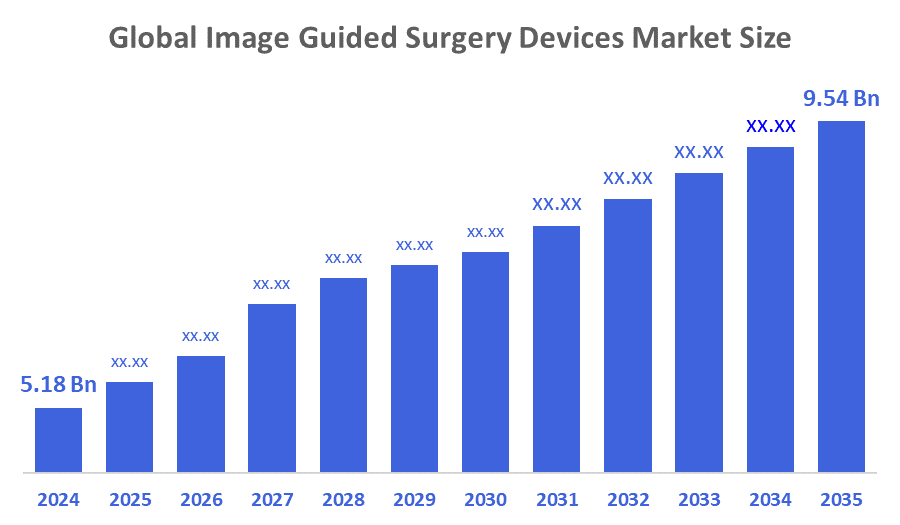
According to a research report published by Decisions Advisors and Consulting, The Global Image Guided Surgery Devices Market Size Was Worth Around USD 5.18 Billion In 2024 And Is Predicted To Grow To Around USD 9.54 Billion By 2035 With A Compound Annual Growth Rate (CAGR) Of 5.71 % From 2025 To 2035. The primary drivers of the market are the growing number of elderly people and their preference for less intrusive procedures, as well as developments in imaging technology. The market is expanding as a result of increased attempts to treat cancer and the growing incidence of chronic illnesses like cancer.
Market Overview
The surgical method referred to as image guided surgery requires surgeons to base their work on two sources, which include both stained surgical instruments and their preoperative or intraoperative photographic records. The implementation of image-guided surgical methods requires the use of cameras, together with ultrasonic or electromagnetic systems, or their combined use, to capture and transmit information about the patient's body and the surgeon's real-time operation to operating room screens and augmented reality headsets. The equipment used in image-guided surgery enables medical professionals to identify and treat multiple medical conditions. The application of image-guided surgical technology results in enhanced surgical precision and operational success. Endoscopic sinus surgery (ESS) evolved into its primary application after its initial development for neurosurgical procedures. The introduction of image-guided surgery represents the most important advancement in endoscopic sinus surgery since the initial introduction of endoscopic techniques. The surgical team can observe real-time anatomical dissection of the sinuses through this technology, which projects the procedure onto a computer screen in the operating room.
HistoSonics has secured an oversubscribed $250 million growth financing round, backed by high-profile investors. The funding will accelerate the global commercial expansion of its Edison® Histotripsy System, a noninvasive therapy platform that uses focused ultrasound to mechanically destroy diseased tissue. The investment also supports the development of new clinical indications across the body and strengthens operational capacity.
OncoRes Medical has secured $19 million in funding to advance its novel imaging technology for cancer surgery. The company’s platform uses real-time intraoperative imaging and AI to help surgeons more accurately distinguish cancerous tissue from healthy tissue, aiming to reduce repeat surgeries and improve patient outcomes. The funding will support OncoRes as it prepares for a U.S. clinical trial, marking a key step toward regulatory approval and commercialisation.
Report Coverage
This research report categorizes the image guided surgery devices market based on various segments and regions, forecasts revenue growth, and analyzes trends in each submarket. The report analyses the key growth drivers, opportunities, and challenges influencing the image guided surgery devices market. Recent market developments and competitive strategies, such as expansion, product launch, development, partnership, merger, and acquisition, have been included to draw the competitive landscape in the market. The report strategically identifies and profiles the key market players and analyzes their core competencies in each sub-segment of the image guided surgery devices market.
Driving Factors
The image guided surgery devices market is primarily driven by the rising demand for minimally invasive procedures, which reduce patient recovery time and hospital stays. The increasing number of chronic diseases and trauma cases, together with cancer surgeries, has led to faster adoption of modern surgical navigation technologies. The market expansion receives additional support from technological advancements, which include real-time imaging and robotics integration and AI-powered surgical guidance systems. The healthcare sector experiences strong demand because of increasing healthcare expenses, expanding hospital facilities and patients developing knowledge about safer surgical procedures.
Philips expanded the commercial availability of LumiGuide, its AI-enabled light-based 3D imaging and navigation system for image-guided therapy. LumiGuide replaces traditional X-ray visualisation with real-time light-based guidance, offering enhanced precision and reduced radiation exposure during complex endovascular procedures.
Restraining Factors
However, the global market for image-guided surgical equipment has a lot of room to grow due to the rising demand and adoption of this technology in emerging nations, and during the projection period, this market would benefit from rising government efforts and expanding healthcare infrastructure. The two main factors that are expected to impede market expansion are the high cost of imaging technology and the strict regulatory environment. Additionally, a lack of knowledge is negatively affecting the market's expansion.
Market Segmentation
The image guided surgery devices market share is classified into product type and application.
- The magnetic resonance imaging (MRI) segment accounted for the largest share in 2024 and is anticipated to grow at a significant CAGR during the forecast period.
Based on the device type, the image guided surgery devices market is segmented into computed tomography (CT), magnetic resonance imaging (MRI), endoscopes, x-ray fluoroscopy, position emitted tomography (PET), and single photon emission computed tomography (SPECT). Among these, the magnetic resonance imaging (MRI) segment accounted for the largest share in 2024 and is anticipated to grow at a significant CAGR during the forecast period. Technology advancements and the wide range of uses for these therapies in treatment planning, delivery and location, and treatment response assessment are the primary factors propelling the category's expansion. These systems have significant uses in radiation oncology, neurology, and trauma care.
For instance, ClearPoint Neuro received EU MDR certification for its MRI-compatible navigation software used for brain and spine procedures. MRI compatibility ensures real-time imaging guidance directly inside surgical suites, a key step for technology adoption in image-guided interventions.
- The cardiac surgery segment accounted for the largest share in 2024 and is anticipated to grow at a significant CAGR during the forecast period.
Based on the application, the image guided surgery devices market is divided into cardiac surgery, neurosurgery, orthopaedic surgery, urology, gastroenterology, oncology surgery, and other applications. Among these, the cardiac surgery segment accounted for the largest share in 2024 and is anticipated to grow at a significant CAGR during the forecast period. The primary driver of death worldwide is cardiovascular diseases (CVDs). One of the main factors driving the segment's growth is the ageing population and the rising prevalence of certain illnesses. Additionally, the incorporation of hybrid operating rooms and improvements in real-time imaging technologies like 3D and 4D ultrasound are driving the industry. these innovations.
For instance, MediView XR, a company blending augmented reality & AI with image-guided navigation, raised $24 million in Series A funding led by GE HealthCare, Mayo Clinic, and others. Although not limited to cardiac surgery, its AR-powered “X-ray vision” platform enhances real-time 3D visualisation and could transform precision in complex cardiac procedures, including structural and interventional cardiology.
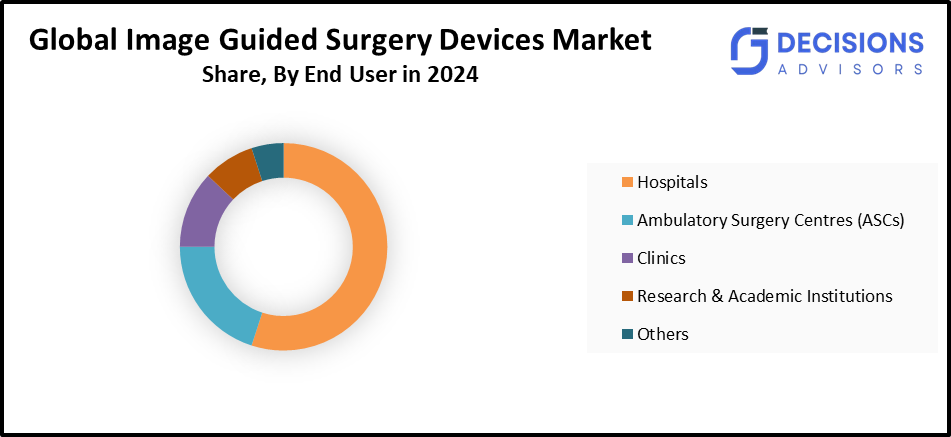
- The hospitals segment accounted for the highest market revenue in 2024 and is anticipated to grow at a significant CAGR during the forecast period.
Based on the end user, the image guided surgery devices market is divided into hospitals, ambulatory surgery centres, clinics, research and academic institutions. Among these, the hospitals segment accounted for the highest market revenue in 2024 and is anticipated to grow at a significant CAGR during the forecast period. The growth of various treatments and the extensive use of image-guided therapy systems in hospitals are the two primary factors propelling the market. Hospitals are adopting these technologies in response to the increasing need for cost-effective clinical workflow optimisation.
Regional Segment Analysis of the Image Guided Surgery Devices Market
- North America (U.S., Canada, Mexico)
- Europe (Germany, France, U.K., Italy, Spain, Rest of Europe)
- Asia-Pacific (China, Japan, India, Rest of APAC)
- South America (Brazil and the Rest of South America)
- The Middle East and Africa (UAE, South Africa, Rest of MEA)
Asia Pacific is anticipated to hold the largest share of the image guided surgery devices market over the predicted timeframe.
Asia Pacific is anticipated to hold the largest share of the image guided surgery devices market over the predicted timeframe. The growing geriatric population, increasing cases of target diseases, and improving healthcare infrastructure are the factors responsible for its rapid growth. In addition, economic growth and government initiatives to improve healthcare access contribute to market expansion. Furthermore, the region's large population and rising healthcare spending create opportunities for image-guided therapy systems. Moreover, this growth is further supported by partnerships between local and international healthcare companies, enhancing technological capabilities.
Royal Philips launched the Image Guided Therapy Mobile C-arm System 9000 – Zenition 90 Motorised in India. This advanced mobile C-arm is designed to support complex vascular procedures and a wide range of clinical applications, including cardiac interventions, pain management, and urology. Featuring intuitive motorisation, automated workflows, and high-power imaging, it empowers surgeons with greater flexibility, independence, and precision. The system will be commercially available in India from Q2 2024, enhancing access to high-quality surgical care.
North America is expected to grow at a rapid CAGR in the image guided surgery devices market during the forecast period. The factors driving this market's growth include improved healthcare infrastructure, technological advancements, and rapid adoption of advanced radiation therapies; the growing geriatric population base, along with an increase in chronic disease cases, is also contributing to the growth of the regional market; product launches and partnerships by major corporations enhance market expansion; and regulatory support fosters innovation and technological advancements.
Method AI, a Boston-based medical technology company, has raised $20 million in Series A funding to advance its image-guided surgery platform. Emerging from the Cleveland Clinic in 2021, the company focuses on solving visualisation challenges faced by robotic surgeons. Its novel surgical ultrasound technology enables doctors to see anatomy deep beneath organ surfaces, beyond the reach of traditional surgical cameras. The funding round was led by a private family office, with participation from Cleveland Clinic and JobsOhio Growth Capital Fund, supporting continued development of the platform to improve outcomes in oncology and other complex conditions.
Competitive Analysis:
The report offers the appropriate analysis of the key organizations/companies involved within the image guided surgery devices market, along with a comparative evaluation primarily based on their product offering, business overviews, geographic presence, enterprise strategies, segment market share, and SWOT analysis. The report also provides an elaborative analysis focusing on the current news and developments of the companies, which includes product development, innovations, joint ventures, partnerships, mergers & acquisitions, strategic alliances, and others. This allows for the evaluation of the overall competition within the market.
List of Key Companies
- Analogic Corporation
- Brainlab AG
- GE Healthcare
- Koninklijke Philips N.V.
- Medtronic
- Olympus Corporation
- Siemens Healthineers
- Stryker
- Varian Medical Systems, Inc.
- Others
Key Target Audience
- Market Players
- Investors
- End-users
- Government Authorities
- Consulting and Research Firm
- Venture capitalists
- Value-Added Resellers (VARs)
Recent Development
- In December 2025, Philips expanded the commercial availability of LumiGuide, the world’s first real-time AI-enabled light-based 3D navigation solution for image-guided therapy. The technology uses light instead of X-rays for device visualisation, improving navigation in complex endovascular procedures. LumiGuide integrates with Philips’ Azurion platform and is now available across Europe and the United States.
- In November 2025, Philips assisted surgeons with heart valve repair by introducing AI into the procedure room. By combining artificial intelligence with real-time imaging and navigational capabilities, the invention enables medical professionals to see and operate devices inside the heart more accurately. This AI-enabled assistance seeks to streamline intricate structural heart surgeries, lower complications, and enhance patient outcomes by increasing accuracy and efficiency.
- In October 2025, Philips announced the installation of its 5,000th Zenition mobile C-arm system, marking a major milestone in expanding access to high-quality, efficient surgical and interventional care worldwide. The Zenition platform is designed to enhance workflow, imaging precision, and flexibility in operating rooms, supporting a broad range of procedures from orthopaedics to vascular interventions. This achievement underscores Philips’ commitment to advancing patient care globally.
Market Segment
This study forecasts revenue at global, regional, and country levels from 2020 to 2035. Decisions Advisors has segmented the image guided surgery devices market based on the below-mentioned segments:
Global Image Guided Surgery Devices Market, By Device Type
- Computed Tomography (CT)
- Scanners
- Ultrasound Systems
- Magnetic Resonance Imaging (MRI)
- Endoscopes
- X-ray Fluoroscopy
- Position Emission Tomography (PET)
- Single Photon Emission Computed Tomography (SPECT)
Global Image Guided Surgery Devices Market, By Application
- Cardiac Surgery
- Neurosurgery
- Orthopaedic Surgery
- Urology Gastroenterology
- Oncology Surgery
- Other Applications
Global Image Guided Surgery Devices Market, By End User
- Hospitals
- Ambulatory Surgery Centres
- Clinics
- Research and Academic Institutions
Global Image Guided Surgery Devices Market, By Regional Analysis
- North America
- US
- Canada
- Mexico
- Europe
- Germany
- UK
- France
- Italy
- Spain
- Russia
- Rest of Europe
- Asia Pacific
- China
- Japan
- India
- South Korea
- Australia
- Rest of Asia Pacific
- South America
- Brazil
- Argentina
- Rest of South America
- Middle East & Africa
- UAE
- Saudi Arabia
- Qatar
- South Africa
- Rest of the Middle East & Africa
Frequently Asked Questions (FAQ)
1. How are artificial intelligence and machine learning transforming image-guided surgery devices?
AI and machine learning enhance surgical precision by enabling automated image interpretation, predictive analytics, and real-time anatomical mapping. These technologies assist surgeons in decision-making, reduce intraoperative errors, and improve procedural efficiency.
2. What role do hybrid operating rooms play in the growth of image-guided surgery devices?
Hybrid operating rooms integrate advanced imaging systems with surgical infrastructure, allowing minimally invasive and open procedures to be performed in the same setting. This integration supports complex interventions and increases demand for high-performance imaging devices.
3. How does the shift toward outpatient and same-day surgeries impact market demand?
The growing preference for outpatient procedures increases the need for compact, mobile, and cost-effective imaging systems that can be deployed in ambulatory surgical centres and specialised clinics.
4. What reimbursement trends are influencing the adoption of image-guided surgery technologies?
Favourable reimbursement policies for minimally invasive and precision-based procedures encourage hospitals and healthcare providers to invest in advanced imaging systems. However, reimbursement variability across regions may impact adoption rates.
5. How are emerging economies contributing to market expansion?
Emerging markets are investing heavily in healthcare modernisation, digital health integration, and advanced surgical infrastructure. This creates strong opportunities for manufacturers to introduce affordable and scalable image-guided systems.
6. What supply chain and manufacturing challenges affect the image-guided surgery devices market?
The market faces challenges such as semiconductor shortages, high production costs, complex regulatory compliance requirements, and dependency on specialised components, which can affect product availability and pricing.
7. How is integration with robotic-assisted surgery influencing future growth?
The convergence of image-guided systems with robotic surgical platforms enhances precision, visualisation, and control during complex procedures. This integration is expected to drive innovation and create new revenue streams within the market.
Check Licence
Choose the plan that fits you best: Single User, Multi-User, or Enterprise solutions tailored for your needs.
We Have You Covered
- 24/7 Analyst Support
- Clients Across the Globe
- Tailored Insights
- Technology Tracking
- Competitive Intelligence
- Custom Research
- Syndicated Market Studies
- Market Overview
- Market Segmentation
- Growth Drivers
- Market Opportunities
- Regulatory Insights
- Innovation & Sustainability
Report Details
| Scope | Global |
| Pages | 240 |
| Delivery | PDF & Excel via Email |
| Language | English |
| Release | Mar 2026 |
| Access | Download from this page |