
Global Immunology Market
 |
Pages:
210
|
Pages:
210
Global Immunology Market Size, Share, By Drug Class (Monoclonal Antibody (mAb), Fusion Proteins, Immunosuppressants, and Others), By Disease Indication (Rheumatoid Arthritis, Psoriatic Arthritis, Plaque Psoriasis, Ankylosing Spondylitis, Inflammatory Bowel Disease, Prophylaxis of Organ Rejection, and Others), By Distribution Channel (Hospital Pharmacies, Retail Pharmacies, and Online Pharmacies), and By Region (North America, Europe, Asia-Pacific, Latin America, Middle East & Africa), Analysis and Forecast 2025?2035.
REPORT COVERAGE
Global
Market Snapshot
- Market Size (2025): USD 110.25 Billion
- Projected Market Size (2035): USD 295.65 Billion
- Compound Annual Growth Rate (CAGR): 10.37%
- Largest Regional Market: North America
- Fastest Growing Region: Asia-Pacific
- 3rd Largest Region: Europe
- Base Year: 2025
- Historical Period: 2021–2024
- Forecast Period: 2026–2035
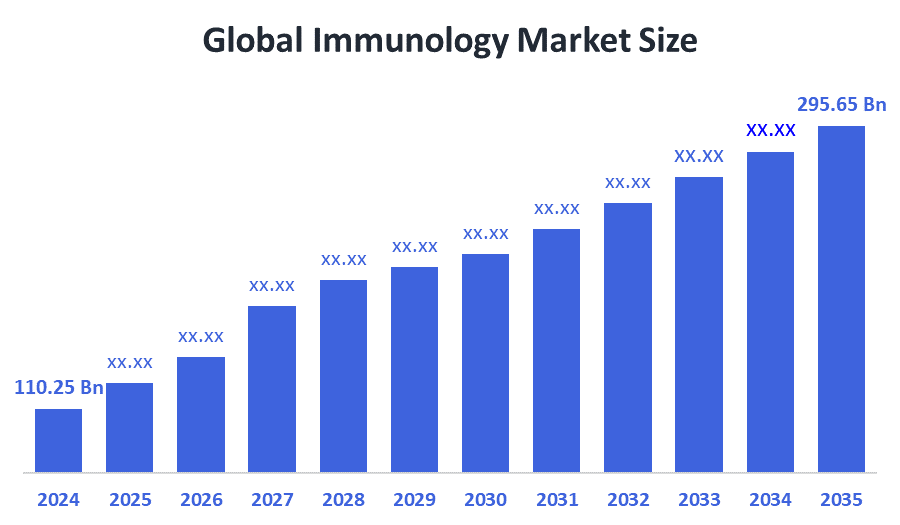
According to Decision Advisors, the Global Immunology Market Size is expected to grow from USD 110.25 Billion in 2024 to USD 295.65 Billion by 2035, at a CAGR of 10.37% during the forecast period 2025-2035. The global Immunology market is projected to grow significantly over the next decade due to increasing autoimmune disease prevalence, advancements in biotechnology, biosimilar entry, increased R&D investment, and rising awareness & diagnostics.
Market Overview/ Introduction
The global immunology market operates through its process of creating and producing medical treatments which doctors use to identify and treat diseases that affect the immune system, including autoimmune diseases, which comprise Rheumatoid Arthritis and Multiple Sclerosis. The market experiences growth because more people develop these conditions, and biotechnology and molecular biology, and targeted therapies continue to advance. The increasing use of biosimilars is making treatments more affordable and accessible to patients. The market presents substantial prospects through the creation of personalized medicine solutions and gene therapy applications, and the development of ground breaking biologic products. The global immunology market will sustain its current growth because developing regions expand their healthcare facilities and increase their research and development spending.
- The Union Budget 2026–27 introduces the ?10,000 crore Biopharma SHAKTI scheme to position India as a global biopharmaceutical manufacturing hub. The initiative focuses on boosting biologics and biosimilars production, strengthening R&D, and improving drug accessibility, thereby supporting innovation and supply capabilities across critical therapeutic areas, including immunology and other complex diseases.
- The proposed EU Biotech Act aims to strengthen Europe’s biotech sector, which employs over 900,000 people and contributes €40 billion. It addresses low 7% global VC share and declining clinical trials (22% to 12%) by improving funding, reducing regulations, and accelerating innovation.
Notable Insights: -
- North America holds the largest regional market share in the global immunology market.
- Asia-Pacific is the fastest-growing region in the global immunology market.
- The monoclonal antibody (mAb) segment held the dominant share of 64.75% in 2025.
- The rheumatoid arthritis segment held a dominating share in the market of 33.85% in 2025.
- The hospital pharmacies segment held a substantial share of the global market of 47.95% in 2025.
- The compound annual growth rate of the Global Immunology Market is 10.37%.
- The market is likely to achieve a valuation of USD 295.65 billion by 2035.
What is role of technology in grooming the market?
Technology plays a crucial role in shaping and accelerating the growth of the global immunology market. Advanced tools such as artificial intelligence and data analytics enable faster drug discovery, improved clinical trial design, and personalized treatment approaches. Innovations in biologics manufacturing and gene editing technologies enhance the development of targeted therapies. Digital health solutions, including telemedicine and remote monitoring, improve patient access and adherence to immunology treatments. Additionally, automation and advanced diagnostics allow early detection of immune-related diseases, leading to timely intervention. Overall, technology drives efficiency, innovation, and accessibility, significantly contributing to the expansion and evolution of the immunology market.
Market Drivers
The global immunology market is witnessing significant growth driven by the rising prevalence of conditions such as Rheumatoid Arthritis, Inflammatory Bowel Disease, and Multiple Sclerosis. Rapid advancements in biotechnology and molecular biology are enabling the development of highly targeted and effective therapies. The increasing adoption of cost-effective biosimilars is improving treatment accessibility and affordability across diverse regions. Additionally, there is a growing emphasis on developing novel immune boosters and innovative therapeutic solutions. Enhanced diagnostic technologies are supporting early detection and timely intervention, ultimately improving patient outcomes and contributing to the sustained expansion of the immunology market globally.
Restrain
The global immunology market faces restraints due to high costs of biologics and advanced therapies, limiting patient access. Stringent regulatory requirements delay approvals and increase development costs. Additionally, limited awareness in developing regions and potential side effects associated with immunotherapies hinder widespread adoption and market growth.
Competitive Analysis:
The report offers the appropriate analysis of the key organizations/companies involved within the Global Immunology Market Market, along with a comparative evaluation primarily based on their product of offering, business overviews, geographic presence, enterprise strategies, segment market share, and SWOT analysis. The report also provides an elaborative analysis focusing on the current news and developments of the companies, which includes product development, innovations, joint ventures, partnerships, mergers & acquisitions, strategic alliances, and others. This allows for the evaluation of the overall competition within the market.
Top Companies in Global Immunology Market
- AbbVie
- Johnson & Johnson
- F. Hoffmann-La Roche
- Pfizer
- Novartis
- Sanofi
- Eli Lilly and Company
- Amgen
- Takeda Pharmaceutical Company
- Bristol Myers Squibb
- GSK
- AstraZeneca
Government Initiatives
|
Country |
Key Government Initiatives |
|
UK |
The UK’s updated Industrial Strategy (2025–2026) aims to establish the country as a leading immunology research hub, supported by 520 million funding. Streamlined approvals through the Medicines and Healthcare products Regulatory Agency and plans to double clinical trial participation will accelerate innovation, boosting growth in the global immunology market. |
|
US |
The National Institute of Allergy and Infectious Diseases has elevated immunology as a core focus for 2026, advancing research on immune-related chronic diseases. In collaboration with Advanced Research Projects Agency for Health, it supports high-risk immune reprogramming technologies, driving innovation and growth in the global immunology market. |
|
India |
The Department of Biotechnology launched the Bio-RIDE scheme by merging programs to support immunology startups across R&D, entrepreneurship, and biomanufacturing. Aiming for a $300 billion bioeconomy by 2030, it strengthens innovation, production, and commercialization, driving growth in the global immunology market. |
Market Segmentation
The immunology market share is classified into facilities, location, and end-user
- The monoclonal antibody (mAb) segment dominated the market in 2025 and is projected to grow at a substantial CAGR during the forecast period.
Based on the drug class, the immunology market is divided into monoclonal antibody (mAb), fusion proteins, immunosuppressants, and others. Among these, the monoclonal antibody (mAb) segment dominated the market in 2025 and is projected to grow at a substantial CAGR during the forecast period. The monoclonal antibody (mAb) segment held the dominant share of 64.75% in 2025. Fueled by the high specificity in targeting immune pathways, leading to superior efficacy and safety. They are widely used in treating diseases like rheumatoid arthritis and psoriasis, supported by strong clinical outcomes, blockbuster drug success, and increasing demand for targeted biologic therapies.
- The rheumatoid arthritis segment accounted for the largest share in 2025, and is anticipated to grow at a significant CAGR of during the forecast period.
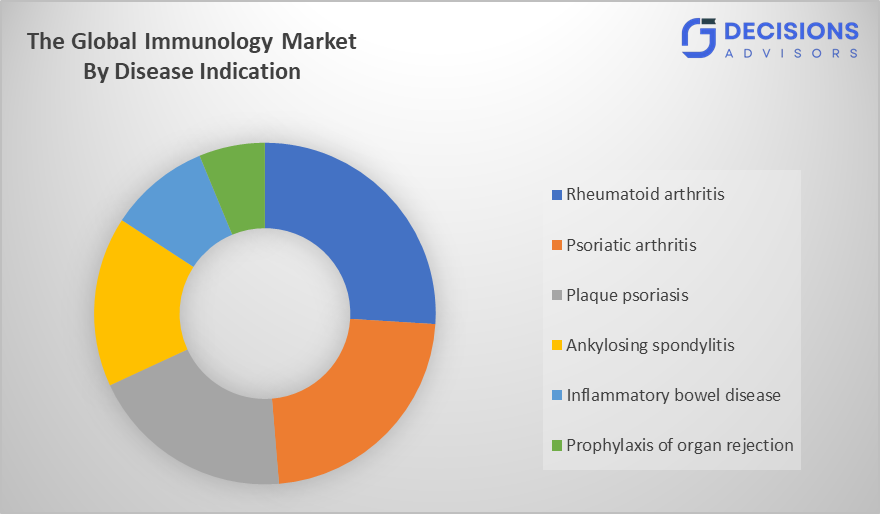
Based on the disease indication, the immunology market is divided into rheumatoid arthritis, psoriatic arthritis, plaque psoriasis, ankylosing spondylitis, inflammatory bowel disease, prophylaxis of organ rejection, and others. Among these, the rheumatoid arthritis segment accounted for the largest share in 2025, and it's anticipated to grow at a significant CAGR during the forecast period. The rheumatoid arthritis segment held a dominating share in the market of 33.85% in 2025. Due to its high global prevalence and chronic nature requiring long-term treatment. Strong availability of biologics and targeted therapies, increasing diagnosis rates, and continuous demand for effective disease management contribute to its large market share and expected significant growth during the forecast period.
- The hospital pharmacies segment dominated the market in 2025 and is projected to grow at a substantial CAGR during the forecast period.
Based on the distribution channel, the immunology market is divided into hospital pharmacies, retail pharmacies, and online pharmacies. Among these, the hospital pharmacies segment dominated the market in 2025 and is projected to grow at a substantial CAGR during the forecast period. The hospital pharmacies segment held a substantial share of the global market of 47.95% in 2025. Fueled by the high administration of biologics and advanced therapies within hospital settings. These facilities ensure proper storage, handling, and supervision of complex treatments. Increasing hospital visits, availability of specialized care, and preference for monitored drug administration further drive segment growth.
Strategies to Implement for Growth of the Market in Non-Leading Regions
To drive growth in non-leading regions of the global immunology market, companies should focus on expanding healthcare infrastructure and improving access to advanced therapies. Strengthening local manufacturing and supply chains can reduce costs and enhance availability. Strategic partnerships with regional firms and governments can support market entry and distribution. Increasing investment in research and clinical trials tailored to local populations will boost adoption. Supportive policies and streamlined regulations, inspired by initiatives like the EU Biotech Act, can accelerate approvals. Additionally, raising awareness, improving diagnostics, and promoting affordable treatment options will help expand patient access and drive sustained market growth.
Regional Segment Analysis of the Immunology Market
- North America (U.S., Canada, Mexico)
- Europe (Germany, France, U.K., Italy, Spain, Rest of Europe)
- Asia-Pacific (China, Japan, India, Rest of APAC)
- South America (Brazil and the Rest of South America)
- The Middle East and Africa (UAE, South Africa, Rest of MEA)
North America is anticipated to hold the largest share of the immunology market over the predicted timeframe. North America is anticipated to hold the largest share of the immunology market over the predicted timeframe. The dominance of this region is primarily driven by its advanced healthcare infrastructure, high healthcare expenditure, and strong presence of leading pharmaceutical and biotechnology companies. The region benefits from extensive research and development activities, early adoption of innovative therapies, and supportive regulatory frameworks, driving higher demand and faster commercialization of immunology treatments.
Asia Pacific is expected to grow at a rapid CAGR in the immunology market during the forecast period.
Asia Pacific is expected to grow at a rapid CAGR in the immunology market during the forecast period. This growth is driven by increasing healthcare demand driven by increasing healthcare expenditure, rising prevalence of autoimmune and infectious diseases, and improving healthcare infrastructure. Expanding access to advanced therapies, growing awareness, and strong government support for the biotechnology and pharmaceutical sectors are further driving demand and accelerating market growth across the region.
Europe is the 3rd largest region to grow in the immunology market during the period. Europe ranks as the third-largest region in the immunology market due to its well-established healthcare systems, strong presence of pharmaceutical and biotechnology companies, and active research environment. Government support, increasing adoption of advanced therapies, and rising prevalence of immune-related diseases contribute to steady demand and sustained market growth across the region.
Future Market Trends in Global Immunology Market: -
- Rise of Advanced & Precision Immunotherapies
Advanced and precision immunotherapies are rising due to their ability to target specific immune pathways, improving treatment effectiveness and safety. These therapies, including biologics and gene therapies, address underlying disease mechanisms rather than symptoms, enabling personalized care, better patient outcomes, reduced side effects, and long-term disease management across various immunological conditions.
- Shift Toward Oral and Patient-Friendly Treatments
The shift toward oral and patient-friendly immunology treatments is driven by the need for greater convenience, improved adherence, and reduced dependence on hospital-based care. Oral therapies simplify administration, enhance patient comfort, lower healthcare costs, and support long-term disease management, making treatments more accessible and widely adopted across diverse patient populations.
- Increasing Strategic Partnerships & Investments
Increasing strategic partnerships and investments are driving growth in the immunology market by enhancing research capabilities, accelerating drug development, and expanding product pipelines. Collaborations between pharmaceutical companies, biotech firms, and research institutions enable resource sharing, innovation, and faster commercialization of advanced therapies, strengthening global competitiveness and market expansion.
Recent Development
- In March 2026, the U.S. Food and Drug Administration's approval of ICOTYDE (icotrokinra) marks a significant advancement in immunology. As a first-line oral peptide therapy for plaque psoriasis, it expands treatment options, improves patient convenience, and drives innovation, contributing positively to growth in the global immunology market.
- In March 2026, the U.S. Food and Drug Administration's approval of KRESLADI for pediatric LAD-I patients marks a major advancement in immunology. This gene therapy targets a rare immune disorder, expanding treatment options, driving innovation in precision medicine, and supporting growth in the global immunology market.
- In March 2026, Novartis’ acquisition of Excellergy Inc. strengthens its allergy and immunology portfolio through next-generation anti-IgE innovation. This deal enhances the development of advanced therapies targeting immune responses, boosts R&D capabilities, and supports growth and innovation in the global immunology market.
- In March 2026, GSK’s acquisition of RAPT Therapeutics strengthens its immunology pipeline with ozureprubart, an oral candidate for atopic dermatitis and asthma. The deal enhances innovation in immune-mediated therapies, expands treatment development, and supports growth and competitiveness in the global immunology market.
How is Recent Developments Helping the Market?
Recent developments are significantly accelerating the growth of the global immunology market through innovation, strategic investments, and supportive policies. Advanced therapies such as ICOTYDE (icotrokinra) and KRESLADI are expanding treatment options and improving patient outcomes. Strategic acquisitions by Novartis and GSK are strengthening immunology pipelines and accelerating drug development. Government initiatives like the EU Biotech Act and programs led by the National Institute of Allergy and Infectious Diseases are enhancing research funding, reducing regulatory barriers, and promoting innovation. Additionally, increased focus on biologics, gene therapies, and clinical trials is improving accessibility and commercialization of immunology treatments. These combined efforts are driving sustained market expansion, fostering technological advancements, and positioning immunology as a key segment within the global healthcare industry.
Market Segment
This study forecasts revenue at global, regional, and country levels from 2020 to 2035. Decision Advisors has segmented the Immunology Market based on the below-mentioned segments:
Global Immunology Market, By Drug Class
- Monoclonal Antibody (mAb)
- Fusion Proteins
- Immunosuppressants
- Others
Global Immunology Market, By Disease Indication
- Rheumatoid Arthritis
- Psoriatic Arthritis
- Plaque Psoriasis
- Ankylosing Spondylitis
- Inflammatory Bowel Disease
- Prophylaxis of Organ Rejection
- Others
Global Immunology Market, By Distribution Channel
- Hospital Pharmacies
- Retail Pharmacies
- Online Pharmacies
Global Immunology Market, By Regional Analysis
- North America
- US
- Canada
- Mexico
- Europe
- Germany
- UK
- France
- Italy
- Spain
- Russia
- Rest of Europe
- Asia Pacific
- China
- Japan
- India
- South Korea
- Australia
- Rest of Asia Pacific
- South America
- Brazil
- Argentina
- Rest of South America
- Middle East & Africa
- UAE
- Saudi Arabia
- Qatar
- South Africa
- Rest of the Middle East & Africa
Frequently Asked Questions (FAQ)
Q What factors are increasing demand for biologics in the immunology market?
A. The demand for biologics is rising due to their high effectiveness in targeting specific immune pathways. Unlike traditional drugs, biologics offer improved outcomes with fewer side effects, making them a preferred choice for treating autoimmune diseases and chronic inflammatory conditions.
Q. How are biosimilars influencing competition in the immunology market?
A. Biosimilars are increasing competition by offering cost-effective alternatives to expensive biologic drugs. This leads to reduced treatment costs, wider patient access, and pricing pressure on original biologic manufacturers, ultimately expanding the overall market.
Q. What role do emerging markets play in the growth of immunology therapies?
A. Emerging markets contribute significantly through expanding healthcare infrastructure, increasing disease awareness, and rising healthcare spending. These regions present strong growth opportunities due to untapped patient populations and improving access to advanced immunology treatments.
Q. How is personalized medicine shaping the future of the immunology market?
A. Personalized medicine enables treatments tailored to individual genetic and immune profiles, improving efficacy and reducing adverse effects. This approach is driving innovation in immunology by supporting targeted therapies and enhancing patient outcomes across various immune-related diseases.
Check Licence
Choose the plan that fits you best: Single User, Multi-User, or Enterprise solutions tailored for your needs.
We Have You Covered
- 24/7 Analyst Support
- Clients Across the Globe
- Tailored Insights
- Technology Tracking
- Competitive Intelligence
- Custom Research
- Syndicated Market Studies
- Market Overview
- Market Segmentation
- Growth Drivers
- Market Opportunities
- Regulatory Insights
- Innovation & Sustainability
Report Details
| Scope | Global |
| Pages | 210 |
| Delivery | PDF & Excel via Email |
| Language | English |
| Release | Mar 2026 |
| Access | Download from this page |