
Global Implantable Port Market
 |
Pages:
220
|
Pages:
220
Global Implantable Port Market Size, Share, and COVID-19 Impact Analysis, By Material (Polyurethane, Silicone, Titanium, and Others), By Insertion Method (Surgical Insertion And Percutaneous Insertion), and By Region (North America, Europe, Asia-Pacific, Latin America, Middle East, and Africa), Analysis and Forecast 2025-2035
REPORT COVERAGE
Global
Global Implantable Port Market Size Insights Forecasts to 2035
- The Global Implantable Port Market Size Was Estimated at USD 3.21 Billion in 2024
- The Market Size is Expected to Grow at a CAGR of around 5.48 % from 2025 to 2035
- The Worldwide Implantable Port Market Size is Expected to Reach USD 5.77 Billion by 2035
- North America is expected to grow the fastest during the forecast period.
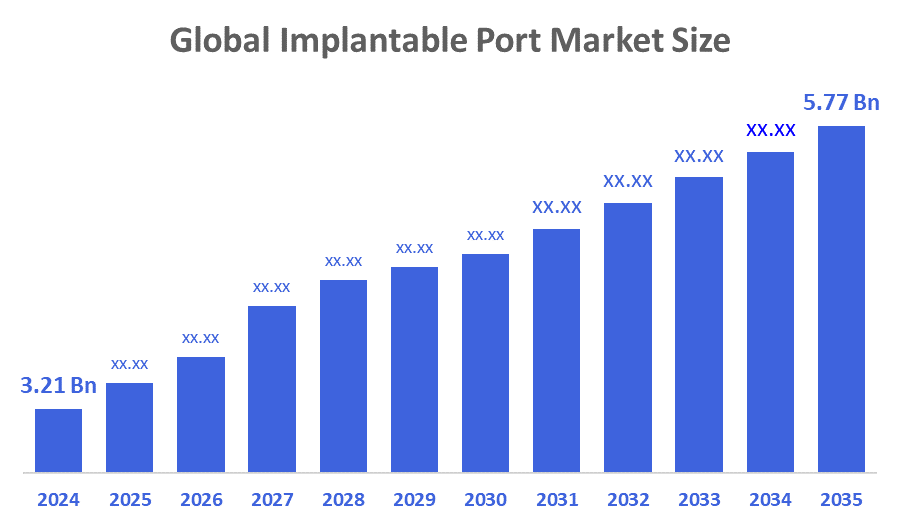
According to a research report published by Decisions Advisors and Consulting, The Global Implantable Port Market Size Was Worth Around USD 3.21 Billion In 2024 And Is Predicted To Grow To Around USD 5.77 Billion By 2035 With A Compound Annual Growth Rate (CAGR) Of 5.48 % From 2025 To 2035. The increasing prevalence of chronic diseases, especially cancer, the growing need for effective chemotherapy drug delivery, and continuing innovations in medical technology have been recognised as the main factors driving the growth of the implantable ports market. As global healthcare systems become more advanced, the requirement for highly efficient and patient-friendly medical solutions such as implantable ports is substantially increasing, thus marking a great future potential of the market.
Market Overview
The global implantable ports market refers to the worldwide market for medical devices called implantable ports or portacath. These instruments are utilised in medical settings to allow repeated access to a patient's blood vein for the administration of medications, fluids or blood products, and for blood sampling. Implantable ports are made up of two primary components: a reservoir or chamber, which is surgically implanted under the skin, most commonly in the chest or upper arm, and a catheter that links the reservoir to a large vein, usually the subclavian vein or jugular vein. The catheter is kept inside the patient's body, thus giving a stable access point for the healthcare providers to administer therapies or do diagnostic procedures. Implantable port devices perform very well in terms of their capability of providing reliable and long-term access to various medical treatments. The device's design and location guarantee the right catheter functioning and firm attachment to the port reservoir. Capacity administration can only be maintained through excellent and very efficient drug delivery, fluid administration or blood transportation. The high success rate of implanted ports in terms of the efficacy of the delivery of medicines leads to an improvement in the patient's treatment.
Portal Access, Inc. announced a USD 7 million Series A financing round to advance its next-generation chemotherapy port through FDA approval and prepare for a limited market launch. Strong clinical conviction and belief in the device's potential to modernise cancer care drug delivery are demonstrated by the involvement of U.S. physician investors, including oncologists, interventional radiologists, cardiologists, vascular surgeons, and others, as well as a partnership with a U.S.-based venture capital fund.
Report Coverage
This research report categorises the implantable port market based on various segments and regions, forecasts revenue growth, and analyzes trends in each submarket. The report analyses the key growth drivers, opportunities, and challenges influencing the implantable port market. Recent market developments and competitive strategies, such as expansion, product launch, development, partnership, merger, and acquisition, have been included to draw the competitive landscape in the market. The report strategically identifies and profiles the key market players and analyzes their core competencies in each sub-segment of the implantable port market.
Driving Factors
The global implantable port market is currently undergoing significant changes that are mainly driven by the improvement of medical technology and the growing demand for less invasive procedures. The expansion of chronic diseases such as cancer and diabetes is increasing the dependency on reliable and efficient drug delivery systems. Implantable ports are one such solution to drug delivery, which is becoming more and more popular among healthcare professionals and therefore, their adoption in clinical settings increases. Besides technological advances, the global implantable port market is also affected by the regulatory environment and reimbursement policies that determine the extent to which medical devices can be utilised. Considering that healthcare systems around the globe are working on improving patient outcomes while at the same time controlling their expenditures, using implantable ports in treatment plans seems like a very appropriate decision. Also, novel trends like this will grow further because the involved parties will still be looking for ways to enhance patient care through better device design and functionality.
Restraining Factors
Despite having promising growth prospects, the market of implantable ports is on the verge of a few obstacles and threats that may retard its advancement. One of the main restrainers is the risk of complications and infections with implantable ports that can lead to adverse patient outcomes and increased healthcare costs. However, the risk of complications is still a major concern for both healthcare providers and patients. Also, the market growth can be affected by regulatory and reimbursement issues, as strict regulations and complicated reimbursement procedures could slow down market access.
Market Segmentation
The implantable port market share is classified into material and insertion method.
- The silicone segment accounted for the largest market share in 2024 and is expected to grow at a significant CAGR during the forecast period.
Based on the material, the implantable port market is divided into polyurethane, silicone, titanium, and others. Among these, the silicone segment accounted for the largest market share in 2024 and is expected to grow at a significant CAGR during the forecast period. This is because of its remarkable flexibility and durability, which improve patient comfort and lower the risk of problems. Silicone continues to be the most popular material in the implantable port industry. Healthcare professionals have a great deal of faith due to its extensive history in medicinal applications. Many medical experts choose silicone materials because they have a documented track record in implantable devices.
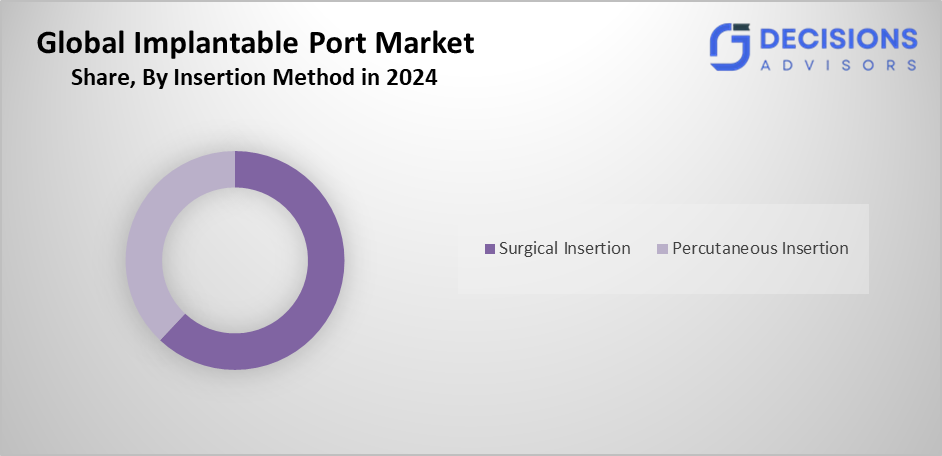
- The surgical insertion segment accounted for the highest market revenue in 2024 and is projected to grow at a remarkable CAGR over the forecast period.
Based on the insertion method, the implantable port market is segmented into surgical insertion and percutaneous insertion. Among these, the surgical insertion segment accounted for the highest market revenue in 2024 and is projected to grow at a remarkable CAGR over the forecast period. In the implantable port industry, surgical insertion has long been the most popular technique due to its all-encompassing approach and capacity to handle complicated patient requirements. This method, which guarantees accurate implant placement for maximum functionality, usually entails a more invasive process. This preference is mostly because surgical treatments have a longer history of use in clinical settings and are therefore trusted.
Regional Segment Analysis of the Implantable Port Market
- North America (U.S., Canada, Mexico)
- Europe (Germany, France, U.K., Italy, Spain, Rest of Europe)
- Asia-Pacific (China, Japan, India, Rest of APAC)
- South America (Brazil and the Rest of South America)
- The Middle East and Africa (UAE, South Africa, Rest of MEA)
Asia Pacific is anticipated to hold the largest share of the implantable port market over the predicted timeframe.
Asia Pacific is anticipated to hold the largest share of the implantable port market over the predicted timeframe. driven by things like growing healthcare investments, bettering healthcare infrastructure, and raising knowledge of cutting-edge treatment choices. The prevalence of chronic illnesses, especially cancer, is rising in emerging nations like China and India, which is predicted to fuel demand for implantable ports in this area. Implantable ports are being more widely used as a result of the increased emphasis on improving patient outcomes and increasing access to healthcare, which presents substantial growth prospects for market participants.
North America is expected to grow at a rapid CAGR in the implantable port market during the forecast period. The regional expansion is fueled by developments in healthcare infrastructure, growing incidences of chronic diseases, and the ageing population. The regulatory backing from organisations such as the FDA also helps to accelerate the market growth by assuring the safety and effectiveness of the medical devices. The US is the major market, with Canada running a close second. The premium position of these companies, such as Bard, Boston Scientific, and Medtronic, contributes significantly to the market. The competitive milieu is marked by constant creativity and strategic collaborations among these firms, which help them to increase their product portfolios and market penetration. The availability of well-established healthcare systems in the region is one of the factors that prompt the use of advanced implantable port technologies, thus driving the growth of this market segment.
Competitive Analysis:
The report offers the appropriate analysis of the key organizations/companies involved within the implantable port market, along with a comparative evaluation primarily based on their product offering, business overviews, geographic presence, enterprise strategies, segment market share, and SWOT analysis. The report also provides an elaborative analysis focusing on the current news and developments of the companies, which includes product development, innovations, joint ventures, partnerships, mergers & acquisitions, strategic alliances, and others. This allows for the evaluation of the overall competition within the market.
List of Key Companies
- AngioDynamics, Inc.
- B. Braun Melsungen AG
- Baxter International Inc.
- C. R. Bard, Inc. (a subsidiary of Becton, Dickinson and Company)
- Cook Medical
- Fresenius Kabi AG
- ICU Medical, Inc.
- Kimal plc
- Medtronic plc
- Navilyst Medical, Inc.
- Pfm Medical AG
- Smiths Medical
- Teleflex Incorporated
- Vygon SA
- Others
Key Target Audience
- Market Players
- Investors
- End-users
- Government Authorities
- Consulting and Research Firm
- Venture capitalists
- Value-Added Resellers (VARs)
Recent Development
- In January 2026, the Bard PowerPort lawsuits involved claims that the implantable port catheter was defectively designed and was prone to fracture, migration, infection, and thrombosis, which led to serious patient injuries. Over 2,500 cases had been consolidated in a federal multidistrict litigation (MDL) in Arizona, with bellwether trials scheduled throughout 2026.
Market Segment
This study forecasts revenue at global, regional, and country levels from 2020 to 2035. Decisions Advisors has segmented the implantable port market based on the below-mentioned segments:
Global Implantable Port Market, By Material
- Polyurethane
- Silicone
- Titanium
- Others
Global Implantable Port Market, By Insertion Method
- Surgical Insertion
- Percutaneous Insertion
Global Implantable Port Market, By Regional Analysis
- North America
- US
- Canada
- Mexico
- Europe
- Germany
- UK
- France
- Italy
- Spain
- Russia
- Rest of Europe
- Asia Pacific
- China
- Japan
- India
- South Korea
- Australia
- Rest of Asia Pacific
- South America
- Brazil
- Argentina
- Rest of South America
- Middle East & Africa
- UAE
- Saudi Arabia
- Qatar
- South Africa
- Rest of the Middle East & Africa
Frequently Asked Questions (FAQ)
1. What is the current size and projected growth of the global implantable port market?
The market was valued at USD 3.21 billion in 2024 and is expected to reach USD 5.77 billion by 2035, growing at a CAGR of 5.48% from 2025 to 2035.
2. What are the primary drivers of the implantable port market?
Growth is fueled by the rising prevalence of chronic diseases like cancer, demand for efficient chemotherapy drug delivery, and advancements in medical technology, alongside improvements in global healthcare infrastructure.
3. What are the main restraining factors for the market?
Key challenges include risks of complications such as infections, thrombosis, and device fractures, as well as strict regulatory hurdles and complex reimbursement processes.
4. How is the implantable port market segmented by material?
Segments include polyurethane, silicone, titanium, and others. Silicone held the largest share in 2024 due to its flexibility, durability, and patient comfort, and is projected to grow at a significant CAGR.
5. What are the insertion methods in the market, and which dominates?
The market is divided into surgical insertion and percutaneous insertion. Surgical insertion led to revenue in 2024 and is expected to grow at a remarkable CAGR, valued for its precision in complex cases.
6. Which region holds the largest market share, and why?
Asia-Pacific is anticipated to hold the largest share, driven by increasing healthcare investments, rising cancer prevalence in countries like China and India, and improving infrastructure.
7. Who are the key players in the global implantable port market?
Major companies include AngioDynamics, Inc., B. Braun Melsungen AG, Baxter International Inc., C. R. Bard, Inc. (BD subsidiary), Medtronic plc, Smiths Medical, Teleflex Incorporated, and others.
Check Licence
Choose the plan that fits you best: Single User, Multi-User, or Enterprise solutions tailored for your needs.
We Have You Covered
- 24/7 Analyst Support
- Clients Across the Globe
- Tailored Insights
- Technology Tracking
- Competitive Intelligence
- Custom Research
- Syndicated Market Studies
- Market Overview
- Market Segmentation
- Growth Drivers
- Market Opportunities
- Regulatory Insights
- Innovation & Sustainability
Report Details
| Scope | Global |
| Pages | 220 |
| Delivery | PDF & Excel via Email |
| Language | English |
| Release | Jan 2026 |
| Access | Download from this page |