
Global In Vitro Fertilization (IVF) Market
 |
Author:
David J
|
Pages:
200
|
Author:
David J
|
Pages:
200
Global In Vitro Fertilization (IVF) Market Size, Share By Technique (Intra-Cytoplasmic Sperm Injection, Traditional IVF, Preimplantation Genetic Testing, Cryopreservation, Embryo Culture), By Product Type (Instruments, Media, Consumables), By End Users (Fertility Clinics, Hospitals, Research Laboratories), and By Region (North America, Europe, Asia-Pacific, Latin America, Middle East & Africa), Analysis and Forecast 2026-2035
CAGR
9.52%
REVENUE 2025
USD Billion 34.6
FORECAST 2035
USD Billion 85.9
REPORT COVERAGE
Global
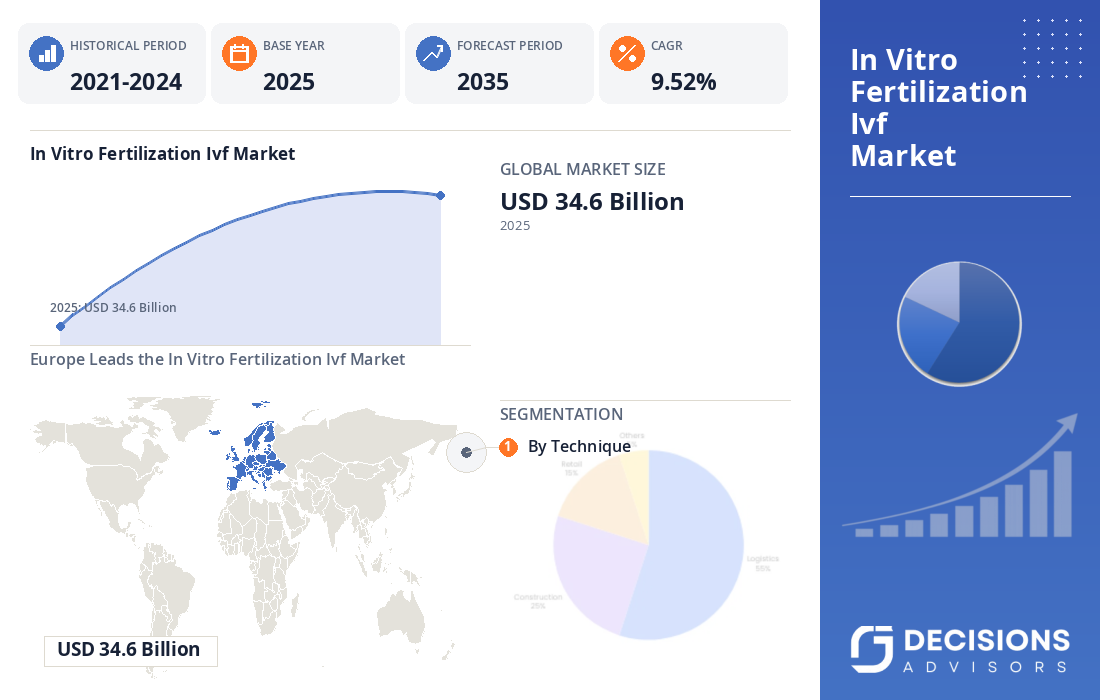
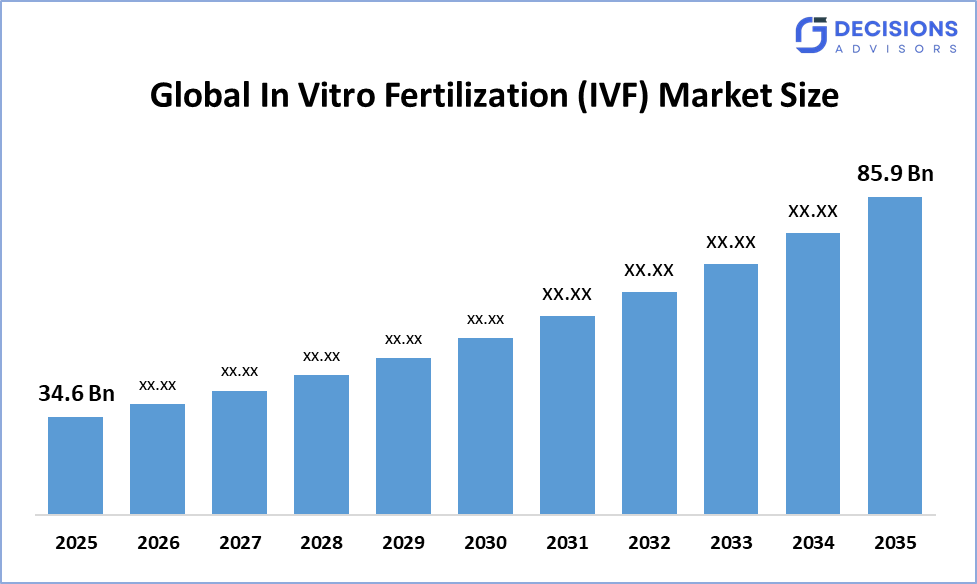
The Global In Vitro Fertilization (IVF) Market Size is predicted to grow from USD 34.6 Billion in 2025 and is likely to reach around USD 85.9 Billion by 2035 with a CAGR of 9.52%. According to Decision Advisors, the growth of the market is influenced by increasing infertility cases, postponed age of parenthood, increased fertility awareness, and development of ARTs. Trends in the market include AI-based embryo selection, laboratory automation, preimplantation genetic testing, cryopreservation, and embryo time-lapse imaging. It is expected that Vitrolife AB constitutes around 18-22% of the IVF cryopreservation market, whereas CooperSurgical and Merck KGaA have around 10-14% and 12-16%, respectively. The major players in the market include Vitrolife AB, CooperSurgical, Merck KGaA, Ferring Pharmaceuticals, Cook Medical, and FUJIFILM Irvine Scientific.
Market Snapshot
- Global In Vitro Fertilization (IVF) Market Size (2025): USD 34.6 Billion
- Projected Global In Vitro Fertilization (IVF) Market Size (2035): USD 85.9 Billion
- Global In Vitro Fertilization (IVF) Market Compound Annual Growth Rate (CAGR): 9.52%
- Largest Regional Market: Europe
- 2nd Largest Region: North America
- Fastest Growing Region: Asia Pacific
- Base Year: 2025
- Historical Period: 2021-2024
- Market Forecast Period: 2026-2035
Market Overview/ Introduction
The Global In Vitro Fertilization (IVF) Market is defined as reproductive techniques and processes wherein eggs are fertilized with sperm in the lab and subsequently the resultant embryos are implanted to conceive. Governments' programs and initiatives are making IVF more affordable and accessible; such as NHS-funded IVF programs in England, where IVF is offered via local Integrated Care Boards, and in the U.S., an executive order for 2025 was issued to increase access to IVF and cut costs. Some latest developments in the market include the revised NICE IVF access guidance from March 2026 and increased adoption of frozen embryo transfers, which made up 48% of all IVF cycles in the UK in 2024. Drivers for market growth include infertility rates, delayed parenting, awareness about fertility treatments, and new developments in technology, such as AI-based embryo selection, preimplantation genetic testing, cryopreservation, and laboratory automation.
- The administration introduced federal guidelines and drug-pricing frameworks alongside agency recommendations intended to reduce out-of-pocket costs and expand employer-sponsored health plan coverage for IVF treatments.
- A national white paper released on World IVF Day proposed integrating subsidized fertility care and fresh IVF cycles into public health schemes like Ayushman Bharat to combat declining birth rates.
Notable Insights: -
- Europe is anticipated to hold approximately 44.82% share of the Global In Vitro Fertilization (IVF) Market over the predicted timeframe.
- Asia Pacific is expected to grow at a rapid CAGR in the Global In Vitro Fertilization (IVF) Market by holding approximately 30.9% of the share during the forecast period.
- By technique, the Intra-Cytoplasmic Sperm Injection (ICSI), segment dominated the market and holds approximately 42% share in 2025 and is projected to grow at a substantial CAGR during the forecast period.
- By product type, the Instruments segment dominated the market and holds approximately 44% share in 2025 and is projected to grow at a substantial CAGR during the forecast period.
- The compound annual growth rate of the Global In Vitro Fertilization (IVF) Market is 9.52%.
- The market is likely to achieve a valuation of USD 85.9 Billion by 2035.
Market Drivers
The Global In Vitro Fertilization (IVF) Market is growing because of increased instances of male and female infertility across the globe. There is an increasing trend of delayed parenthood due to various reasons such as career goals, lifestyle changes, and late marriages. This results in higher demand for ARTs. Increased awareness and acceptance of IVF treatments, along with increased fertility education and counseling, add to the list of factors driving the market growth. Advances in IVF technology like AI-based embryo selection, preimplantation genetic testing, time-lapse embryo imaging, and cryopreservation have improved the success rate of IVF treatments and added to their adoption. Increased government assistance and fertility treatments coverage programs also aid the growth of this market.
Restrain
High treatment costs, insufficient insurance coverage, moral dilemmas, psychological strain, and inconsistent treatment success rates are some of the issues facing the global in vitro fertilization (IVF) market. Accessibility and affordability are hampered by high IVF costs, especially for patients without full insurance coverage.
Competitive Analysis:
The report offers the appropriate analysis of the key organizations/companies involved within the Global In Vitro Fertilization (IVF) Market along with a comparative evaluation primarily based on their product offerings, business overviews, geographic presence, enterprise strategies, segment market share, and SWOT analysis. The report also provides an elaborative analysis focusing on the current news and developments of the companies, which includes product development, innovations, joint ventures, partnerships, mergers & acquisitions, strategic alliances, and others. This allows for the evaluation of the overall competition within the market.
Top Companies in the Global In Vitro Fertilization (IVF) Market
- CooperSurgical
- Vitrolife
- Merck KGaA
- Cook Medical
- Thermo Fisher Scientific
- Ferring Pharmaceuticals
- FUJIFILM Irvine Scientific
- Hamilton Thorne
- Esco Lifesciences
- Genea Limited
Government Initiatives
|
Country |
Key Government Initiatives |
|
Taiwan |
Introduced upgraded financial subsidies to help couples undergo fertility treatment, covering significant portions of multiple IVF cycles to combat declining birth rates. |
|
Poland |
Launched a comprehensive government-funded reimbursement program providing free access to IVF cycles and fertility preservation treatments for eligible residents. |
|
India |
Offers localized public hospital assistance and central government employee reimbursements via schemes like CGHS, though widespread national coverage remains limited. |
Market Segmentation
The Global In Vitro Fertilization (IVF) Market share is classified into Technique, Product Type and End Users
- The Intra-Cytoplasmic Sperm Injection (ICSI) segment dominated the market and holds approximately 42% share in 2025 and is projected to grow at a substantial CAGR during the forecast period.
Based on the technique, the Global In Vitro Fertilization (IVF) Market is bifurcated into Intra-Cytoplasmic Sperm Injection, Traditional IVF, Preimplantation Genetic Testing, Cryopreservation, and Embryo Culture. Out of these segments, the Intra-Cytoplasmic Sperm Injection (ICSI) is the dominant segment and is expected to capture around 42% of the share in 2025. The major factor for the dominance of ICSI in the global In Vitro Fertilization (IVF) Market is its efficacy in overcoming male-factor infertility and improving fertilization results.
- The Instruments segment accounted for the largest share of approximately 44% in 2025 and is anticipated to grow at a significant CAGR during the forecast period.
Based on the product type, the segments included in the Global In Vitro Fertilization (IVF) Market are Instruments, Media, and Consumables. Out of these, the share held by the Instruments segment was the highest, which comprises 44% in 2025. This is due to the growing demand for sophisticated equipment used in IVF laboratories, which includes incubators, micromanipulators, imaging system, and cryopreservation equipment. The increased use of automated technologies in laboratories and advanced procedures in reproduction also adds to segment growth.
- The Fertility Clinics segment accounted for the largest share of approximately 55% in 2025 and is anticipated to grow at a significant CAGR during the forecast period.
Based on end users, the Global In Vitro Fertilization (IVF) Market is segmented into Fertility Clinics, Hospitals, and Research Laboratories. Out of these, Fertility Clinics are dominating the market with around 55% market share by 2025. This market share of the segment can be attributed to the increasing number of fertility clinics, increased demand for reproductive technology procedures, and advancements in the field of In Vitro Fertilization (IVF) technologies. Increasing incidences of infertility, success rate in the treatment of infertility, and expansion of private fertility clinics also contribute to the growth of the segment.
Regional Segment Analysis of the Global In Vitro Fertilization (IVF) Market
- Asia-Pacific (China, Japan, India, South Korea, Australia, and Rest of Asia-Pacific)?
- North America (United States and Canada)
- Europe (Spain, Germany, France, UK, Italy, Czech Republic, Denmark, and Rest of Europe)
- Latin America (Brazil, Mexico, Argentina, Colombia, and Rest of Latin America)?
- The Middle East and Africa (Saudi Arabia, UAE, Israel, South Africa, and Rest of MEA)
Europe is anticipated to hold approximately 44.82% share of the Global In Vitro Fertilization (IVF) Market over the predicted timeframe.
The Europe region holds an estimated 44.82% share of the Global In Vitro Fertilization (IVF) Market, thus being the leading region in terms of the market share. These advantages include fertility centers that are well established, use of advanced assisted reproductive techniques, a good regulatory framework, and increased accessibility of fertility treatments. Spain, United Kingdom, France, Germany, and Italy among other countries are major contributors to regional demand. Growth in medical tourism and especially in cases relating to IVF and donors also boosts Europe’s market dominance. Infertility, postponed pregnancies, government-sponsored fertility programs, and increased awareness of reproductive treatment methods are some of the factors that are helping to drive market growth. Besides, the advanced techniques adopted in the region including ICSI, PGD, embryo cryopreservation, and time lapse embryo monitoring are also contributing to market growth.
North America is expected to grow at a rapid CAGR in the Global In Vitro Fertilization (IVF) Market, holding approximately 37% of the share during the forecast period
The North American region represents about 37% of the Global In Vitro Fertilization (IVF) Market and is anticipated to register robust growth over the forecast period. The growth of the regional market can be attributed to the availability of highly developed fertility care infrastructure, a wide number of specialized fertility clinics, higher prevalence of infertility, and higher adoption of assisted reproduction techniques. The leading contributor to the regional market is the US where more than 100,000 babies have been born through IVF in 2024.
Asia-Pacific is the fastest-growing region in the Global In Vitro Fertilization (IVF) Market during the period, holding approximately 30.9% share.
The Asia-Pacific region represents 30.9% of the Global In-Vitro Fertilization Market and is anticipated to continue to be the fastest-growing regional market during the forecast period. Factors that contribute to growth include an increase in infertility, high awareness about ART techniques, development in fertility centers, improvements in health infrastructure and the rise in medical tourism. China and India drive demand in the region while Japan, South Korea, and Australia also contribute towards market growth. Adoption of advanced methods of IVF such as ICSI, preimplantation genetic screening, embryo freezing, and AI-based embryo selection also adds to the growth potential of the region.
Future Market Trends in Global In Vitro Fertilization (IVF) Market: -
-
- Expansion of AI-Assisted Embryo Selection
Embryo selection using artificial intelligence is increasingly being used in fertility clinics to assess the quality and viability of embryos. Algorithms assess images of embryos as well as the developmental pattern of embryos, helping the embryologist select the viable embryos. There is an increasing need for increased success in IVF treatments.
-
- Rising Adoption of Preimplantation Genetic Testing
The use of preimplantation genetic testing is increasingly popular due to its ability to identify chromosomal abnormalities and genetically inherited diseases prior to transferring the embryos. Preimplantation genetic testing helps in selecting the embryos, thereby reducing the chances of developing genetic diseases.
-
- Growth in Embryo Cryopreservation
Cryopreservation of embryos is emerging as an important concept with the development of cryopreservation techniques like vitrification in fertility centers. It allows patients to store embryos for future treatment cycles without compromising embryo viability. Increasing demand for fertility preservation, delayed conception, repeat IVF treatments, and better cryopreservation results are driving market growth.
-
- Increasing IVF Laboratory Automation
Automation is revolutionizing IVF labs through automation of embryo manipulation, culture, sperm analysis, and lab management. Automation increases accuracy, standardization, and efficiency while minimizing errors. Increasing numbers of fertility clinic cases, increasing need for standardization, and technological innovations are prompting laboratories to embrace more advanced automated IVF systems globally.
Recent Development
- In March 2022, Alife Health obtained USD 22 million in Series A funding to create artificial intelligence solutions for customized IVF clinical decision-making and reproductive treatment optimization.
- In May 2023, AIVF unveiled EMA 4.0, which included time-lapse incubator connectivity, AI-powered embryo evaluation, and laboratory performance monitoring to enhance IVF effectiveness and individualized patient care.
- In September 2023, At Brazil's Perfetto Clinic, AIVF introduced its EMA AI-powered IVF operating system, which supports clinical judgments, lab operations, and enhanced clinic-patient communication.
Market Segment
This study forecasts revenue at global, regional, and country levels from 2020 to 2035. Decision Advisors has segmented the Global In Vitro Fertilization (IVF) Market based on the below-mentioned segments:
Global In Vitro Fertilization (IVF) Market, By Technique
- Intra-Cytoplasmic Sperm Injection
- Traditional IVF
- Preimplantation Genetic Testing
- Cryopreservation
- Embryo Culture
Global In Vitro Fertilization (IVF) Market, By Product Type
- Instruments
- Media
- Consumables
Global In Vitro Fertilization (IVF) Market, By End Users
- Fertility Clinics
- Hospitals
- Research Laboratories
Global In Vitro Fertilization (IVF) Market, By Regional Analysis
- Asia-Pacific
- China
- Japan
- India
- South Korea
- Australia
- Rest of Asia-Pacific
- North America
- United States
- Canada
- Europe
- Spain
- Germany
- France
- UK
- Italy
- Czech Republic
- Denmark
- Rest of Europe
- Latin America
- Brazil
- Mexico
- Argentina
- Colombia
- Rest of Latin America
- Middle East & Africa
- Saudi Arabia
- UAE
- Israel
- South Africa
- Rest of MEA
Frequently Asked Questions (FAQ)
Q. What is driving the growth of the Global In Vitro Fertilization (IVF) Market?
A. The global IVF market is expanding due to several factors, including rising infertility rates, postponed parenthood, increased fertility awareness, better treatment success rates, and developments in assisted reproductive technology.
Q. Why is Intra-Cytoplasmic Sperm Injection (ICSI) widely adopted in IVF?
A. ICSI is very helpful for male-factor infertility, prior fertilization failures, and low sperm count or motility. It involves injecting a sperm directly into an egg.
Q. How is artificial intelligence influencing IVF treatment?
A. AI helps embryologists make more reliable and data-driven clinical decisions by supporting treatment planning, laboratory automation, embryo selection, and embryo quality assessment.
Q. What role does cryopreservation play in the IVF market?
A. By preserving eggs, sperm, and embryos for next treatment cycles, cryopreservation promotes delayed motherhood, recurrent IVF efforts, and fertility preservation.
Check Licence
Choose the plan that fits you best: Single User, Multi-User, or Enterprise solutions tailored for your needs.
We Have You Covered
- 24/7 Analyst Support
- Clients Across the Globe
- Tailored Insights
- Technology Tracking
- Competitive Intelligence
- Custom Research
- Syndicated Market Studies
- Market Overview
- Market Segmentation
- Growth Drivers
- Market Opportunities
- Regulatory Insights
- Innovation & Sustainability
Report Details
| Scope | Global |
| Pages | 200 |
| Delivery | PDF & Excel via Email |
| Language | English |
| Release | Aug 2026 |
| Access | Download from this page |