
India Kamikaze Drone Market
 |
Pages:
210
|
Pages:
210
India Kamikaze Drone Market Size, Share, By Type (Fixed-wing, Rotorcraft, and Hybrid), By Range (Short-range, Long-range), and By End User (Army, Navy, Air Force, and Paramilitary), Analysis and Forecast 2026-2035
REPORT COVERAGE
country
Market Snapshot
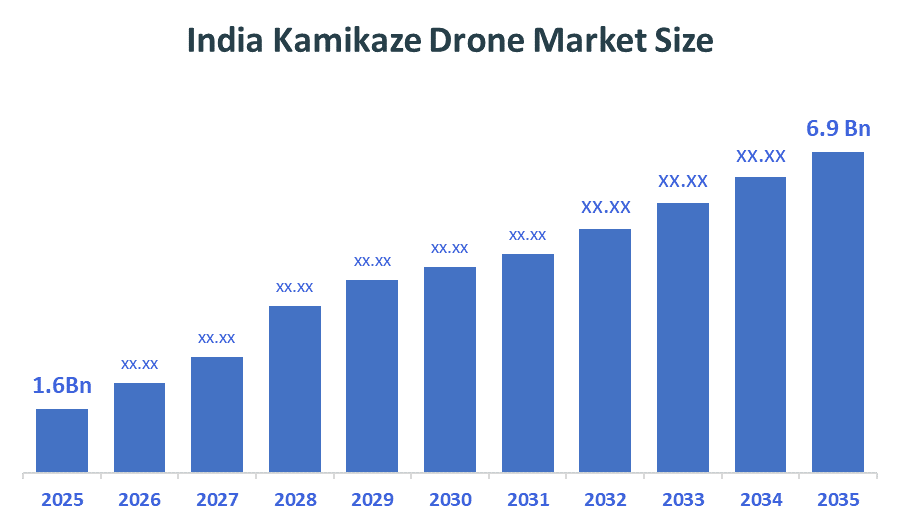
- India Kamikaze Drone Market Size (2025): USD 1.6 Billion
- India Kamikaze Drone Projected Market Size (2035): USD 6.9 Billion
- India Kamikaze Drone Compound Annual Growth Rate (CAGR): 15.74%
- Base Year: 2025
- Historical Period: 2021-2024
- Forecast Period: 2026-2035
Market Overview/Introduction
The India kamikaze drone sector is associated with the manufacturing and deployment of loitering weapons capable of detecting and attacking enemy targets by means of an impact-based warhead, using cutting-edge navigation and sensor technology to guarantee accuracy in compliance with contemporary strike requirements. These types of weaponry are necessary for asymmetric combat operations and cheap air dominance, representing a unique medium for tactical surveillance and reducing civilian casualties using diverse systems such as fixed-wing, rotor, and tube-launched weapons. The recent boost of this industry in India includes support from Innovations for Defence Excellence (iDEX) and Atmanirbhar Bharat through funding aimed at indigenously developed swarming technologies and autonomous devices to diminish India's dependence on foreign military products. This has been possible due to the successful integration of AI-controlled and equipped drones using thermal cameras that work at high altitudes.
- In March 2026, the Ministry of Defence announced the Innovations for Defence Excellence (iDEX) 3.0 with a focused budget for autonomous suicide drones, directly boosting the local production of high-precision loitering munitions.
- In January 2026, Adani Defence and Tata Advanced Systems began commercial operations of their dedicated drone assembly and testing units, enhancing the domestic supply chain for tactical aerial components, including warhead integration.
Notable Insights: -
- The India kamikaze drone market is expected to grow at a CAGR of approximately 15.74% from 2025 to 2035, driven by strong demand for border security and government initiatives focused on defense self-sufficiency under Atmanirbhar Bharat.
- By technology, fixed-wing kamikaze drones are gaining higher adoption due to their extended range, endurance, and ability to deliver high-impact payloads with aerodynamic efficiency during terminal dives.
- By end user, the Indian Army holds a dominant position, supported by growing requirements for man-portable loitering munitions and rising focus on enhancing tactical capabilities along the northern and western borders.
What is the Role of Technology in Grooming the Market?
The primary drivers behind the complexity in the India kamikaze drone market come down to the integration of sophisticated AI technology in terms of target recognition and carbon-fibre composites manufacturing. In terms of trends of development within the market, a significant example is the implementation of the Autonomous Swarm ecosystem, which is characterised by a high level of reliability due to its encryption-based communication and GNSS-denied navigation technology, which meets global standards in regard to electronic warfare resilience. Technological advancements in the sector are represented by such things as the integration of modular warhead units and automated recovery sensors in order to provide combat mission flexibility. The quality of production is often ensured by indigenous test facilities and certification standards for military aviation.
Market Drivers
The factors that have been responsible for the development of the kamikaze drone market in India include the modernisation of the current border security systems and the establishment of drone pilot training centers on a massive scale. One of the major influences on the balance of demand and supply in the market includes the growing trend of acquiring expendable aerial drones due to the steep hike in the cost of the conventional piloted fighter jets. The unique requirements of the special forces industry, where there is a need for silent man-portable suicide drones, ensure sustained consumer interest in the defense market. Moreover, there are numerous R&D centers in India that enable local firms to transform commercial drones into combat drones.
Restraints
Even as the technology is of immense value, there exist some potential difficulties that might come about due to the creation of highly advanced electronic warfare systems capable of jamming or hijacking drones' frequencies. Potential difficulties could include the difficulty involved in procuring high-quality explosives for warhead production and ensuring compliance with the demanding standards associated with testing autonomous military flights.
Study on the Supply, Demand, Distribution, and Market Environment
When it comes to kamikaze drones for the Indian market, the product is believed to be in a growth stage, given the fact that it is considered to be an important product under the Make in India campaign and also highly dependent on global logistics of its unique components. When it comes to sources of production of the product components, it should be mentioned that they are produced by global aerospace companies and defense PSUs of the country, and the product itself is being assembled in technology centers such as Bengaluru and Hyderabad. Discussing the demands of the product, it should be said that they remain relatively stable due to the demand from different wings of the Indian Army, Navy, and Air Force.
Price Analysis and Consumer Behaviour Analysis
The results that emerge from the price-based study indicate that the market comprises elements of the hierarchy, where short-range tactical drones are sold at fixed prices, but advanced long-range loitering weapons equipped with AI tracking are costly due to their intricate sensor technology. Even though these weapons are relatively costly compared to conventional artillery, they are considered valuable in terms of precision combat operations rather than being viewed as simple commodities. The fact that India has made considerable acquisitions shows that consumers consider maintenance within the country, along with their adaptability to different terrains such as deserts and mountains. For consumers, it is more advantageous to acquire weapons that are extremely efficient in minimising combat risk for people.
Market Segmentation
The India kamikaze drone market is categorised by type, range, and end user.
The fixed-wing segment dominated the market in 2025 and held a market capture of approximately 55.5%.
Based on the type, the kamikaze drone market is divided into Fixed-wing, Rotorcraft, and Hybrid. Among these, the fixed-wing segment dominated the market in 2025 and held a market capture of approximately 55.5%. This kind of domination is associated with the need for long-range reconnaissance and the massive requirements of the defense sector for deep-strike capabilities. These kinds of devices have high demand in the Indian border security operations because they can meet the requirements of high-speed interception. Modern technologies of folding-wing design and stealth coatings have quickly been introduced into domestic manufacturing facilities to follow the necessary defense quality mandates.
The short-range product segment dominated the market in 2025 and held a market capture of approximately 62.0%.
Based on the range, the market is divided into Short-range (up to 25 km) and Long-range (above 25 km). Among these, the short-range product segment dominated the market in 2025 and held a market capture of approximately 62.0%. In actual fact, it is because of the efficiency and effectiveness of these designs in terms of handling tactical squad-level operations, coupled with stringent compliance to portability standards, that makes the short-range segments the most efficient designs to bear with the immediate combat requirements of modern infantry units. While long-range designs have been gaining traction for strategic missions, the shift toward localized tactical superiority still makes the short-range segments the leaders of the market structure.
The Army application segment accounted for the largest share in 2025 and represented a market capture of nearly 60.0%.
Based on the end user, the market is divided into the Army, Navy, Air Force, and the Paramilitary. Among these, the Army application segment accounted for the largest share in 2025 and represented a market capture of nearly 60.0%. The integration of advanced suicide drones in the process of border patrolling and counter-insurgency operations becomes inevitable due to the need for rapid response and strike stability in rugged settings, following the government’s modernisation schemes. Among the factors responsible for the increase in potential is the emergence of digital battlefield initiatives in India, as well as the adoption of automated weapon systems.
Recent Developments
- In September 2025, Garuda Aerospace reported a significant 30% year-on-year revenue growth in its defense division. The company attributed this surge to the successful testing of its new stealth kamikaze drone.
- In December 2024, the Indian Army received the complete delivery of 480 Nagastra-1 loitering munitions from Solar Industries, following a ?212 crore contract, marking one of the largest indigenous kamikaze drone inductions in India.
- In June 2024, the Indian Army inducted the first batch of 120 Nagastra-1 loitering munitions, India’s first indigenous man-portable kamikaze drone system, featuring a 15-40 km operational range, high-altitude capability, and over 75% indigenous content.
- In February 2024, Bharat Electronics Ltd (BEL) signed a Memorandum of Understanding (MoU) with an Israeli aerospace firm to co-develop indigenous loitering munition sensors.
Competitive Analysis
The report offers the appropriate analysis of the key organisations/companies involved within India kamikaze drone market, along with a comparative evaluation primarily based on their product offering, business overviews, geographic presence, enterprise strategies, segment market share, and SWOT analysis. The report also provides an elaborate analysis focusing on the current news and developments of the companies, which includes product development, innovations, joint ventures, partnerships, mergers & acquisitions, strategic alliances, and others. This allows for the evaluation of the overall competition within the market.
Top Key Companies in the India Kamikaze Drone Market
- Solar Industries India Ltd
- NewSpace Research & Technologies
- Adani Defence & Aerospace
- Tata Advanced Systems Ltd (TASL)
- Bharat Electronics Ltd (BEL)
- Garuda Aerospace
- ideaForge Technology
- Alpha Design Technologies
- Raphe mPhibr Pvt Ltd
- DCM Shriram Industries
Key Target Audience
- Market Players
- Investors
- End-users
- Government Authorities
- Consulting and Research Firm
- Venture capitalists
- Value-Added Resellers (VARs)
Market Segmentation
This study forecasts revenue at the national level from 2021 to 2035. The report segmented the India Kamikaze Drone Market based on the following segments:
India Kamikaze Drone Market, By Type
- Fixed-wing
- Rotorcraft
- Hybrid
India Kamikaze Drone Market, By Range
- Short-range (up to 25 km)
- Long-range (above 25 km)
India Kamikaze Drone Market, By End User
- Army
- Navy
- Air Force
- Paramilitary
Frequently Asked Questions (FAQ)
How does the transition to Artificial Intelligence (AI) impact the India kamikaze drone market through 2035?
The shift toward AI-driven navigation and targeting is a defining trend for the Indian market. These advanced drones offer superior autonomous decision-making and target discrimination compared to traditional units. This transition is essential for the domestic defense industry, as AI-integrated drones significantly reduce the cognitive load on operators and ensure mission success in electronically contested environments.
What influence does the expansion of satellite communication have on drone demand in India?
The nationwide rollout of dedicated military satellite bandwidth is a major catalyst for the kamikaze drone sector. Long-range missions require high-bandwidth communication links to handle real-time video feeds. Satellite integration plays a vital role in these units by providing over-the-horizon control, ensuring the reliability of strike missions across the diverse topography of India.
How is the development of indigenous propulsion systems affecting the cost-efficiency of Indian kamikaze drones?
The localised production of high-performance electric motors and miniature engines is significantly lowering the acquisition costs for the Indian Armed Forces. By moving away from imported propulsion units, domestic manufacturers are able to optimise drone endurance and speed while benefiting from the Production Linked Incentive (PLI) scheme.
In what way does the integration of multi-spectral imaging sensors enhance the operational capability of suicide drones in high-altitude regions?
The employment of modern multi-spectral sensors, such as thermal and infrared cameras, makes kamikaze drones well-equipped to perform under adverse weather conditions, such as heavy snow and dense fog prevailing in the Himalayas region. The sensors help to detect any sort of hidden objects at night time. It helps the Indian armed forces to achieve uninterrupted surveillance and strike capabilities using loitering ammunition technology.
Check Licence
Choose the plan that fits you best: Single User, Multi-User, or Enterprise solutions tailored for your needs.
We Have You Covered
- 24/7 Analyst Support
- Clients Across the Globe
- Tailored Insights
- Technology Tracking
- Competitive Intelligence
- Custom Research
- Syndicated Market Studies
- Market Overview
- Market Segmentation
- Growth Drivers
- Market Opportunities
- Regulatory Insights
- Innovation & Sustainability
Report Details
| Scope | country |
| Pages | 210 |
| Delivery | PDF & Excel via Email |
| Language | English |
| Release | Apr 2026 |
| Access | Download from this page |