
India Low Carbon Farming Market
 |
Author:
Sayali T
|
Pages:
180
|
Author:
Sayali T
|
Pages:
180
India Low Carbon Farming Market Size, Share, and COVID-19 Impact Analysis, By Type (Solution, and Services), By Application (Agroforestry, Silvopasture, Aquaculture/Ocean Farming, No-Till and Pasture Cropping, Holistically Managed Grazing, Biochar, and Others), and India Low Carbon Farming Market Insights, Industry Trend, Forecasts to 2035
CAGR
12.88%
REVENUE 2025
Million 50.26
FORECAST 2035
Million 190.47
REPORT COVERAGE
Country
India Low Carbon Farming Market Insights Forecasts to 2035
- The India Low Carbon Farming Market Size was estimated at USD 50.26 Million in 2024
- The Market Size is Expected to Grow at a CAGR of around 12.88% from 2025 to 2035
- The India Low Carbon Farming Market Size is Expected to Reach USD 190.47 Million by 2035
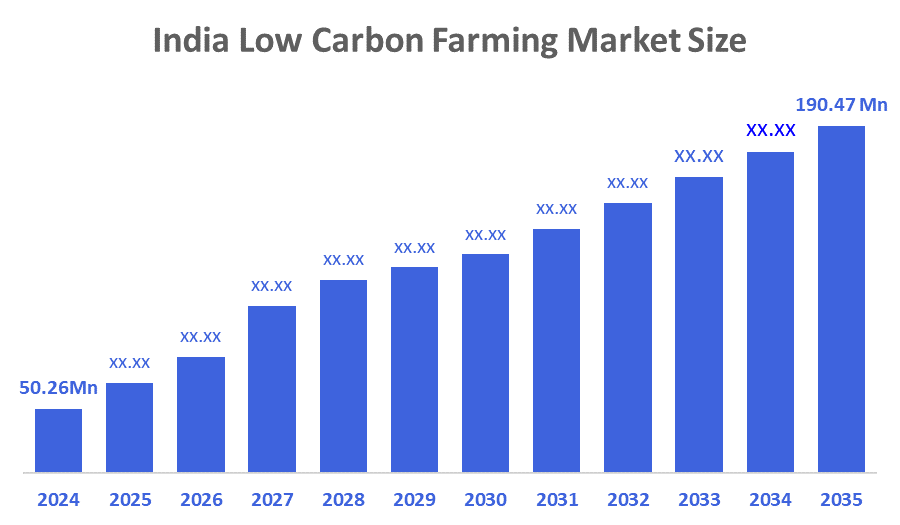
According To a Research Report Published By Decisions Advisors And Consulting, The India Low Carbon Farming Market is Anticipated To Reach USD 190.47 Million By 2035, Browing At a CAGR Of 12.88% From 2025 to 2035. The government support, rising consumer demand for organic produce, rising soil degradation concerns, corporate sustainability commitments, expanding carbon credit programs, advancements in agri-tech solutions, rising climate resilience needs, and initiatives promoting biofertilizers all drive the market. Furthermore, the growth of regenerative agriculture certification programs is enabling farmers to obtain premium pricing in both domestic and foreign markets.
Market Overview
The Indian low carbon farming market refers to the industry focused on the section of agriculture focusing on lowering greenhouse gas (GHG) emissions and boosting carbon sequestration through sustainable techniques. It comprises farming methods, technologies, and policies aiming to minimise agriculture's carbon footprint while enhancing productivity, resilience, and farmer incomes. Regenerative agriculture is a comprehensive approach to land management that prioritises soil health, biodiversity, water retention, and carbon sequestration. The strategy includes several practices, such as no-till and vertical farming, cover cropping, crop rotation, livestock integration, and agroforestry, all customised to the farm's individual ecological situation. The primary goal is to generate a living soil rich in organic matter and microbial activity, capable of sustaining healthy plant growth while also contributing to a more stable environment.
Kerala is set to roll out a major low-carbon rice farming initiative through a three-day workshop titled “Catalysing Transitions to Low-Emission Rice-Based Systems in Kerala”. The program, hosted at Kerala Agricultural University in Thrissur, is part of the Kerala Climate Resilient Agri-Value Chain Modernisation Project (KERA), supported by the World Bank.
Mirova (an affiliate of Natixis Investment Managers) announced a $30 million investment in India's Kheti soil carbon project, which Varaha developed. This is Mirova's largest carbon transaction to date, and its first carbon investment in India, supporting smallholder farmers in adopting regenerative agriculture practices.
Report Coverage
This research report categorises the market for the India low carbon farming market based on various segments and regions, and forecasts revenue growth and analyses trends in each submarket. The report analyses the key growth drivers, opportunities, and challenges influencing the India low carbon farming market. Recent market developments and competitive strategies, such as expansion, product launch, development, partnership, merger, and acquisition, have been included to draw the competitive landscape in the market. The report strategically identifies and profiles the key market players and analyses their core competencies in each sub-segment of the India low carbon farming market.
Driving Factors
The market for India low carbon farming is driven by the growing popularity as a crucial climate mitigation strategy. Besides, farmers are now able to profit from sustainable land management techniques due to the growing investment in the integration of regenerative agriculture into carbon credit markets. Moreover, food and agribusiness companies are supporting carbon offset projects by working with farmers to implement techniques including cover cropping, no-till farming, agroforestry, and rotational grazing. Furthermore, the growth of regenerative agriculture certification programs is enabling farmers to obtain premium pricing in both domestic and foreign markets. Agribusiness firms and exporters are adopting certification criteria, such as third-party sustainability audits and organic-regenerative labelling.
Boomitra, a leading soil carbon project developer, registered its first Verra-certified project in India, comprising over 88,000 acres and engaging more than 23,000 farmers. This initiative supports regenerative methods such as intercropping, composting, and residue management, enabling farmers to earn carbon credits and enhance soil health, supported by an ecosystem of local partners and AI-based remote sensing technology.
Restraining Factors
Despite its ecological and economic promise, India's low carbon farming business is hampered by scattered awareness, poor infrastructure, regulatory uncertainty, and high transition costs, slowing implementation.
Market Segmentation
The India low carbon farming market share is classified into type and application.
- The solution segment dominated the market in 2024 and is projected to grow at a significant CAGR during the forecast period.
The India low carbon farming market is segmented by type into solution, and services. Among these, the solution segment dominated the market in 2024 and is projected to grow at a significant CAGR during the forecast period. There is a growing demand for real-time, technology-enabled solutions to record and monitor regenerative impacts. Agriculture is hastening the spread of regenerative farming by combining technology such as remote sensing, AI soil analysis, satellite imaging, and IoT monitoring. These tools monitor critical outcomes like carbon levels, biodiversity, and crop resilience, giving verified data for carbon credit participation, certifications, and ESG reporting.
- The agroforestry segment held a significant share in 2024 and is expected to grow at a rapid pace over the forecast period.
The India low carbon farming market is divided by application into agroforestry, silvopasture, aquaculture/ocean farming, no-till and pasture cropping, holistically managed grazing, biochar, and others. Among these, the agroforestry segment held a significant share in 2024 and is expected to grow at a rapid pace over the forecast period. Agroforestry systems, which incorporate trees and shrubs into agricultural and livestock farming systems, provide numerous environmental and economic benefits. These include increased biodiversity, soil fertility, carbon sequestration, and several income streams for farmers. An increasing emphasis on climate and smart agriculture, as well as a better knowledge of the long-term sustainability benefits of agroforestry practices, is projected to gain traction.
Competitive Analysis:
The report offers the appropriate analysis of the key organizations/companies involved within the India low carbon farming market, along with a comparative evaluation primarily based on their product offering, business overviews, geographic presence, enterprise strategies, segment market share, and SWOT analysis. The report also provides an elaborative analysis focusing on the current news and developments of the companies, which includes product development, innovations, joint ventures, partnerships, mergers & acquisitions, strategic alliances, and others. This allows for the evaluation of the overall competition within the market.
List of Key Companies
- Boomitra?
- Regen Agri Pvt Ltd
- UPL Ltd
- ReGro.Earth
- Inera
- LCB Fertilisers Private Limited
- Supr Enviro Farms Private Limited
- Grow Indigo
- Mati Carbon
- Other
Recent Developments:
- In December 2025, Varaha and Kellanova officially launched a five-year regenerative corn program in Maharashtra, India, aimed at supporting 5,000 smallholder farmers and embedding low-carbon, regenerative practices across 12,500 acres of farmland. The effort is compatible with the Greenhouse Gas Protocol and major worldwide carbon standards. To maintain transparency, Varaha will monitor every acre with its scientifically robust digital MRV systems.
- In November 2024, Diageo India officially launched a regenerative agriculture programme in Telangana to reduce its carbon emissions and water footprint. The scheme, run by the Centre for Sustainable Agriculture, will work with over 220 farmers from 15 villages in Telangana, covering over 500 hectares of land in its first year.
Key Target Audience
- Market Players
- Investors
- End-users
- Government Authorities
- Consulting and Research Firm
- Venture capitalists
- Value-Added Resellers (VARs)
Market Segment
This study forecasts revenue at India, regional, and country levels from 2020 to 2035. Spherical Insights has segmented the India low carbon farming market based on the below-mentioned segments:
India Low Carbon Farming Market, By Type
- Solution
- Services
India Low Carbon Farming Market, By Application
- Agroforestry
- Silvopasture
- Aquaculture/Ocean Farming
- No-Till and Pasture Cropping
- Holistically Managed Grazing
- Biochar
- Others
FAQ
- What is the projected growth of the India Low Carbon Farming Market?
The market is expected to grow from USD 50.26 million in 2024 to USD 190.47 million by 2035, at a CAGR of 12.88% during 2025-2035.
- What drives the growth of low-carbon farming in India?
Key drivers include government support, rising demand for organic produce, soil degradation concerns, corporate sustainability commitments, carbon credit programs, advancements in agri-tech, climate resilience needs, and biofertilizer initiatives.
- What farming practices are included in low-carbon farming?
Practices such as agroforestry, silvopasture, aquaculture, no-till and pasture cropping, grazing management, biochar, crop rotation, cover cropping, and regenerative agriculture certifications.
- Which segment leads the market by type and application?
The solution segment leads by type with demand for tech-enabled monitoring and reporting tools. Agroforestry has a significant share and is growing rapidly due to its environmental and economic benefits.
- What government initiatives support low-carbon farming in India?
Initiatives like the Kerala Climate Resilient Agri-Value Chain Modernisation Project, the Indian Carbon Market, Carbon Credit Trading Scheme, NABARD's Carbon Fund, and various subsidy and support programs for sustainable agriculture.
- Who are the key companies in the India Low Carbon Farming Market?
Some key players include Boomitra, Regen Agri Pvt Ltd, UPL Ltd, and ReGro.Earth, Inera, LCB Fertilisers Private Limited, Supr Enviro Farms Private Limited, Grow Indigo, and Mati Carbon.
- What are some recent developments in this market?
Varaha and Kellanova launched a regenerative corn program in Maharashtra for 5,000 farmers; Diageo India initiated a regenerative agriculture program in Telangana.
Check Licence
Choose the plan that fits you best: Single User, Multi-User, or Enterprise solutions tailored for your needs.
We Have You Covered
- 24/7 Analyst Support
- Clients Across the Globe
- Tailored Insights
- Technology Tracking
- Competitive Intelligence
- Custom Research
- Syndicated Market Studies
- Market Overview
- Market Segmentation
- Growth Drivers
- Market Opportunities
- Regulatory Insights
- Innovation & Sustainability
Report Details
| Scope | Country |
| Pages | 180 |
| Delivery | PDF & Excel via Email |
| Language | English |
| Release | Dec 2025 |
| Access | Download from this page |