
India Milk Market
 |
Author:
Sayali T
|
Pages:
210
|
Author:
Sayali T
|
Pages:
210
India Milk Market Size, Share, By Product Type (Full Cream Milk, Toned Milk, Double Toned Milk, Skimmed Milk, Flavored Milk, and Organic Milk), By Distribution Channel (Online Retail and Offline Retail), By Packaging Type (Pouches, Bottles, Cartons, and Others), By Nature (Conventional and Organic), and By Region (North India, South India, East India, and West India), Analysis and Forecast 2026-2035.
CAGR
9.02%
REVENUE 2025
USD Billion 149.8
FORECAST 2035
USD Billion 355.2
REPORT COVERAGE
Country
Market Snapshot
- India Milk Market Size (2025): USD 149.80 Billion
- India Milk Market Size (2035): USD 355.20 Billion
- India Milk Compound Annual Growth Rate (CAGR): 9.02%
- Base Year: 2025
- Historical Period: 2021–2024
- Forecast Period: 2026–2035
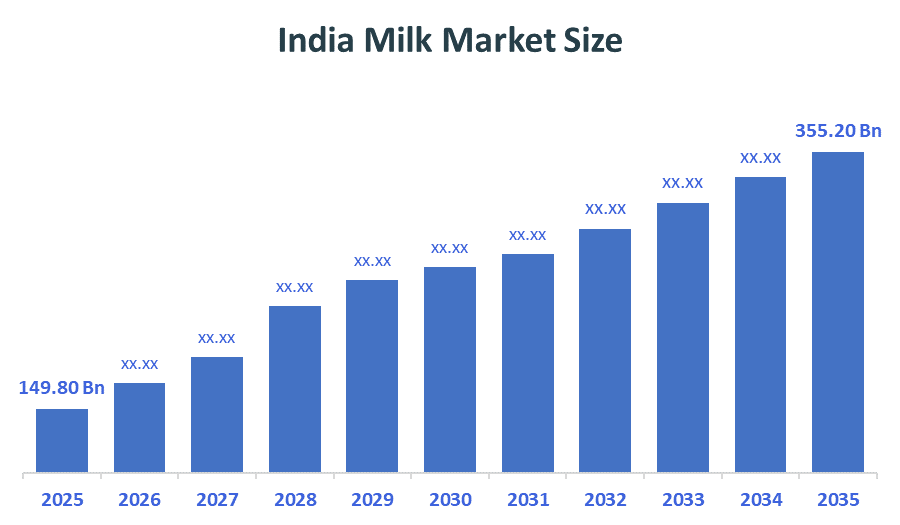
According to Decision Advisors, The India Milk Market Size is projected to grow from USD 149.80 Billion in 2025 and is expected to reach approximately USD 355.20 Billion by 2035. Indian milk market shows that the rising demand for packaged and value-added milk products is emerging as a dominant trend, for nearly 40-50% of the overall market share. Gujarat Cooperative Milk Marketing Federation leads the market with annual revenues of approximately USD 12 Billion, making it a key contributor to the Indian milk market.
Market Overview/Introduction
The Indian milk market is of utmost importance to the worldwide dairy market owing to its healthy consumption rates, large-scale production, and being the highest milk producer in the world. Increased consumption of quality dairy products among both urban and rural consumers forms the driving force for the market. Ultra-high temperature processing technology, pasteurisation techniques, and digital monitoring systems are extensively used in ensuring that product safety is maintained along with adherence to the standards set forth by the Food Safety and Standards Authority of India (FSSAI). Moreover, increased consumption of milk in packaging formats like liquid milk pouches, long-life cartons, and A2 milk products is helping the growth of the market. Apart from that, advanced technologies are being utilised in the milk market, which includes IoT-enabled monitoring and tracing systems that help reduce wastage in the supply chain.
Market trend for milk systems in India includes rapid adaptation of equipment that utilises IoT technology in universal collection systems capable of handling the cooling capacity of solar-powered chillers. Precision nutrition solutions have become popular, especially in metropolitan areas and fitness-centric retail, whereby specialised milk variants are distributed in order to project the identity of the health brand as well as create protein-centred dietary designs.
- In February 2026, the Confederation of Indian Industry launched the Resilient Dairy Alliance to foster climate-resilient farm practices and sustainable dairy ecosystems across the country.
- In January 2026, the National Dairy Development Board expanded the Bharat Pashudhan digital livestock mission, enhancing the traceability of milk through unique Pashu Aadhaar identification tags.
Notable Insights: -
- The India milk market is expected to grow at a CAGR of approximately 9.02% from 2025 to 2035, driven by strong demand for value-added dairy products and government initiatives focused on farmer income doubling and livestock health.
- By product type, packaged milk and value-added variants like yoghurt and paneer are gaining higher adoption due to their perceived safety and ability to deliver convenient nutrition with reduced risk of adulteration.
- By end use, the residential segment holds a dominant position, supported by growing urbanisation and rising consumer focus on nutrient-dense and hygienic dairy solutions in modern Indian households.
What is the Role of Technology in Grooming the Market?
There are several major drivers behind the rising complexity of the Indian milk market, which include the use of precision biotechnological methods combined with connectivity solutions. In the context of the trends in the sector, the major one can be described as the formation of the smart dairy ecosystem due to the presence of reliable digital collection systems required by the national standards to guarantee zero adulteration. As for advanced innovations in the sphere, apart from other methods used, there are special chilling units and controllers to provide precise temperature control and synchronisation of fat testing. The quality of products is ensured through automatic quality measurement and electronic transactions performed with dairy farmers.
Market Drivers
What drives the growth of the Indian milk market is improved cooperative resources and innovations in dairy management systems. In terms of the main determinants of market equilibrium, the growing preference for customised nutrition solutions has been brought about by the rising market penetration of delivery apps and high-end wellness products. The specific needs of the urban retail sector, in terms of products with longer shelf life and high-protein beverages, assure the consistent demand for the premium segment. Furthermore, India has sophisticated research and development capabilities, allowing local producers to transform regular farm produce into premium organic and A2-certified milk products.
Restraints
Despite its significance, there might be some potential issues that can occur owing to the invention of other forms of alternative proteins, including plant milk that has a comparable nutritional content. One of the potential issues might be the added difficulty in complying with the high standards set for exports and the environmental concerns related to methane emissions from cattle.
Study on the Supply, Demand, Distribution, and Market Environment
In regard to the dairy product being discussed, it is safe to say that such a product plays an essential role in the country as one of the primary sources of nutrition, due to the large dependence on agricultural engineering. As far as sources of manufacture of the above-mentioned component of these dairy products, one should note that they are obtained from millions of farms and cooperatives producing and processing milk in the centers operating in such Indian states as Uttar Pradesh, Rajasthan, and Gujarat. Regarding the demand for this particular product, one should pay attention to the point that it remains quite stable due to some basic nutritional needs and the thriving restaurant industry.
Price Analysis and Consumer Behaviour Analysis
Consequently, according to the findings based on the pricing method, the hierarchy occurs in the considered market in terms of the fact that usual milk packets are priced under regulation, while organic milk packets, after processing, high-protein shakes, and certain varieties of milk cartons are quite pricey since the process of obtaining them is rather complicated. Although the cost of the products mentioned above exceeds that of other beverages, consumers view them as a means that can guarantee good health to family members. In terms of the Indian purchase, the focus is on the fresh nature of the products. People must purchase a more reliable system due to such factors as no preservatives in the products, which makes them non-shelf-stable. There are also those who prefer ordering the products via their smartphones.
Market Segmentation
The India milk market is categorised by product type, distribution channel, packaging type, and region.
- The liquid milk variants dominated the market in 2025 and are projected to grow at a steady CAGR of approximately 7.4% during the forecast period.
Based on the product type, the milk market is divided into Full Cream Milk, Toned Milk, Double Toned Milk, Skimmed Milk, Flavoured Milk, and Organic Milk. Among these, the liquid milk variants dominated the market in 2025 and are projected to grow at a steady CAGR of approximately 7.4% during the forecast period. This kind of domination is associated with the need for high-protein nutritional staples and energy-efficient dairy supply chains, providing maximum convenience. These kinds of products have high demand in the Indian middle-class residential and urban retail sector because they can meet the requirements of modern households looking for ready-to-consume and fortified solutions. Modern technologies of ultra-high temperature (UHT) treatment and microprocessor-based quality checks have quickly been introduced into Indian manufacturing facilities to follow the necessary FSSAI and ISO quality standards.
The offline retail and organised distribution segment dominated the market in 2025 and is projected to grow at a substantial CAGR of approximately 6.5% during the forecast period.
Based on the distribution channel, the milk market is divided into Online Retail and Offline Retail. Among these, the offline retail and organised distribution segment dominated the market in 2025 and is projected to grow at a substantial CAGR of approximately 6.5% during the forecast period. In actual fact, it is because of the efficiency and effectiveness of these traditional networks in terms of local accessibility and daily morning deliveries, coupled with stringent compliance to the Indian Food Safety Regulations, that makes the offline and organised cooperative segments the most efficient designs to handle the high volume of perishable dairy. While traditional local vendors have been maintaining a presence in the basic rural market segment due to their cost-effective nature, the shift toward online quick-commerce within the urban residential industry (which is the biggest user) still makes the modern organised segments the giants of the market structure.
The North India and West India application regions accounted for the largest share in 2025 and are anticipated to grow at a significant CAGR of approximately 8.2% during the forecast period.
Based on the region, the milk market is divided into North India, South India, East India, and West India. Among these, the North India and West India application regions accounted for the largest share in 2025 and are anticipated to grow at a significant CAGR of approximately 8.2% during the forecast period. The integration of advanced dairy processing in the process of industrial food production and dietary management becomes inevitable due to the need for high-yield procurement and cost reduction in states like Uttar Pradesh and Gujarat, following the stringent cooperative regulations of the country with regard to production efficiency, coupled with the rising demand for premium dairy products. Among the factors responsible for the increase in potential is the emergence of the smart dairy city initiatives in India, as well as the adoption of effective livestock management systems.
Recent Developments
- In April 2026, the Gujarat Cooperative Milk Marketing Federation (GCMMF), which markets the Amul brand, achieved a historic milestone by crossing a total turnover of USD 12 Billion (INR 1 Lakh Crore) for the financial year 2025-26, representing an 11% growth driven by a diversified portfolio of over 1,200 product variants.
- In January 2026, the National Dairy Development Board (NDDB) accelerated the digital transformation of the sector through the National Digital Livestock Mission, successfully issuing over 35.68 Crore Pashu Aadhaar unique identification tags to ensure 100% traceability and transparent livestock management across India.
- In March 2025, the Union Cabinet approved the revised National Program for Dairy Development (NPDD) with an additional budget of INR 1,000 Crore, aiming to establish 10,000 new dairy cooperative societies and enhance milk procurement and quality control infrastructure to support net-zero agricultural targets by 2025-26.
Competitive Analysis
The report offers the appropriate analysis of the key organisations/companies involved within the India milk market, along with a comparative evaluation primarily based on their product offering, business overviews, geographic presence, enterprise strategies, segment market share, and SWOT analysis. The report also provides an elaborate analysis focusing on the current news and developments of the companies, which includes product development, innovations, joint ventures, partnerships, mergers & acquisitions, strategic alliances, and others. This allows for the evaluation of the overall competition within the market.
Top Key Companies in the India Milk Market
- Amul
- Mother Dairy Fruit & Vegetable Pvt Ltd
- Karnataka Cooperative Milk Producers Federation Ltd (Nandini)
- Hatsun Agro Product Ltd (Arokya)
- Tamil Nadu Cooperative Milk Producers Federation Ltd (Aavin)
- Nestlé India Ltd
- Heritage Foods Limited
- Parag Milk Foods Ltd (Gowardhan / Pride of Cows)
- Dodla Dairy Ltd
- Mehsana District Cooperative Milk Producers Union Ltd (Dudhsagar Dairy)
- VRS Foods Limited (Paras)
- Kerala Cooperative Milk Marketing Federation Ltd (Milma)
- Britannia Industries Ltd
- Creamline Dairy Products Ltd (Godrej Jersey)
- The Odisha State Cooperative Milk Producers Federation Ltd (OMFED)
- Others
Key Target Audience
- Market Players
- Investors
- End-users
- Government Authorities
- Consulting and Research Firm
- Venture capitalists
- Value-Added Resellers (VARs)
Market Segmentation
This study forecasts revenue at the national level from 2021 to 2035. Decision Advisor has segmented the India Milk Market based on the following segments:
India Milk Market, By Product Type
- Full Cream Milk
- Toned Milk
- Double Toned Milk
- Skimmed Milk
- Flavored Milk
- Organic Milk
India Milk Market, By Distribution Channel
- Online Retail
- Offline Retail
India Milk Market, By Packaging Type
- Pouches
- Bottles
- Cartons
- Others
India Milk Market, By Nature
- Conventional
- Organic
India Milk Market, By Region
- North India
- South India
- East India
- West India
Frequently Asked Questions (FAQ)
- How is the demand for nutritional security driving the India milk market?
The focus on offering high-protein sources and controlling the malnutrition levels acts as an effective motivational factor that can help move the industry ahead. The requirement for more sophisticated dairy products owing to their ability to provide vitamins and bone strength is a key factor that helps boost their significance in contemporary diet plans.
- What is the role of UHT technology, and how does it help growth?
It ensures that processing plants can correctly estimate the shelf life of liquid milk by using heat treatment, which removes the harmful bacteria from the milk without having to store it under cold conditions before opening it. It helps extend the reach of dairy systems to ensure that all consumers, whether in cities or rural areas, have easy access to proper nutrition.
- What is the role of IoT and cold-chain connectivity in the market?
The recent trend is toward automated wireless chilling systems, which result in supply chain networks that lack the risk of temperature fluctuations and have become highly appreciated within the global logistics and retail industries. It not only enhances the transparency of the milk collection process but also makes the equipment easier to monitor and upgrade during procurement cycles without damaging product quality.
- How do FSSAI standards impact the 2035 forecast?
The national food safety policy calls for a move towards organised dairy production systems that are inherently quality assured and fully compatible with state-of-the-art testing laboratories. Coupled with the encouragement from the government on digital livestock management technology and the mandatory incomes for farmers, this ensures that the move towards intelligence and compliance-driven dairy chains is achieved well before 2035.
Check Licence
Choose the plan that fits you best: Single User, Multi-User, or Enterprise solutions tailored for your needs.
We Have You Covered
- 24/7 Analyst Support
- Clients Across the Globe
- Tailored Insights
- Technology Tracking
- Competitive Intelligence
- Custom Research
- Syndicated Market Studies
- Market Overview
- Market Segmentation
- Growth Drivers
- Market Opportunities
- Regulatory Insights
- Innovation & Sustainability
Report Details
| Scope | Country |
| Pages | 210 |
| Delivery | PDF & Excel via Email |
| Language | English |
| Release | Apr 2026 |
| Access | Download from this page |