
India Quick Service Restaurants (QSR) Market
 |
Author:
Sayali T
|
Pages:
210
|
Author:
Sayali T
|
Pages:
210
India Quick Service Restaurants (QSR) Market Size, Share, By Service Type (Dine-In, Takeaway, and Delivery), By Cuisine Type (Bakeries, Burger, Ice Cream, Meat-Based Cuisines, Pizza, and Other QSR Cuisines), and By Outlet (Chained Outlets, and Independent Outlets), and Analysis and Forecast 2025-2035.
CAGR
9.42%
REVENUE 2025
USD Billion 28.6
FORECAST 2035
USD Billion 70.39
REPORT COVERAGE
Country
Market Snapshot
- India Quick Service Restaurants (QSR) Market Size (2025): USD 28.6 billion
- Projected India Quick Service Restaurants (QSR) Market Size (2035): USD 70.39 billion
- India Quick Service Restaurants (QSR) Market Compound Annual Growth Rate (CAGR): 9.42%
- Base Year: 2025
- Historical Period: 2021–2024
- Forecast Period: 2026–2035
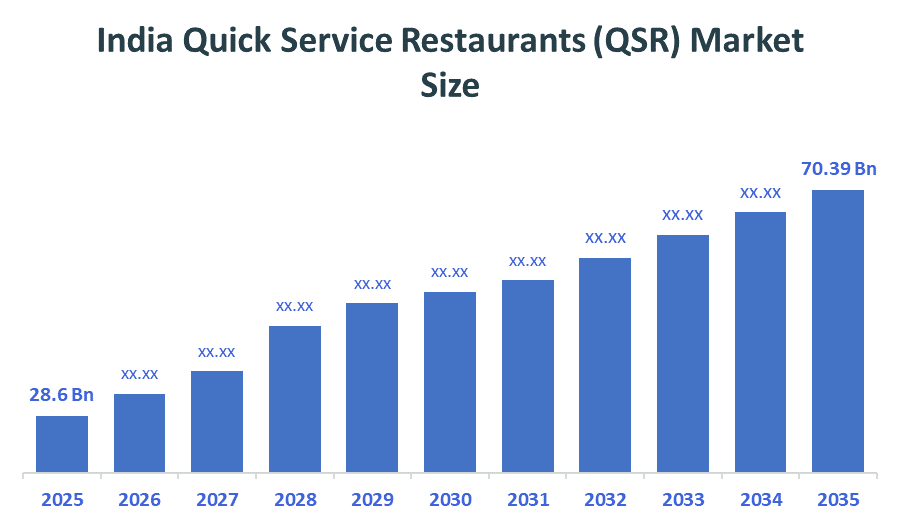
According to Decision Advisors, the India Quick Service Restaurants (QSR) Market Size is expected to grow from USD 28.6 billion in 2024 to USD 70.39 billion by 2035, at a CAGR of 9.42% during the forecast period 2026-2035. India Quick Service Restaurants (QSR) Market experiences rapid growth because of digital technology reaches more people who use Zomato and Swiggy to order food from restaurants. The fast food chains like McDonald's and Domino's enter Tier 2 and Tier 3 cities to establish their presence in new markets.
Market Overview/Introduction
The India's quick service restaurant industry operates with a standardized system which delivers affordable meals through fast service that requires limited menu options and maximum operational efficiency. The business model serves urban millennials and busy customers who prefer its food delivery and takeaway services as their main source of income. The segment operates through major chains like McDonald's, Domino’s, and KFC which use their large scale and franchise system and digital technologies to expand their market presence and maintain customer engagement throughout India's developing cities. The QSR market in India is currently experiencing technological changes which digital ordering systems from Zomato use to generate high transaction volume, while AI-powered kitchen systems and predictive analytics improve their operational performance. The business world will discover its upcoming opportunities through expanding into Tier 2 and Tier 3 markets and growing breakfast consumption and developing personalized marketing systems. The combination of cloud kitchens and sustainable infrastructure and localized menu development will enable businesses to achieve cost savings and enhance customer interaction and create pathways for sustainable business expansion.
- In India is witnessing rising restaurant spending and transaction volumes, supported by 10-11% sectoral growth, indicating stronger discretionary consumption. This trend is significantly accelerating demand in the India Quick Service Restaurants (QSR) Market across urban and emerging Tier 2/3 markets.
- In India’s Pradhan Mantri Mudra Yojana (PMMY) enables collateral-free loans up to ?10 lakh for micro and small enterprises, strengthening entrepreneurship. This initiative is significantly supporting outlet expansion and new entrants in the India Quick Service Restaurants (QSR) Market.
- In India’s Digital India initiative has accelerated UPI-led payments, accounting for 81% of retail transactions, enhancing transaction efficiency and data capture. This digital shift is significantly boosting operational throughput and consumer engagement in the India Quick Service Restaurants (QSR) Market.
Notable Insights: -
- By service type, the delivery segment held a dominant position with 37.2% in terms of market share in 2025.
- By cuisine type, Pizza segment is the dominating accounting for over 27.1% of the China market share in 2025.
- The compound annual growth rate of the India Quick Service Restaurants (QSR) Market is 9.42%.
- The market is likely to achieve a valuation of USD 70.39 billion by 2035.
What is role of technology in grooming the market?
The India Quick Service Restaurants (QSR) Market now sees technology as its essential element which produces customer demand and improves restaurant operations. The market now has greater accessibility because of digital platforms like Zomato and Swiggy have expanded their reach while AI-based demand forecasting and smart kitchen technology and automated kiosks have improved both operating capacity and cost management. The data analytics enables businesses to conduct hyper-personalized marketing through its ability to create customized advertisements and establish dynamic pricing systems which help keep their customers. The implementation of UPI-based contactless payment systems together with cloud-based point of sale systems improves transaction efficiency while enabling businesses to grow their operations in both urban areas and developing market regions.
Market Drivers
The India Quick Service Restaurants (QSR) Market experiences its structural changes because of the digital consumption patterns and demographic shifts are creating a new market environment. The market gains more customers through Zomato and Swiggy because of they provide platform-based ordering services which meet the needs of the growing urban workforce who prefer quick meal options. The brands are entering Tier 2/3 cities to meet the demand which exists in those areas because they provide affordable prices and products that suit local needs. The Domino's and other organized companies in the market achieve cost advantages through their operational scale. The digital India and other government programs about digital technology business operations both establish formal transaction processes which improve business visibility and support economic growth that comes from increased customer spending.
Restrain
The quick service restaurants (QSR) market in India experiences structural challenges which result from increased operational expenses and unpredictable input costs that threaten business profitability. The market is losing ground because cloud kitchens and rapid-delivery formats are becoming more competitive. The sector faces operational efficiency challenges and sustainable margin expansion limits because of consumer demand has decreased from price sensitivity and labour shortages and high aggregator commissions.
Strategies to Implement for Growth of the Market
Strategies to Implement for Growth of the India quick service restaurants (QSR) market, sustainable growth through implementation of multiple strategic initiatives. Operators need to increase their digital integration efforts by developing their own applications and using data to create personalized experiences while they decrease operational expenses through cloud kitchens and asset-light business models. The expansion into Tier 2/3 cities will create new business opportunities. The restaurant will achieve better profitability through menu engineering which combines affordable items with high-end products. The company can be expanding its market presence through strategic partnerships with Zomato while supply chain localization decreases operational risks. The company will enhance its competitiveness and brand value through its investments in automation and workforce development and sustainability programs.
Market Segmentation
The India Quick Service Restaurants (QSR) Market share is classified into service, cuisine, and outlet
- The Delivery segment dominated the market in 2024, and is projected to grow at a substantial CAGR of approximately 9.2% during the forecast period.
Based on the service type, the quick service restaurants (QSR) market is divided into dine-in, takeaway, and delivery. Among these, the Delivery segment dominated the market in 2024, and is projected to grow at a substantial CAGR of approximately 9.2% during the forecast period. It is because of Zomato and Swiggy use platform-based demand aggregation systems which decrease both customer search activities and their transaction process. The system achieves higher order volumes because it provides users with simple and fast solutions, while operators can expand their business through cloud kitchen operations and improved asset management and expanded service areas without having to make major real estate purchases.
- The Pizza segment accounted for the largest share in 2024, and is anticipated to grow at a significant CAGR of approximately 10.3% during the forecast period.
Based on the cuisine type, the quick service restaurants (QSR) market is divided into bakeries, burger, ice cream, meat-based cuisines, pizza, and other QSR cuisines. Among these, the Pizza segment accounted for the largest share in 2024, and is anticipated to grow at a significant CAGR of approximately 10.3% during the forecast period. It is dominating because the business requires delivery-based consumption systems which need standardized processing methods to support its growth. The domino's uses its customers frequent orders and their price packages to increase sales while its products meet local market demands.
- The Independent Outlets segment dominated the market in 2024, and is projected to grow at a substantial CAGR during the forecast period.
Based on the outlet, the quick service restaurants (QSR) market is divided into chained outlets, and independent outlets. Among these, the Independent Outlets segment dominated the market in 2024, and is projected to grow at a substantial CAGR during the forecast period. The business model requires minimal capital investment while maintaining adaptable operations that meet local customer preferences. Their extensive presence across tier-2 and tier-3 cities, coupled with competitive pricing, ensures higher consumer penetration than organized chains.
Recent Development
- In March 2024, sector reports highlighted that the India Quick Service Restaurants (QSR) Market is poised to employ over 10 million individuals by 2025, driven by post-pandemic recovery, rapid outlet expansion, and rising urban consumption demand.
- In January 2024, India’s Press Information Bureau reported UPI accounts for 85% of digital transactions, with 491 million users and 65 million merchants, significantly boosting efficiency and transaction volumes in the India Quick Service Restaurants (QSR) Market.
Competitive Analysis
The report offers the appropriate analysis of the key organisations/companies involved within the India quick service restaurants (QSR) market, along with a comparative evaluation primarily based on their product offering, business overviews, geographic presence, enterprise strategies, segment market share, and SWOT analysis. The report also provides an elaborative analysis focusing on the current news and developments of the companies, which includes product development, innovations, joint ventures, partnerships, mergers & acquisitions, strategic alliances, and others. This allows for the evaluation of the overall competition within the market.
Top Key Companies in India Quick Service Restaurants (QSR) Market
- McDonald's
- Domino's Pizza
- KFC
- Burger King
- Subway
- Pizza Hut
- Jubilant FoodWorks
- Westlife Foodworld
- Devyani International
- Sapphire Foods India
- Restaurant Brands Asia
Key Target Audience
- Market Players
- Investors
- End-users
- Government Authorities
- Consulting and Research Firm
- Venture capitalists
- Value-Added Resellers (VARs)
Market Segment
This study forecasts revenue at the India, regional, and country levels from 2020 to 2035. Decision Advisors has segmented the India Quick Service Restaurants (QSR) Market based on the below-mentioned segments
India Quick Service Restaurants (QSR) Market, By Service Type
- Dine-In
- Takeaway
- Delivery
India Quick Service Restaurants (QSR) Market, By Cuisine Type
- Bakeries, Burger
- Ice Cream
- Meat-Based Cuisines
- Pizza
- and Other QSR Cuisines
India Quick Service Restaurants (QSR) Market, By Outlet
- Chained Outlets
- Independent Outlets
Frequently Asked Questions (FAQ)
Q. What is driving growth in the India Quick Service Restaurants (QSR) Market?
A. The quick-service restaurant industry in India experiences growth because more people move to cities and more families have two working members and people want to eat fast food. The organized companies expand their restaurant networks while they develop digital ordering systems which leads to increased customer demand in both metropolitan areas and new developing cities.
Q. Which segment dominates the India QSR market?
A. Independent outlets dominate India’s QSR landscape because they offer affordable prices and they operate successfully in different regions while they have strong business presence in smaller cities. However, organized chains are steadily gaining share because brand trust and standardization and scalable franchise-led expansion models support their growth.
Q. What role do food delivery platforms play in the QSR market?
A. The delivery platforms used by restaurants have become essential business tools which enable restaurants to reach customers who live outside their dining establishments. The QSR brands utilize three services which include demand aggregation and last-mile logistics and promotional visibility to achieve rapid expansion while decreasing their reliance on in-restaurant customer traffic.
Q. Why are tier-2 and tier-3 cities important for QSR growth?
A. The tier-2 and tier-3 cities serve as the upcoming market for QSR growth because increasing disposable incomes together with changing consumer habits drive this expansion. The two markets become appealing to businesses because of their reduced property expenses together with their absence of established market competitors.
Check Licence
Choose the plan that fits you best: Single User, Multi-User, or Enterprise solutions tailored for your needs.
We Have You Covered
- 24/7 Analyst Support
- Clients Across the Globe
- Tailored Insights
- Technology Tracking
- Competitive Intelligence
- Custom Research
- Syndicated Market Studies
- Market Overview
- Market Segmentation
- Growth Drivers
- Market Opportunities
- Regulatory Insights
- Innovation & Sustainability
Report Details
| Scope | Country |
| Pages | 210 |
| Delivery | PDF & Excel via Email |
| Language | English |
| Release | Apr 2026 |
| Access | Download from this page |