
India Sesame Market
 |
Pages:
210
|
Pages:
210
India Sesame Market Size, Share, By Product Type (Hulled Sesame Seeds, Natural/Unhulled Sesame Seeds, Black Sesame Seeds, and Organic Sesame Seeds), By Application (Food Processing, Edible Oil Production, Bakery & Confectionery, and Cosmetics & Personal Care), and By Distribution Channel (Supermarkets & Hypermarkets, Traditional Retail Stores, Online Retail, and Export Channels), Analysis and Forecast 2026 ? 2035.
REPORT COVERAGE
Country
Market Snapshot
- India Sesame Market Size (2025): USD 1.45 Billion
- India Sesame Projected Market Size (2035): USD 2.10 Billion
- India Sesame Compound Annual Growth Rate (CAGR): 3.8%
- Base Year: 2025
- Historical Period: 2021–2024
- Forecast Period: 2026–2035
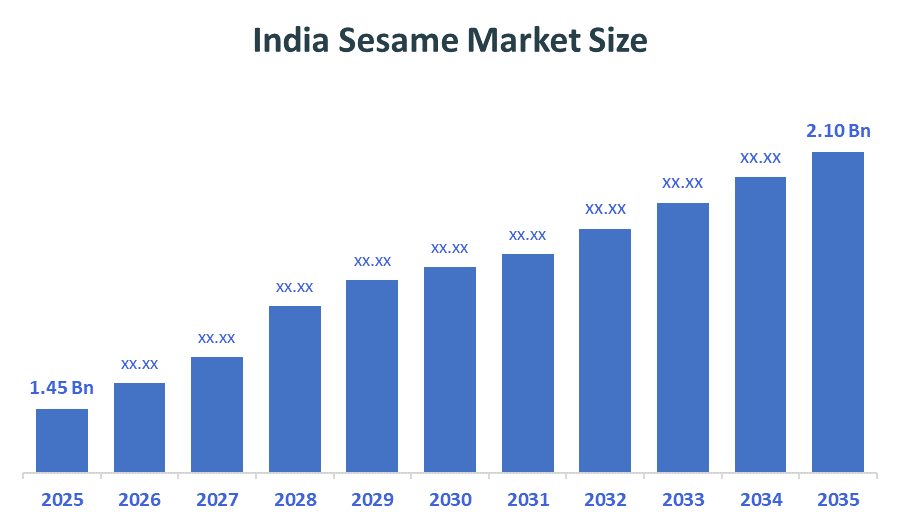
According to Decision Advisors, the India sesame market size is expected to grow from USD 1.45 billion in 2025 to USD 2.10 billion by 2035, at a CAGR of 3.8% during the forecast period 2026–2035. The Indian agriculture industry will experience steady growth in the next ten years because of the increasing demand for nutrient-packed superfoods in the international market of health foods as well as in the rapidly growing local market of retail products. While there are other sources of oilseeds, the current knowledge that goes hand-in-hand with the cultivation of sesame seeds and the need to ensure food security by creating crops that yield large amounts despite the presence of drought are vital contributors to the development of the industry.
Market Overview/Introduction
The sesame market in India involves the production and processing of premium-quality oilseed crops, meant for international and local consumption. It is important for the use of special machines that process the oilseed by hulling, roasting, and extracting the oil from it, in order to achieve high purity standards set by international food safety guidelines. This crop has been highly sought after in the market owing to its ability to provide high protein and antioxidant content, along with acting as a versatile ingredient in different cuisines. Products currently found in the market include white, black, and brown types of sesame as well as value-added products, including tahini and cold-pressed oil. Consumers have been looking for these products because of the need for superfoods and natural supplements in recent times. A trend seen in this industry involves the use of new technology, such as the use of automatic hulling and digital colour sorting, for improving the quality of exports. Purity of sesame oil has gained immense popularity, especially in the pharmaceutical and cosmetics industries, owing to its high smoke point and skin-friendly nature. The traditional open-market trading in India has transformed into more advanced value chain systems to ensure better safety of food and reduce pesticide content.
- Although there are many other oils available today, sesame seeds continue to play a vital role within the Indian agriculture sector due to their special nut-like taste and crunchy texture that make them preferred over other alternatives in the premium bakery sector.
- Roughly 65% of sesame demand in the country is driven by the export market, as international buyers from South Korea, the United States, and Russia continue to source high-quality Indian seeds for industrial and retail use.
Notable Insights
- India emerges as an important source for world sesame seed consumption, with its output estimated at approximately 750 to 800 thousand metric tons during 2024. India's share in world exports is estimated at approximately 45%, owing largely to high demand in Asian and Middle Eastern markets.
- The white variety of sesame seeds is considered the regular one for the bakery and confectionery industry, making up about 65% of the market share by 2025. The benefits of this kind of seed lie in their high visual attractiveness for decorating dishes, as well as in their ability to have a mild nutty flavour, unlike other colored types of seeds.
- With respect to market drivers, the need for processed and value-added products, along with the requirement for ingredients within the nutraceuticals market, which makes up close to 40% of the market size of sesame oil and powder, would keep the market going forward.
What is the Role of Technology in Grooming the Market?
One of the most significant drivers behind the growing popularity of the India sesame market is the development of highly sophisticated techniques of agricultural processing and optical sorting systems. The technological trend currently prevailing in the market is related to the implementation of intelligent cleaning systems that enhance safety by means of increased mechanical discharge accuracy, resulting in higher purity rates. Modern technologies such as digital colour sorters and ultrasonic hulling have become a means of achieving a very high rate of purity, as well as equalising the sizes of seeds within rather complicated logistic chains. The premium export products may be sterilised with steam, as well as controlled with moisture sensors according to international phytosanitary standards and transportation time.
Market Drivers
The Indian sesame manufacturing industry is driven by the fact that India is the largest exporter of high-quality sesame seeds in the world and follows international standards when it comes to quality. There is another key factor that makes the market stable, and that is the requirement for protein-rich components in the increasing range of vegan products in the market. The specificity of requirements for different sectors and the nutraceutical sector in particular, in which the antioxidants of sesame play an essential role, ensures constant demand through the production of value-added products. It is efficient logistics that give India an edge in the global market because the country houses many manufacturers of high-quality hulled and natural seeds.
Restraints
In spite of the industry exhibiting stability in its operations, there remain some impediments to the growth of the market in the form of fast-emerging alternatives to the oilseeds like sunflower and flax seed oil that are gaining popularity within the mass snack production system. It is quite possible that the prohibitive cost involved in obtaining zero-pesticide residue certificates could be an impediment to market entry.
Study on the Supply, Demand, Distribution, and Market Environment
Sesame in India represents an established market that operates on the basis of the premier agricultural exports industry in the country. The sources of supply emanate from the processing centers of Gujarat and Rajasthan, which have high production capabilities of hulled types and natural oil products in locations close to important ports. The demand is consistent in nature since it emanates from the requirement to satisfy the needs of the international baking industries, as well as other pharmaceutical and traditional healing purposes. Two main channels exist for the distribution of this commodity, which include direct international contracts between foreign companies and Indian processors, as well as domestic networks using traditional APMC market systems and new electronic platforms.
Price Analysis and Consumer Behaviour Analysis
Analysis of Price indicates how the market has been tiered in a way that common natural sesame seeds have consistent pricing, while organic and EU-grade hulled seeds need premium pricing as a result of advanced cleaning technology and certification costs incurred. Nevertheless, sesame seeds can be regarded as high-quality alternatives to expensive protein supplements despite the fact that their cost at retail stores is higher compared to conventional grains. Consumer Behaviour in India and other destinations to which these products are exported indicates how consumers pay a lot of attention to nutritional content and the purity of the product. In particular, buyers tend to prefer organic certification to enhance the safety of the food products consumed. Besides, there are certain consumers interested in the taste and texture of the Indian varieties of sesame seeds.
Market Segmentation
The India Sesame Market is categorised by product type, application, and distribution channel.
- The hulled sesame seeds segment dominated the market in 2025 and is projected to grow at a steady CAGR of approximately 3.5% during the forecast period.
Based on the product type, the sesame market is divided into hulled sesame seeds, natural/unhulled sesame seeds, black sesame seeds, and organic sesame seeds. Among these, the hulled sesame seeds segment dominated the market in 2025 and is projected to grow at a steady CAGR of approximately 3.5% during the forecast period. When the stripping off of the outer skin to make it more tender is favoured. There is an immense popularity for this type in global trade due to its ability to meet the high standards required by gourmet food companies. There has been a quick acceptance of the hulling machine technology in places like Gujarat, India, for processing purposes.
- The food processing application segment accounted for the largest share in 2025 and is anticipated to grow at a significant CAGR of approximately 3.2% during the forecast period.
Based on the application, the sesame market is divided into food processing, edible oil production, bakery & confectionery, and cosmetics & personal care. Among these, the food processing application segment accounted for the largest share in 2025 and is anticipated to grow at a significant CAGR of approximately 3.2% during the forecast period. The inclusion of sesame within food production processes is encouraged due to its high content of plant protein and minerals, which corresponds with the increasing preference for vegan and healthy diets across the globe. The increased growth potential of this segment can also be attributed to the growth of the local Indian FMCG industry, in which companies are including nutrient-rich seeds.
- The export channels distribution segment dominated the market in 2025 and is projected to grow at a substantial CAGR of approximately 4.1% during the forecast period.
Based on the distribution channel, the sesame market is divided into supermarkets & hypermarkets, traditional retail stores, online retail, and export channels. Among these, export channels distribution segment dominated the market in 2025 and is projected to grow at a substantial CAGR of approximately 4.1% during the forecast period. The systematic functioning of export firms, along with their compliance with international phytosanitary regulations, renders this mode of business the most efficient method for generating income on a massive scale. Even though online commerce in the domestic environment is flourishing owing to e-commerce websites, the magnitude of international business deals and bulk transport makes export channels the reigning giants of the market structure.
Recent Developments
- In November 2025, the Indian National Agricultural Cooperative Marketing Federation increased its purchases of oilseeds, such as sesame, by about 12% at the mandi level, to try to stabilise the income of farmers and improve supply chains in the country.
- In August 2025, the Ministry of Agriculture and Farmers’ Welfare provided increased assistance within the scheme of developing oilseeds; an increase of 5% is anticipated for sesame per hectare owing to improved seed distribution.
- In April 2024, India’s leading exporters enhanced their processing capabilities through the use of state-of-the-art cleaning and hulling technology, thereby ensuring that the quality of the sesame exported was better and that there was almost a 15% increase in efficiency.
Competitive Analysis
The report offers the appropriate analysis of the key organisations/companies involved within the India sesame market, along with a comparative evaluation primarily based on their product offering, business overviews, geographic presence, enterprise strategies, segment market share, and SWOT analysis. The report also provides an elaborate analysis focusing on the current news and developments of the companies, which includes product development, innovations, joint ventures, partnerships, mergers & acquisitions, strategic alliances, and others. This allows for the evaluation of the overall competition within the market.
Top Key Companies in the India Sesame Market
- SadBhaav Spices
- HL Agro Products Pvt. Ltd.
- Vora Spice Mills LLP
- Dhaval Agri Exports Limited
- Ashapura Exporters
- B.N. Exports Pvt. Ltd.
- Sivaroma Naturals Pvt. Ltd.
- Sun Agro Exports Co.
- Manishankar Oils Pvt. Ltd.
- Others
Key Target Audience
- Market Players
- Investors
- End-users
- Government Authorities
- Consulting and Research Firm
- Venture capitalists
- Value-Added Resellers (VARs)
Market Segmentation
This study forecasts revenue at the national and regional levels from 2020 to 2035. The report segmented the India sesame market based on the following segments:
India Sesame Market, By Product Type
- Hulled Sesame Seeds
- Natural/Unhulled Sesame Seeds
- Black Sesame Seeds
- Organic Sesame Seeds
India Sesame Market, By Application
- Food Processing
- Edible Oil Production
- Bakery & Confectionery
- Cosmetics & Personal Care
India Sesame Market, By Distribution Channel
- Supermarkets & Hypermarkets
- Traditional Retail Stores
- Online Retail
- Export Channels
Frequently Asked Questions (FAQ)
- How is the demand for premium healthy ingredients driving the India sesame market?
The focus on nutritional wellness and vegetarian diets provides the necessary motivation for market growth. The demand for sesame seeds, because of their rich protein, healthy fats, and antioxidants, among health-conscious individuals, is instrumental in increasing the value of the product as a superfood.
- Why is India a leading market for sesame production and export?
India’s dominance lies in its excellence in the cultivation of sesame seeds, which has been made possible due to the presence of large processing clusters in the regions of Gujarat and Rajasthan. This has been coupled with the focus on producing highly pure hulled products, together with the fact that India is well known for its various strains of white and black sesame seeds.
- What is the role of digital colour sorting technology, and how does it help growth?
It allows the processing units to accurately detect and eliminate any seeds or impurities that are not colour coordinated. It assists in increasing the purity level of the batches of sesame to ensure that they can easily comply with the stringent export requirements while at the same time maintaining their nutritional value.
- What is the role of hulled sesame technology in the market?
The recent trend is towards mechanised hulling systems, which result in seeds that lack any skin at all and have become highly appreciated within the global bakery and confectionery industries. It not only enhances their appearance but also makes them more palatable and easier to digest.
- How do food safety regulations impact the 2035 forecast?
The industrial policies of large importing zones emphasise the transition to sesame that does not contain any pesticides and is organically certified. This, combined with the government support of sustainable farming methods, ensures that by 2035, the shift towards eco-friendly supply chains will have already taken place. Continued growth will be ensured through the adoption of new international standards in production.
Check Licence
Choose the plan that fits you best: Single User, Multi-User, or Enterprise solutions tailored for your needs.
We Have You Covered
- 24/7 Analyst Support
- Clients Across the Globe
- Tailored Insights
- Technology Tracking
- Competitive Intelligence
- Custom Research
- Syndicated Market Studies
- Market Overview
- Market Segmentation
- Growth Drivers
- Market Opportunities
- Regulatory Insights
- Innovation & Sustainability
Report Details
| Scope | Country |
| Pages | 210 |
| Delivery | PDF & Excel via Email |
| Language | English |
| Release | Apr 2026 |
| Access | Download from this page |