
India Smart Pole Market
 |
Pages:
190
|
Pages:
190
India Smart Pole Market Size, Share, By Type of Pole (LED Smart Poles, Solar-Powered Smart Poles, Hybrid Smart Poles), By Technology (IoT-Enabled Smart Poles, AI-Integrated Smart Poles, 5G/Communication-Enabled Smart Poles), and By End-User Industry (Government and Municipal Corporations, Government and Municipal Corporations, Defense and Security Agencies, Commercial and Industrial Spaces), Analysis and Forecast 2025-2035.
REPORT COVERAGE
Country
Market Snapshot
- Market Size (2025): USD 871.87 Million
- Projected Market Size (2035): USD 4738.29 Billion
- Compound Annual Growth Rate (CAGR): 24.6%
- Base Year: 2025
- Historical Period: 2021–2024
- Forecast Period: 2026–2035
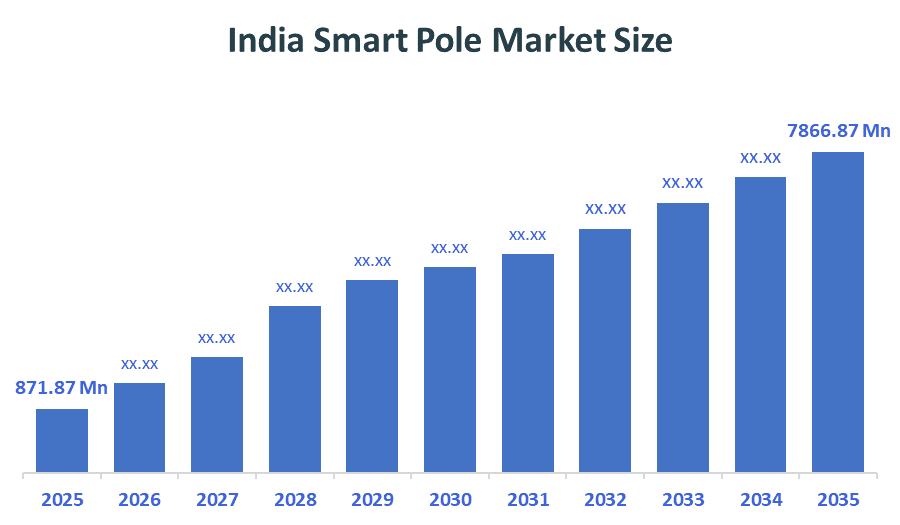
According to Decision Advisors, the India smart pole market Size is expected to grow from USD 871.87 Million in 2025 to USD 7866.87 Million by 2035, at a CAGR of 24.6% during the forecast period 2025-2035. India smart pole market is projected to grow significantly over the next decade due to advanced wound care integration types become more popular and chronic diseases become more common and new foam material technologies emerge and healthcare facilities develop in hospitals and homecare environments.
Market Overview/Introduction
The India Smart Pole Market refers to the ecosystem of multifunctional urban poles that combine LED lighting, IoT sensors, connectivity, surveillance, and communication systems to support smart city infrastructure and public services. The smart poles use their environmental sensors, traffic monitoring equipment, safety measures to gather real-time information about environmental conditions, traffic patterns, safety hazards while their system enables users to control lights remotely and lights operate at reduced energy consumption. The Smart Cities Mission together with urban infrastructure modernization projects drives the current market development. These poles use adaptive LED lighting together with Wi-Fi hotspots, air quality, traffic sensors and CCTV cameras to create a system which improves urban monitoring, public safety according to sustainability and IoT standards. Recent trends include deployments in cities like New Delhi and Vadodara, where smart poles support public Wi?Fi, command?control connectivity, improving citizen services and operational efficiency. The organization can create advantages from areas which include its capacity to develop rural areas, its ability to use renewable energy and its capacity for data-based urban planning.
Notable Insights: -
- By substrate material, the LED Smart Poles held a dominant position with 23% in terms of market share in 2025.
- By integration type, IoT-Enabled Smart Poles is the dominating accounting for over 24% of the Canada market share in 2025.
- The compound annual growth rate of the India smart pole market is 24.6%.
- The market is likely to achieve a valuation of USD 7866.87 Million by 2035.
What is role of technology in grooming the market?
The growth and adoption of smart poles in India develops mainly through technological advancements. Smart poles combine IoT, AI, and wireless communication systems to deliver advanced capabilities which include environmental monitoring and traffic management and public safety surveillance and data collection, in addition to their basic street lighting function. LED and adaptive lighting technologies enable energy savings between 50%-70% when compared to traditional systems, which results in decreased operating expenses. The combination of cloud-based platforms with centralized control systems supports organizations in monitoring their operations and conducting predictive maintenance work, which results in improved system reliability and longer equipment life. Urban service delivery gains from the installation of sensors and cameras and Wi-Fi hotspots and 5G-ready connectivity, which also enables the development of new business models that include data-driven city planning and public safety analytics. Technology enables smart poles to achieve better functionality, operational efficiency, environmental sustainability and business growth, which establishes their vital role in India's smart city development projects.
Market Drivers
The Smart Cities Mission develops smart urban infrastructure for more than 100 cities which drives the India Smart Pole Market together with rising urban growth which creates a need for combined street lighting and security systems and environmental monitoring equipment. Energy-efficient LED and adaptive lighting reduce consumption by 50–70% which helps organizations achieve their sustainability objectives. The system uses IoT sensors and AI analytics together with 5G-ready connectivity to provide users with real-time monitoring and predictive maintenance capabilities. Cities and private investors benefit from increased public safety needs and traffic management requirements and disaster preparedness needs which create Wi-Fi hotspot commercial opportunities and advertising revenue streams.
Restrain
Smart poles face adoption challenges in regions with budget constraints due to their high initial costs, their complicated installation process and maintenance needs. The ability of small towns to function properly gets restricted due to their insufficient connectivity and power supply systems. The deployment process experiences delay due to regulatory obstacles which include right-of-way permissions and urban planning approvals. The streetlight market faces growth limitations because of competition from traditional streetlights and other smart lighting products, despite increasing urban population and smart city development efforts.
Study on the Supply, Demand, Distribution, and Market Environment India Smart Pole Market
India's smart pole market supply receives support through its urban infrastructure projects which the government advances through its Smart Cities Mission and increasing IoT, LED lighting and connectivity system adoption in Delhi, Mumbai and Bengaluru. Cities demand real-time monitoring solutions, traffic management systems and public safety equipment due to they have deployed more than 7000 smart poles throughout 100 cities which operate under smart city programmes. The market distributes products through channels which include direct government procurement, public-private partnerships and OEM networks while technological integration, energy efficiency, sustainability drive market development which enables rural expansion and renewable energy implementation.
Price Analysis and Consumer Behaviour Analysis
The cost of smart poles in India varies according to their technological capabilities and available features. Basic LED smart poles cost less than IoT-enabled and AI-integrated and 5G-ready units because the latter systems require additional sensors and connectivity modules. Municipal buyers focus on total cost of ownership because they want to achieve energy savings between 50-70% through LED and adaptive lighting, which allows them to spend more on initial expenses. Government and municipal bodies prefer modular systems that offer upgrade possibilities, which enable surveillance and environmental monitoring and public Wi-Fi, as these systems demonstrate the shift towards data-driven infrastructure investments. The widespread implementation of solutions in Tier-2 and Tier-3 cities depends on organizations needing both affordable pricing and transparent return-on-investment models.
Strategies to Implement for Growth of the Market
To expand the India Smart Pole Market, companies should leverage the Smart Cities Mission, which covers over 100 cities, to secure funding and accelerate deployments. Establishing local manufacturing units can reduce costs by 15–20% and improve supply chain efficiency. Integration of AI, IoT sensors, adaptive LED lighting, and 5G-ready connectivity enhances functionality and operational efficiency. Pilot projects in airports, highways, and commercial zones demonstrate benefits, while leasing and installment financing options lower adoption barriers. Multi-functional features like Wi-Fi hotspots, environmental monitoring, and advertising create revenue opportunities.
Market Segmentation
The India smart pole market share is classified into type of pole, technology, and end-user industry
- The LED smart polesdominated the market in 2024, and is projected to grow at a substantial CAGR of approximately 23% during the forecast period.
Based on the Type of Pole, the photonic integrated circuit market is divided into LED smart poles, solar-powered smart poles, hybrid smart poles. Among these, the LED Smart Poles dominated the market in 2024, and is projected to grow at a substantial CAGR of approximately 23% during the forecast period. LED smart poles become the primary choice for smart city projects due to their energy efficiency and ability to connect with various platforms. The market for LED smart poles, which provide connected urban lighting solutions, will experience significant growth throughout the forecast period due to cities increasingly adopt energy-efficient lighting systems.
- The IoT-Enabled Smart Poles accounted for the largest share in 2024, and is anticipated to grow at a significant CAGR of approximately 24 % during the forecast period.
Based on the Technology, the photonic integrated circuit market is divided into IoT-enabled smart poles, AI-integrated smart poles and 5G/communication-enabled smart poles. Among these, the IoT-Enabled Smart Poles accounted for the largest share in 2024, and is anticipated to grow at a significant CAGR of approximately 24% during the forecast period. The combination of real-time data collection and environmental monitoring and traffic monitoring and energy-efficient LED systems makes IoT-enabled smart poles the leading technology. The combination of smart city projects and government financial support and the need for urban areas to have connected multifunctional infrastructure leads to rising adoption rates and continuous growth throughout India.
- The Government and Municipal Corporations segment dominated the market in 2024, and is projected to grow at a substantial CAGR approximately 23% during the forecast period.
Based on the End-User Industry, the photonic integrated circuit market is divided into government and municipal corporations, government and municipal corporations, defense and security agencies, commercial and industrial spaces. Among these, the Government and Municipal Corporations segment dominated the market in 2024, and is projected to grow at a substantial CAGR approximately 23% during the forecast period. Government and municipal corporations maintain control over urban territories because they implement extensive street lighting systems and their traffic control solutions and their public safety projects through India's Smart Cities Mission. The market experience continuous growth because investors increasingly support energy-efficient smart poles equipped with Internet of Things technology.
Recent Development
- In January?2026, Srinagar expanded smart city infrastructure with smart poles equipped with Wi?Fi hubs, EV charging points, LED lighting, CCTV, and environmental sensors, while Delhi’s NDMC installed smart poles featuring panic buttons for emergency alerts at schools, metro stations, and sensitive locations, enhancing public safety and urban monitoring.
- In January?2025, Hyderabad and Ranchi are implementing smart urban lighting and monitoring initiatives; Telangana is deploying smart poles with surveillance capabilities, and Ranchi installed around 1,300 AI?enabled auto?dimming LED street lights to improve citywide monitoring and energy efficiency. These efforts relate to smart pole and smart city infrastructure development.
- In October?2024, Pegatron 5G and Flexsol partnered to deliver “Make in India” private 5G solutions, combining Pegatron’s 5G equipment with Flexsol’s smart infrastructure products, including smart poles and related systems, to support 5G?enabled smart city and industrial applications
Competitive Analysis
The report offers the appropriate analysis of the key organisations/companies involved within the India smart pole market, along with a comparative evaluation primarily based on their Technology offering, business overviews, geographic presence, enterprise strategies, segment market share, and SWOT analysis. The report also provides an elaborative analysis focusing on the current news and developments of the companies, which includes Technology development, innovations, joint ventures, partnerships, mergers & acquisitions, strategic alliances, and others. This allows for the evaluation of the overall competition within the market.
Top Key Companies in India smart pole market
- Signify Innovations (formerly Philips Lighting India)
- Bajaj Electricals Limited
- Larsen & Toubro (L&T)
- Bharat Electronics Limited (BEL)
- Wipro Enterprises Ltd
- Honeywell Automation India Ltd
- ABB India Ltd
- Siemens Limited
- Iram Technologies Pvt. Ltd
- Efftronics Systems Pvt. Ltd
- Others
Key Target Audience
- Market Players
- Investors
- End-users
- Government Authorities
- Consulting and Research Firm
- Venture capitalists
- Value-Added Resellers (VARs)
Market Segment
This study forecasts revenue at the India, regional, and country levels from 2020 to 2035. Decision Advisors has segmented the India smart pole market based on the below-mentioned segments
India smart pole market, By Type of Pole
- LED Smart Poles
- Solar-Powered Smart Poles
- Hybrid Smart Poles
India smart pole market, By Integration Type
- IoT-Enabled Smart Poles
- AI-Integrated Smart Poles
- 5G/Communication-Enabled Smart Poles
India smart pole market, By End-User Industry
- Government and Municipal Corporations
- Medium-Scale PIC
- Defense and Security Agencies
- Commercial and Industrial Spaces
Frequently Asked Questions (FAQ)
Q1. What are smart poles, and how do they support smart city infrastructure in India?
- Smart poles serve as multifunctional urban poles which combine LED lighting with IoT sensors and surveillance cameras and connectivity systems. The system functions with smart city operations while it delivers public safety and traffic monitoring and environmental sensing and energy efficient operations.
Q2. Which type of smart pole dominates the Indian market, and why?
- The market mainly consists of LED Smart Poles because they provide energy efficiency and they can work with IoT platforms and they can function with AI and 5G systems used for urban monitoring and public safety applications.
Q3. How is technology driving the growth of the India smart pole market?
- Smart poles operate as essential components for city modernization through their integration of IoT and AI and adaptive LED lighting and 5G-ready communication which enables real-time monitoring and predictive maintenance and energy savings and data-driven urban planning.
Q4. What are the main challenges affecting smart pole adoption in India?
- The process of market adoption faces obstacles from high initial costs and complex installation and maintenance requirements and regulatory approvals and limited connectivity or power supply in small towns which have strong growth potential.
Q5. How do smart poles contribute to sustainability and energy efficiency in urban areas?
- Smart poles use adaptive LED lighting which reduces energy consumption by 50 -70% compared to traditional lighting. The system uses IoT monitoring to optimize usage while it decreases operational costs and helps cities achieve their sustainability objectives.
Check Licence
Choose the plan that fits you best: Single User, Multi-User, or Enterprise solutions tailored for your needs.
We Have You Covered
- 24/7 Analyst Support
- Clients Across the Globe
- Tailored Insights
- Technology Tracking
- Competitive Intelligence
- Custom Research
- Syndicated Market Studies
- Market Overview
- Market Segmentation
- Growth Drivers
- Market Opportunities
- Regulatory Insights
- Innovation & Sustainability
Report Details
| Scope | Country |
| Pages | 190 |
| Delivery | PDF & Excel via Email |
| Language | English |
| Release | Apr 2026 |
| Access | Download from this page |