
Global Industrial Brushes Market
 |
Author:
Pranali P
|
Pages:
210
|
Author:
Pranali P
|
Pages:
210
Global Industrial Brushes Market Size, Share, By Product Type (Wheel Brushes, Cylinder Brushes, Strip Brushes, End Brushes, and Power Brushes) By Material (Wire Brushes, Synthetic Brushes, Natural Fiber, and Abrasive Filament) By Application (Surface Finishing, Cleaning, Deburring, Polishing, and Material Removal) By End User (Automotive, Manufacturing & Metalworking, Food & Beverage, Construction, and Aerospace) and By Region (North America, Europe, Asia-Pacific, Latin America, Middle East and Africa), Analysis and Forecast 2026 - 2035
CAGR
5.92%
REVENUE 2025
USD Million 545.3
FORECAST 2035
USD Million 969.53
REPORT COVERAGE
Global
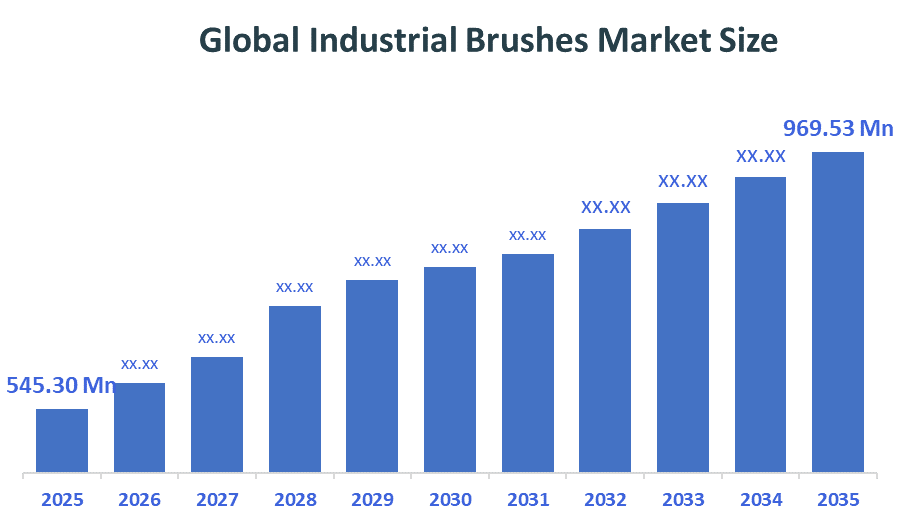
The Global Industrial Brushes Market size is projected to grow from approximately USD 545.30 million in 2025 to around USD 969.53 million by 2035. According to Decision Advisors, a detailed research report on the space battery market shows that power-driven and abrasive filament brushes dominate the market, holding around 55%-65% share due to rising demand for precision finishing in automated manufacturing. Companies like Tanis Brush are key market leaders. Based on available data, Tanis Brush's estimated annual revenue is approximately $8.4 million. making it one of the major market drivers for shaping the industry.
Market Snapshot
- Global Industrial Brushes Market Size (2025): USD 545.30 Million
- Global Industrial Brushes Projected Market Size (2035): USD 969.53 Million
- Global Industrial Brushes Compound Annual Growth Rate (CAGR): 5.92%
- Largest Regional Market: Asia-Pacific
- Fastest Growing Region: North America
- 3rd Largest Region: Europe
- Base Year: 2025
- Historical Period: 2021 - 2024
- Forecast Period: 2026 - 2035
Market Overview / Introduction
Industrial brushes serve as one of the most important arrays of manufacturing tool systems that enable efficient and immediate efficiency in the preparation of surfaces by removing contaminants, burrs, and oxides from large volumes of parts needed in automotive, aerospace, and construction services. They act as the vital link between raw material fabrication and final product finishing using rotary drive systems and adjustable filament density to achieve even texture without room for errors. The current systems employ innovative designs like the usage of ceramic-infused abrasive filaments and high-torque energy-efficient cores in order to offer reliable and consistent operations while eliminating the possibility of filament breakage when handling high-speed deburring operations. In their simplest form, industrial brushes are just mechanical sweepers that have now transformed into precision-engineered devices known for their excellent reliability ratings, heat-resistant capabilities, and easy integration into modern CNC and robotic arrangements.
- Industrial brushes are utilized extensively in manufacturing and metalworking operations, constituting about 60% of overall demand, bolstered by the growth of the international market for machine tools and metal finishing machinery.
- There is increased utilization of automated power brushes, with the entire industrial abrasive and brush industry growing at a steady pace due to increasing demands for consistency and labor reduction in high-volume production lines.
Notable Insights: -
- The industrial brushes market is closely linked to the expansion of the global automotive and aerospace sectors, contributing to steady market growth with valuations surpassing USD 650 million in 2025.
- Large-scale cylinder brushes are gaining higher adoption in industrial conveyor systems, supported by increasing food safety regulations and the rapid growth of automated material handling across urban logistics regions.
- Asia-Pacific contributes nearly 38% share in the broader industrial tool industry, making it a key growth region for industrial brushes due to rapid industrialization and the expansion of organized manufacturing sectors.
What is the Role of Technology in Shaping the Market?
Technological advancements are creating a revolution in the industrial brushes industry through enhanced performance through innovations such as improved filament retention, durable core structures, and heat-resistant polymers. The modern-day surface treatment systems are not merely passive consumables, but intelligent, high-density, and abrasive-loaded tools that can operate independently for extended periods, thanks to the incorporation of high-quality materials such as stainless-steel wire, state-of-the-art silicon carbide filaments, and integration with robotic arm technology.
How are Recent Developments Helping the Market?
These new inventions have greatly helped in driving growth in the market. Companies have come up with a modular brush system that is capable of handling different forms of surfaces, starting from fragile electronic components to heavy industrial steel plates. The machines have been designed in such a manner that they perform very well even when operated at times when there are high demands on them, without requiring much manual assistance. With the help of these new wear-resistant mechanical systems, the brushes will now be capable of maintaining constant pressure according to the resistance offered by the workpiece, thus preventing any chances of damage to both the tools and the parts.
Market Drivers
The worldwide industrial brushes industry is experiencing a period of growth with the rising expenditures of automotive manufacturers and infrastructure developers on sustainability in terms of production efficiency and building durable structures. Contemporary brushes are winning great popularity in the market because of the benefit of incorporating various features like quick-change cores, self-cleaning filament structures, and ergonomic compactness in one efficient and maintenance-free device. Meanwhile, the emerging trend of complex geometry in 3D-printed metal parts is driving the need for advanced deburring solutions that can help with shifting to high-capacity automated finishing.
Restraints
The growth of the global industrial brushes industry is hindered by the difficulties that arise in ensuring the longevity of the filaments in highly aggressive chemical environments because of consistent friction and extreme temperatures. The financial burden that comes with creating exclusive high-grade abrasive alloys and the precise manufacturing process becomes yet another obstacle to rapidly adopting the new technology within smaller independent workshops.
Competitive Analysis:
The report offers the appropriate analysis of the key organisations/companies involved within the global industrial brushes market, along with a comparative evaluation primarily based on their product offerings, business overviews, geographic presence, enterprise strategies, segment market share, and SWOT analysis. The report also provides an elaborate analysis focusing on the current news and developments of the companies, which includes product development, innovations, joint ventures, partnerships, mergers & acquisitions, strategic alliances, and others. This allows for the evaluation of the overall competition within the market.
Top 10 Companies in the Global Industrial Brushes Market
- Osborn
- Weiler Corporation
- Tanis Brush, Inc.
- KOTI Industrial Brushes
- Spiral Brushes Inc.
- Gordon Brush Mfg. Co., Inc.
- Jenkins Brush Company
- Associated Brushes Ltd.
- Mink Brushes
- Fuller Industries LLC
Government Initiatives
|
Country |
Key Government Initiatives |
|
India |
In July 2025, the Union Cabinet approved a total outlay of ?6,520 crore for the Pradhan Mantri Kisan SAMPADA Yojana (PMKSY) for the period ending in 2026. This includes a specific allocation of ?1,000 crore to support integrated cold chain and value addition infrastructure and ?920 crore for food safety and quality assurance. |
|
US |
The USDA continues to support the Food Supply Chain Guaranteed Loan Program, which provides up to $40 million in guaranteed loans per project to help food processors and manufacturers expand infrastructure and purchase advanced equipment. A program in Pennsylvania opened second-round applications for $10 million in grants to help food businesses adopt new technologies and improve production efficiency. |
|
UK |
As part of the Advanced Manufacturing Plan, the UK government confirmed a funding envelope of £4.5 billion to support strategic manufacturing sectors over five years starting in 2025. This includes the expansion of the Made Smarter Adoption programme in 2025-26, which provides small and medium-sized (SME) food manufacturers with access to digital technologies and automated equipment to boost productivity. |
Study on the Supply, Demand, Distribution, and Market Environment
The sustainability of the industrial brushes industry lies in the balance that exists between the capacity to function at peak mechanical efficiency and the emerging demands for continuous and intelligent surface management systems. Supply in the industrial brushes sector stems from the emphasis on developing high-tensile wire alloys and advanced synthetic abrasive filaments that can ensure rapid material removal and cleaning without experiencing the prolonged delays inherent in manual scrubbing operations. Demand factors arise from the shift towards manufacturing automation and the integration of digital wear sensors to monitor filament health and contact force, notifying the production supervisors about the tool's state of affairs in real-time.
Price Analysis and Consumer Behaviour Analysis
The price ranges for industrial brushes depend on the filament density, core material durability, and specialized features such as anti-static or heat-resistant properties. The equipment, featuring a ceramic-infused abrasive filament and integrated sensor mechanisms for robotic mounting, is costly. Standard wheel brushes and small hand-held scratch brushes suitable for local workshops cost less and offer perfect opportunities for localized supplemental cleaning and surface preparation services in industrial hubs. Consumers are inclined to select products that will last longer without filament shedding and provide ease of use and consistent abrasive action for a long time. Therefore, manufacturers are expected to focus on products that guarantee autonomous operation, equipment-friendly mounting, and exact placement of abrasive elements for a long time to come.
Market Segmentation
The Global Industrial Brushes Market share is classified into product type, material, application, and end user.
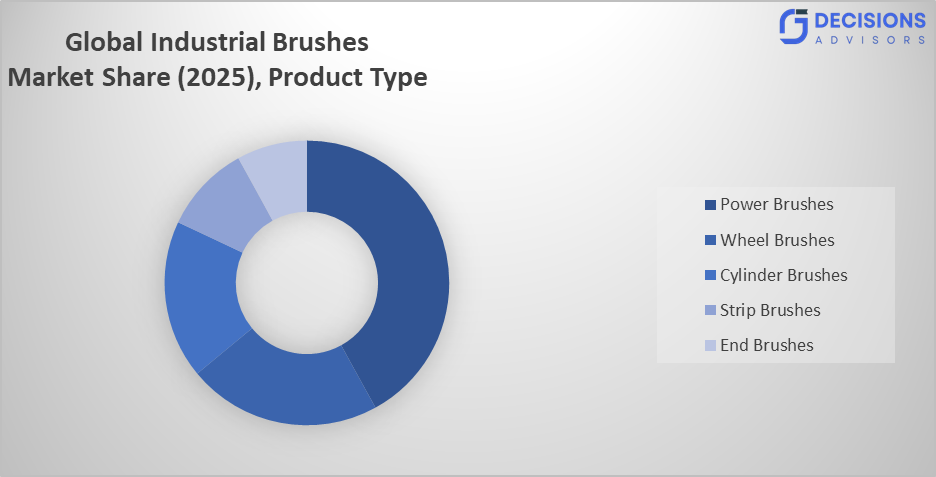
The Power Brushes segment holds the largest share, contributing approximately 42% of the market in 2025.
Based on the Product Type, the global industrial brushes market is divided into Wheel Brushes, Cylinder Brushes, Strip Brushes, End Brushes, and Power Brushes. Among these, the Power Brushes segment holds the largest share, contributing approximately 42% of the market in 2025. The reason behind their dominance lies in their greater versatility when integrated into automated machinery and robotic cells, as well as their ability to perform high-speed deburring and polishing functions automatically. The wheel and cylinder types form a significant portion of the rest of the market and are highly valued for their ability to handle wide-surface cleaning and heavy-duty conveyor maintenance with maximum torque.
The Wire Brushes segment holds the largest share, contributing approximately 45% of the market in 2025.
Based on the Material, the global industrial brushes market is divided into Wire Brushes, Synthetic Brushes, Natural Fiber, and Abrasive Filament. Among these, the Wire Brushes segment holds the largest share, contributing approximately 45% of the market in 2025. This dominance is due to the material's superior aggressive cleaning power and heat resistance, making steel and stainless-steel wires the primary choice for rust removal, weld cleaning, and heavy-duty metalworking. The Abrasive Filament category is seeing a sharp increase in use, particularly by precision manufacturers who value the self-sharpening nature of silicon carbide or ceramic-infused nylon for edge rounding and fine finishing.
The Surface Finishing segment accounts for the largest share, representing over 38% of the global market in 2025.
Based on the Application, the global industrial brushes market is divided into Surface Finishing, Cleaning, Deburring, Polishing, and Material Removal. Among these, the Surface Finishing segment accounts for the largest share, representing over 38% of the global market in 2025. These applications are critical for maintaining the structural integrity of machined parts, improving coating adhesion, and reducing production-wide friction losses through the adoption of modern, high-density abrasive brush equipment.
Manufacturing & Metalworking dominates the global market, accounting for approximately 52% of the total revenue in 2025.
Based on the End User, the global industrial brushes market is divided into Automotive, Manufacturing & Metalworking, Food & Beverage, Construction, and Aerospace. Among these, the Manufacturing & Metalworking segment dominates the global market, accounting for approximately 52% of the total revenue in 2025. This segment is preferred by operators who require large-scale integrated solutions and professional-grade durability for complex fabrication and assembly lines. The Automotive category is seeing a sharp increase in use, especially by electric vehicle manufacturers who require non-marking, static-dissipative brushes for sensitive electronic sub-assemblies and aluminium body panel preparation.
Strategies to Implement for Growth of the Market in Non-Leading Regions
The potential for growth within the industrial brushes industry in emerging regions could be increased through the deployment of efficient modular brush platforms for local industrial developers, as well as local agencies tasked with manufacturing infrastructure management. Programs aimed at achieving industrial quality resilience by governments, coupled with the expansion of high-precision engineering standards, contribute substantially toward demand within regions with traditional fabrication setups that pose significant challenges to the installation of massive permanent automated production lines on the ground. Further support through increasing investments in training local technical engineering technicians, as well as setting up regional maintenance facilities, will facilitate the adoption of sustainable surface treatment and smart finishing solutions.
Regional Segment Analysis of the Global Industrial Brushes Market
- North America (U.S., Canada, Mexico)
- Europe (Germany, France, U.K., Italy, Spain, Rest of Europe)
- Asia-Pacific (China, Japan, India, South Korea, Rest of APAC)
- Latin America (Brazil and the Rest of Latin America)
- The Middle East and Africa (UAE, South Africa, Rest of MEA)
Asia-Pacific is projected to be the fastest-growing region over the forecast period. This region is anticipated to witness a growth rate of around 8.5% CAGR, maintaining a dominant market share within the global industry. In 2025, the Asia-Pacific already account for approximately 36.5% of global revenue. This is owing to the fast-developing industrial manufacturing infrastructure, coupled with the growing demand for modern metalworking equipment in countries such as China, India, and Japan. Other reasons for the same include greater investments made toward sustainable industrial planning in the region, state-supported indigenous research and development projects for low-cost energy-efficient power brushes, and widespread adoption of abrasive-based finishing strategies.
North America is expected to hold a significant share of the industrial brushes market during the forecast period. This region holds approximately 28.2% share of global revenue in 2025, thanks to its highly sophisticated infrastructure related to automotive and aerospace manufacturing, along with the extensive adoption of automation-resilient technology in both national industrial goals and high-value equipment security applications. The largest part of this region’s revenues comes from the United States, as there is a lot of spending at the corporate level in efficiency assistance programs for automated tool adoption, along with local research related to sensor-integrated robotic deburring systems.
Europe is anticipated to hold a substantial share, contributing approximately 21.9% of the global market share. There is a competitive advantage in the region owing to clusters of precision engineering technology innovation, and financing for sustainable protection of the production environment, as well as surface treatment management research. There is also a comparative advantage with countries like Germany, the United Kingdom, and Italy, which are highly skilled at precision engineering for high-performance self-activating brush units. Moreover, the rigorous regulatory standards that they have regarding worker safety and industrial waste further give them a comparative advantage. The presence of big manufacturing firms, along with improved digital awareness systems, has also helped introduce advanced automated industrial brushes slowly but steadily.
Recent Developments
- In November 2025, Weiler Abrasives expanded its high-performance product lineup with a new colour-coded brush portfolio designed specifically for stainless steel applications. This innovation aims to prevent cross-contamination in industrial metalworking environments.
- In May 2025, Osborn LLC announced a major capital investment to transition its compound manufacturing operations to a new state-of-the-art facility in Richmond, Indiana. This move aims to modernise production with updated mixing and quality systems, reinforcing the company's long-term commitment to precision surface treatment and global supply chain resilience.
Market Segmentation
This study forecasts revenue at global, regional, and country levels from 2021 to 2035. The Global Cooling Management System Market is segmented based on the following categories:
Global Industrial Brushes Market, By Product Type
- Wheel Brushes
- Cylinder Brushes
- Strip Brushes
- End Brushes
- Power Brushes
Global Industrial Brushes Market, By Material
- Wire Brushes
- Synthetic Brushes
- Natural Fiber
- Abrasive Filament
Global Industrial Brushes Market, By Application
- Surface Finishing
- Cleaning
- Deburring
- Polishing
- Material Removal
Global Industrial Brushes Market, By End User
- Automotive
- Manufacturing & Metalworking
- Food & Beverage
- Construction
- Aerospace
Global Industrial Brushes Market, By Regional Analysis
North America
- United States
- Canada
- Mexico
Europe
- Germany
- United Kingdom
- France
- Italy
- Spain
- Russia
- Rest of Europe
Asia Pacific
- China
- Japan
- India
- South Korea
- Australia
- Rest of Asia Pacific
Latin America
- Brazil
- Argentina
- Rest of Latin America
Middle East & Africa
- United Arab Emirates
- Saudi Arabia
- Qatar
- South Africa
- Rest of Middle East & Africa
Frequently Asked Questions (FAQ)
What is an industrial brush, and why is it important?
An industrial brush is a specialised mechanical tool designed to regulate and finish the surfaces of industrial components. These systems are essential for maintaining production consistency, protecting expensive machinery from contaminants, and ensuring the structural integrity of metal parts through processes like deburring and cleaning.
What factors are driving the growth of the industrial brushes market?
The market growth can be attributed to the massive investments made in automated manufacturing infrastructure by industrial giants, the rising requirements for precision deburring in the automotive and aerospace sectors, and the widespread adoption of high-performance abrasive filaments.
Which product type dominates the industrial brushes market?
Power brushes represent the largest and most influential segment of the market due to their exceptional operational versatility, the capability to be integrated into robotic arms and CNC machinery, and their efficiency in handling high-speed industrial finishing tasks.
Which applications are widely used in this market?
Surface finishing and deburring are the most prominent applications due to the acute necessity to maintain smooth surface profiles for safety-critical components and provide reliable edge preparation for complex metal parts in modern manufacturing lines.
Check Licence
Choose the plan that fits you best: Single User, Multi-User, or Enterprise solutions tailored for your needs.
We Have You Covered
- 24/7 Analyst Support
- Clients Across the Globe
- Tailored Insights
- Technology Tracking
- Competitive Intelligence
- Custom Research
- Syndicated Market Studies
- Market Overview
- Market Segmentation
- Growth Drivers
- Market Opportunities
- Regulatory Insights
- Innovation & Sustainability
Report Details
| Scope | Global |
| Pages | 210 |
| Delivery | PDF & Excel via Email |
| Language | English |
| Release | May 2026 |
| Access | Download from this page |