
Global Industrial Dryers Market
 |
Author:
Pranali P
|
Pages:
210
|
Author:
Pranali P
|
Pages:
210
Global Industrial Dryers Market Size, Share, By Product Type (Direct Dryers, Indirect Dryers, Specialized Dryers) By Technology (Rotary, Fluidized Bed, Spray, Flash, Vacuum, Freeze, and Others) By Application (Food & Beverage, Pharmaceutical, Chemical, Fertilizer, Mining & Minerals, and Cement) and By Region (North America, Europe, Asia-Pacific, Latin America, Middle East and Africa), Analysis and Forecast 2026 - 2035
CAGR
3.72%
REVENUE 2025
USD Million 8230.2
FORECAST 2035
USD Million 11857.43
REPORT COVERAGE
Global
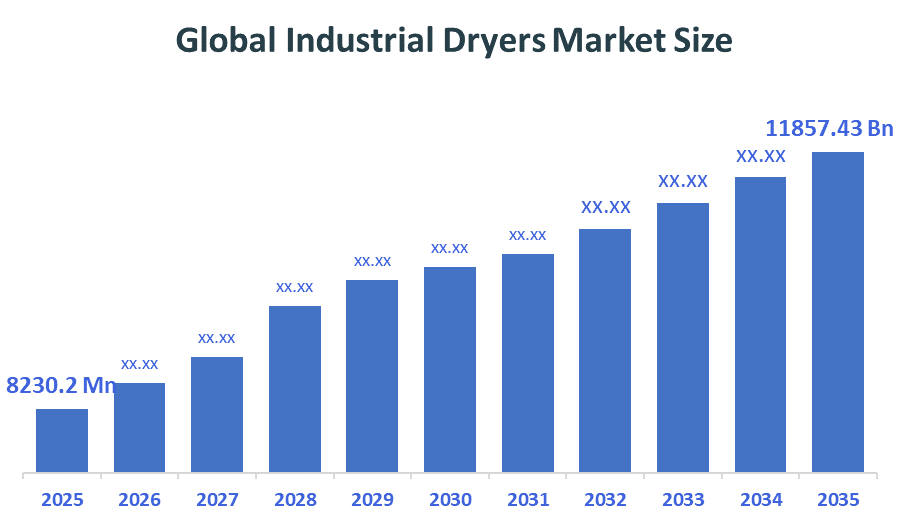
The Global Industrial Dryers Market Size was predicted to grow from USD 8230.2 million in 2025 and is projected to reach around USD 11857.43 million by 2035. According to Decision Advisors, a detailed research report on the industrial dryers market shows that the spray drying technology trend dominates the global market, holding approximately 30-35% of the total share worldwide. GEA Group leads the market with approximately USD 5.8 billion in annual revenue and a 12–18% global market share, making it one of the major market drivers for shaping the industry.
Market Snapshot
- Global Industrial Dryers Market Size (2025): USD 8230.2 Million
- Global Industrial Dryers Projected Market Size (2035): USD 11857.43 Million
- Global Industrial Dryers Compound Annual Growth Rate (CAGR): 3.72%
- Largest Regional Market: Asia-Pacific
- 2nd Largest Region: Europe
- 3rd Largest Region: North America
- Base Year: 2025
- Historical Period: 2021 to 2024
- Forecast Period: 2026 to 2035
Market Overview / Introduction
Industrial dryers are complex mechanical systems designed to reduce the moisture content of bulk solids, slurries, or solutions through the application of heat and mass transfer. These systems serve as a vital final phase in production lines, using convective or conductive heat transfer methods to ensure product stability and shelf-life. Modern industrial dryers possess features such as PLC automation and advanced airflow sensors to ensure consistent moisture levels while lowering the possibility of material overheating. Industrial drying equipment formerly relied on basic combustion but has been upgraded into fully integrated thermal systems with heat recovery technology and IoT connectivity. The increased adoption of industrial dryers is attributed to the rise in demand for processed foods and the expansion of the chemical manufacturing sector. Industrial dryers help protect bulk products against microbial growth and chemical instability due to their ability to achieve precise moisture targets without damaging the physical integrity of the material.
- The food and beverage and pharmaceutical segments contribute to approximately 48% of the application-based use in the market, driven by the increasing demand for powdered ingredients, long-term storage solutions, and the strict safety standards of the healthcare sector.
- Automated moisture control technology in the chemical sector is experiencing substantial growth, with a CAGR forecasted to surpass 5% on account of the increasing adoption of continuous drying systems as part of the advanced generation of specialty chemical production for providing optimized consistency to large-scale batches.
Notable Insights: -
- Spray drying modules make up about 32.4% of the total market share of this sector. They have gained a reputation in high-volume processing operations, particularly in dairy production, pharmaceutical powder formulation, and ceramic manufacturing units.
- About 68.2% of all installations occur in large-scale manufacturing plants and mineral processing facilities. These investments are stimulated mainly by high levels of investment into automated processing lines and sustainability initiatives because many industries experience moisture-related quality issues that result in the waste of valuable raw materials.
- Applications of industrial drying in the sphere of waste-to-energy and sludge management account for almost 15.6% of all demand. The rapid development of environmental regulations, alongside increased focus on biomass utilization, has become one of the main drivers of using these advanced systems.
- About 42.1% of the market value belongs to the Asia-Pacific region in 2026. Many countries within this region, like China and India, invest considerable amounts of money in food processing infrastructure and pharmaceutical hubs in order to address the growing needs of their expanding domestic markets.
- Fluidized bed dryers show an annual increase above 5.2%. The rise in granular material production and frequent occurrences of demand for uniform heat distribution create the conditions that encourage enterprises to invest more money in versatile drying solutions.
What is the Role of Technology in Shaping the Market?
Technological progress is making groundbreaking modifications within the thermal processing industry with respect to thermal efficiency, moisture precision, and automation of operations. The present generation of drying platforms has ceased to be simple heating chambers, but now they are complex atmospheric management platforms capable of self-operation for prolonged periods of time owing to their capacity to utilize heat pumps, ultrasonic assistance, and real-time moisture monitoring integration.
How are Recent Developments Helping the Market?
These innovations include the implementation of heat pump-integrated drying systems, the incorporation of advanced infrared heating elements, and closed-loop inert gas systems for volatile materials. These innovations have significantly aided in promoting development and growth within the market. Innovations have included the creation of modular drying systems that are capable of processing all manner of materials, which may range from delicate heat-sensitive enzymes to heavy mineral ores, all without fail. Using smart sensor-based mechanics, such innovations will enable autonomous management of drying cycles through utilization of the moisture feedback loops without any form of human error or over-drying occurring.
Market Drivers
Market demand for global industrial dryers is rising owing to the increased funding of manufacturing firms and industry bodies towards sustainable production and energy-efficient machinery that can satisfy environmental regulations in the present times. Modern drying systems have gained considerable popularity in the market on account of their benefits associated with incorporating several features, including exhaust heat recovery, intelligent material flow, and compact footprints in one robust solution. Conversely, the emergence of high-value specialty chemicals has led to an increased need for precision drying solutions that can help cater to the trend of moving away from batch processing to continuous, highly controlled drying environments.
Restraints
The growth of the international market for the industrial dryer industry is constrained by the difficulties in maintaining high thermal efficiency in older facilities because of the high initial capital expenditure required for upgrading to modern energy-saving equipment.
Competitive Analysis:
The report offers the appropriate analysis of the key organizations/companies involved within the industrial dryers market, along with a comparative evaluation primarily based on their product offerings, business overviews, geographic presence, enterprise strategies, segment market share, and SWOT analysis. The report also provides an elaborate analysis focusing on the current news and developments of the companies, which includes product development, innovations, joint ventures, partnerships, mergers & acquisitions, strategic alliances, and others. This allows for the evaluation of the overall competition within the market.
Top 10 Companies in the Global Industrial Dryers Market
- GEA Group AG
- Andritz AG
- Metso Outotec
- Buhler AG
- Thyssenkrupp AG
- Carrier Vibrating Equipment, Inc.
- Anhydro (SPX FLOW)
- Comessa
- Mitchell Dryers Ltd
- FLSmidth
Government Initiatives
|
Country |
Key Government Initiatives |
|
US |
In alignment with the Department of Energy's industrial decarbonization goals for 2026, the federal government has increased funding for high-efficiency thermal processes. This initiative supports the adoption of electric heat pump dryers to reduce the carbon footprint of the industrial sector. |
|
EU |
The Ecodesign for Sustainable Products Regulation (ESPR) 2024 has introduced stricter efficiency requirements for industrial machinery, pushing manufacturers to integrate heat recovery systems and smarter controls into industrial drying units. |
|
India |
Under the PM Formalisation of Micro food processing Enterprises (PMFME) scheme, the government provides financial and technical support for upgrading drying and dehydration technologies in the agricultural and food processing sectors. |
Study on the Supply, Demand, Distribution, and Market Environment
The success of the industrial dryer industry depends on finding the sweet spot between the ability to operate with maximum thermal reliability and the growing need for constant, smart-enabled energy management. The supply of industrial dryers comes from a focus on producing corrosion-resistant alloys and highly efficient heat exchangers capable of delivering consistent moisture removal without the excessive operational lag associated with legacy drying hardware.
Price Analysis and Consumer Behaviour Analysis
The pricing for industrial dryers varies depending on the drying capacity, technology type, and automation level. Higher-end products using freeze-drying (lyophilisation) technology and equipped with state-of-the-art AI-driven moisture sensors coupled with sterile-grade components are more expensive. However, rotary dryers and basic tray dryers for agricultural use are less costly and provide an ideal opportunity for localised bulk processing and primary moisture reduction. Consumers have clearly demonstrated a preference toward long-term cost-effectiveness and energy efficiency; hence, companies are expected to favour products that ensure operational autonomy, easy maintenance, and precise moisture positioning for long periods of time.
Market Segmentation
The Global Industrial Dryers Market share is classified into product type, technology, application, and region.
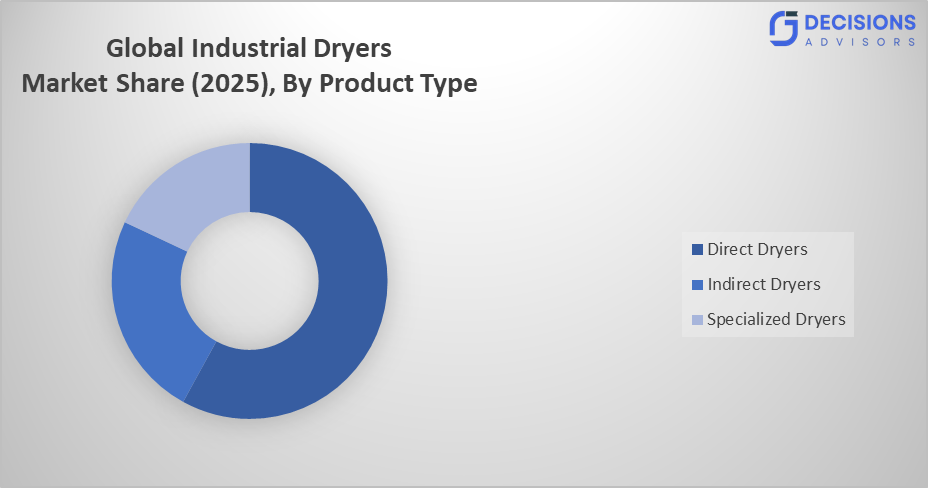
The Direct Dryers segment holds the largest share, contributing approximately 58% of the market in 2025.
Based on the Product Type, the global industrial dryers market is divided into Direct Dryers, Indirect Dryers, and Specialized Dryers. Among these, the Direct Dryers segment holds the largest share, contributing approximately 58% of the market in 2025. The reason behind their dominance lies in their high thermal efficiency and the simplicity of bringing hot drying gases into direct contact with the material, which ensures rapid moisture removal. Indirect and specialised dryers form a significant portion of the rest of the market and are highly valued for processing heat-sensitive or volatile materials where contamination must be strictly avoided.
The Spray Dryers segment holds the largest share, contributing approximately 32% of the market in 2025.
Based on the Technology, the global industrial dryers market is divided into Rotary, Fluidised Bed, Spray, Flash, Vacuum, Freeze, and Others. Among these, the Spray Dryers segment holds the largest share, contributing approximately 32% of the market in 2025. The reason behind their dominance lies in their unique ability to transform liquid feeds into uniform, free-flowing powders in a single continuous step, making them essential for high-volume dairy and pharmaceutical production. The rotary and fluidised bed types represent significant market shares and are valued for their reliability in handling heavy mineral ores and granular chemical products, respectively.
The Food & Beverage segment holds the largest share, contributing approximately 34% of the market in 2025.
Based on the Application, the global industrial dryers market is divided into Food & Beverage, Pharmaceutical, Chemical, Fertiliser, Mining & Minerals, and Cement. Among these, the Food & Beverage segment holds the largest share, contributing approximately 34% of the market in 2025. The reason behind their dominance lies in the global surge in demand for processed, shelf-stable goods and powdered ingredients that require precise moisture control to meet safety standards. The pharmaceutical and chemical segments also represent major shares, where drying technology is critical for maintaining the chemical stability and molecular integrity of high-value active ingredients.
Strategies to Implement for Growth of the Market in Non-Leading Regions
The potential for growth within the industrial dryer industry in emerging regions could be increased through the deployment of efficient modular drying platforms for local food processors, as well as local agencies tasked with agricultural value-addition. Programs aimed at reducing post-harvest losses by governments contribute substantially toward demand within regions where traditional drying methods result in high waste. Further support through increasing investments in training local technicians and setting up regional maintenance facilities will facilitate the adoption of sustainable drying and smart thermal response solutions.
Regional Segment Analysis of the Global Industrial Dryers Market
- North America (U.S., Canada, Mexico)
- Europe (Germany, France, U.K., Italy, Spain, Rest of Europe)
- Asia-Pacific (China, Japan, India, South Korea, Rest of APAC)
- Latin America (Brazil and the Rest of Latin America)
- The Middle East and Africa (UAE, South Africa, Rest of MEA)
Asia-Pacific is projected to be the fastest-growing region over the forecast period. This region is anticipated to witness a growth rate of around 5.8% CAGR, maintaining a dominant market share within the global industry. In 2025, the Asia-Pacific region will already account for approximately 42.1% of global revenue. This is owing to the fast-developing food processing infrastructure, coupled with the growing demand for modern pharmaceutical production in countries such as China and India.
The European market holds a prominent position as the 2nd Largest Region in the global industry. This standing is driven by a highly mature manufacturing ecosystem that prioritises precision engineering and strictly adheres to sustainability mandates. With the implementation of the EU Ecodesign directives in 2025, the region has seen a massive shift toward energy-efficient thermal processing equipment. Germany and Italy remain the primary contributors, focusing on high-specification drying systems for the pharmaceutical and speciality chemical sectors, where maintaining material integrity is a top priority
North America, ranking as the 3rd Largest Region, remains a critical hub for technological innovation and high-value industrial applications. The market is propelled by a robust food processing base and a rapidly expanding pharmaceutical sector in the United States and Canada. Growth in this region is defined by the integration of smart, IoT-enabled monitoring systems that optimise drying cycles and reduce operational downtime. Regulatory oversight from the FDA and EPA ensures a steady demand for validated, high-performance drying hardware that meets rigorous safety and energy standards.
Recent Developments
- In April 2023, SPX FLOW announced a major expansion of its Anhydro spray drying solutions specifically tailored for the electric vehicle (EV) market. This innovation focuses on the precise drying of cathode active materials to remove solvents and form dry powders, supporting the global surge in lithium-ion battery production.
- In November 2022, GEA Group launched the G-Series Spray Dryer line, featuring advanced integrated heat recovery systems. This development was part of their "Mission 26" strategy to enhance sustainability, offering manufacturers a way to repurpose waste heat and reduce the total carbon footprint of large-scale powder production in the food and chemical sectors.
- In May 2022, Metso Outotec introduced the Circored fluidised-bed technology at an industrial scale for hydrogen-based ironmaking. This collaboration with steel manufacturers allows for the direct reduction of iron ore fines without the need for pelletizing, significantly lowering energy consumption and CO2 emissions in heavy industrial drying and processing applications.
Market Segmentation
This study forecasts revenue at global, regional, and country levels from 2021 to 2035. The Global Industrial Dryers Market is segmented based on the following categories:
Global Industrial Dryers Market, By Product Type
- Direct Dryers
- Indirect Dryers
- Specialized Dryers
Global Industrial Dryers Market, By Technology
- Rotary
- Fluidized Bed
- Spray
- Flash
- Vacuum
- Freeze
Global Industrial Dryers Market, By Application
- Food & Beverage
- Pharmaceutical
- Chemical
- Fertilizer
- Mining & Minerals
Global Industrial Dryers Market, By Regional Analysis
North America
- United States
- Canada
- Mexico
Europe
- Germany
- United Kingdom
- France
- Italy
- Spain
- Russia
- Rest of Europe
Asia Pacific
- China
- Japan
- India
- South Korea
- Australia
- Rest of Asia Pacific
Latin America
- Brazil
- Argentina
- Rest of Latin America
Middle East & Africa
- United Arab Emirates
- Saudi Arabia
- Qatar
- South Africa
- Rest of Middle East & Africa
Frequently Asked Questions (FAQ)
How do heat transfer mechanisms distinguish between direct and indirect drying systems?
Direct dryers utilize convective heat transfer, where hot gases or air come into immediate contact with the material to vaporize moisture. In contrast, indirect dryers rely on conduction through a heat-conducting wall, such as a jacketed vessel or heated tube, ensuring the heating medium never touches the product. This distinction is critical for industries handling volatile or heat-sensitive materials where preventing contamination or oxidation is a primary operational requirement.
What specific challenges are accelerating the adoption of vacuum and freeze-drying technologies? The rise of biologics, heat-sensitive active pharmaceutical ingredients (APIs), and high-value nutraceuticals has created a need for moisture removal at lower temperatures to preserve molecular integrity. Vacuum dryers address this by lowering the atmospheric pressure to reduce the boiling point of solvents, while freeze-dryers (lyophilization) skip the liquid phase entirely through sublimation. These technologies are essential for maintaining the bio-efficacy and structural stability of products that would otherwise degrade under the intense heat of conventional rotary or flash drying.
In what way is the integration of IoT and AI-driven moisture sensors reshaping market competitiveness?
The shift toward "Smart Drying" allows manufacturers to move from periodic batch testing to continuous, real-time feedback systems. AI-integrated sensors monitor variables such as humidity, airflow, and exhaust temperature to automatically adjust energy input, preventing "over-drying" which can lead to product waste and excessive utility costs. Companies adopting these automated solutions gain a significant competitive edge by reducing energy consumption by up to 15–20% and ensuring total batch-to-batch consistency.
How do global sustainability targets influence the selection of industrial drying equipment?
With industrial drying accounting for nearly 12–15% of total energy usage in sectors like food and textiles, there is an aggressive move toward decarbonization. This has led to the prioritization of heat pump dryers and solar-assisted systems that significantly lower carbon emissions compared to traditional fossil-fuel-fired burners. Regulatory frameworks, such as the EU’s Energy Efficiency Directive, are essentially mandating that new installations include heat recovery loops and high-thermal-conductivity materials to meet 2030 climate goals.
Check Licence
Choose the plan that fits you best: Single User, Multi-User, or Enterprise solutions tailored for your needs.
We Have You Covered
- 24/7 Analyst Support
- Clients Across the Globe
- Tailored Insights
- Technology Tracking
- Competitive Intelligence
- Custom Research
- Syndicated Market Studies
- Market Overview
- Market Segmentation
- Growth Drivers
- Market Opportunities
- Regulatory Insights
- Innovation & Sustainability
Report Details
| Scope | Global |
| Pages | 210 |
| Delivery | PDF & Excel via Email |
| Language | English |
| Release | May 2026 |
| Access | Download from this page |