
Global Industrial Laser Systems Market
 |
Author:
Achal E
|
Pages:
210
|
Author:
Achal E
|
Pages:
210
Global Industrial Laser Systems Market Size, Share, By laser Type (Fiber Lasers, CO? Lasers, Solid-State Lasers, Diode Lasers, Ultrafast Lasers, Excimer Lasers, Others), By power Range(Low Power (<1 kW), Medium Power (1?6 kW), High Power (>6 kW)), By System Configuration (Standalone Laser Machines, Robotic Laser Processing Systems, Integrated Production Line Systems), and By Region (North America, Europe, Asia-Pacific, Latin America, Middle East, and Africa), Analysis and Forecast 2025 ? 2035.
CAGR
5.2%
REVENUE 2025
USD Billion 6.81
FORECAST 2035
USD Billion 11.89
REPORT COVERAGE
Global
Market Snapshot
- Market Size (2025): USD 6.81 Billion
- Projected Market Size (2035): USD 11.89 Billion
- Compound Annual Growth Rate (CAGR): 5.2%
- Largest Regional Market: Asia-Pacific
- Fastest Growing Region: Europe
- 3rd Largest Region: North America
- Base Year: 2025
- Historical Period: 2021–2024
- Forecast Period: 2026–2035
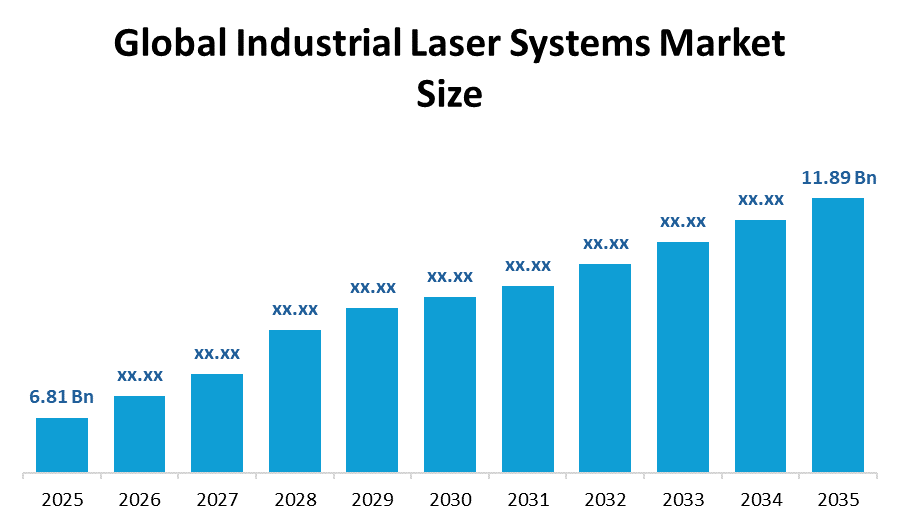
According to Decision Advisors, the Global Industrial Laser Systems Market Size is expected to grow from USD 6.81 billion in 2025 to USD 11.89 billion by 2035, at a CAGR of 5.2% during the forecast period 2025-2035. The global industrial laser systems market experiences growth because of industries adopts precision production methods and digital manufacturing systems. The demand for high-performance laser-based industrial solutions is growing because of three factors which include the increasing use of fiber lasers and the development of electric vehicle and advanced engineering industries and the rising implementation of robotic manufacturing systems.
Market Overview/ Introduction
The industrial laser systems exist as precision-controlled systems which produce focused light beams that enable precise cutting, welding, and marking, and micromachining work across various industrial applications.The global Industrial Laser Systems Market experiences future growth through three technology trends which include additive manufacturing and electronics miniaturisation and EV production, as customers demand complex lightweight traceable parts that drive the need for advanced laser systems in future industrial applications. The industrial laser systems function as sophisticated digital systems which use focused light for executing exact manufacturing tasks. The global industrial laser systems market will create new business prospects through three technological advancements namely AI-enabled process optimisation and smart factory integration and high-power fiber innovations. The applications of laser technologies in electric vehicles and semiconductor production and renewable energy systems combined with their role in sustainable manufacturing and adoption by emerging markets position these technologies as essential drivers of industrial transformation in the future.
- In India, SRIJAN portal, listing over 19,000-46,000 defence items for indigenisation, is accelerating domestic manufacturing. This is indirectly boosting demand in the global Industrial Laser Systems Market, valued at approximately USD 22.3 billion, driven by precision fabrication needs.
- In China, smart manufacturing push under Made in China 2025 and over $230 billion EV support are driving large-scale automation, positioning it as the largest demand hub in the global industrial laser systems market, valued at approximately USD 22.3 billion.
Notable Insights: -
- Asia-Pacific holds the largest regional market share, approximately 46.7% in the global Industrial Laser Systems Market.
- Europe is the fastest growing region in the global industrial laser systems market, because of the adoption of automation together with the growth of electric vehicle production and the rising funding for state-of-the-art manufacturing technologies across Germany and France drive this development.
- By Laser type, the Fiber Lasers segment held a dominant position with 42.8% in terms of market share in 2025.
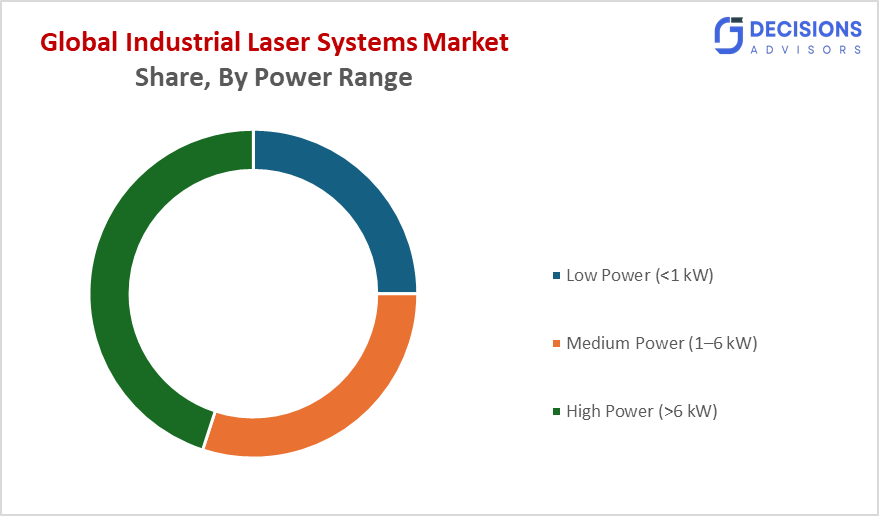
- By Power Range, High Power (>6 kW) segment is the dominating accounting for over 37.9% of the global market share in 2025.
- The compound annual growth rate of the global Industrial Laser Systems Market is 5.2%.
- The market is likely to achieve a valuation of USD 11.89 Billion by 2035.
What is role of technology in grooming the market?
The Global Industrial Laser Systems Market experiences transformation through technological advancements which provide precise automated systems and enhanced efficiency to various industrial sectors. The usage of fiber laser technology together with artificial intelligence process control and smart manufacturing systems creates better accuracy while minimizing waste and production halts. The implementation of ultrafast and high-power laser systems enables advanced functions for electric vehicle batteries and semiconductor devices and aerospace applications. The State Council of China reports that Made in China 2025 accelerates the adoption of smart manufacturing and high-end equipment which creates increased demand for advanced laser systems in large-scale automated production facilities.
How is Recent Developments Helping the Market?
Recent developments are significantly accelerating the global Industrial Laser Systems Market by enhancing precision, scalability, and automation across industries.The combination of fiber laser technology and ultrafast laser technology creates new possibilities for electric vehicle and semiconductor and aerospace applications while Industry 4.0 implementation boosts operational efficiency and decreases equipment downtime. The market which currently operates at a value of approximately USD 22.9 billion receives additional support from Europe's Made in Europe Partnership which brings together more than €1 billion of public and private funding to advance smart manufacturing and digital transformation and high-precision industrial technologies thereby increasing the need for advanced laser systems.
Market Drivers
The global Industrial Laser Systems Market is experiencing growth because of manufacturing systems need better operational flexibility and exact production capabilities. The industries are choosing advanced fabrication technologies which provide better design options and higher precision limits and increased production speed. The fiber laser innovation is producing better results because its performance and operational dependability are bettering which leads to its increased use in industrial settings. The implementation of digital factory systems is establishing laser technologies as essential components of smart manufacturing networks which increase production efficiency and product quality. The Japan's Society 5.0 program promotes AI IoT and robotics integration into manufacturing processes which create intelligent data-based production systems that drive demand for advanced laser technologies.
Restrain
The global Industrial Laser Systems Market experiences structural limitations which prevent it from meeting its increasing demand requirements. Small and medium enterprises face an essential obstacle because they lack sufficient funds to cover both high initial investment costs and necessary system integration expenses. The total operational expenses of the system increase because the system requires expensive maintenance for its optics and diodes. The technology restricts its ability to function across multiple substrates because it cannot handle various materials and faces issues with material distortion. The effective implementation process faces obstacles because there is a lack of qualified workers who can operate advanced laser systems. The European Union established its European Skills Agenda with funding of €580 million to create workforce solutions which will help companies implement advanced manufacturing technologies.
Competitive Analysis:
The report offers the appropriate analysis of the key organizations/companies involved within the industrial laser systems market, along with a comparative evaluation primarily based on their product of offering, business overviews, geographic presence, enterprise strategies, segment market share, and SWOT analysis. The report also provides an elaborative analysis focusing on the current news and developments of the companies, which includes product development, innovations, joint ventures, partnerships, mergers & acquisitions, strategic alliances, and others. This allows for the evaluation of the overall competition within the market.
Top Companies in Global Industrial Laser Systems Market
- TRUMPF Group
- IPG Photonics Corporation
- Coherent Corp.
- Han's Laser Technology Industry Group Co., Ltd.
- Jenoptik AG
- Lumentum Holdings Inc.
- Bystronic AG
- Mitsubishi Electric Corporation
- Laserline GmbH
- Lumibird Group
Government Initiatives
|
Country |
Key Government Initiatives |
|
US |
The U.S. CHIPS and Science Act, allocating over USD 52 billion for semiconductor manufacturing and R&D, is accelerating advanced fabrication capacity, thereby driving demand in the global Industrial Laser Systems Market through increased precision manufacturing requirements. |
|
China |
The China’s Made in China 2025, backed by hundreds of billions in state funding and incentives, is accelerating smart manufacturing and high-tech production, driving demand in the global Industrial Laser Systems Market, valued at approximately USD 22.3 billion. |
|
South Korea |
In South Korea’s smart factory initiative, targeting 30,000 digitally integrated units and backed by over USD 1.7 billion in support, is accelerating automation and precision manufacturing, boosting demand in the global Industrial Laser Systems Market. |
Market Segmentation
The Industrial Laser Systems Market share is classified into laser type, power range, and system configuration.
- The fiber lasers segment dominated the market in 2025 and is projected to grow at a substantial CAGR of approximately 9.2% during the forecast period.
Based on the laser type, the industrial laser systems market is divided into fiber lasers, CO? lasers, solid-state lasers, diode lasers, ultrafast lasers, excimer lasers, others. Among these, the fiber lasers segment dominated the market in 2025 and is projected to grow at a substantial CAGR of approximately 9.2% during the forecast period. It is because of its superior efficiency and precision and cost-effective solutions. The automotive industry and electronics sector and advanced manufacturing sector all prefer the technology which demonstrates a wider industry trend toward high-performance laser systems that require minimal support automated production processes.
- The high power (>6 kW) segment accounted for the largest share in 2025 and is anticipated to grow at a significant CAGR of approximately 8.1% during the forecast period.
Based on the power range, the industrial laser systems market is divided into low power (<1 kW), medium power (1–6 kW), high power (>6 kW). Among these, the high power (>6 kW) segment accounted for the largest share in 2025 and is anticipated to grow at a significant CAGR of approximately 8.1% during the forecast period. It is dominating because of the essential for automotive and aerospace and shipbuilding operations. These industries require faster cutting and deep welding and large-scale fabrication capabilities.
- The standalone laser machines segment dominated the market in 2025, and is projected to grow at a substantial CAGR during the forecast period.
Based on the system configuration, the industrial laser systems market is divided into standalone laser machines, robotic laser processing systems, integrated production line systems. Among these, the standalone laser machines segment dominated the market in 2025 and is projected to grow at a substantial CAGR during the forecast period. The cost efficiency and operational flexibility and its ability to be deployed in various industrial environments. The systems are most commonly used by small and mid-sized manufacturers because they need less capital investment and require simpler systems integration. The technology achieves wide industrial use because it can be used for cutting and welding and marking applications in automotive and electronics and metal fabrication industries.
Strategies to Implement for Growth of the Market in Non-Leading Regions
The Industrial Laser Systems Market expands into non-leading regions through a combination of policy support and localization and capability building according to calibrated requirements. The government provides tax benefits and capital subsidies and import duty rationalization to create financial incentives for organizations that want to adopt advanced equipment. The establishment of regional manufacturing hubs and service centers will decrease operational expenses while making services easier to reach. Industry players should focus on developing budget-friendly modular laser solutions which meet the needs of small and medium-sized enterprises while establishing distribution partnerships with local companies. The country needs to invest in workforce training and technical institutes because these institutions play a vital role in developing required skills. The integration of laser systems with digital manufacturing ecosystems will drive adoption because it helps regions advance to high-precision production methods that use advanced technology.
Regional Segment Analysis of the industrial laser systems market
- North America (U.S., Canada, Mexico)
- Europe (Germany, France, U.K., Italy, Spain, Rest of Europe)
- Asia-Pacific (China, Japan, India, Rest of APAC)
- South America (Brazil and the Rest of South America)
- The Middle East and Africa (UAE, South Africa, Rest of MEA)
Asia-Pacific is anticipated to hold the largest share of the Industrial Laser Systems Market over the predicted timeframe. Asia-Pacific is anticipated to hold the largest share of the industrial laser systems market, accounting for approximately 47.7% of total revenue over the forecast period. It is because of the strong manufacturing base of South Korea develops its automated systems at a quick pace while maintaining strong manufacturing capabilities across its entire territory. The Japan establishes its Society 5.0 system through public and private research and development efforts that aim to spend ¥120 trillion on advancing smart factory technology which creates a need for high-precision laser systems.
Europe is expected to grow at a rapid CAGR in the Industrial Laser Systems Market during the forecast period. The Europe market will experience fast growth because it accounts for approximately 6.7% of it is due to the growing automation requirements. The EU's Made in Europe Partnership which receives more than €1 billion in combined public and private funding, promotes the development of smart manufacturing and digital technologies and advanced production methods throughout the European Union.
North America is the 3rd largest region to grow in the Industrial Laser Systems Market during the region. The North America region stands as the third biggest area global for the Industrial Laser Systems Market since it holds approximately 22.8% the organization displays ongoing growth because the CHIPS and Science Act provide more than $52 billion to support semiconductor production and advanced manufacturing capabilities.
Future Market Trends in Industrial Laser Systems Market: -
- Rise of High-Power Laser Applications
The Industrial demand is steadily shifting toward high-power laser systems which can process both thick materials and large industrial projects. Heavy industries such as shipbuilding, aerospace, and infrastructure have begun using these systems to improve their operational efficiency through faster production processes which deliver precise results at high capacity.
- Growth in Semiconductor and Electronics Fabrication
The rising need for ultrafast and micro-processing laser systems results from increased investment in semiconductor fabrication plants and miniaturized electronic equipment. The technologies enable advanced patterning and precise material processing which meets the rising demands of complex chip designs and electronic device development in the expanding digital economy.
- Advancements in Ultrafast Laser Technology
The ongoing development of ultrafast laser technology enables researchers to perform micro and nano scale processing work while producing only minimal heat effects. The new technological advancements enable fresh applications to emerge across the fields of electronics and photonics and advanced materials research which establishes laser systems as essential tools for developing modern industrial breakthroughs.
Recent Development
- In January 2024, Germany-based TRUMPF leads the global Industrial Laser Systems Market with an estimated 5.81% share, supported by its strong technological capabilities and global footprint in advanced laser manufacturing and precision engineering solutions.
- In March 2024, IPG Photonics reaffirmed its position as a global leader in fiber laser technology, strengthening its role in the global Industrial Laser Systems Market through advanced, high-efficiency solutions for precision manufacturing applications.
- In February 2024, Coherent Corp. strengthened its position in the global Industrial Laser Systems Market, supported by significant investments, including over $1 billion in capital expansion and additional funding toward manufacturing and R&D capabilities.
Market Segment
This study forecasts revenue at global, regional, and country levels from 2020 to 2035. Decision Advisors has segmented the industrial laser systems market based on the above-mentioned segments:
Global Industrial Laser Systems Market, By Laser Type
- Fiber Lasers
- CO? Lasers
- Solid-State Lasers
- Diode Lasers
- Ultrafast Lasers
- Excimer Lasers
- Others
Global Industrial Laser Systems Market, By Power Range
- Low Power (<1 kW)
- Medium Power (1–6 kW)
- High Power (>6 kW)
Global Industrial Laser Systems Market, By System Configuration
- Standalone Laser Machines
- Robotic Laser Processing Systems
- Integrated Production Line Systems
Global Industrial Laser Systems Market, By Regional Analysis
- North America
- US
- Canada
- Mexico
- Europe
- Germany
- UK
- France
- Italy
- Spain
- Russia
- Rest of Europe
- Asia Pacific
- China
- Japan
- India
- South Korea
- Australia
- Rest of Asia Pacific
- South America
- Brazil
- Argentina
- Rest of South America
- Middle East & Africa
- UAE
- Saudi Arabia
- Qatar
- South Africa
- Rest of the Middle East & Africa
Frequently Asked Questions (FAQ)
Q. What is the future outlook for the global industrial laser systems market?
A. The global Industrial Laser Systems Market will maintain its positive outlook because laser technology advancements and increased industrial usage of lasers will continue to progress. The industrial growth of precision manufacturing will be driven by the rising importance of automation and sustainable practices. Laser systems will enable industries to achieve higher productivity and operational efficiency when they implement smart manufacturing and digital transformation initiatives.
Q. What challenges are impacting the industrial laser systems market?
A. The market encounters obstacles because it requires expensive initial investments together with skilled workers who can operate its advanced technological systems. The expenses of maintaining systems together with the difficulties of integrating them into existing operations create barriers that prevent small and medium enterprises from adopting those systems. The processing quality needs advanced solutions together with specialized knowledge to overcome material restrictions and thermal distortion problems which hinder consistent performance across different applications.
Q. Why are fiber lasers gaining strong traction in the market?
A. Fiber lasers receive strong market acceptance because they provide better energy efficiency and extended operational lifespan and require less maintenance than other systems. The system enables better beam quality and operational flexibility for multiple applications including cutting and welding and marking. Manufacturers find the equipment appealing because it delivers economic benefits while supporting nonstop industrial operations which help them achieve higher productivity at lower production costs in competitive manufacturing settings.
Q. How is Industry 4.0 influencing laser system adoption?
A. Digital technologies which include artificial intelligence and Internet of Things and real-time analytics systems now drive production processes of manufacturing through their implementation in Industry 4.0. The implementation of intelligent automated environments enables laser systems to function more efficiently while their operational time increases. Laser technologies serve as essential elements for future data-driven manufacturing systems because their predictive maintenance and process optimization functions improve system efficiency.
Check Licence
Choose the plan that fits you best: Single User, Multi-User, or Enterprise solutions tailored for your needs.
We Have You Covered
- 24/7 Analyst Support
- Clients Across the Globe
- Tailored Insights
- Technology Tracking
- Competitive Intelligence
- Custom Research
- Syndicated Market Studies
- Market Overview
- Market Segmentation
- Growth Drivers
- Market Opportunities
- Regulatory Insights
- Innovation & Sustainability
Report Details
| Scope | Global |
| Pages | 210 |
| Delivery | PDF & Excel via Email |
| Language | English |
| Release | Apr 2026 |
| Access | Download from this page |