
Global Industrial Refrigeration Systems Market
 |
Author:
Achal E
|
Pages:
210
|
Author:
Achal E
|
Pages:
210
Global Industrial Refrigeration Systems Market Size, Share, By Component Type (Compressors, Condensers, Evaporators, Controls), By Refrigerant Type (Ammonia (NH3), Carbon Dioxide (CO2), Hydrofluorocarbons (HFCs), Others), By Application (Food & Beverage Processing, Chemicals, Pharmaceuticals, Cold Storage & Logistics, Petrochemical, Others), and By Region (North America, Europe, Asia-Pacific, Latin America, Middle East, and Africa), Analysis and Forecast 2026-2035
CAGR
7.48%
REVENUE 2025
USD Billion 24.7
FORECAST 2035
USD Billion 50.8
REPORT COVERAGE
Global
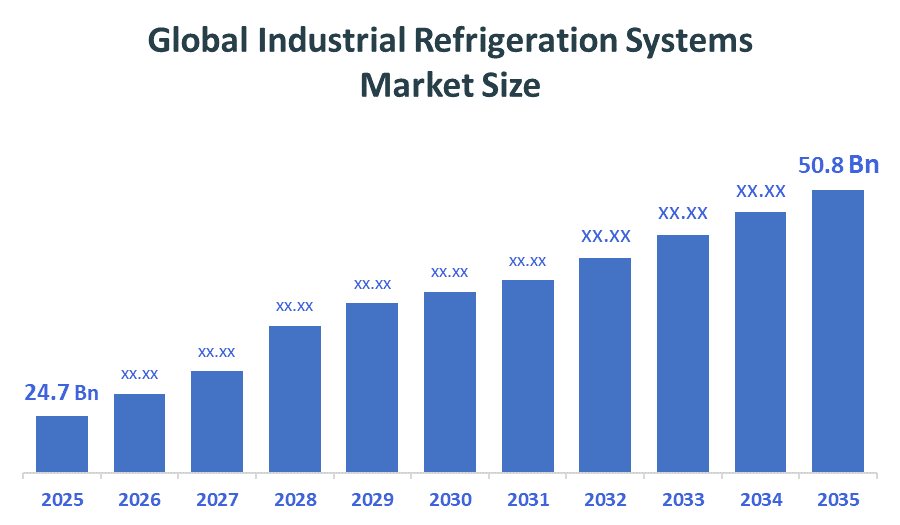
The Global Industrial Refrigeration Systems Market Size is Expected to grow from USD 24.7 billion in 2025 and is expected to reach around USD 50.8 billion by 2035. According to Decision Advisors, a strategic market study indicates that the natural refrigerants segment maintains dominance, holding close to 41-42% of the worldwide industrial refrigeration systems market. Danfoss commands a strong global position, generating USD 10-11 billion in turnover while holding around 20-28% share across worldwide markets, affecting international industry direction and competitive frameworks.
Market Snapshot
- Global Industrial Refrigeration Systems Market Size (2025): USD 24.7 billion
- Projected Global Industrial Refrigeration Systems Market Size (2035): USD 50.8 billion
- Global Industrial Refrigeration Systems Market Compound Annual Growth Rate (CAGR): 7.48%
- Largest Regional Market: Asia-Pacific
- Fastest Growing Region: North America
- 3rd Largest Region: Europe
- Base Year: 2025
- Historical Period: 2021-2024
- Forecast Period: 2026-2035
Market Overview/ Introduction
The global industrial refrigeration systems market includes advanced cooling systems which enable industrial operations to sustain specific temperature requirements. The systems use compressors and refrigerants together with heat exchangers to achieve effective temperature management throughout their operational areas. The applications require precise temperature control because they handle food and beverage processing and cold storage logistics, pharmaceutical chemical, petrochemical operations which need to maintain product quality, safety and meet regulatory standards. The market is evolving through technological innovations which include energy-efficient compressors and natural refrigerants that use ammonia and CO2 and smart monitoring systems that use IoT technology for real-time performance optimization. These organizations use advanced automation together with predictive maintenance tools to achieve better operational reliability while decreasing their total energy expenses. The expanding global cold-chain infrastructure together with rising processed food demand and environmental regulations that require low-GWP refrigerants create future business opportunities. The adoption of sustainable cooling solutions together with modular refrigeration systems and AI-driven energy management will enhance system performance and extend equipment performance and enable organizations to achieve their decarbonization objectives worldwide.
- In United States, AIM Act implementation accelerated the global industrial refrigeration systems market, driving USD 2.3 billion investments toward HFC phase-down compliance, boosting adoption of natural refrigerants and energy-efficient industrial cooling infrastructure.
- In Canada, initiatives like Refrigerant Management Canada supported the global industrial refrigeration systems market, driving USD 1.9 billion investments in sustainable refrigerant disposal, accelerating adoption of low-emission cooling systems and regulatory compliance across industrial sectors.
- In Europe, the European Union refrigerant regulations accelerated the global industrial refrigeration systems market, driving USD 2.0 billion investments in recycling and recovery infrastructure, boosting adoption of sustainable, low-emission industrial cooling technologies across Europe.
- In India, PMKSY cold chain scheme accelerated the global industrial refrigeration systems market, driving USD 2.2 billion investments in storage and logistics infrastructure, boosting demand for energy-efficient industrial refrigeration solutions across food processing sectors.
Notable Insights: -
- Asia-Pacific holds the largest regional market share, approximately 42.7% in the global industrial refrigeration systems market.
- North America is the fastest growing region in the industrial refrigeration systems market supported by the United States and Canada experience an increasing need for cold-chain logistics, which expands due to multiple factors, including food safety regulations, pharmaceutical storage requirements, and the fast adoption of energy-efficient refrigeration systems.
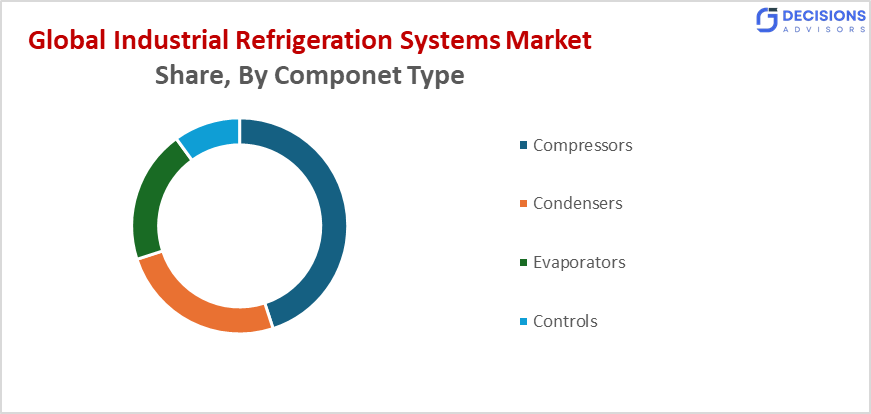
- By component type, the compressors segment held a dominant position with 38.2% in terms of market share in 2025.
- By refrigerant type, Ammonia (NH3) segment is the dominating accounting for over 47.5% of the global market share in 2025.
- The compound annual growth rate of the global industrial refrigeration systems market is 7.48%.
- The market is likely to achieve a valuation of USD 50.8 billion by 2035.
What is role of technology in grooming the market?
The global Industrial Refrigeration Systems Market experiences fundamental transformation through technological innovation which delivers improved efficiency together with better reliability and operational control capabilities. The combination of compressor design advancements together with natural refrigerant implementation which includes ammonia and CO2 results in greater energy efficiency and decreased environmental effects. The system enables real-time performance optimization through its IoT-based monitoring and remote diagnostics capabilities while its predictive maintenance systems reduce system downtime. Industrial settings use smart control systems together with automation to achieve precise temperature control and quick system reactions. The use of modular refrigeration units together with AI-based energy management systems enables organizations to achieve better scalability while reducing their energy expenses and maintaining environmentally friendly high-efficiency cooling systems worldwide.
How is Recent Developments Helping the Market?
The global industrial refrigeration systems market is experiencing rapid growth because of recent technological breakthroughs which improve energy efficiency and create sustainable cooling methods. The use of natural refrigerants such as ammonia and CO2 improves environmental compliance while businesses save money on their operating expenses. Danfoss and Johnson Controls have developed intelligent refrigeration systems which use Internet of Things technology to monitor their operations and perform predictive maintenance. The demand for products has increased because of government regulations which support low-GWP refrigerants and because investments have been made in developing cold-chain infrastructure. The combination of supply chain optimization and localized manufacturing practices enables businesses to expand their operations in food processing, pharmaceuticals, and logistics throughout the world.
Market Drivers
The global industrial refrigeration systems market is influenced by the factors which include technological advancement, regulatory pressure, increasing demand from end users. The cold-chain logistics and food processing industries experience rapid growth which creates a demand for effective cooling solutions that can operate at industrial capacity. The pharmaceutical industry needs more temperature-controlled environments because of the increasing production of drugs and the rising demand for vaccine storage. The system performance improves and operational costs decrease through the use of energy-efficient compressors and natural refrigerants and IoT-enabled monitoring systems. Strict environmental regulations establish requirements for low-global-warming-potential refrigerants which accelerate the industry shift toward sustainable refrigeration technologies. The market expansion in emerging economies occurs because industrialization and infrastructure development accelerate while investments in advanced cold storage and logistics systems progress.
Restrain
The global industrial refrigeration systems market faces significant market restrictions because it requires expensive capital investment and complicated operational processes. The requirement for substantial initial funding to purchase compressors, refrigerants, and complete installation work prevents small businesses from adopting the technology. The costs of essential materials including steel and refrigerants experience unpredictable price changes which cause problems with maintaining price stability. Environmental rules that require system improvements need businesses to spend extra money for compliance requirements.
Competitive Analysis:
The report offers the appropriate analysis of the key organizations/companies involved within the global industrial refrigeration systems market, along with a comparative evaluation primarily based on their product offering, business overviews, geographic presence, enterprise strategies, segment market share, and SWOT analysis. The report also provides an elaborative analysis focusing on the current news and developments of the companies, which includes product development, innovations, joint ventures, partnerships, mergers & acquisitions, strategic alliances, and others. This allows for the evaluation of the overall competition within the market.
Top Companies in Global Industrial Refrigeration Systems Market
- Johnson Controls
- Danfoss
- GEA Group
- Emerson Electric Co.
- Mayekawa Mfg. Co., Ltd.
- BITZER Kühlmaschinenbau GmbH
- Daikin Industries Ltd.
- EVAPCO Inc.
- Güntner GmbH & Co. KG
- LU-VE Group
Government Initiatives
|
Country |
Key Government Initiatives |
|
Japan |
In Japan sustainability initiatives boosted the global industrial refrigeration systems market, with USD 1.8 billion investments supporting low-GWP refrigerant adoption, reducing HFC reliance, and accelerating deployment of energy-efficient industrial cooling technologies across manufacturing and logistics sectors. |
|
Germany |
In Germany BMWK decarbonization initiatives propelled the global industrial refrigeration systems market, mobilizing USD 2.1 billion investments toward low-GWP refrigerants, accelerating sustainable cooling adoption and industrial energy-efficiency upgrades across manufacturing and logistics sectors. |
|
|
Market Segmentation
The Industrial Refrigeration Systems Market share is classified into component type, refrigerant type, and application
- The compressors segment dominated the market in 2024 and is projected to grow at a substantial CAGR of approximately 5.8% during the forecast period.
Based on the component type, the industrial refrigeration systems market is divided into compressors, condensers, evaporators, controls. Among these, the compressors segment dominated the market in 2024 and is projected to grow at a substantial CAGR of approximately 5.8% during the forecast period. It is because of the system depends on three key elements which include system performance, energy efficiency, and refrigerant circulation efficiency. The food processing industry, cold storage industry and chemical industry maintain high demand for compressors which leads to their global adoption.
- The ammonia (NH3) segment accounted for the largest share in 2024 and is anticipated to grow at a significant CAGR of approximately 6.2% during the forecast period.
Based on the refrigerant type, the industrial refrigeration systems market is divided into ammonia (NH3), carbon dioxide (CO2), hydrofluorocarbons (HFCs), others. Among these, the ammonia (NH3) segment accounted for the largest share in 2024 and is anticipated to grow at a significant CAGR of approximately 6.2% during the forecast period. It is dominating because of the technology offers exceptional energy efficiency together with minimal operational expenses and it has been successfully implemented in industrial settings that operate at large scales which include cold storage facilities and food processing plants and chemical manufacturing sites.
- The cold storage & logistics segment dominated the market in 2024, and is projected to grow at a substantial CAGR during the forecast period.
Based on the application, the industrial refrigeration systems market is divided into food & beverage processing, chemicals, pharmaceuticals, cold storage & logistics, petrochemical, others. Among these, the cold storage & logistics segment dominated the market in 2024, and is projected to grow at a substantial CAGR during the forecast period. It is because of the expanded cold-chain infrastructure and growing needs for temperature-controlled storage and increased worldwide demand for perishable food products and pharmaceutical items.
Strategies to Implement for Growth of the Market in Non-Leading Regions
The global industrial refrigeration systems market needs its development in non-leading regions to use specific strategies which combine cost reduction, local presence and infrastructure building. The budget-restricted sectors need manufacturers to deliver modular systems which operate with high energy efficiency and to provide different financing options that enable customers to use their products. The government can create demand through its investments in cold chain infrastructure, food security projects and its efforts to establish skill development programs. International safety and environmental standards serve as market credibility standards which businesses must meet through their product development.
Regional Segment Analysis of the Global Industrial Refrigeration Systems Market
- North America (U.S., Canada, Mexico)
- Europe (Germany, France, U.K., Italy, Spain, Rest of Europe)
- Asia-Pacific (China, Japan, India, Rest of APAC)
- South America (Brazil and the Rest of South America)
- The Middle East and Africa (UAE, South Africa, Rest of MEA)
Asia-Pacific is anticipated to hold the largest share of the industrial refrigeration systems market over the predicted timeframe. The Asia-Pacific is anticipated to hold the largest share of the industrial refrigeration systems market, accounting for approximately 43.2% of total revenue over the forecast period. It is because of the industrialization process, which moves at a high speed, leads to the establishment of cold-chain systems in multiple regions, while food processing and pharmaceutical and logistics sectors in China and India and Japan create strong demand.
North America is expected to grow at a rapid CAGR in the industrial refrigeration systems market during the forecast period. The North America market will experience fast growth because it accounts for approximately 5.9% of it is due to the strong cold-chain expansion, stringent food safety regulations, and rising demand for energy-efficient cooling solutions across industries in United States and Canada.
Europe is the 3rd largest region to grow in the industrial refrigeration systems market during the region. The Europe region stands as the third biggest area global for the industrial refrigeration systems market since it holds approximately 28.2% the advanced industrial infrastructure, strict environmental regulations, and strong adoption of energy-efficient cooling technologies across Germany, France, and United Kingdom.
Future Market Trends in Industrial Refrigeration Systems Market: -
1.Expansion of Cold-Chain Infrastructure
The increasing worldwide need for products that require temperature control systems has created demand for major investments in cold storage facilities and transportation networks. Emerging economies, particularly India and China, are expanding cold-chain capacity which drives their need for advanced industrial refrigeration systems and integrated cooling solutions.
2.Energy Efficiency and Decarbonization Focus
Industries are prioritizing energy-efficient refrigeration technologies to reduce operational costs and carbon emissions. The implementation of advanced compressors and heat recovery systems together with optimized system designs results in increased efficiency which meets global decarbonization goals and corporate environmental sustainability commitments.
3. Modular and Scalable System Adoption
Manufacturers are adopting modular refrigeration systems which provide them with flexible operational capacity and expandable system size and straightforward installation process. The systems help industries to increase their operational capacity while minimizing equipment downtime during system improvements and maximizing their use of space in complex industrial settings.
Recent Development
- In January 2026, Canada Kigali-aligned HFC phase-down policies accelerated the global industrial refrigeration systems market, driving USD 1.9 billion investments toward low-GWP refrigerants, boosting adoption of sustainable, energy-efficient industrial cooling technologies across key sectors.
- In April 2026, China Garrett Motion innovations accelerated the global industrial refrigeration systems market, driving USD 2.4 billion investments in oil-free centrifugal compressors, enhancing energy efficiency and supporting sustainable industrial cooling applications across data centers and energy sectors.
- In March 2025, South Korea LG Electronics innovations accelerated the global industrial refrigeration systems market, driving USD 1.7 billion investments in AI-enabled, energy-efficient cooling systems, enhancing predictive maintenance and operational efficiency across industrial applications
Market Segment
This study forecasts revenue at global, regional, and country levels from 2020 to 2035. Decision Advisors has segmented the global industrial refrigeration systems market based on the above-mentioned segments:
Global Industrial Refrigeration Systems Market, By Component Type
- Compressors
- Condensers
- Evaporators
- Controls
Global Industrial Refrigeration Systems Market, By Refrigerant Type
- Ammonia (NH3)
- Carbon Dioxide (CO2)
- Hydrofluorocarbons (HFCs)
- Others
Global Industrial Refrigeration Systems Market, By Application
- Food & Beverage Processing
- Chemicals
- Pharmaceuticals
- Cold Storage & Logistics
- Petrochemical
- Others
Global Industrial Refrigeration Systems Market, By Regional Analysis
- North America
- US
- Canada
- Mexico
- Europe
- Germany
- UK
- France
- Italy
- Spain
- Russia
- Rest of Europe
- Asia Pacific
- China
- Japan
- India
- South Korea
- Australia
- Rest of Asia Pacific
- South America
- Brazil
- Argentina
- Rest of South America
- Middle East & Africa
- UAE
- Saudi Arabia
- Qatar
- South Africa
- Rest of the Middle East & Africa
Frequently Asked Questions (FAQ)
Q. Which industries generate the highest demand for industrial refrigeration systems?
A. The primary market need develops from the food and beverage processing sector together with cold storage logistics and pharmaceutical and chemical manufacturing industries. The three sectors depend on dependable temperature-controlled systems because they need to protect product integrity and extend shelf life and meet strict regulatory requirements which creates a continuous need for high-tech refrigeration systems throughout the world.
Q. Why are natural refrigerants gaining importance in this market?
A. Natural refrigerants like ammonia and carbon dioxide currently experience increasing popularity because these substances possess low global warming potential and high energy efficiency. The regulatory limits on synthetic refrigerants prompt industries to adopt sustainable environmental solutions which boost their operational performance while maintaining compliance with international environmental standards.
Q. What challenges are limiting market expansion?
A. The market faces challenges through three main factors which include high initial capital investment and fluctuating raw material costs and the requirement for complex system installation processes. The requirement for skilled technical expertise together with the need to follow changing environmental regulations creates barriers to adoption that especially affect small and medium-sized enterprises across the world.
Q. What is the future outlook for the Global Industrial Refrigeration Systems Market?
A. The market outlook remains positive because technological innovations continue to develop and cold-chain networks expand and temperature-controlled storage demand increases. The combination of smart technology integration and sustainable solution regulatory support and industrial development in emerging markets will drive global market growth for an extended period
Check Licence
Choose the plan that fits you best: Single User, Multi-User, or Enterprise solutions tailored for your needs.
We Have You Covered
- 24/7 Analyst Support
- Clients Across the Globe
- Tailored Insights
- Technology Tracking
- Competitive Intelligence
- Custom Research
- Syndicated Market Studies
- Market Overview
- Market Segmentation
- Growth Drivers
- Market Opportunities
- Regulatory Insights
- Innovation & Sustainability
Report Details
| Scope | Global |
| Pages | 210 |
| Delivery | PDF & Excel via Email |
| Language | English |
| Release | May 2026 |
| Access | Download from this page |