
Global Industrial Synchronous Belt Drives Market
 |
Author:
Pranali P
|
Pages:
210
|
Author:
Pranali P
|
Pages:
210
Global Industrial Synchronous Belt Drives Market Size, Share, By Type (Rubber Synchronous Belts, Polyurethane Synchronous Belts, Timing Belts, Others), By Material (Steel Reinforced, Fiberglass Reinforced, Aramid Reinforced), By End User (Automotive, Food and Beverage, Packaging, Industrial Machinery, Textile, Mining, Others) and By Region (North America, Europe, Asia-Pacific, Latin America, Middle East, and Africa), Analysis and Forecast 2026-2035.
CAGR
4.08%
REVENUE 2025
USD Million 1627.93
FORECAST 2035
USD Million 2427.61
REPORT COVERAGE
Global
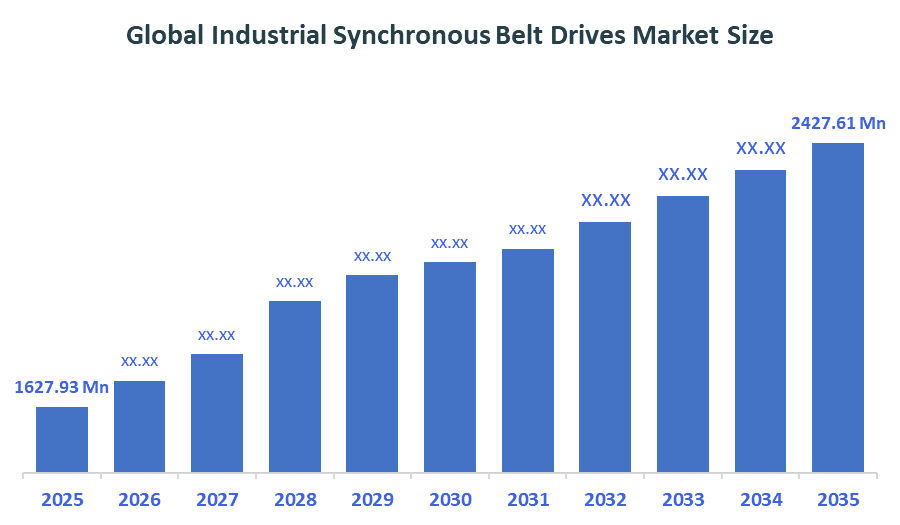
The Global Industrial Synchronous Belt Drives Market Size is forecasted to grow from USD 1627.93 Million in 2025 and going to reach approx. USD 2427.61 Million by 2035. According to Decision Advisors, there is a detailed research report on the Global Industrial Synchronous Belt Drives Market highlights polyurethane synchronous belt drives dominate the global market, accounting for approximately 38–42% of the total share worldwide. Gates Corporation generate strong revenue through its power transmission and industrial belt solutions, which accounts for approximately 14–18% market share, thus acting as a main driver of innovation in high-performance belt materials, energy-efficient transmission systems, and advanced industrial automation solutions across global manufacturing industries.
Market Snapshot
- Market Size (2025): USD 1627.93 Million
- Projected Market Size (2035): USD 2427.61 Million
- Compound Annual Growth Rate (CAGR): 4.08%
- Largest Regional Market: Asia- Pacific
- Fastest Growing Region: North America
- 3rd Largest Region: Europe
- Base Year: 2025
- Historical Period: 2021–2025
- Forecast Period: 2025–2035
Market Overview/ Introduction
The Industrial Synchronous Belt Drives Market includes systems which enable precise mechanical power transfer between two rotating shafts without any power loss through slippage. The drives find multiple applications across automated production lines, CNC machines, conveyors, robotic systems, and packaging machinery because these systems require precise operations which must work together in perfect timing. The market experiences continuous growth because industrial automation processes expand, businesses seek energy-efficient drive systems, existing chain and gear systems get replaced by belt systems which require minimal maintenance. Modern material technology advancements have improved product durability through reinforced polyurethane, fiberglass, aramid tensile cords which extend operational lifespan and increase load-carrying capacity. Industry research shows that approximately 45% of manufacturing plants use synchronous belt drives while more than 50% of recent installations incorporate intelligent monitoring systems together with predictive maintenance technology. The systems provide automotive packaging and industrial machinery sectors worldwide with solutions that achieve 30 to 40% downtime reduction together with 20 to 25% efficiency gains.
- In April 2024, India is emerging as a significant growth market for industrial synchronous belt drives, driven by rising industrial production, expanding manufacturing capacity, and increasing adoption of energy-efficient and low-maintenance power transmission systems across industries such as automotive, packaging, and machinery.
- In 2024, The market is shifting toward bio-based polyurethane and recyclable synchronous belts, with Megadyne’s MegaEco reducing CO? emissions while maintaining performance and supporting sustainable industrial manufacturing.
Notable Insights: -
- North America is the fastest growing region market share approximately 5.8% in the Global Industrial Synchronous Belt Drives Market
- Asia Pacific holds the largest regional market share approximately 41% in the Global Industrial Synchronous Belt Drives Market
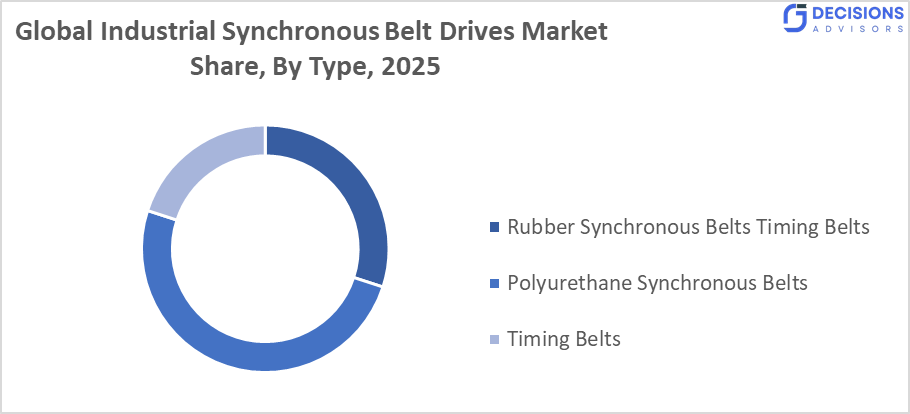
- By type, the Polyurethane Synchronous Belts segment held a dominant position approximately 6.5% in terms of market share in 2025.
- By material, Fiberglass Reinforced segment is the dominating accounting for approximately 6.3% of the global market share in 2025.
- The compound annual growth rate of the Global Industrial Synchronous Belt Drives Market is 4.08%.
- The market is likely to achieve a valuation of USD 2427.61Million by 2035.
What is role of technology in grooming the market?
Present-day industrial operations experience substantial performance enhancements because of ongoing technological progressions that enhance synchronous belt drive systems. High-strength composite materials increase load capacity plus service life, while precision-engineered belt tooth profiles deliver torque transmission efficiency gains between 20 and 25%. Smart manufacturing systems increasingly integrate belt drives with sensors and IoT-enabled monitoring, which enables predictive maintenance that decreases downtime between 30 and 40% while enhancing operational reliability. The combination of advanced alignment technologies together with digital control tools enables users to achieve higher precision results while reducing equipment damage and improving system efficiency. The adoption of Industry 4.0 is accelerating automation, which leads to production environments that operate with enhanced intelligence and connectivity while achieving better energy performance and productivity outcomes.
Market Drivers
The Industrial Synchronous Belt Drives Market exists because industries across the world are implementing automated systems and constructing smart manufacturing plants. The industrial sector needs energy-efficient power transmission systems which results in companies replacing their traditional chain and gear systems. The market demand for products increases because industrial applications of robotics and CNC machines and packaging systems and conveyor systems have grown to represent more than 40% of total industrial usage. The increasing manufacturing output from emerging economies which contributes 35% of global industrial growth requires accurate motion control systems. The manufacturing industry now implements Industry 4.0 solutions because approximately 50% of new factories have adopted smart monitoring systems to enhance their operational efficiency in the automotive and food processing and industrial machinery sectors throughout the world.
Restrain
The Industrial Synchronous Belt Drives Market faces several restraints that limit its broader adoption. The load capacity of these drives does not meet extreme heavy-duty requirements which chain and gear systems handle more effectively. The drives become less efficient and experience reduced operational lifespan because of their vulnerability to misalignment and tension errors which require proper maintenance to function correctly. Traditional chain and gear drive systems present strong competition which prevents market growth in cost-sensitive industries. The high initial system integration costs of advanced automated setups create a barrier for small and medium-scale enterprises which prevents them from adopting these systems despite their long-term operational efficiency benefits.
Competitive Analysis:
The report offers the appropriate analysis of the key organizations/companies involved within the Global Industrial Synchronous Belt Drives Market, along with a comparative evaluation primarily based on their product of offering, business overviews, geographic presence, enterprise strategies, segment market share, and SWOT analysis. The report also provides an elaborative analysis focusing on the current news and developments of the companies, which includes product development, innovations, joint ventures, partnerships, mergers & acquisitions, strategic alliances, and more. This allows for the evaluation of the overall competition within the market.
Top Companies in Global Industrial Synchronous Belt Drives Market
- Continental AG
- Gates Corporation
- Habasit AG
- Mitsuboshi Belting Ltd.
- SKF Group
- Optibelt GmbH
- Bando Chemical Industries
- Fenner Drives
- Megadyne Group
- Brecoflex Co.
- Others
Government Initiatives
|
Country |
Key Government Initiatives |
|
South Korea |
In April 2024, South Korea’s Manufacturing Innovation 3.0 initiative targets the development of over 30,000 smart factories by 2025, significantly boosting demand for advanced automation, industrial equipment, and smart manufacturing systems. |
|
US |
In April 2024, Japan is accelerating its Society 5.0 initiative to promote smart factories and address labor shortages, with government-backed programs investing billions of JPY in AI, IoT, and robotics integration to enhance manufacturing productivity, automation, and industrial competitiveness. |
|
China
|
In April 2024, China’s “Made in China 2025” initiative continues to drive industrial upgrading by increasing domestic content in core manufacturing technologies, with strong emphasis on AI, robotics, and advanced automation systems, supporting large-scale investment in smart factories and automated production infrastructure.
|
Study on the Supply, Demand, Distribution, and Market Environment of Global Industrial Synchronous Belt Drives Market
The Industrial Synchronous Belt Drives Market supply chain operates through three main components which are OEM manufacturers, industrial distributors and automation solution providers together with aftermarket suppliers. The supply side of OEMs holds a market share between 60 and 65 percent because they possess advanced engineering skills together with their worldwide manufacturing capabilities. The industrial machinery sector drives demand because it produces about 40 percent of total demand while automotive production provides 25 percent and packaging systems contribute 15 percent of total demand. The distribution process receives support from global industrial suppliers combined with digital procurement platforms that experience rapid growth which demonstrates strong B2B e-commerce integration within industrial sales. The market experiences consistent growth because both increasing automation and replacement requirements create a stable supply-demand equilibrium across all major regions.
Price Analysis and Consumer Behaviour Analysis
The Industrial Synchronous Belt Drives Market shows significant price differences which depend on the specific material type and design complexity and application needs. Standard belts are priced between USD 10–50 per unit, while industrial-grade belts range from USD 50–200. High-performance customized systems designed for heavy-duty and precision applications can reach USD 200–800+. The different products show variations because their durability and load capacity and engineering specifications distinct from each other. Consumer behaviour analysis shows a strong preference for performance and efficiency-driven purchasing decisions. Around 62% of users prioritize durability and product lifespan, while 55% focus on low maintenance requirements. Customers show a preference for energy-efficient solutions which help them save money during operations and 40% of customers value total lifecycle cost more than initial purchase price. The value-based procurement process has become the primary method for industrial decision-making because organizations now prioritize long-term efficiency and reliability above upfront costs.
Market Segmentation
The Global Industrial Synchronous Belt Drives Market share is classified into type, material, and end user
- The Polyurethane Synchronous Belts segment dominated the market in 2024, and is projected to grow at a substantial CAGR of approximately 5.8% during the forecast period.
Based on the type, the Global Industrial Synchronous Belt Drives Market is divided into Rubber Synchronous Belts, Polyurethane Synchronous Belts, Timing Belts, Others. Among these, the Polyurethane Synchronous Belts segment dominated the market in 2024, and is projected to grow at a substantial CAGR of approximately 5.8% during the forecast period Polyurethane belts dominate due to their high durability, superior wear resistance, better flexibility, and suitability for high-precision automation applications, especially in robotics, CNC machinery, and packaging systems where long service life and low maintenance are critical.
- The Fiberglass Reinforced segment accounted for the largest share in 2024, and is anticipated to grow at a significant CAGR of approximately 6.3% during the forecast period.
Based on the Material, the Global Industrial Synchronous Belt Drives Market is divided Steel Reinforced, Fiberglass Reinforced, Aramid Reinforced. Among these, the Fiberglass Reinforced segment accounted for the largest share in 2024, and is anticipated to grow at a significant CAGR of approximately 6.3% during the forecast period. The dominant market position of fiberglass reinforced belts results from their combination of high tensile strength lightweight design and exceptional dimensional stability which makes them cost-effective for use in industrial automation systems and conveyor systems and precision machinery applications across various industrial sectors.
- The industrial machinery segment dominated the market in 2024, and is projected to grow at a substantial CAGR approximately 6.4% during the forecast period.
Based on the End User, the Global Industrial Synchronous Belt Drives Market is divided into automotive, food and beverage, packaging, industrial machinery, textile, mining, others. Among these, the industrial machinery segment dominated the market in 2024, and is projected to grow at a substantial CAGR approximately 6.4% during the forecast period. This represents approximately USD 294 million of the total market value of USD 763 million in 2024. This dominance is attributed to the widespread use of synchronous belt drives in automated production lines, CNC machines, conveyors, and heavy-duty manufacturing equipment, where precise motion control, high efficiency, and low maintenance are critical for continuous industrial operations.
Strategies to Implement for Growth of the Market in Non-Leading Regions
The Industrial Synchronous Belt Drives Market needs non-leading regions to grow through manufacturers who must increase public knowledge regarding energy-saving power transmission systems which require less upkeep. The establishment of local partnerships between OEMs and distributors and industrial contractors will enable businesses to better access markets while they solve supply chain problems. The development of affordable modular belt drive systems should be pursued by businesses to serve small and medium-sized enterprises which represent approximately 40 to 45 percent of unserved market needs in developing countries. The expansion of local manufacturing and assembly facilities enables businesses to cut product expenses by 15 to 20 percent while enhancing their capacity to deliver products. The implementation of technician training programs together with maintenance staff training will help increase user adoption. The combination of IoT-based monitoring systems in mid-range products and flexible financing solutions will enable greater product adoption. Businesses should work together with government industrial modernization programs to raise public knowledge which will drive sustainable market development in developing regions.
Regional Segment Analysis of the Global Industrial Synchronous Belt Drives Market
- North America (U.S., Canada, Mexico)
- Europe (Germany, France, U.K., Italy, Spain, Rest of Europe)
- Asia-Pacific (China, Japan, India, Rest of APAC)
- South America (Brazil and the Rest of South America)
- The Middle East and Africa (UAE, South Africa, Rest of MEA)
Asia Pacific is anticipated to hold the largest share approximately 41% of the Global Industrial Synchronous Belt Drives Market over the predicted timeframe.
Asia Pacific is expected to dominate the Global Industrial Synchronous Belt Drives Market because of its strong industrial base and rapid manufacturing expansion. The region accounts for nearly 41% of the global market share, supported by large-scale production activities in China, India, Japan, and South Korea. The demand for accurate power transmission systems increases because industrial automation and robotics and CNC machinery have reached high adoption levels. The region achieves competitive advantages through its lower manufacturing costs and raw material accessibility and extensive OEM presence. The market experiences growth acceleration because governments support industrial modernization and infrastructure development, which establishes Asia Pacific as the dominant market region until the end of the forecast period.
North America is expected to grow at a rapid CAGR approximately 5.8% in the Global Industrial Synchronous Belt Drives Market during the forecast period. The Global Industrial Synchronous Belt Drives Market in North America will see a compound annual growth rate of 5.8% because of increased industrial automation and ongoing upgrades to manufacturing plants. The region has a high adoption rate of advanced robotics, CNC machinery, and smart factory systems, which increases demand for precise and efficient power transmission solutions. The market is expanding because companies are replacing their outdated industrial systems with modern energy-efficient technologies. The implementation of strict energy efficiency regulations together with the increased emphasis on reducing operational expenses drives wider technology adoption. The region maintains continuous growth because of major manufacturing companies and the high-level investment toward Industry 4.0 technologies
Europe is the 3rd largest region to grow in the Global Industrial Synchronous Belt Drives Market during the region.
The Global Industrial Synchronous Belt Drives Market experiences its third-largest market presence through the industrial strength and advanced manufacturing capabilities and extensive automation technology usage which Europe maintains as its primary growth driver. The automotive, food processing, packaging and industrial machinery sectors in the region establish their foundation through their need for advanced power transmission systems, which support their production processes. Industries across Europe are shifting to low-loss, high-performance synchronous belt drives because of the EU regulations which establish energy efficiency standards and carbon emissions restrictions. The current increase in demand occurs because companies improve their old industrial systems and additional funds support the development of Industry 4.0 technologies. The engineering capabilities of Germany, France and the UK make these countries the top market for adoption because they focus on productivity and sustainability, which drives regional market expansion.
Future Market Trends in Global Industrial Synchronous Belt Drives Market: -
• Rising Adoption of Smart Belt Drives (Industry 4.0 Integration)
The market is shifting toward IoT-enabled synchronous belt systems with real-time monitoring and predictive maintenance. Nearly 45–50% of new industrial installations are expected to integrate smart sensors, improving efficiency and reducing downtime by up to 30%.
• Growth of Energy-Efficient and Low-Noise Systems
Manufacturers are increasingly focusing on high-efficiency belt materials and optimized tooth profiles, improving energy transfer efficiency by 20–25% and reducing operational noise in automated production environments.
• Expansion in Industrial Automation and Robotics
Rising automation in manufacturing, packaging, and CNC machinery is driving strong demand, with automation-linked applications accounting for over 40% of total usage in the market. Top of Form
Recent Development
- In January 2025, SKF announced a strategic agreement to acquire Timken’s power transmission business, expanding its industrial belt drives portfolio and strengthening global presence in mechanical power transmission and automation solutions.
- In April 2024, Gates Corporation launched next-generation synchronous belts designed for improved wear resistance and higher torque handling in heavy-duty industrial applications, enhancing durability, efficiency, and long operational life in automated manufacturing systems.
- In March 2024, Megadyne promoted its MegaEco bio-based polyurethane belts (Megaflex/Megalinear series) designed to reduce CO? emissions and dependence on fossil feedstocks while maintaining standard mechanical performance and efficiency in industrial applications.
- In April 2024, Bosch Rexroth introduced next-generation modular automation and material handling systems with improved configuration flexibility, faster installation, and higher efficiency for industrial power transmission and production applications.
- In April 2024, Conveyor OEM Partnerships Suppliers are increasingly collaborating with conveyor OEMs and intralogistics integrators to deploy synchronous belt drives in high-speed sorting, warehousing, and automated material handling systems, improving precision, throughput, and operational efficiency.
How is Recent Developments Helping the Market?
The Industrial Synchronous Belt Drives Market performance and market adoption currently experience major enhancements through recent advances which establish better operational efficiency and system reliability and enable seamless integration of automated systems. The development of high-strength materials through polyurethane and aramid and fiberglass reinforcements has created materials which can handle heavier loads while extending the operational life of belts to decrease their need for replacement and their overall operational expenses. The installation of IoT-enabled sensors together with predictive maintenance systems enables operators to monitor belt tension and alignment and wear patterns in real time which leads to a decrease in unplanned equipment downtime that ranges from 30 to 40%. The combination of digital manufacturing and Industry 4.0 technologies enables automated production lines to achieve better motion control accuracy and system synchronization results. The new tooth profile design enhancements provide a torque transmission efficiency improvement between 20 and 25% which enables robotics and CNC machinery to achieve greater precise operations. Through these innovations industries worldwide today achieve higher productivity levels while spending less on maintenance and using energy more efficiently throughout their various manufacturing operations.
Market Segment
This study forecasts revenue at global, regional, and country levels from 2020 to 2035. Spherical Insights has segmented the Global Industrial Synchronous Belt Drives Market based on the below-mentioned segments:
Global Industrial Synchronous Belt Drives Market, By Type
- Rubber Synchronous Belts
- Polyurethane Synchronous Belts
- Timing Belts
- Others
Global Industrial Synchronous Belt Drives Market, By Material
- Steel Reinforced
- Fiberglass Reinforced
- Aramid Reinforced
Global Industrial Synchronous Belt Drives Market, By End User
- Automotive
- Food and Beverage
- Packaging
- Industrial Machinery
- Textile
- Mining
- Others
Global Industrial Synchronous Belt Drives Market, By Regional Analysis
- North America
- US
- Canada
- Mexico
- Europe
- Germany
- UK
- France
- Italy
- Spain
- Russia
- Rest of Europe
- Asia Pacific
- China
- Japan
- India
- South Korea
- Australia
- Rest of Asia Pacific
- South America
- Brazil
- Argentina
- Rest of South America
- Middle East & Africa
- UAE
- Saudi Arabia
- Qatar
- South Africa
- Rest of the Middle East & Africa
Frequently Asked Questions (FAQ)
- What makes synchronous belt drives more suitable for high-precision automation compared to conventional V-belts?
Synchronous belt drives eliminate slippage due to toothed engagement, ensuring exact speed synchronization, which is critical for robotics, CNC machining, and automated assembly lines requiring precise motion control.
- How is Industry 4.0 reshaping the performance expectations of industrial synchronous belt systems?
Industry 4.0 is driving demand for smart belts integrated with sensors that track tension, wear, and alignment, enabling predictive maintenance and reducing unexpected breakdowns in automated production systems.
- Why are polyurethane synchronous belts gaining higher adoption than rubber-based alternatives?
Polyurethane belts offer superior abrasion resistance, higher flexibility, and longer service life, making them more efficient in high-speed and high-load industrial environments.
- How do synchronous belt drives contribute to energy optimization in manufacturing plants?
They improve mechanical efficiency by reducing friction losses and maintaining consistent power transmission, helping industries reduce energy consumption by up to 15–25% in automated systems.
- What role do synchronous belt drives play in modern robotics and smart factories?
They ensure precise motion control in robotic arms, conveyors, and automated tools, supporting synchronized operations essential for high-speed, error-free manufacturing.
Check Licence
Choose the plan that fits you best: Single User, Multi-User, or Enterprise solutions tailored for your needs.
We Have You Covered
- 24/7 Analyst Support
- Clients Across the Globe
- Tailored Insights
- Technology Tracking
- Competitive Intelligence
- Custom Research
- Syndicated Market Studies
- Market Overview
- Market Segmentation
- Growth Drivers
- Market Opportunities
- Regulatory Insights
- Innovation & Sustainability
Report Details
| Scope | Global |
| Pages | 210 |
| Delivery | PDF & Excel via Email |
| Language | English |
| Release | Apr 2026 |
| Access | Download from this page |