
Global Inland Container Depot (ICD) and Dry Port Market
 |
Author:
Atul K
|
Pages:
200
|
Author:
Atul K
|
Pages:
200
Global Inland Container Depot (ICD) and Dry Port Market Size, Share By Type (Rail-Connected Inland Container Depot, Road-Connected Inland Container Depot, Inland Dry Port, and Others), By Application (Import & Export Cargo, Domestic Freight Distribution, Container Storage & Handling, Customs Clearance, and Others), By Technology (Terminal Operating Systems, IoT & Smart Logistics, Automated Cargo Handling, Digital Freight Management, and Others), and Region (North America, Europe, Asia-Pacific, South America, Middle East & Africa), Analysis and Forecast 2026-2035
CAGR
5.94%
REVENUE 2025
USD Billion 32.45
FORECAST 2035
USD Billion 57.78
REPORT COVERAGE
Global
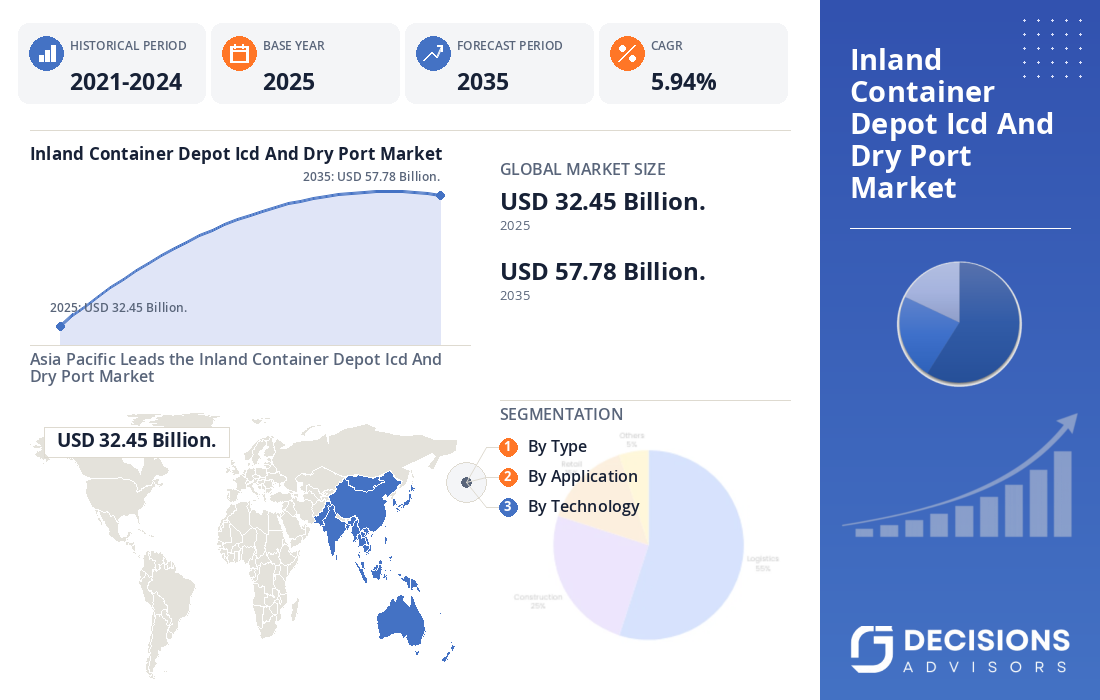
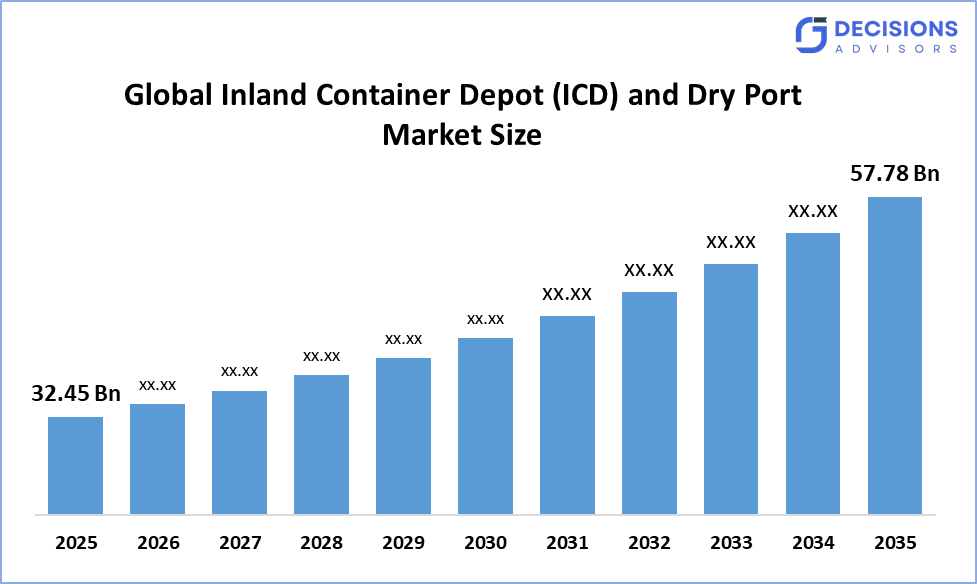
The Global Inland Container Depot (ICD) and Dry Port Market Size is predicted to grow from USD 32.45 Billion in 2025 and is likely to reach around USD 57.78 Billion by 2035 with a CAGR of 5.94%. driven by the rapid expansion of international trade, increasing intermodal freight transportation, and rising investments in inland logistics infrastructure. Governments and private logistics operators are increasingly developing inland container terminals to reduce port congestion, improve cargo handling efficiency, and strengthen multimodal transportation networks.
Market Snapshot
- Global Inland Container Depot (ICD) and Dry Port Market Size (2025): USD 32.45 Billion.
- Projected Global Inland Container Depot (ICD) and Dry Port Market Size (2035): USD 57.78 Billion.
- Global Inland Container Depot (ICD) and Dry Port Market Compound Annual Growth Rate (CAGR): 5.94%.
- Largest Regional Market: Asia-Pacific
- 2nd Largest Region: Europe
- Fastest Growing Region: North America
- Base Year: 2025
- Historical Period: 2021-2024
- Market Forecast Period: 2026-2035
Market Overview/ Introduction
The Global Inland Container Depot (ICD) and Dry Port Market comprises inland logistics facilities that perform many of the functions traditionally handled by seaports, including container storage, customs clearance, cargo consolidation, freight forwarding, and multimodal transportation. Strategically located away from congested coastal ports, these facilities connect ports with industrial zones, manufacturing hubs, and consumption centers through rail and road transportation.
- The market continues to expand as international trade volumes increase and governments invest heavily in logistics infrastructure to support economic development. Growing e-commerce activities, industrialization, and cross-border trade agreements have significantly increased demand for efficient inland freight terminals capable of handling rising container traffic.
- Leading logistics infrastructure operators including DP World, PSA International, APM Terminals, CMA CGM, and Adani Ports and Special Economic Zone continue expanding their inland logistics networks through acquisitions, strategic partnerships, and infrastructure investments.
Notable Insights: -
- Asia-Pacific is expected to account for approximately 43% of the Global Inland Container Depot (ICD) and Dry Port Market revenue in 2025, supported by expanding manufacturing activities, rising exports, and continuous investments in rail freight infrastructure.
- Europe is projected to hold nearly 26% of the global market due to its mature intermodal transportation network, extensive rail connectivity, and government initiatives promoting sustainable freight logistics.
- By Type, the Rail-Connected Inland Container Depot segment dominated the market, accounting for approximately 48% of total revenue in 2025, owing to superior cargo capacity, lower transportation costs, and improved long-distance freight efficiency.
- By Application, the Import & Export Cargo segment held approximately 45% of the market share in 2025, driven by increasing international trade, containerized freight movement, and growing demand for customs clearance facilities.
- The Global Inland Container Depot (ICD) and Dry Port Market is projected to expand at a CAGR of 5.94% during the forecast period from 2026 to 2035.
- The market is anticipated to reach a valuation of approximately USD 57.78 Billion by 2035.
Market Drivers
The Global Inland Container Depot (ICD) and Dry Port Market is primarily driven by the rapid expansion of global trade, increasing containerization of cargo, and rising demand for efficient multimodal transportation systems. Governments worldwide are investing significantly in dedicated freight corridors, inland logistics parks, railway modernization, and port connectivity projects to improve supply chain resilience and reduce congestion at seaports. Growing industrialization, expanding manufacturing clusters, and the rise of cross-border e-commerce have further increased the need for strategically located inland freight terminals capable of providing customs clearance, container handling, and cargo storage services. Technological advancements such as IoT-enabled cargo tracking, terminal operating systems, AI-based logistics optimization, and automated container handling equipment continue enhancing operational efficiency while lowering transportation costs.
Restrain
Despite strong growth prospects, the Global Inland Container Depot (ICD) and Dry Port Market faces several challenges. High capital investment requirements for rail connectivity, cargo handling equipment, land acquisition, and terminal development remain major barriers, particularly in developing countries. Delays in infrastructure approvals, customs inefficiencies, inconsistent regulatory frameworks, and inadequate multimodal transportation networks can limit operational performance.
Competitive Analysis:
The report offers the appropriate analysis of the key organizations/companies involved within the global inland container depot and dry port market, along with a comparative evaluation primarily based on their product offerings, business overviews, geographic presence, enterprise strategies, segment market share, and SWOT analysis. The report also provides an elaborative analysis focusing on the current news and developments of the companies, which includes product development, innovations, joint ventures, partnerships, mergers & acquisitions, strategic alliances, and others. This allows for the evaluation of the overall competition within the market.
Top Companies in the Global Inland Container Depot (ICD) and Dry Port Market
- DP World
- PSA International
- APM Terminals
- Adani Ports and Special Economic Zone Ltd.
- CMA CGM Group
- Hutchison Ports
- China Merchants Port Holdings Co., Ltd.
- Container Corporation of India Ltd. (CONCOR)
- Eurogate GmbH & Co. KGaA
- Yilport Holding.
Government Initiatives
|
Country |
Key Government Initiatives |
|
India |
The Government of India is expanding the PM Gati Shakti National Master Plan, Dedicated Freight Corridors (DFC), and Multi-Modal Logistics Parks (MMLPs) to improve rail connectivity, reduce logistics costs, and enhance inland container depot capacity. |
|
China |
China continues investing in inland dry ports under the Belt and Road Initiative (BRI), expanding multimodal freight corridors, customs integration, and rail connectivity between inland industrial regions and international trade routes. |
|
Germany |
Germany supports the development of intermodal freight terminals through investments in rail freight modernization, digital logistics infrastructure, and sustainable transport policies that strengthen inland cargo movement across Europe. |
Market Segmentation
The Global Inland Container Depot (ICD) and Dry Port Market is segmented basedon Type, Application, and Technology
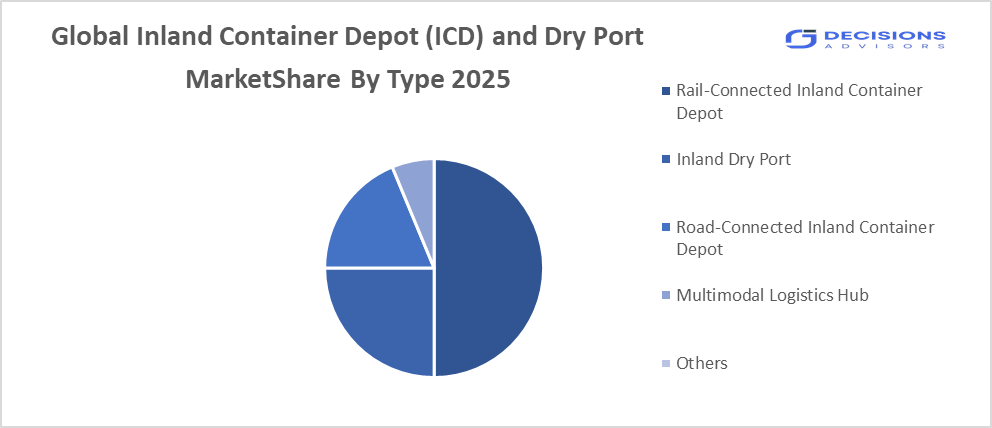
- The Rail-Connected Inland Container Depot segment dominated the Global Inland Container Depot (ICD) and Dry Port Market and accounted for approximately 48% of the market share in 2025.
Based on Type, the market is segmented into Rail-Connected Inland Container Depot, Road-Connected Inland Container Depot, Inland Dry Port, and Others. Rail-connected ICDs remain the dominant segment due to their ability to transport large container volumes efficiently over long distances while reducing fuel consumption and logistics costs. These facilities play a crucial role in linking seaports with inland manufacturing and consumption centers. Growing investments in dedicated freight corridors, railway electrification, and intermodal logistics infrastructure continue to strengthen this segment.
- The Import & Export Cargo segment held the largest market share of approximately 45% in 2025 and is expected to maintain its leadership throughout the forecast period.
Based on Application, the market is categorized into Import & Export Cargo, Domestic Freight Distribution, Container Storage & Handling, Customs Clearance, and Others. Import and export cargo dominates because international containerized trade continues to expand across manufacturing, retail, automotive, chemicals, and consumer goods industries. Inland container depots simplify customs procedures, reduce port congestion, and shorten cargo transit times, making them indispensable for exporters and importers. Rising global trade agreements, increasing container throughput, and expanding industrial production further support the segment's growth.
- The Terminal Operating Systems (TOS) segment accounted for approximately 41% of the market in 2025.
Based on Technology, the market is segmented into Terminal Operating Systems (TOS), IoT & Smart Logistics, Automated Cargo Handling, Digital Freight Management, and Others. Terminal Operating Systems dominate the market because they enable real-time cargo tracking, yard planning, container allocation, inventory management, and operational optimization. Logistics operators increasingly rely on digital platforms to improve productivity and reduce turnaround times. Meanwhile, IoT-enabled logistics solutions, AI-powered predictive analytics, and automated container handling technologies are expected to experience the fastest growth during the forecast period as logistics providers pursue greater efficiency and supply chain visibility.
Regional Segment Analysis of the Global Inland Container Depot (ICD) and Dry Port Market
- North America (U.S., Canada, Mexico)?
- Europe (Germany, U.K., France, Italy, Spain, Netherlands, Rest of Europe).
- Asia-Pacific (China, Japan, India, Australia, South Korea, Rest of Asia-Pacific).
- South America (Brazil, Argentina, Rest of South America).
- Middle East & Africa (UAE, Saudi Arabia, South Africa, Rest of MEA).
Asia-Pacific accounted for approximately 43% of the Global Inland Container Depot (ICD) and Dry Port Market in 2025 and continues to dominate the global industry.
The region benefits from large-scale manufacturing activities, rapidly expanding international trade, and substantial investments in logistics infrastructure. China and India continue developing inland freight corridors, multimodal logistics parks, and rail-based container transportation to improve export competitiveness. Government-backed infrastructure programs, increasing industrial production, and growing e-commerce volumes continue driving demand for inland container depots and dry ports. Rising foreign direct investment in logistics infrastructure further strengthens regional growth.
Europe represented approximately 26% of the global market in 2025, making it the second-largest regional market.
Europe possesses one of the world's most advanced intermodal transportation systems, supported by extensive rail freight networks and integrated customs operations. Germany, the Netherlands, France, and the United Kingdom remain major logistics hubs connecting inland industrial centers with major seaports. Strong sustainability initiatives encouraging rail freight over road transport, coupled with continuous investments in digital freight management and green logistics infrastructure, continue supporting market expansion throughout the region.
North America is projected to be the fastest-growing regional market during the forecast period.
The United States, Canada, and Mexico continue investing in inland freight terminals to accommodate increasing cross-border trade and e-commerce logistics. Modernization of rail infrastructure, expansion of inland logistics hubs, and adoption of digital cargo management systems are improving operational efficiency across the region. Growing manufacturing reshoring initiatives, nearshoring strategies, and increasing containerized freight movement are expected to create significant growth opportunities for inland container depot operators.
Future Market Trends in Global Inland Container Depot (ICD) and Dry Port Market: -
-
- Smart Digital Terminal Operations
The integration of artificial intelligence, Internet of Things (IoT), cloud-based Terminal Operating Systems, and digital twins is transforming inland container depot operations. Real-time cargo visibility, predictive maintenance, automated scheduling.
-
- Expansion of Multimodal Logistics Corridors
Governments and private logistics providers are increasingly investing in rail-road-port connectivity to establish integrated freight corridors. Dedicated freight corridors, inland logistics parks, and multimodal transportation hubs improve supply chain resilience while reducing congestion at major seaports.
-
- Automation of Cargo Handling Operations
Automated cranes, autonomous vehicles, robotic container handling equipment, and AI-powered warehouse management systems are becoming increasingly common across modern inland container depots.
-
- Sustainable and Green Logistics Infrastructure
Growing environmental regulations and corporate sustainability commitments are encouraging operators to adopt electric cargo handling equipment, renewable energy systems, rail-based transportation, and carbon-efficient logistics practices.
Recent Development
- In March 2025, DP World announced the expansion of its integrated inland logistics network by enhancing rail-connected container terminals and digital cargo visibility solutions across key international trade corridors.
- In November 2024, APM Terminals introduced advanced digital terminal operating technologies at selected inland logistics facilities to improve cargo handling efficiency and optimize container movement.
- In August 2024, Adani Ports and Special Economic Zone expanded inland container depot capacity in India through investments in multimodal logistics infrastructure connected to Dedicated Freight Corridors.
- In May 2024, PSA International strengthened its inland logistics network through strategic partnerships focused on smart freight management, digital supply chain integration, and sustainable cargo transportation.
Market Segment
This study forecasts revenue at global, regional, and country levels from 2021 to 2035. Decision Advisors has segmented the Global Inland Container Depot (ICD) and Dry Port Market based on the below-mentioned segment:
Global Inland Container Depot (ICD) and Dry Port Market, By Type
- Rail-Connected Inland Container Depot
- Road-Connected Inland Container Depot
- Inland Dry Port
- Others.
Global Inland Container Depot (ICD) and Dry Port Market, By Application
- Import & Export Cargo
- Domestic Freight Distribution
- Container Storage & Handling
- Customs Clearance
- Others.
Global Inland Container Depot (ICD) and Dry Port Market, By Technology
- Terminal Operating Systems (TOS)
- IoT & Smart Logistics
- Automated Cargo Handling
- Digital Freight Management
- Others.
Global Inland Container Depot (ICD) and Dry Port Market, By Regional Analysis
- North America
- US
- Canada
- Mexico
- Europe
- Germany
- UK
- France
- Italy
- Spain
- Russia
- Rest of Europe
- Asia Pacific
- China
- Japan
- India
- South Korea
- Australia
- Rest of Asia Pacific
- South America
- Brazil
- Argentina
- Rest of South America
- Middle East & Africa
- UAE
- Saudi Arabia
- Qatar
- South Africa
- Rest of the Middle East & Africa
Frequently Asked Questions (FAQ)
Q. Why are Inland Container Depots (ICDs) and Dry Ports becoming increasingly important in global logistics?
A. Inland Container Depots and Dry Ports improve supply chain efficiency by reducing congestion at seaports, facilitating customs clearance closer to industrial centers, lowering transportation costs through multimodal freight movement, and improving cargo turnaround times. They have become critical infrastructure supporting international trade and regional economic development.
Q. Which type segment dominates the Global Inland Container Depot (ICD) and Dry Port Market?
A. Rail-Connected Inland Container Depots currently dominate the market, accounting for approximately 48% of global revenue in 2025. Their ability to transport high cargo volumes efficiently over long distances, combined with lower emissions and reduced logistics costs, supports widespread adoption.
Q. How is digital technology transforming Inland Container Depot operations?
A. Technologies such as Terminal Operating Systems, IoT-enabled cargo tracking, AI-powered logistics optimization, automated cargo handling equipment, and cloud-based freight management platforms improve operational visibility, increase terminal productivity, minimize delays, and strengthen overall supply chain performance.
Q. What factors are expected to drive the Global Inland Container Depot (ICD) and Dry Port Market through 2035?
A. Market growth will be driven by increasing international trade, expansion of containerized freight transport, investments in dedicated freight corridors, development of multimodal logistics infrastructure, rising adoption of digital logistics technologies, government support for supply chain modernization, and growing demand for sustainable transportation solutions.
Check Licence
Choose the plan that fits you best: Single User, Multi-User, or Enterprise solutions tailored for your needs.
We Have You Covered
- 24/7 Analyst Support
- Clients Across the Globe
- Tailored Insights
- Technology Tracking
- Competitive Intelligence
- Custom Research
- Syndicated Market Studies
- Market Overview
- Market Segmentation
- Growth Drivers
- Market Opportunities
- Regulatory Insights
- Innovation & Sustainability
Report Details
| Scope | Global |
| Pages | 200 |
| Delivery | PDF & Excel via Email |
| Language | English |
| Release | Aug 2026 |
| Access | Download from this page |