
Global Insulin Drugs Delivery Devices Market
 |
Author:
Pranali P
|
Pages:
190
|
Author:
Pranali P
|
Pages:
190
Global Insulin Drugs Delivery Devices Market Size, Share By Product Type (Insulin Pens, Insulin Pumps, Insulin Syringes, Insulin Jet Injectors, and Others), By Application (Type 1 Diabetes, Type 2 Diabetes, and Gestational Diabetes), By End Use (Hospitals & Clinics, Homecare, and Others), and By Region (North America, Europe, Asia-Pacific, Latin America, Middle East & Africa), Analysis and Forecast 2026-2035
CAGR
8.05%
REVENUE 2025
USD Billion 19.25
FORECAST 2035
USD Billion 41.74
REPORT COVERAGE
Global
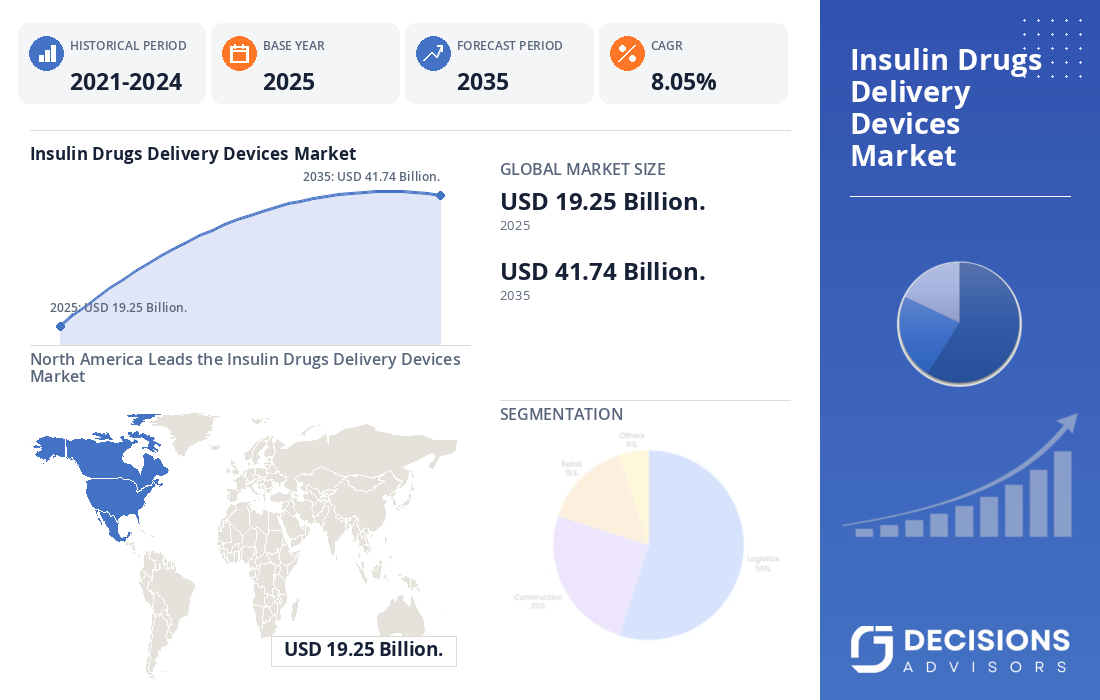
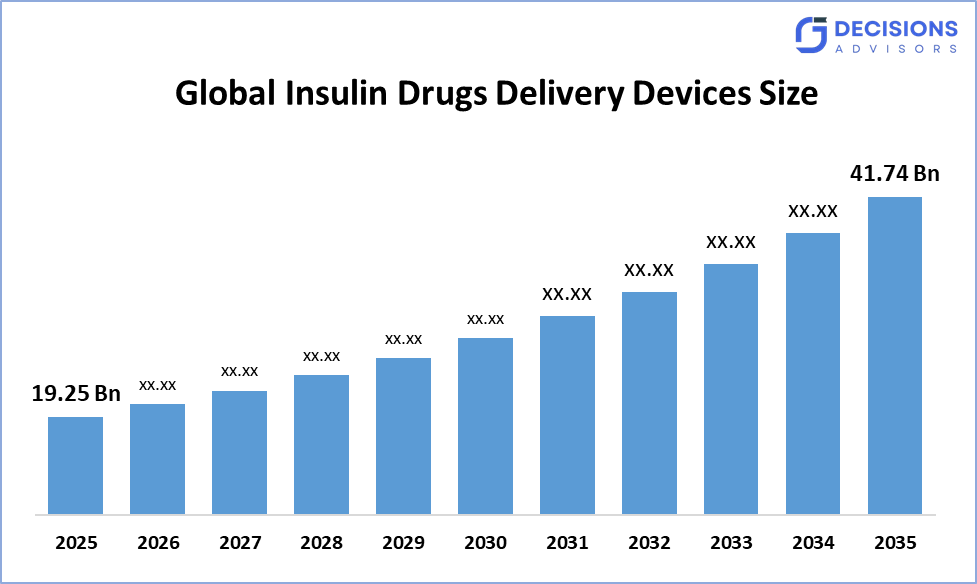
The Global Insulin Drugs Delivery Devices Market Size is predicted to grow from USD 19.25 Billion in 2025 and is likely to reach around USD 41.74 Billion by 2035 with a CAGR of 8.05%. According to Decision Advisors, the increasing adoption of convenient and connected insulin delivery systems dominates the Global Insulin Drugs Delivery Devices Market, supported by rising diabetes prevalence, greater home-based care, and demand for more precise insulin administration. Novo Nordisk, Medtronic, Insulet, Eli Lilly, and Becton Dickinson remain among the major contributors to market development through insulin pens, pumps, needles, and connected diabetes-care technologies.
Market Snapshot
- Global Insulin Drugs Delivery Devices Market Size (2025): USD 19.25 Billion.
- Projected Global Insulin Drugs Delivery Devices Market Size (2035): USD 41.74 Billion.
- Global Insulin Drugs Delivery Devices Market CAGR: 8.05%.
- Largest Regional Market: North America
- 2nd Largest Region: Europe
- Fastest Growing Region: Asia-Pacific
- Base Year: 2025
- Historical Period: 2021-2024
- Market Forecast Period: 2026-2035
Market Overview/ Introduction
The Global Insulin Drugs Delivery Devices Market comprises medical devices used to administer insulin to people living with diabetes. Major product categories include insulin pens, insulin pumps, syringes, pen needles, jet injectors, and wearable delivery systems. Market expansion is being supported by the rising global diabetes burden, increasing demand for self-administered treatment, improved healthcare access, and growing preference for convenient and accurate insulin administration. Advanced systems are increasingly combining insulin delivery with continuous glucose monitoring, smartphone applications, and automated dosing algorithms. Technological development is shifting the market from conventional injection methods toward smart and connected delivery ecosystems. Tubeless patch pumps, hybrid closed-loop systems, connected pens, dose-tracking platforms, and automated insulin delivery systems are gaining importance, particularly among patients requiring intensive insulin therapy. Abbott's collaboration with Insulet and Tandem's agreement with Abbott demonstrate the industry's movement toward integrated glucose sensing and insulin delivery platforms.
- United States, Diabetes affordability initiatives and expanding reimbursement for advanced diabetes technologies are supporting access to insulin and delivery devices. California's CalRx program is also focused on expanding access to lower-cost insulin products.
- Japan, The Japan Diabetes Society updated guidance for appropriate use of automated insulin delivery devices in May 2026 following expanded indications, supporting wider clinical adoption of AID technologies.
- Asia-Pacific, Rising diabetes prevalence, improving healthcare infrastructure, and increasing adoption of home-based diabetes management are creating significant opportunities for insulin pens, pumps, and connected delivery systems.
Notable Insights: -
- North America is anticipated to hold approximately 40% share of the Global Insulin Drugs Delivery Devices Market over the predicted timeframe.
- Asia-Pacific is expected to grow at a rapid CAGR, holding approximately 27% of the share during the forecast period.
- By Product Type, the Insulin Pens segment dominated the market and holds approximately 35% share in 2025 and is projected to grow at a substantial CAGR during the forecast period.
- By Application, the Type 2 Diabetes segment dominated the market and holds approximately 68% share in 2025 and is projected to grow at a substantial CAGR during the forecast period.
- The compound annual growth rate of the Global Insulin Drugs Delivery Devices Market is 8.05%.
- The market is likely to achieve a valuation of USD 41.74 Billion by 2035.
Market Drivers
The global insulin drugs delivery devices market is primarily driven by the increasing prevalence of diabetes and the growing number of patients requiring long-term insulin therapy. Rising obesity, sedentary lifestyles, population aging, and improved diabetes diagnosis are expanding the addressable patient population. At the same time, patients and healthcare providers are increasingly seeking devices that simplify dosing, improve adherence, reduce injection burden, and support more consistent glucose management. The transition toward home-based healthcare is further increasing demand for easy-to-use insulin pens, connected pens, patch pumps, and wearable systems. Technological integration represents another major growth driver. Smart insulin pens can record dosing information, while advanced pumps increasingly communicate with continuous glucose monitors and automated dosing algorithms. Abbott and Insulet are integrating glucose-monitoring technology with automated insulin delivery, while Tandem and Abbott are developing integrated solutions combining glucose-ketone sensing with insulin delivery systems.
Restrain
The market faces several constraints, including the relatively high acquisition cost of advanced insulin pumps, wearable systems, and connected devices compared with conventional syringes and pens. Reimbursement limitations in some developing markets can delay adoption of technologically advanced products. Device complexity, patient training requirements, infusion-site complications, connectivity issues, cybersecurity concerns, and regulatory requirements can also restrict adoption. In addition, supply-chain disruptions involving specialized components and infusion accessories can affect product availability.
Competitive Analysis:
The report offers the appropriate analysis of the key organizations/companies involved within the global insulin drugs delivery devices market, along with a comparative evaluation primarily based on their product offerings, business overviews, geographic presence, enterprise strategies, segment market share, and SWOT analysis. The report also provides an elaborative analysis focusing on the current news and developments of the companies, which includes product development, innovations, joint ventures, partnerships, mergers & acquisitions, strategic alliances, and others. This allows for the evaluation of the overall competition within the market.
Top Companies in the Global Insulin Drugs Delivery Devices Market
- Novo Nordisk A/S
- Medtronic plc
- Eli Lilly and Company
- Insulet Corporation
- Becton, Dickinson and Company
- Tandem Diabetes Care, Inc.
- Sanofi
- Ypsomed AG
- Terumo Corporation
- Gerresheimer AG.
Government Initiatives
|
Country |
Key Government Initiatives |
|
United States |
Federal and state initiatives are improving diabetes treatment affordability and access. Medicare insulin cost-sharing provisions and state programs such as California's CalRx support lower-cost insulin access |
|
Japan |
Japan's diabetes-care ecosystem is supporting adoption of automated insulin delivery through clinical guidance and expanded appropriate-use recommendations for AID devices |
|
China |
China's healthcare modernization, diabetes prevention programs, expanding hospital infrastructure, and digital-health initiatives are supporting wider access to diabetes-management technologies and insulin delivery systems |
Market Segmentation
The Global Insulin Drugs Delivery Devices Market share is classified into Product Type, Application and End Use.
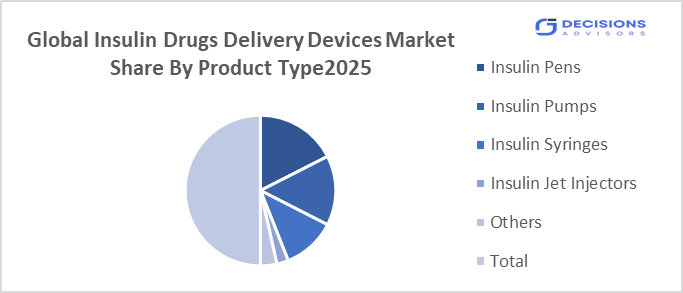
- The Insulin Pens segment dominated the market and holds approximately 35% share in 2025 and is projected to grow at a substantial CAGR during the forecast period.
Based on Product Type, the Global Insulin Drugs Delivery Devices Market is divided into Insulin Pens, Insulin Pumps, Insulin Syringes, Insulin Jet Injectors, and Others. Among these, Insulin Pens dominate the market because of their portability, dosing convenience, ease of use, and compatibility with both disposable and reusable formats. Pen-based delivery is particularly attractive for patients managing insulin therapy outside clinical settings. The growing development of smart pens with dose memory and connectivity is also strengthening the segment's long-term growth prospects. Industry research similarly identifies insulin pens as a leading product category.
- The Type 2 Diabetes segment accounted for the largest share of approximately 68% in 2025 and is anticipated to grow at a significant CAGR during the forecast period.
Based on Application, the market is divided into Type 1 Diabetes, Type 2 Diabetes, and Gestational Diabetes. Among these, Type 2 Diabetes accounted for the largest share because it represents the majority of the global diabetes population and an expanding proportion of patients eventually require insulin therapy. Increasing obesity and aging populations are contributing to greater treatment demand. Wider diagnosis and improved access to diabetes management are also expanding the population receiving insulin-based treatment.
- The Homecare segment accounted for the largest share of approximately 52% in 2025 and is anticipated to grow at a significant CAGR during the forecast period.
Based on End Use, the market is divided into Hospitals & Clinics, Homecare, and Others. Homecare is increasingly important because insulin therapy is commonly administered by patients or caregivers outside clinical environments. Portable pens, smart pens, patch pumps, and connected insulin pumps allow patients to manage therapy while maintaining normal daily activities. The shift toward decentralized chronic-care management is therefore expected to support continued homecare adoption.
Regional Segment Analysis of the Global Insulin Drugs Delivery Devices Market
- North America (U.S., Canada, Mexico)?
- Europe (Germany, U.K., France, Italy, Spain, Netherlands, Rest of Europe).
- Asia-Pacific (China, Japan, India, Australia, South Korea, Rest of Asia-Pacific).
- South America (Brazil, Argentina, Rest of South America).
- Middle East & Africa (UAE, Saudi Arabia, South Africa, Rest of MEA).
North America is anticipated to hold approximately 40% share of the Global Insulin Drugs Delivery Devices Market over the predicted timeframe.
North America remains the largest regional market due to high diabetes prevalence, advanced healthcare infrastructure, strong reimbursement mechanisms, and high adoption of insulin pumps and connected diabetes technologies. The United States has a particularly mature market for automated insulin delivery, wearable pumps, smart pens, and CGM-integrated systems. Major technology companies and diabetes-device manufacturers are headquartered or strongly established in the region, supporting continuous product development. Current market research also identifies North America as the leading regional market.
Europe is expected to hold approximately 25% share of the Global Insulin Drugs Delivery Devices Market during the forecast period.
Europe benefits from established public healthcare systems, increasing diabetes awareness, strong medical-device regulation, and growing adoption of digital diabetes management. Countries including Germany, the U.K., France, Italy, and Spain are supporting demand for insulin pens, pumps, and connected systems. European companies such as Ypsomed are also contributing to the region's insulin-device ecosystem. Increased emphasis on patient-centered care and home-based disease management will continue to support adoption.
Asia-Pacific is the fastest-growing region in the Global Insulin Drugs Delivery Devices Market, holding approximately 27% share during the forecast period.
Asia-Pacific is experiencing strong growth because of rising diabetes prevalence, urbanization, lifestyle changes, improving healthcare infrastructure, and increasing awareness of insulin therapy. China and India represent major growth opportunities because of their large diabetic populations, while Japan and South Korea provide technologically advanced markets for automated delivery and connected devices. Increasing healthcare expenditure and expansion of home-based diabetes management are also supporting demand. The region is expected to record the fastest growth during 2026-2035.
Future Market Trends in Global Insulin Drugs Delivery Devices Market: -
-
- Growth of Automated Insulin Delivery
Automated insulin delivery systems are expected to become increasingly important as pumps, CGMs, and dosing algorithms become more closely integrated. These systems can automate portions of insulin administration and reduce the burden of frequent manual decision-making. Tandem's collaboration with the University of Virginia highlights continued development of fully automated closed-loop systems.
-
- Expansion of Smart Insulin Pens
Smart insulin pens are expected to gain adoption because they combine familiar pen-based administration with digital dose tracking. Connected systems can record dosing information and communicate with mobile applications, helping patients and clinicians better understand insulin-use patterns.
-
- Increasing Adoption of Tubeless Patch Pumps
Tubeless patch pumps are likely to expand as patients seek less intrusive and more convenient alternatives to conventional tubed pumps. Their compact form factor and wearable design make them suitable for home-based diabetes management and active lifestyles.
-
- Integration of CGM and Insulin Delivery
Integration between continuous glucose monitoring and insulin delivery will remain one of the most important technology trends. Abbott's collaboration with Insulet demonstrates the movement toward systems in which glucose data can be used to automatically adjust insulin delivery.
Recent Development
- In January 2025, Tandem Diabetes Care entered a multi-year research collaboration with the University of Virginia Center for Diabetes Technology to advance fully automated closed-loop insulin delivery systems.
- In June 2025, Tandem Diabetes Care and Abbott announced an agreement to develop and commercialize integrated diabetes solutions combining Abbott's future glucose-ketone sensor with Tandem's insulin delivery systems.
- In 2026, Abbott and Insulet advanced their collaboration to integrate Abbott's next-generation glucose-monitoring technology with Insulet's automated insulin delivery platform, supporting more personalized insulin management.
Market Segment
This study forecasts revenue at global, regional, and country levels from 2021 to 2035. Decision Advisors has segmented the global insulin drugs delivery devices market based on the below-mentioned segment:
Global Insulin Drugs Delivery Devices Market, By Product Type.
- Insulin Pens
- Insulin Pumps
- Insulin Syringes
- Insulin Jet Injectors
- Others.
Global Insulin Drugs Delivery Devices Market, By Application.
- Type 1 Diabetes
- Type 2 Diabetes
- Gestational Diabetes.
Global Insulin Drugs Delivery Devices Market, By End Use.
- Hospitals & Clinics
- Homecare
- Others.
Global Insulin Drugs Delivery Devices Market, By Regional Analysis.
- North America
- US
- Canada
- Mexico
- Europe
- Germany
- UK
- France
- Italy
- Spain
- Russia
- Rest of Europe
- Asia Pacific
- China
- Japan
- India
- South Korea
- Australia
- Rest of Asia Pacific
- South America
- Brazil
- Argentina
- Rest of South America
- Middle East & Africa
- UAE
- Saudi Arabia
- Qatar
- South Africa
- Rest of the Middle East & Africa
Frequently Asked Questions (FAQ)
Q. What is driving the growth of the Global Insulin Drugs Delivery Devices Market?
A. The market is primarily driven by increasing diabetes prevalence, growing insulin dependence, rising demand for convenient self-administration, and technological advancements in insulin pens, pumps, and wearable systems. Connected and automated delivery technologies are also accelerating market development.
Q. Why are insulin pens gaining popularity compared with conventional syringes?
A. Insulin pens provide greater portability, easier dose measurement, and greater convenience for routine self-administration. Smart pen technologies additionally enable dose tracking and digital connectivity, making them increasingly attractive for patients seeking simpler diabetes management.
Q. How are automated insulin delivery systems changing diabetes management?
A. Automated insulin delivery systems combine insulin pumps, glucose monitoring, and software algorithms to adjust insulin delivery based on glucose information. This approach can reduce the burden of manual insulin adjustment and support more consistent glucose management. Abbott-Insulet and Tandem-Abbott collaborations demonstrate the industry's movement toward integrated systems.
Q. Which region dominates the Global Insulin Drug Delivery Devices Market?
A. North America is expected to remain the largest regional market, supported by advanced healthcare infrastructure, high adoption of insulin pumps and connected devices, strong reimbursement capabilities, and the presence of leading diabetes-device manufacturers.
Check Licence
Choose the plan that fits you best: Single User, Multi-User, or Enterprise solutions tailored for your needs.
We Have You Covered
- 24/7 Analyst Support
- Clients Across the Globe
- Tailored Insights
- Technology Tracking
- Competitive Intelligence
- Custom Research
- Syndicated Market Studies
- Market Overview
- Market Segmentation
- Growth Drivers
- Market Opportunities
- Regulatory Insights
- Innovation & Sustainability
Report Details
| Scope | Global |
| Pages | 190 |
| Delivery | PDF & Excel via Email |
| Language | English |
| Release | Aug 2026 |
| Access | Download from this page |