
Global Integrated Patient Portal Market
 |
Author:
David J
|
Pages:
200
|
Author:
David J
|
Pages:
200
Global Integrated Patient Portal Market Size, Share By Component (Software, Services), By Deployment Mode (Cloud-based, On-premises), By Application (Appointment Management, Billing and Payments, Patient Engagement, Health Information Management, Others), and By Region (North America, Europe, Asia-Pacific, Latin America, Middle East & Africa), Analysis and Forecast 2026-2035
CAGR
14.42%
REVENUE 2025
USD Billion 4.79
FORECAST 2035
USD Billion 18.42
REPORT COVERAGE
Global
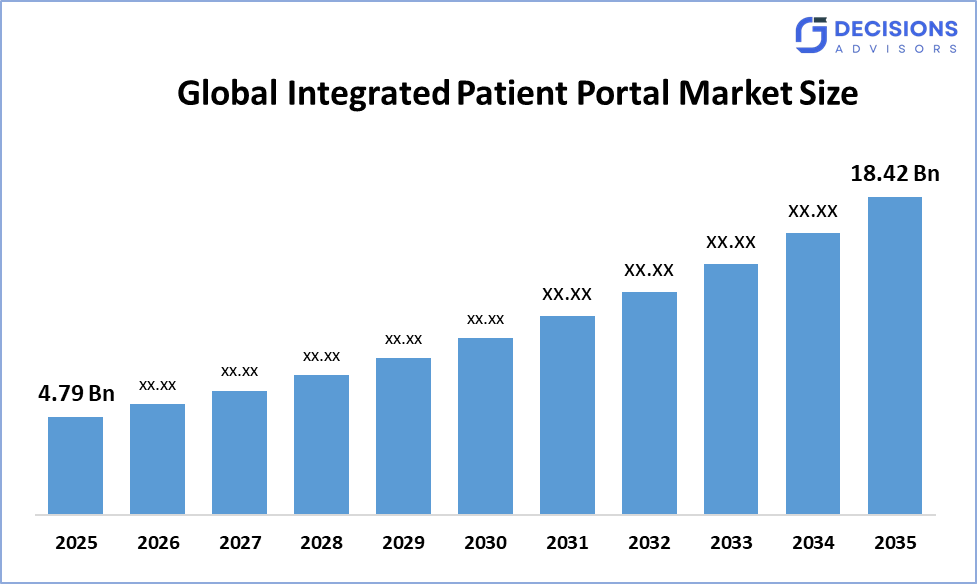
The Global Integrated Patient Portal Market Size is predicted to grow from USD 4.79 Billion in 2025 and is likely to reach around USD 18.42 Billion by 2035 with a CAGR of 14.42%. According to Decision Advisors, the integrated patient portal segment is currently ruling the market and holds about 64.28% of the total share in 2025 because of increased interoperability and efficient data flow with the EHR system. One of the top companies in the business is Epic Systems Corporation due to its EHR ecosystem and patient solutions. In 2024, Epic held about 42.3% of the U.S. acute care EHR market share.
Market Snapshot
- Global Integrated Patient Portal Market Size (2025): USD 4.79 Billion
- Projected Global Integrated Patient Portal Market Size (2035): USD 18.42 Billion
- Global Integrated Patient Portal Market Compound Annual Growth Rate (CAGR): 14.42%
- Largest Regional Market: North America
- 2nd Largest Region: Europe
- Fastest Growing Region: Asia Pacific
- Base Year: 2025
- Historical Period: 2021-2024
- Market Forecast Period: 2026-2035
Market Overview/ Introduction
The Global Integrated Patient Portal Market includes digital healthcare systems that integrate with electronic health records, hospital information systems, and clinical processes, allowing patients to access medical records, appointment scheduling, prescriptions, billing details, test results, and secure messaging with providers. Governments have been promoting digital health in their countries via such measures as the 21st Century Cures Act in the USA, ONC interoperability requirements, and EHDS (European Health Data Space). Recent innovations are associated with the incorporation of artificial intelligence (AI), telemedicine, mobile apps, and data interoperability standards in the functioning of patient portals. Market development is supported by the increasing digitization of healthcare, rising prevalence of chronic diseases, growing need for remote patient engagement, and wide implementation of electronic health records. Cloud computing platforms and mobile-centric approaches are adding fuel to the adoption of patient portals in hospitals, clinics, and ambulatory centers. The focus on patient-centered care, data interoperability, cybersecurity, and personalized healthcare will continue driving the robust market development up to 2035.
- Federal rules via the Office of the National Coordinator for Health Information Technology enforce strict patient data access, reducing information blocking and pushing integrated portals to handle direct-to-consumer health data sharing.
- Australia’s government operated My Health Record provides consumers with secure online access to important healthcare information, supporting nationwide digital record availability and integrated patient information management.
Notable Insights: -
- North America is anticipated to hold approximately 43.8% share of the Global Integrated Patient Portal Market over the predicted timeframe.
- Asia-Pacific is expected to grow at a rapid CAGR in the Global Integrated Patient Portal Market by holding approximately 21.34% of the share during the forecast period.
- By component, the Software, segment dominated the market and holds approximately 62% share in 2025 and is projected to grow at a substantial CAGR during the forecast period.
- By deployment mode, the Cloud-based segment dominated the market and holds approximately 68% share in 2025 and is projected to grow at a substantial CAGR during the forecast period.
- The compound annual growth rate of the Global Integrated Patient Portal Market is 14.42%.
- The market is likely to achieve a valuation of USD 18.42 Billion by 2035.
Market Drivers
The Global Integrated Patient Portal Market is registering robust growth owing to the rising usage of electronic health records (EHRs) and digital healthcare platforms through which the patients can access medical records, appointment scheduling, prescriptions, lab reports, and bills. Increasing preference for patient-centric care drives the providers to offer digital connectivity tools. Various government programs that support healthcare interoperability, exchange of EHI, and digital health infrastructure development are fuelling the adoption of these portals. Growing popularity of telemedicine and remote healthcare services is creating the demand for these integrated platforms to provide virtual consultation facilities and secure information exchange. Furthermore, rising incidence of chronic diseases also supports the continuous interaction between the patient and the provider. Cloud computing technology, artificial intelligence, mobile apps, and interoperability technologies are making the portals more efficient and user-friendly.
Restrain
Cybersecurity threats, data privacy issues, interoperability difficulties, and high implementation costs across healthcare institutions are some of the problems facing the global integrated patient portal market. Sensitive patient data may be exposed by cybersecurity threats, raising implementation costs and regulatory requirements.
Competitive Analysis:
The report offers the appropriate analysis of the key organizations/companies involved within the Global Integrated Patient Portal Market along with a comparative evaluation primarily based on their product offerings, business overviews, geographic presence, enterprise strategies, segment market share, and SWOT analysis. The report also provides an elaborative analysis focusing on the current news and developments of the companies, which includes product development, innovations, joint ventures, partnerships, mergers & acquisitions, strategic alliances, and others. This allows for the evaluation of the overall competition within the market.
Top Companies in the Global Integrated Patient Portal Market
- Epic Systems Corporation
- Oracle Health (Cerner)
- Athenahealth
- eClinicalWorks
- Allscripts / Veradigm (Altera)
- NextGen Healthcare
- MEDITECH
- McKesson Corporation
- GE HealthCare
- CureMD Healthcare
Government Initiatives
|
Country |
Key Government Initiatives |
|
India |
The Ayushman Bharat Digital Mission links citizens' health records to a unique ID, enabling consented data sharing and unified registration through national mobile platforms. |
|
United Kingdom |
The NHS App acts as a single gateway for citizens to book appointments, order repeat prescriptions, and view medical records directly from secondary and primary care providers. |
|
China |
National guidelines promoting smart hospitals and regional health networks drive large-scale adoption of internet hospital applications featuring integrated patient portals. |
Market Segmentation
The Global Integrated Patient Portal Market share is classified into Component, Deployment Mode and Application
- The Software segment dominated the market and holds approximately 62% share in 2025 and is projected to grow at a substantial CAGR during the forecast period.
Based on the component, the Global Integrated Patient Portal Market includes two major segments which are Software and Services. Of these, the segment of Software takes precedence over others, as it is estimated to capture around 62% market share in 2025. The reason for this is the rising need for an integrated platform which connects the electronic health records, appointment scheduling, billing, prescriptions, and patient-provider communication. It has been observed that the advanced software is being implemented by the healthcare organizations to engage the patients, make data access easier, etc.
- The Cloud-based segment accounted for the largest share of approximately 68% in 2025 and is anticipated to grow at a significant CAGR during the forecast period.
Based on the deployment mode, The Global Integrated Patient Portal Market includes the segments of Cloud-based and On-premises. These segments include Cloud-based that leads the market, with a share of around 68% in 2025. The reason for the leadership of this segment lies in the increasing need for scalable, cost-effective, and remote healthcare platforms. Cloud-based portals allow for the secure management of patient data, enabling real-time communication, electronic health records integration, and telehealth services. Investments in healthcare digital infrastructure, data interoperability improvements, and cloud security innovations stimulate the adoption of cloud-based integrated patient portals across the globe.
- The Health Information Management segment accounted for the largest share of approximately 36% in 2025 and is anticipated to grow at a significant CAGR during the forecast period.
Based on application, the Global Integrated Patient Portal Market is segmented into Appointment Management, Billing and Payments, Patient Engagement, Health Information Management, and Others. Out of all these, the Health Information Management segment commands a leading position in the market, contributing around 36% market share in 2025. The rising demand for easy access to electronic health records, medical history, test results, prescriptions, and clinical data are some of the reasons that drive the segment. The increasing use of EHRs, interoperability standards, and the need for patients to access their health data anytime is adding impetus to the growth of this segment.
Regional Segment Analysis of the Global Integrated Patient Portal Market
- Asia-Pacific (China, Japan, India, and Rest of Asia-Pacific)?
- North America (United States and Canada)
- Europe (Germany, United Kingdom, France, and Rest of Europe)
- Latin America (Brazil, Mexico, and Rest of Latin America)?
- The Middle East and Africa (United Arab Emirates (UAE), Saudi Arabia, South Africa, and Rest of MEA)
North America is anticipated to hold approximately 44% share of the Global Integrated Patient Portal Market over the predicted timeframe.
The North America region contributes about 44% of the Global Integrated Patient Portal Market, owing to its developed IT structure in the healthcare sector and usage of electronic health records and digital healthcare solutions. United States and Canada are both developed countries with established healthcare systems and advanced technology, as well as the requirement for easy patient portal solutions. There is already a presence of major healthcare technology vendors, along with growing investment in cloud-based healthcare solutions, which will further contribute towards the success of the region in the market. Growth is also being stimulated due to rising adoption of telemedicine, increase in the demand for secured access to medical records and government policies for the interoperability of healthcare.
Asia-Pacific is expected to grow at a rapid CAGR in the Global Integrated Patient Portal Market, holding approximately 22% of the share during the forecast period
The Asia-Pacific region accounts for about 22% of the Global Integrated Patient Portal Market due to the rapid digitalization of the healthcare system, increasing use of the EHR system, and the demand for patient-friendly healthcare services. Nations like China, Japan, India, South Korea, and Australia are spending heavily on information technology in the healthcare sector. The growth of the cloud-based healthcare platform, telehealth service, and mobile health applications is contributing significantly to the market development in the region. The increase in healthcare spending, high internet and smartphone penetration, and government efforts for the transformation into digital healthcare are boosting the integration of patient portals. The increasing requirement for remote access to medical record, appointment bookings, diagnosis report, and interaction with healthcare providers are further driving market development in the Asia-Pacific region. The region's potential for digitalization in healthcare and investments in healthcare technologies will improve its competitiveness in the global market.
European is the fastest-growing region in the Global Integrated Patient Portal Market during the period, holding approximately 20% share.
The European region constitutes one of the largest regions, capturing about 20% share in the Global Integrated Patient Portal Market due to the growing utilization of electronic health records, superior healthcare IT infrastructure, and favorable government policies to promote the digitalization of the healthcare industry. Countries in the region are developing healthcare systems that are interoperable, are cloud-based and offer various digital services that help in improving access to healthcare. The region has also been benefiting from the various programs aimed at offering citizens access to their electronic health records and the European Union wants to achieve this target for all its citizens by the year 2030. Increased demand for online records, digital appointments, telemedicine services and secure communication between patients and healthcare providers has been fueling the growth of the market.
Future Market Trends in Global Integrated Patient Portal Market: -
-
- Expansion of Cloud-Based Patient Portals
The use of cloud-based integrated patient portals is becoming common in hospitals and healthcare institutions because of their scalability, accessibility, and economical nature. The patient portal makes it possible to access health records, schedules, prescriptions, and billings remotely. There is an increasing trend towards digitization of the health sector and utilization of telemedicine.
-
- AI-Enabled Personalized Patient Engagement
Artificial intelligence is revolutionizing integrated patient portals with its capabilities of personalized recommendations, automated communication, predictive analytics, virtual assistance, and intelligent appointment scheduling. AI technology assists healthcare providers in improving patient engagement and understanding their needs as well as streamlining administrative processes. Increased use of AI-enabled healthcare technologies is contributing to the evolution of patient portals.
-
- Growth in Mobile Patient Portal Applications
There are an increasing number of healthcare providers who develop mobile-based portals for their patients to access their medical information like medical records, scheduling, medications, test results, and communication from the healthcare provider through their smartphones. The increase in smartphone adoption and the need for easy access to healthcare services are driving this trend.
-
- Rising Focus on Interoperability and Health Data Exchange
The interoperability standards are becoming increasingly prevalent in the integrated patient portals to facilitate connections between various electronic health record systems, laboratories, pharmacy systems, hospitals, and other healthcare platforms. The process ensures effective sharing of data for better coordination of patient care and provides patients with full access to their health information.
Recent Development
- In February 2025, to enhance self-service patient care, Epic Systems Corporation added AI-driven symptom checks and automated risk assessments to its MyChart integrated patient portal platform.
- In January 2026, saw the introduction of new digital front door models that integrated automated billing, live continuous biometric data tracking from distant devices, and patient intake into hospital networks.
- In June 2026, national rollouts, such as India's Ayushman Bharat Digital Mission, advanced the integration of health information interchange by linking millions of validated health IDs with both public and private websites.
Market Segment
This study forecasts revenue at global, regional, and country levels from 2020 to 2035. Decision Advisors has segmented the Global Integrated Patient Portal Market based on the below-mentioned segments:
Global Integrated Patient Portal Market, By Component
- Software
- Services
Global Integrated Patient Portal Market, By Deployment Mode
- Cloud-based
- On premises
Global Integrated Patient Portal Market, By Application
- Appointment Management
- Billing and Payments
- Patient Engagement
- Health Information Management
- Others
Global Integrated Patient Portal Market, By Regional Analysis
- Asia-Pacific
- China
- Japan
- India
- Rest of Asia-Pacific
- North America
- United States
- Canada
- Europe
- Germany
- United Kingdom
- France
- Rest of Europe
- Latin America
- Brazil
- Mexico
- Rest of Latin America
- Middle East & Africa
- United Arab Emirates (UAE)
- Saudi Arabia
- South Africa
- Rest of MEA
Frequently Asked Questions (FAQ)
Q. How are integrated patient portals improving modern healthcare delivery?
A. Patient participation and care coordination are enhanced via integrated patient portals, which offer easy access to medical data, appointments, medications, test results, billing, and secure provider communication.
Q. Why are integrated patient portals preferred by healthcare organizations?
A. They facilitate effective, patient-centered healthcare delivery, optimize administrative procedures, enhance information accessibility, and link patient-facing services with EHRs and healthcare systems.
Q. What role does artificial intelligence play in integrated patient portals?
A. AI improves patient experiences and healthcare provider efficiency by enabling tailored health recommendations, virtual help, automated appointment scheduling, predictive insights, and intelligent communication.
Q. How is cloud technology influencing the Global Integrated Patient Portal Market?
A. In addition to facilitating secure health-data management, interoperability, telehealth integration, and seamless access across healthcare facilities, cloud-based portals offer scalable, remotely accessible, and affordable platforms.
Check Licence
Choose the plan that fits you best: Single User, Multi-User, or Enterprise solutions tailored for your needs.
We Have You Covered
- 24/7 Analyst Support
- Clients Across the Globe
- Tailored Insights
- Technology Tracking
- Competitive Intelligence
- Custom Research
- Syndicated Market Studies
- Market Overview
- Market Segmentation
- Growth Drivers
- Market Opportunities
- Regulatory Insights
- Innovation & Sustainability
Report Details
| Scope | Global |
| Pages | 200 |
| Delivery | PDF & Excel via Email |
| Language | English |
| Release | Aug 2026 |
| Access | Download from this page |