
Global Intelligence, Surveillance, and Reconnaissance (ISR) Market
 |
Author:
David J
|
Pages:
190
|
Author:
David J
|
Pages:
190
Global Intelligence, Surveillance, and Reconnaissance (ISR) Market Size, Share By Platform (Airborne, Naval, Ground, Space-Based), By Application (Military & Defense, Homeland Security, Border Surveillance, Maritime Surveillance, Disaster Management), By Component (Sensors, Communication Systems, Command & Control Systems, Electronic Warfare Systems), and By Region (North America, Europe, Asia-Pacific, Latin America, Middle East & Africa), Analysis and Forecast 2026-2035
CAGR
5.61%
REVENUE 2025
USD Billion 44.58
FORECAST 2035
USD Billion 76.98
REPORT COVERAGE
Global
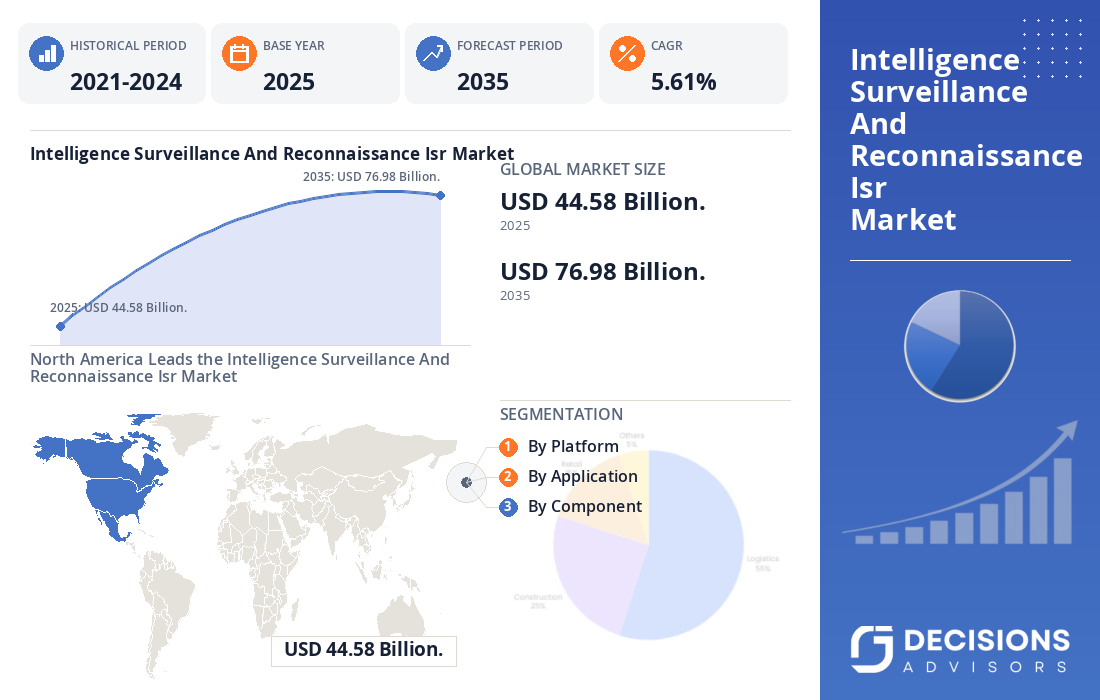
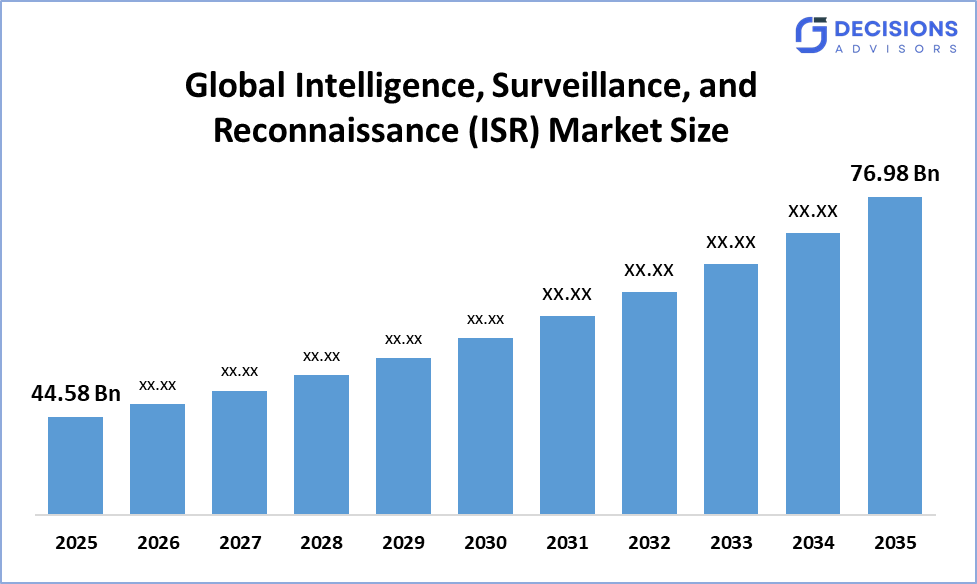
The Global Intelligence, Surveillance, and Reconnaissance (ISR) Market size is predicted to grow from USD 44.58 Billion in 2025 and is likely to reach around USD 76.98 Billion by 2035, growing at a CAGR of 5.61% during the forecast period. According to Decision Advisors, increasing geopolitical tensions, modernization of defense forces, and the growing deployment of AI-enabled surveillance systems are accelerating market expansion worldwide. The Military & Defense application dominates the market, accounting for approximately 63% of global demand. Lockheed Martin Corporation, with annual revenue of approximately USD 71.04 Billion (2025), remains one of the leading contributors through advanced ISR aircraft, satellites, radar systems, and integrated battlefield intelligence solutions.
Market Snapshot
- Global Intelligence, Surveillance, and Reconnaissance (ISR) Market Size (2025): USD 44.58 Billion.
- Projected Global Intelligence, Surveillance, and Reconnaissance (ISR) Market Size (2035): USD 76.98 Billion.
- Global Intelligence, Surveillance, and Reconnaissance (ISR) Market CAGR: 5.61%.
- Largest Regional Market: North America
- 2nd Largest Region: Asia-Pacific
- Fastest Growing Region: Europe
- Base Year: 2025
- Historical Period: 2021-2024
- Market Forecast Period: 2026-2035
Market Overview/ Introduction
The Global Intelligence, Surveillance, and Reconnaissance (ISR) Market comprises advanced technologies, integrated platforms, and data-centric systems designed to collect, process, analyze, and disseminate intelligence for military, security, and civil applications. ISR systems integrate satellites, airborne platforms, unmanned aerial vehicles (UAVs), naval assets, ground-based sensors, radar networks, electro-optical systems, communication equipment, and artificial intelligence to deliver real-time situational awareness. Governments worldwide continue investing in multi-domain ISR capabilities to strengthen border security, maritime surveillance, counter-terrorism operations, disaster response, and national defense modernization. The market continues to expand because of rising geopolitical conflicts, increasing defense budgets, rapid adoption of autonomous surveillance technologies, and growing investments in space-based intelligence capabilities. Artificial intelligence, machine learning, cloud-based analytics, and sensor fusion technologies are significantly improving intelligence accuracy while reducing response time. Major companies including Lockheed Martin, Northrop Grumman, RTX Corporation, BAE Systems, L3Harris Technologies, General Dynamics, Saab AB, Leonardo S.p.A., Elbit Systems, and Thales Group continue investing in next-generation ISR platforms featuring advanced radar, electronic warfare, cyber intelligence, and autonomous reconnaissance capabilities.
- United States, The U.S. Department of Defense continues expanding Joint All-Domain Command and Control (JADC2), accelerating integration of AI-enabled ISR platforms, satellite intelligence, and unmanned reconnaissance systems across military branches.
- Japan, Japan's National Defense Strategy significantly increases investment in space surveillance, early-warning systems, long-range reconnaissance aircraft, and integrated maritime ISR capabilities to strengthen Indo-Pacific security.
- United Kingdom, The UK's Defence Command Paper supports investments in autonomous surveillance systems, ISR aircraft modernization, cyber intelligence infrastructure, and next-generation military satellites under the Integrated Review framework.
Notable Insights: -
- North America is anticipated to hold approximately 39% share of the Global Intelligence, Surveillance, and Reconnaissance (ISR) Market over the forecast period.
- Europe is expected to witness the fastest CAGR while accounting for approximately 24% market share during the forecast period.
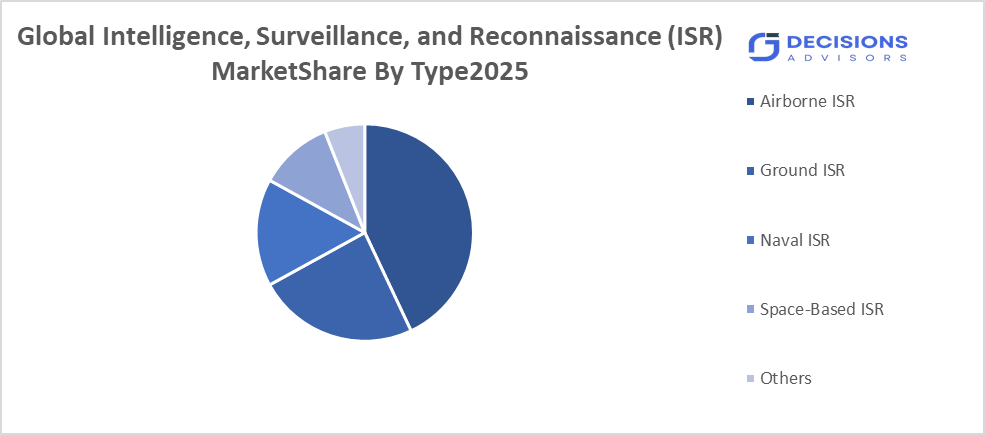
- By Platform, the Airborne segment dominated the market and held approximately 43% share in 2025 and is projected to grow at a substantial CAGR during the forecast period.
- By Application, the Military & Defense segment dominated the market and held approximately 63% share in 2025 and is projected to maintain its leadership.
- The Global Intelligence, Surveillance, and Reconnaissance (ISR) Market is projected to grow at a CAGR of 5.61%.
- The market is expected to reach USD 76.98 Billion by 2035.
Market Drivers
The Global Intelligence, Surveillance, and Reconnaissance (ISR) Market is primarily driven by increasing geopolitical instability, modernization of military forces, and growing emphasis on real-time battlefield awareness. Governments are significantly increasing investments in unmanned aerial vehicles, satellite constellations, advanced radar systems, cyber intelligence, and electronic warfare capabilities to improve operational efficiency and national security. The integration of artificial intelligence, machine learning, edge computing, and cloud-based analytics has transformed ISR operations by enabling faster intelligence processing, predictive threat detection, and autonomous decision support. Rising border security concerns, maritime surveillance requirements, anti-terrorism operations, and disaster management initiatives further contribute to market expansion.
Restrain
Despite strong growth prospects, the ISR market faces several challenges. High procurement costs associated with advanced surveillance aircraft, military satellites, sophisticated radar systems, and secure communication infrastructure limit adoption, particularly among developing economies. Integration complexity across multi-domain defense platforms and interoperability issues between legacy and next-generation systems increase deployment timelines and operational costs. Additionally, cybersecurity threats targeting ISR networks, stringent export control regulations, data privacy concerns, and dependence on highly specialized semiconductor and sensor supply chains continue to restrict market growth.
Competitive Analysis:
The report offers the appropriate analysis of the key organizations/companies involved within the Global Intelligence, Surveillance, and Reconnaissance (ISR) Market, along with a comparative evaluation primarily based on their product offerings, business overviews, geographic presence, enterprise strategies, segment market share, and SWOT analysis. The report also provides an elaborative analysis focusing on the current news and developments of the companies, which includes product development, innovations, joint ventures, partnerships, mergers & acquisitions, strategic alliances, and others. This allows for the evaluation of the overall competition within the market.
Top Companies in the Global Intelligence, Surveillance, and Reconnaissance (ISR) Market
- Lockheed Martin Corporation
- Northrop Grumman Corporation
- RTX Corporation
- L3Harris Technologies Inc.
- BAE Systems plc
- General Dynamics Corporation
- Leonardo S.p.A.
- Thales Group
- Saab AB
- Elbit Systems Ltd.
Government Initiatives
|
Country |
Key Government Initiatives |
|
United States |
The U.S. Department of Defense continues expanding the Joint All-Domain Command and Control (JADC2) program while increasing investments in AI-enabled ISR, autonomous reconnaissance, satellite surveillance, and integrated battlefield intelligence through the FY2025 defense budget. |
|
Japan |
Under Japan's National Defense Strategy and Defense Buildup Program, the government is strengthening space-based surveillance, maritime reconnaissance, early-warning radar systems, and unmanned ISR capabilities to improve regional security. |
|
China |
China's 14th Five-Year Plan prioritizes military modernization through investments in satellite constellations, unmanned aerial systems, AI-enabled surveillance, cyber intelligence, and integrated command-and-control capabilities for national defense. |
Market Segmentation
The Global Intelligence, Surveillance, and Reconnaissance (ISR) Market share is classified into Platform, Application, and Component
- The Airborne segment dominated the market and holds approximately 43% share in 2025 and is projected to grow at a substantial CAGR during the forecast period.
Based on the Platform, the global intelligence, surveillance, and reconnaissance market is divided into airborne, naval, ground, space-based, and others. Among these, the Airborne segment dominates the market with approximately 43% market share in 2025. Airborne ISR platforms including surveillance aircraft, UAVs, AEW&C aircraft, and reconnaissance helicopters provide long-range intelligence collection, rapid deployment capability, and real-time battlefield awareness. Continuous investments in autonomous drones, high-altitude surveillance aircraft, and multi-mission intelligence platforms continue supporting the segment's leadership.
- Military & Defense segment accounted for the largest share of approximately 63% in 2025 and is anticipated to grow at a significant CAGR during the forecast period.
Based on Application, the market is divided into military & defense, homeland security, border surveillance, maritime surveillance, and disaster management. Among these, Military & Defense accounted for the largest market share owing to increasing geopolitical conflicts, defense modernization programs, anti-terrorism operations, and rising procurement of advanced surveillance technologies. Governments worldwide continue prioritizing ISR capabilities to improve tactical intelligence, precision targeting, and strategic decision-making across land, sea, air, cyber, and space domains.
- The Sensors segment accounted for the largest share of approximately 37% in 2025 and is anticipated to grow at a significant CAGR during the forecast period.
Based on Component, the market is divided into sensors, communication systems, command & control systems, and electronic warfare systems. Among these, Sensors dominate the market due to increasing deployment of electro-optical sensors, infrared imaging, synthetic aperture radar, multispectral imaging systems, and advanced electronic intelligence sensors. Continuous technological advancements in AI-assisted sensing and high-resolution imaging continue driving strong demand globally.
Regional Segment Analysis of the Global Intelligence, Surveillance, and Reconnaissance (ISR) Market
- North America (U.S., Canada, Mexico)?
- Europe (Germany, U.K., France, Italy, Spain, Netherlands, Rest of Europe).
- Asia-Pacific (China, Japan, India, Australia, South Korea, Rest of Asia-Pacific).
- South America (Brazil, Argentina, Rest of South America).
- Middle East & Africa (UAE, Saudi Arabia, South Africa, Rest of MEA).
North America is anticipated to hold approximately 39% share of the Global Intelligence, Surveillance, and Reconnaissance (ISR) Market over the predicted timeframe.
North America dominates the market due to substantial defense budgets, continuous military modernization, advanced aerospace manufacturing capabilities, and the presence of major defense contractors including Lockheed Martin, Northrop Grumman, RTX Corporation, General Dynamics, and L3Harris Technologies. The United States leads investments in AI-enabled surveillance, military satellites, electronic warfare systems, autonomous UAVs, cyber intelligence, and multi-domain command systems. Strong government funding and continuous technological innovation maintain North America's leadership position.
Asia-Pacific is expected to grow at a rapid CAGR in the Global Intelligence, Surveillance, and Reconnaissance (ISR) Market, holding approximately 30% of the market share during the forecast period.
Asia-Pacific is witnessing rapid growth due to increasing defense expenditures across China, India, Japan, South Korea, and Australia. Rising border disputes, maritime security challenges, and expanding naval modernization programs are accelerating procurement of surveillance aircraft, reconnaissance satellites, and unmanned systems. Regional governments continue strengthening indigenous defense manufacturing and AI-enabled intelligence capabilities.
Europe is the fastest-growing region during the forecast period, holding approximately 24% share.
Europe experiences strong growth because of NATO defense commitments, increasing military cooperation, and investments in advanced ISR technologies. Countries including the United Kingdom, Germany, France, Italy, and Poland continue modernizing surveillance aircraft, battlefield intelligence systems, and satellite-based reconnaissance infrastructure. Growing emphasis on cybersecurity, electronic warfare, and integrated defense networks further strengthens regional demand.
Future Market Trends in Global Intelligence, Surveillance, and Reconnaissance (ISR) Market: -
-
- AI-Powered Intelligence Analytics
Artificial intelligence and machine learning are increasingly automating intelligence processing, target recognition, predictive threat analysis, and decision support. AI significantly reduces response times while improving surveillance accuracy across military and homeland security operations.
-
- Expansion of Autonomous ISR Platforms
Governments are rapidly deploying autonomous drones, unmanned ground vehicles, and autonomous maritime surveillance systems capable of operating in contested environments with minimal human intervention, improving operational efficiency while reducing personnel risks.
-
- Growth of Space-Based ISR Systems
The increasing deployment of low-Earth orbit satellites, synthetic aperture radar satellites, hyperspectral imaging systems, and commercial Earth observation constellations is enhancing global intelligence collection, maritime surveillance, and disaster monitoring capabilities.
-
- Multi-Domain Command and Control Integration
Modern defense organizations are integrating land, sea, air, cyber, and space intelligence into unified command-and-control platforms. Cloud computing, secure communications, and sensor fusion technologies enable real-time operational awareness across multiple combat domains.
Recent Development
- In April 2025, Lockheed Martin Skunk Works and Arquimea demonstrated an AI-enabled anomaly detection capability for Intelligence, Surveillance, and Reconnaissance (ISR) platforms, enhancing electro-optical and infrared surveillance performance through advanced AI-based image analysis.
- In September 2024, L3Harris Technologies secured a U.S. Air Force contract worth up to USD 182 million to deliver advanced Video Data Link (VDL) systems, strengthening real-time ISR communications and battlefield situational awareness for U.S. and allied forces.
- In June 2025, Lockheed Martin launched its AI Fight Club™ initiative to accelerate the testing and operational deployment of artificial intelligence across air, land, sea, and space defense missions, supporting next-generation ISR and autonomous military capabilities.
Market Segment
This study forecasts revenue at global, regional, and country levels from 2021 to 2035. Decision Advisors has segmented the global intelligence, surveillance, and reconnaissance market based on the below-mentioned segment:
Global Intelligence, Surveillance, and Reconnaissance (ISR) Market, By Platform
- Airborne
- Naval
- Ground
- Space-Based
- Others.
Global Intelligence, Surveillance, and Reconnaissance (ISR) Market, By Application
- Military & Defense
- Homeland Security
- Border Surveillance
- Maritime Surveillance
- Disaster Management.
Global Intelligence, Surveillance, and Reconnaissance (ISR) Market, By Component
- Sensors
- Communication Systems
- Command & Control Systems
- Electronic Warfare Systems.
Global Intelligence, Surveillance, and Reconnaissance (ISR) Market, By Regional Analysis
- North America
- US
- Canada
- Mexico
- Europe
- Germany
- UK
- France
- Italy
- Spain
- Russia
- Rest of Europe
- Asia Pacific
- China
- Japan
- India
- South Korea
- Australia
- Rest of Asia Pacific
- South America
- Brazil
- Argentina
- Rest of South America
- Middle East & Africa
- UAE
- Saudi Arabia
- Qatar
- South Africa
- Rest of the Middle East & Africa
Frequently Asked Questions (FAQ)
Q. What are the major technologies driving the Intelligence, Surveillance, and Reconnaissance (ISR) Market?
A. Artificial intelligence, machine learning, satellite imaging, electro-optical sensors, synthetic aperture radar, autonomous drones, cloud computing, and advanced communication systems are the major technologies transforming modern ISR operations by enabling faster and more accurate intelligence gathering.
Q. Why are airborne ISR platforms dominating the market?
A. Airborne platforms provide extensive coverage, rapid deployment, real-time intelligence collection, and operational flexibility. Their integration with advanced sensors and autonomous systems makes them essential for modern military reconnaissance and surveillance missions.
Q. Which end-use sector contributes the largest revenue in the ISR Market?
A. Military & Defense remains the largest revenue-generating application due to continuous investments in defense modernization, border security, counter-terrorism operations, electronic warfare, and multi-domain battlefield intelligence.
Q. What factors are expected to drive future market growth?
A. Increasing geopolitical tensions, defense modernization programs, AI-enabled surveillance, autonomous reconnaissance systems, satellite constellations, electronic warfare technologies, and growing investments in space-based intelligence infrastructure are expected to drive sustained market growth through 2035.
Check Licence
Choose the plan that fits you best: Single User, Multi-User, or Enterprise solutions tailored for your needs.
We Have You Covered
- 24/7 Analyst Support
- Clients Across the Globe
- Tailored Insights
- Technology Tracking
- Competitive Intelligence
- Custom Research
- Syndicated Market Studies
- Market Overview
- Market Segmentation
- Growth Drivers
- Market Opportunities
- Regulatory Insights
- Innovation & Sustainability
Report Details
| Scope | Global |
| Pages | 190 |
| Delivery | PDF & Excel via Email |
| Language | English |
| Release | Aug 2026 |
| Access | Download from this page |