
Global Intelligent Virtual Assistant Market
 |
Author:
Kunal M
|
Pages:
190
|
Author:
Kunal M
|
Pages:
190
Global Intelligent Virtual Assistant Market Size, Share By Product (Smart Speaker, Chatbot, In-Car IVA), By Deployment Mode (Cloud, On-Premises / Edge), By User-Interface Technology (Voice-Based (ASR + TTS), Text-Based (Text-to-Text), Multimodal (Voice-Visual)), and By Region (North America, Europe, Asia-Pacific, Latin America, Middle East & Africa), Analysis and Forecast 2026-2035.
CAGR
30.51%
REVENUE 2025
USD Billion 18.4
FORECAST 2035
USD Billion 263.7
REPORT COVERAGE
Global
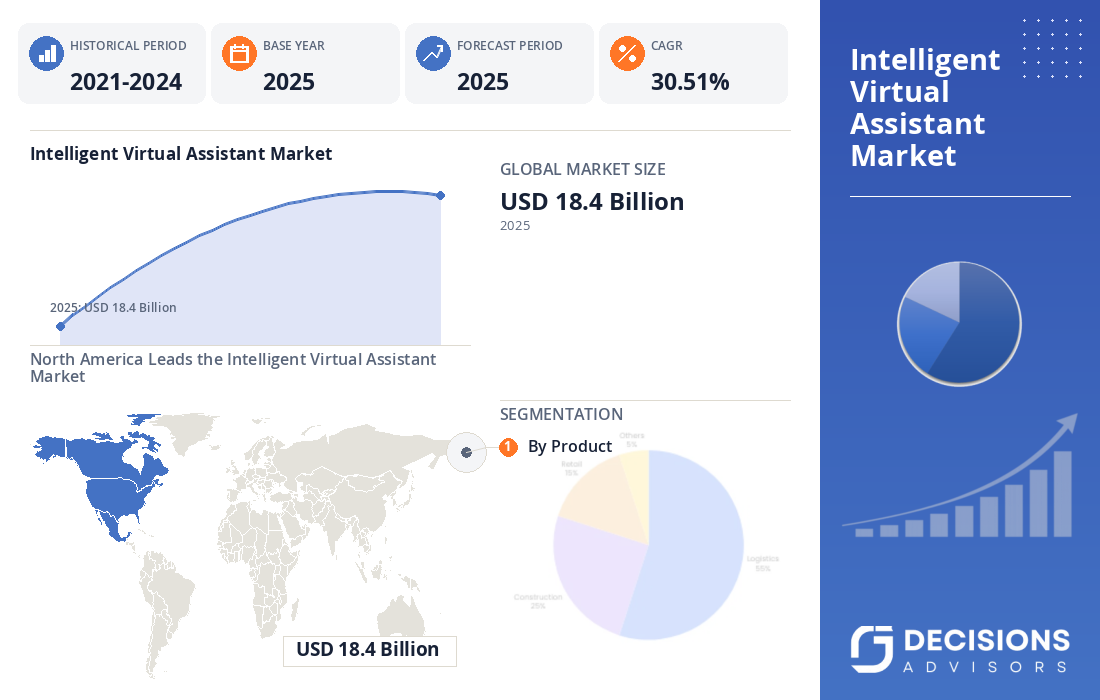
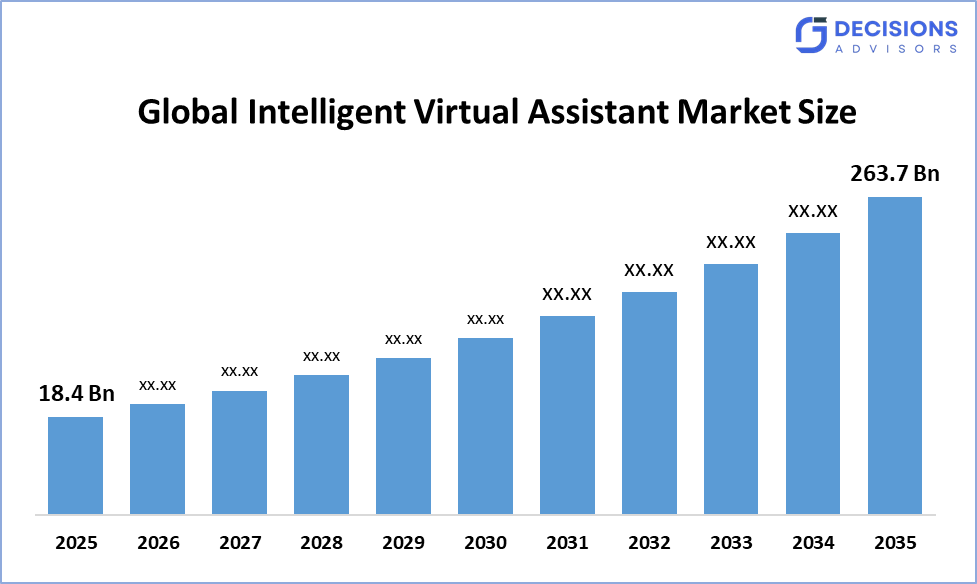
The Global Intelligent Virtual Assistant Market Size is predicted to grow from USD 18.4 Billion in 2025 and is likely to reach around USD 263.7 Billion by 2035 with a CAGR of 30.51%. According to Decision Advisors, the trend toward voice-based interfaces has become prevalent in the Global Intelligent Virtual Assistant Market, comprising almost 56.94% of the entire market share globally by 2025. Microsoft Corporation is one of the prominent firms because of the presence of the Copilot platform, along with enterprise AI and cloud services.
Market Snapshot
- Global Intelligent Virtual Assistant Market Size (2025): USD 18.4 Billion
- Projected Global Intelligent Virtual Assistant Market Size (2035): USD 263.7 Billion
- Global Intelligent Virtual Assistant Market Compound Annual Growth Rate (CAGR): 30.51%
- Largest Regional Market: North America
- 2nd Largest Region: Europe
- Fastest Growing Region: Asia Pacific
- Base Year: 2025
- Historical Period: 2021-2024
- Market Forecast Period: 2026-2035
Market Overview/ Introduction
The Global Intelligent Virtual Assistant Market consists of software products with AI capability which can understand natural language and automate assistance via text and voice to help customers in customer service, scheduling, data searching, and business processes. Governments have been supporting the use of AI with measures like U.S. National AI Initiative, European Union AI Act, and IndiaAI Mission. Some recent trends include the incorporation of AI generators, large language models, multilingual features, speech recognition capability, and personalization in virtual assistant platforms. Market growth is being fueled by the growing preference for automated customer assistance, the adoption of cloud technology, increase in usage of smartphones and smart devices, and the cost-cutting efforts by enterprises. Various organizations operating in the banking sector, healthcare, retail, telecommunication, and education sectors are implementing virtual assistants to enhance their productivity and customer engagement.
- The Ministry of Minority Affairs is leveraging the IndiaAI Mission to integrate AI-powered multilingual virtual assistants and smart digital interfaces into public services, streamlining citizen support via apps like Haj Suvidha.
- The European Union’s proposed AI Act fosters ethical conversational tech while allocating specialized public funding, prompting agencies and healthcare providers to deploy secure, compliant virtual assistants that align with strict data sovereignty standards.
Notable Insights: -
- North America is anticipated to hold approximately 36.55% share of the Global Intelligent Virtual Assistant Market over the predicted timeframe.
- Asia-Pacific is expected to grow at a rapid CAGR in the Global Intelligent Virtual Assistant Market by holding approximately 29.4% of the share during the forecast period.
- By product, the Chatbot segment dominated the market and holds approximately 48% share in 2025 and is projected to grow at a substantial CAGR during the forecast period.
- By deployment mode, the Cloud segment dominated the market and holds approximately 72% share in 2025 and is projected to grow at a substantial CAGR during the forecast period.
- The compound annual growth rate of the Global Intelligent Virtual Assistant Market is 30.51%.
- The market is likely to achieve a valuation of USD 263.7 Billion by 2035.
Market Drivers
The Global Intelligent Virtual Assistant Market is witnessing significant growth owing to high demands for automated services with the help of AI technology in customer service, business operations, and digital interactions. Rapid developments in generative AI, natural language processing (NLP), machine learning, and speech recognition technologies are enhancing virtual assistant functionality and experience for users. High penetration rates of smartphones, smart speakers, and smart devices are creating more avenues for deployment of the technology. Companies are making increasing use of intelligent virtual assistants for round-the-clock customer service, reduction in costs, and response times. The growth in cloud computing infrastructure is allowing companies to deploy the technology more easily and at lower costs. Increasing use in industries such as banking, healthcare, retail, telecommunications, education, and e-commerce is contributing towards growth of the market.
Restrain
Data privacy issues, cybersecurity threats, erroneous responses, integration difficulties, high implementation costs, and regulatory compliance requirements are some of the difficulties facing the global intelligent virtual assistant market. Adoption may be hampered by data privacy issues since virtual assistants handle sensitive personal and corporate data.
Competitive Analysis:
The report offers the appropriate analysis of the key organizations/companies involved within the Global Intelligent Virtual Assistant Market along with a comparative evaluation primarily based on their product offerings, business overviews, geographic presence, enterprise strategies, segment market share, and SWOT analysis. The report also provides an elaborative analysis focusing on the current news and developments of the companies, which includes product development, innovations, joint ventures, partnerships, mergers & acquisitions, strategic alliances, and others. This allows for the evaluation of the overall competition within the market.
Top Companies in the Global Intelligent Virtual Assistant Market
- Apple Inc.
- Google LLC
- Amazon.com, Inc.
- Microsoft Corporation
- IBM Corporation
- Baidu, Inc.
- Samsung Electronics Co., Ltd.
- Oracle Corporation
- Nuance Communications, Inc.
- 24/7.ai
Government Initiatives
|
Country |
Key Government Initiatives |
|
India |
The National Informatics Centre launched Virtual Assistance by NIC (VANI) to provide multilingual conversational AI and voice-based governance services across multiple regional languages. |
|
United Arab Emirates |
The Ministry of Interior utilizes advanced AI assistants for 24/7 omnichannel citizen services, supporting a national strategy for streamlined bureaucratic operations. |
|
China |
Government programs funding localized AI innovation and smart city transformations drive massive enterprise and consumer adoption of embedded virtual assistants. |
Market Segmentation
The Global Intelligent Virtual Assistant Market share is classified into Product, Deployment Mode and User-Interface Technology
- The Chatbot segment dominated the market and holds approximately 48% share in 2025 and is projected to grow at a substantial CAGR during the forecast period.
Based on the product, the Global Intelligent Virtual Assistant Market can be categorized into Smart Speaker, Chatbot, and In-Car IVA. Out of all these, the Chatbot sub-segment accounts for more than 48% of the market share in 2025. The reason for their dominance in the market is the growing popularity of artificial intelligence-based customer services, automation of communications, and digital engagements. The chatbots offer round-the-clock support, personalized conversations, and affordable service provision in the areas of banking, healthcare, retail, telecommunication, and e-commerce.
- The Cloud segment accounted for the largest share of approximately 72% in 2025 and is anticipated to grow at a significant CAGR during the forecast period.
Based on the deployment mode, the Global Intelligent Virtual Assistant Market consists of two segments which include Cloud and on premises / Edge. Out of the two, the Cloud segment leads the market and accounts for approximately 72% of the share in 2025. The Cloud segment has the edge due to its scalable nature, easy deployment process, cost savings on infrastructure, and integration with AI-driven software applications. Using cloud-based intelligent virtual assistants allows companies to offer remote and real-time customer support at lower operational costs.
- The Voice-Based segment accounted for the largest share of approximately 52% in 2025 and is anticipated to grow at a significant CAGR during the forecast period.
Based on user-interface technology, the Global Intelligent Virtual Assistant Market can be segmented into Voice-Based (ASR + TTS), Text-Based (Text-to-Text), and Multimodal (Voice-Visual). Out of these segments, the Voice-Based segment accounts for a large share of the Global Intelligent Virtual Assistant Market and constitutes around 52% in 2025. This is because there is increasing use of voice assistants in smartphones, smart speakers, cars, and connected devices. There have been improvements in ASR, TTS, NLP, and voice technology.
Regional Segment Analysis of the Global Intelligent Virtual Assistant Market
- Asia-Pacific (China, India, Japan, and Rest of Asia-Pacific)?
- North America (United States and Canada)
- Europe (United Kingdom, Germany, France, and Rest of Europe)
- Latin America (Brazil, Mexico, and Rest of Latin America)?
- The Middle East and Africa (United Arab Emirates (UAE), Saudi Arabia, South Africa, and Rest of MEA)
North America is anticipated to hold approximately 36.55% share of the Global Intelligent Virtual Assistant Market over the predicted timeframe.
The North America region represents about 36.55% of the Global Intelligent Virtual Assistant Market due to the high availability of artificial intelligence infrastructure, smart devices, and high demand for conversational AI solutions in the area. North America consists of technologically advanced countries like the United States and Canada which use intelligent virtual assistants in enterprises for customer services and enterprise automation purposes. Availability of advanced technology companies, cloud-computing infrastructure, and generative AI solutions further support the development of the market. Adoption of voice assistants, smart speakers, chatbots, and customer engagement AI solutions will be one of the growth factors in the coming years.
Europe is expected to grow at a rapid CAGR in the Global Intelligent Virtual Assistant Market, holding approximately 22.9% of the share during the forecast period
The Europe represents about 22.9% of the Global Intelligent Virtual Assistant Market due to the rise in the implementation of artificial intelligence, conversational AI, and digital customer engagement solutions. Europe is characterized by a sophisticated technological ecosystem, developed digital infrastructure, and investment in AI and cloud-based technologies. Enterprises from the fields of healthcare, banking, retail, telecommunications, and other industries are increasingly using intelligent virtual assistants to increase their efficiency and improve customer service. The increasing usage of voice assistants, AI chatbots, multilingual conversational systems, and personalization in the digital environment drives the growth of the regional market. Also, the rise in concern regarding data privacy, cybersecurity, responsible AI, and compliance with regulations promotes the creation of secure virtual assistant solutions.
Asia Pacific is the fastest-growing region in the Global Intelligent Virtual Assistant Market during the period, holding approximately 23.8% share.
The Asia-Pacific region makes up about 23.8% of the Global Intelligent Virtual Assistant Market owing to the rapid uptake of artificial intelligence, growing digital infrastructure, and high demand for conversational and voice technologies. Regions like China, Japan, India, and South Korea have seen significant deployments of intelligent virtual assistants in sectors including healthcare, retail, banking, telecoms, automobile, and many others. The Asia-Pacific region is experiencing increased use of smartphones, cloud technologies, enterprise automation, and generative AI. High demand for multilingual assistants, personalized digital experiences, smart speakers, and artificial intelligence-supported customer services is contributing to the growth of the regional market.
Future Market Trends in Global Intelligent Virtual Assistant Market: -
-
- Expansion of Generative AI-Powered Assistants
With the advancement of generative artificial intelligence technology, intelligent virtual assistants are now capable of having more human-like conversations, providing context-based responses, offering personalized advice, and performing complicated tasks. The integration of large language models has helped virtual assistants offer better performance in various fields including customer support, healthcare, banking, retail, and enterprise operations.
-
- Rising Adoption of Multimodal Virtual Assistants
Modern intelligent virtual assistants are integrating multimodal interactions using voice, text, visual information, and context to create a more intuitive user experience. Such an approach allows these systems to receive various inputs and interact effectively on smartphones, cars, smart devices, and enterprise applications. Improvements in AI, computer vision, speech recognition, and NLP make global implementation possible.
-
- Growth in Enterprise Automation
Intelligent virtual assistants are being used by firms for automated processes such as customer support, employee assistance, appointment scheduling, data retrieval, and various other administrative tasks. Virtual assistants assist firms in cutting down on their operational expenses and offer timely responses. Digital transformation efforts in banking, healthcare, telecom, retail, and e-commerce are fueling this global trend considerably.
-
- Rising Integration with Smart Devices and IoT
Smart assistants have become an integral part of various smart devices such as smart speakers, smart cars, smart phones, home appliances, wearables, and IoT systems. The voice-based interface enables convenient and customized experience through connected devices. Smart devices’ high penetration, advancement in speech recognition technology, availability of cloud services, and consumer demands are driving global market growth.
Recent Development
- In February 2025, Amazon released Alexa+, a generative AI-powered next-generation voice assistant. It is a sophisticated subscription service that offers extensive, conversational, and highly tailored user interactions.
- In May 2026, Google unveiled Gemini Spark, an agentic personal assistant that integrates seamlessly with Gmail and Google Cloud and can carry out long-term activities with little supervision.
- In April 2026, Meta unveiled Muse Spark, a cutting-edge AI model that gives Meta AI better capabilities, such as quicker voice answers and increased conversational support across all Meta platforms.
Market Segment
This study forecasts revenue at global, regional, and country levels from 2020 to 2035. Decision Advisors has segmented the Global Intelligent Virtual Assistant Market based on the below-mentioned segments:
Global Intelligent Virtual Assistant Market, By Product
- Smart Speaker
- Chatbot, In-Car IVA
Global Intelligent Virtual Assistant Market, By Deployment Mode
- Cloud
- On-Premises / Edge
Global Intelligent Virtual Assistant Market, By User-Interface Technology
- Voice-Based (ASR + TTS)
- Text-Based (Text-to-Text)
- Multimodal (Voice-Visual)
Global Intelligent Virtual Assistant Market, By Regional Analysis
- Asia-Pacific
- China
- India
- Japan
- Rest of Asia-Pacific
- North America
- United States
- Canada
- Europe
- United Kingdom
- Germany
- France
- Rest of Europe
- Latin America
- Brazil
- Mexico
- Rest of Latin America
- Middle East & Africa
- United Arab Emirates (UAE)
- Saudi Arabia
- South Africa
- Rest of MEA
Frequently Asked Questions (FAQ)
Q. How are intelligent virtual assistants improving customer interactions?
A. They offer individualized answers, quicker query resolution, round-the-clock automated assistance, and smooth phone, text, and digital platform connection.
Q. Why are businesses adopting intelligent virtual assistants?
A. Thru scalable AI-powered support, they lower operating costs, automate repetitive processes, increase customer engagement, and improve service efficiency.
Q. What role does generative AI play in intelligent virtual assistants?
A. Virtual assistant capabilities are greatly enhanced by generative AI, which makes it possible for more natural chats, contextual comprehension, tailored responses, and sophisticated job execution.
Q. How is cloud technology influencing the intelligent virtual assistant market?
A. Scalable infrastructure, remote accessibility, simpler integration, and economical deployment of AI-powered virtual assistants across industries are all made possible by cloud platforms.
Check Licence
Choose the plan that fits you best: Single User, Multi-User, or Enterprise solutions tailored for your needs.
We Have You Covered
- 24/7 Analyst Support
- Clients Across the Globe
- Tailored Insights
- Technology Tracking
- Competitive Intelligence
- Custom Research
- Syndicated Market Studies
- Market Overview
- Market Segmentation
- Growth Drivers
- Market Opportunities
- Regulatory Insights
- Innovation & Sustainability
Report Details
| Scope | Global |
| Pages | 190 |
| Delivery | PDF & Excel via Email |
| Language | English |
| Release | Aug 2026 |
| Access | Download from this page |