
Global Interface IC Market
 |
Author:
Achal E
|
Pages:
220
|
Author:
Achal E
|
Pages:
220
Global Interface IC Market Size, Share By Type of Interface (Analog, Digital, and Mixed-Signal), By Interface Standard (Serial, Parallel, and High-Speed), By End Use (Consumer Electronics, Automotive, Industrial Automation, Telecommunications, and Others), and By Region (North America, Europe, Asia-Pacific, Latin America, Middle East & Africa), Analysis and Forecast 2026-2035.
CAGR
4.26%
REVENUE 2025
USD Billion 2.9
FORECAST 2035
USD Billion 4.4
REPORT COVERAGE
Global
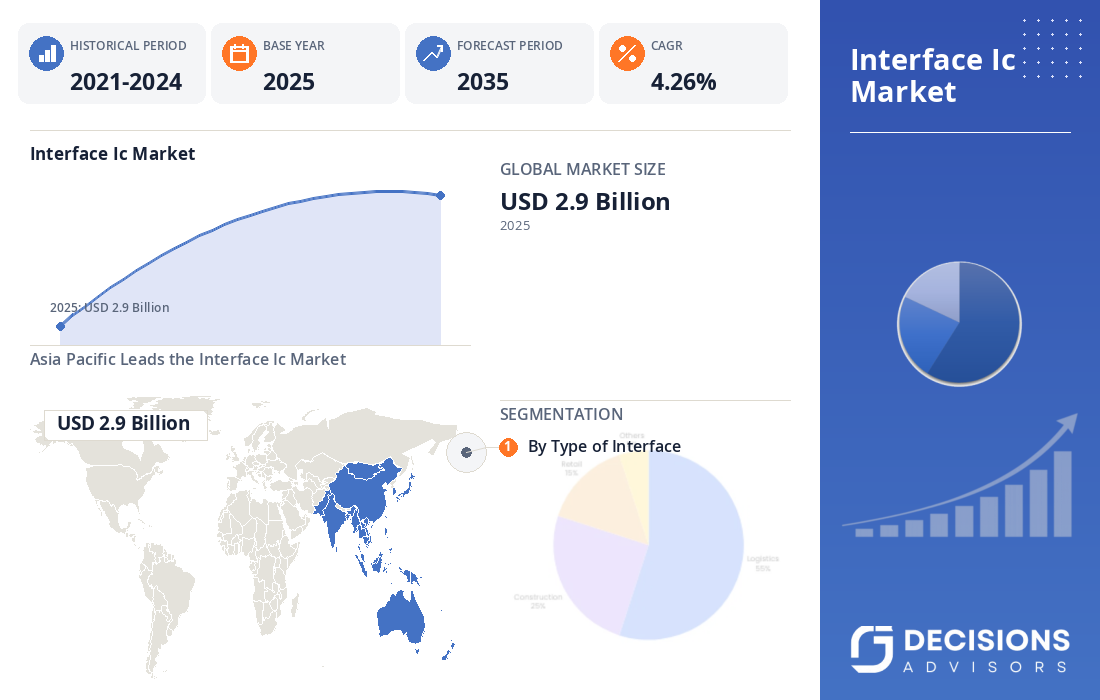
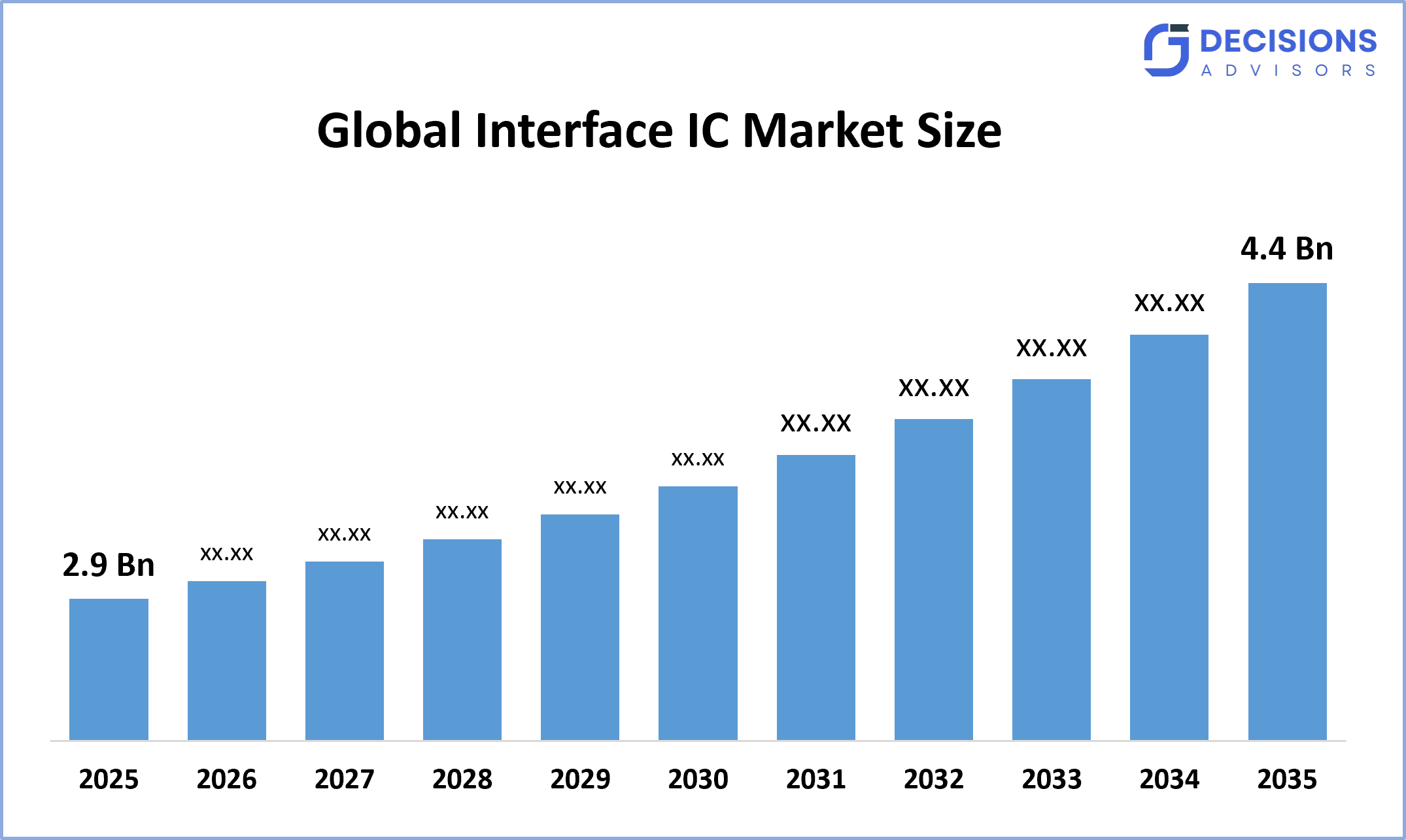
The Global Interface IC Market Size is predicted to grow from USD 2.9 Billion in 2025 and is likely to reach around USD 4.4 Billion by 2035 with a CAGR of 4.26%. According to Decision Advisors, there are several trends being observed in the market such as high-speed connectivity, low power consumption, multi-protocol interfaces, auto electronics, industrial automation, and data centers applications. Increasing adoption of USB, Ethernet, serial, display, and high-speed interface integrated circuits is driving market growth. Texas Instruments is a leading player in the market with a market share of more than 17%, followed by Analog Devices, NXP Semiconductors, STMicroelectronics, and Semtech.
Market Snapshot
- Global Interface IC Market Size (2025): USD 2.9 Billion
- Projected Global Interface IC Market Size (2035): USD 4.4 Billion
- Global Interface IC Market Compound Annual Growth Rate (CAGR): 4.26%
- Largest Regional Market: Asia Pacific
- 2nd Largest Region: North America
- Fastest Growing Region: North America
- Base Year: 2025
- Historical Period: 2021-2024
- Market Forecast Period: 2026-2035
Market Overview/ Introduction
The Global Interface IC Market involves the use of integrated circuits that enable communication, signal translation, and data transfer among the electronic components, devices, and systems. The market consists of integrated circuits that are extensively used in consumer electronics, automotive system, telecommunication, industrial machinery, medical devices, and computer systems. Government Initiatives: Government schemes like U.S. CHIPS and Science Act and the European Chips Act enable domestic production, research and innovation, packaging, and the supply chain resilience of semiconductors and help in interface IC development. Recent Trends: The semiconductor companies are offering high-speed and low power interface products specifically for AI infrastructure, electric vehicles, connected devices, and industrial automation. Drivers: Market growth is fueled by growing requirements of high-speed connections, USB, Ethernet, display interface, automotive systems, intelligent devices, and data center infrastructure. Digitalization, connected technologies, automation, and high-end computing are some of the trends encouraging interface IC development.
- The EU Chips Act scales up public-private investments toward a targeted €120 billion by 2035. The framework aims to secure supply chains for smart automotive networks and industrial connectivity.
- The India Semiconductor Mission and its DLI scheme back local design startups and EDA tools. Expanded Phase 2 targets local IP creation and robust packaging to reduce import dependence.
Notable Insights: -
- Asia-Pacific is anticipated to hold approximately 41.9% share of the Global Interface IC Market over the predicted timeframe.
- North America is expected to grow at a rapid CAGR in the Global Interface IC Market by holding approximately 34.7% of the share during the forecast period.
- By type of interface, the Digital Interface IC, segment dominated the market and holds approximately 42% share in 2025 and is projected to grow at a substantial CAGR during the forecast period.
- By interface standard, the Serial Interface segment dominated the market and holds approximately 46% share in 2025 and is projected to grow at a substantial CAGR during the forecast period.
- The compound annual growth rate of the Global Interface IC Market is 4.26%.
- The market is likely to achieve a valuation of USD 4.4 Billion by 2035.
Market Drivers
The Global Interface IC Market is witnessing growth due to the rising requirement of fast communication between various electronic parts present in smartphones, computers, and connected devices. With the growing implementation of 5G networks, Internet of Things (IoT), and edge computing, there has been an increasing usage of advanced interface ICs to ensure effective data transfer. The growth in automotive electronics such as infotainment, driver assistance systems, and electric vehicles will also help in supporting the growth of the market. Automation in the industrial sector and implementation of Industry 4.0 initiatives have increased the need for interface ICs in robotics, control systems, and smart manufacturing equipment. Rapid development in data centers, artificial intelligence systems, and high-performance computing has created the need for high-speed interfaces.
Restrain
High semiconductor manufacturing prices, complicated design specifications, supply-chain interruptions, and quick technical obsolescence are some of the obstacles that the global interface IC industry must overcome to develop. Sophisticated technologies are needed for advanced interface IC fabrication, which raises production costs and restricts manufacturers' capacity to purchase them.
Competitive Analysis:
The report offers the appropriate analysis of the key organizations/companies involved within the Global Interface IC Market along with a comparative evaluation primarily based on their product offerings, business overviews, geographic presence, enterprise strategies, segment market share, and SWOT analysis. The report also provides an elaborative analysis focusing on the current news and developments of the companies, which includes product development, innovations, joint ventures, partnerships, mergers & acquisitions, strategic alliances, and others. This allows for the evaluation of the overall competition within the market.
Top Companies in the Global Interface IC Market
- Texas Instruments
- Analog Devices
- NXP Semiconductors
- Infineon Technologies
- Microchip Technology
- STMicroelectronics
- Renesas Electronics
- ON Semiconductor
- Broadcom
- Semtech
Government Initiatives
|
Country |
Key Government Initiatives |
|
United States |
Provides $52.7 billion for semiconductor manufacturing, R&D, and workforce development. It includes vital incentives for mature and legacy nodes essential for automotive and industrial interface ICs. |
|
European Union |
Mobilizes public-private funds targeting €120 billion by 2035. The updated framework emphasizes demand accelerators, linking local European startups directly with domestic chipmakers. |
|
China |
Capitalized with roughly $47.5 billion, this third iteration of the "Big Fund" focuses heavily on overcoming Western trade restrictions by funding local lithography and mature-to-advanced IC tools. |
Market Segmentation
The Global Interface IC Market share is classified into Type of Interface, Interface Standard and End Use
- The Digital Interface ICs segment dominated the market and holds approximately 42% share in 2025 and is projected to grow at a substantial CAGR during the forecast period.
Based on the type of interface, the Global Interface IC Market can be segmented into three categories, namely the Analog, Digital, and Mixed Signal Interfaces. Of these segments, the Digital Interface ICs lead the market with a 42% market share in 2025. This can be due to growing demand for faster data transmission and better signal processing in electronic devices. Digital Interface ICs find their applications in smartphones, computers, automotive electronics, industrial electronics, data centres, and telecommunication equipment, among others.
- The Serial Interface segment accounted for the largest share of approximately 46% in 2025 and is anticipated to grow at a significant CAGR during the forecast period.
Based on the interface standard, the Global Interface IC Market is segmented into Serial Interface, Parallel Interface, and High-Speed Interface. In all these segments, the highest market share is held by Serial Interface Segment, which is expected to capture around 46% of market share in 2025. The reason behind such high market share is attributed to the growing requirement for reliable communication of data, fewer wires, and connectivity efficiency. These serial interfaces are majorly employed in consumer electronics, automobiles, industrial systems, telecommunication devices, and computing systems.
- The Hospitals and Retail Pharmacies segment accounted for the largest share of approximately 58% in 2025 and is anticipated to grow at a significant CAGR during the forecast period.
Based on end use, the Global Interface IC Market is categorized into Consumer Electronics, Automotive, Industrial Automation, Telecommunication, and Others. Out of these segments, the Consumer Electronics segment captured the largest market share and is estimated to have around 38% share by 2025. The reasons behind such high market share of the segment include growing demand for smartphones, laptops, tablets, smart televisions, game consoles, and other electronic devices. Adoption of advanced connectivity technologies and high-speed data interface technologies is another reason behind segment growth.
Regional Segment Analysis of the Global Interface IC Market
- Asia-Pacific (China, Japan, South Korea, Taiwan, India, and Rest of Asia-Pacific)?
- North America (United States and Canada)
- Europe (Germany, UK, France, Italy, and Rest of Europe)
- Latin America (Brazil, Mexico, Argentina, and Rest of Latin America)?
- The Middle East and Africa (UAE, Saudi Arabia, South Africa, and Rest of MEA)
Asia-Pacific is anticipated to hold approximately 41.9% share of the Global Interface IC Market over the predicted timeframe.
The Asia-Pacific market occupies around 41.9% of the total Global Interface IC market owing to its robust semiconductor industry and high demand for electronics, telecommunication products, automotive electronics, and industrial automation. Major players contributing towards the growth of the market in the region include China, Japan, South Korea, Taiwan, and India. Strengths of the region include an existing electronics industry infrastructure, increased semiconductor manufacturing, greater use of connected devices, and increased investment in advanced computing and high-speed connectivity technologies.
North America is expected to grow at a rapid CAGR in the Global Interface IC Market, holding approximately 34.7% of the share during the forecast period
The North America Region represents about 34.7% of the Global Interface IC Market owing to the high capability of semiconductors, increasing use of AI and data center infrastructure, adoption of electronic systems for automobiles, industrial automation, and developments in high-speed connectivity technologies. The region derives advantage from the growing need for advanced interface ICs in computing, telecom, electric vehicles, and connected devices.
Europe is the fastest-growing region in the Global Interface IC Market during the period, holding approximately 26.1% share.
The Global Interface IC market shares 26.1% of its sales in Europe, owing to significant production in the automotive electronics sector, along with industrial automation, telecommunication infrastructure, initiatives of building smart cities, and high-level engineering skills. Some of the main countries that contribute to the European demand include Germany, United Kingdom, France, and Italy.
Future Market Trends in Global Interface IC Market: -
-
- Rising Adoption of High-Speed Interface ICs
High speed IC interface solutions are gaining popularity in data centers, AI infrastructure, telecommunication networks, and high-end computing systems. The need for greater bandwidth is driving manufacturers to design solutions that are faster, efficient, and reliable. An increased demand for high-speed connectivity solutions will likely drive adoption in computing, networking, automotive, and industrial sectors worldwide.
-
- Integration of AI and Advanced Computing
There is increasing convergence of technology with artificial intelligence and computing that requires development of complex IC interfaces that can facilitate high-speed communication and processing capabilities. They enhance connectivity among processors, memory modules, sensors and peripherals. Growing AI infrastructure, edge computing and machine learning applications will add to this innovation trend.
-
- Growth in Automotive Interface ICs
Interface ICs are finding more use in the infotainment, advanced driver assistance, electric vehicles, digital cockpit, and car-to-car networks. With the increasing electrification of cars and rising content per vehicle, there is increasing demand for communication solutions. Interface ICs have thus become a hot choice for semiconductor companies to come up with innovative solutions.
-
- Expansion of IoT and Connected Devices
There is a huge rise in the number of IoT ecosystem growth which will lead to greater demand for interface ICs that can facilitate seamless communication between sensors, processor, controller, and other interconnected components. The smart home, industrial IoT, wearables, and interconnected appliances are some examples where there will be a need for energy-efficient interface ICs.
Recent Development
- In In April 2022, Texas Instruments released CAN signal-improvement-capable transceivers that enable intricate automotive and industrial network designs and increase dependability at higher data rates.
- In October 2022, Analog Devices and Keysight Technologies worked together to develop phased-array technology, integrating interface, testing, and calibration capabilities for advanced connectivity systems, radar, and satellite communications.
- In July 2023, Compact bridges and protocol converters for networked, low-power electronic applications were added to NXP's interface portfolio along with I2C, SPI, and faster I3C solutions.
Market Segment
This study forecasts revenue at global, regional, and country levels from 2020 to 2035. Decision Advisors has segmented the Global Interface IC Market based on the below-mentioned segments:
Global Interface IC Market, By Type of Interface
- Analog
- Digital
- Mixed-Signal
Global Interface IC Market, By Interface Standard
- Serial,
- ParallelHigh-Speed
Global Interface IC Market, By End Use
- Consumer Electronics
- Automotive
- Industrial Automation
- Telecommunications
- Others
Global Interface IC Market, By Regional Analysis
- Asia-Pacific
- China
- Japan
- South Korea
- TaiwanIndia
- Rest of Asia-Pacific
- North America
- United States
- Canada
- Europe
- Germany
- UK
- France Italy
- Rest of Europe
- Latin America
- Brazil
- Mexico
- Argentina
- Rest of Latin America
- Middle East & Africa
- UAE
- Saudi Arabia
- South Africa
- Rest of MEA
Frequently Asked Questions (FAQ)
Q. How are interface ICs improving connectivity in modern electronic devices?
A. Interface integrated circuits (ICs) improve data transfer, system performance, and connection across electronic applications by facilitating dependable, fast communication between processors, sensors, memory, and peripheral devices.
Q. Why are interface ICs important in automotive applications?
A. They facilitate effective data interchange in connected and electric automobiles by facilitating communication between sensors, controllers, networking modules, infotainment units, and vehicle electronic systems.
Q. What role do interface ICs play in industrial automation?
A. Interface integrated circuits (ICs) provide automation, real-time monitoring, machine connectivity, and effective manufacturing operations by facilitating communication between industrial controllers, sensors, actuators, and networking equipment.
Q. How is semiconductor innovation influencing interface IC development?
A. High-speed communication, AI infrastructure, IoT devices, and next-generation electronic systems are all supported by smaller, quicker, lower-power, and highly integrated interface ICs made possible by advancements in semiconductor technology.
Check Licence
Choose the plan that fits you best: Single User, Multi-User, or Enterprise solutions tailored for your needs.
We Have You Covered
- 24/7 Analyst Support
- Clients Across the Globe
- Tailored Insights
- Technology Tracking
- Competitive Intelligence
- Custom Research
- Syndicated Market Studies
- Market Overview
- Market Segmentation
- Growth Drivers
- Market Opportunities
- Regulatory Insights
- Innovation & Sustainability
Report Details
| Scope | Global |
| Pages | 220 |
| Delivery | PDF & Excel via Email |
| Language | English |
| Release | Aug 2026 |
| Access | Download from this page |