
Global Internet of Things (IoT) Microcontroller Market
 |
Author:
Achal E
|
Pages:
200
|
Author:
Achal E
|
Pages:
200
Global Internet of Things (IoT) Microcontroller Market Size, Share By Product (8 Bit, 16 Bit, 32 Bit), By Application (Industrial Automation, Smart Homes, Consumer Electronics, Smartphones, Wearables, Others, Others), By End-User (Consumer Electronics, Automotive, Industrial Automation, and Healthcare), and By Region (North America, Europe, Asia-Pacific, Latin America, Middle East & Africa), Analysis and Forecast 2026-2035
CAGR
14.13%
REVENUE 2025
USD Billion 6.23
FORECAST 2035
USD Billion 23.37
REPORT COVERAGE
Global
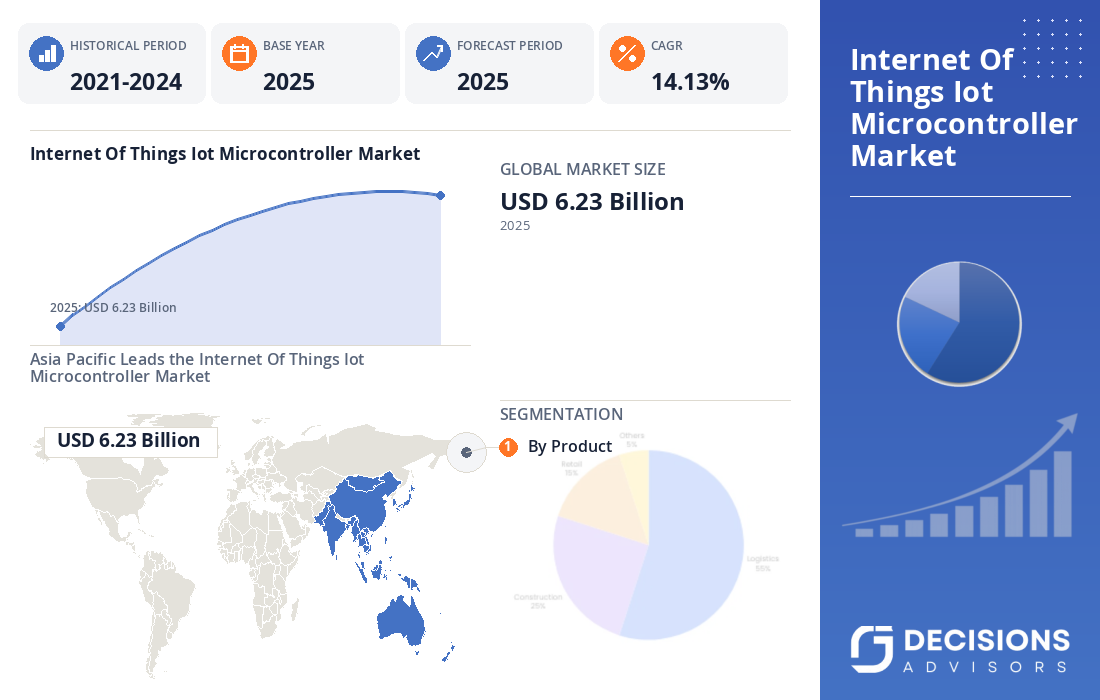
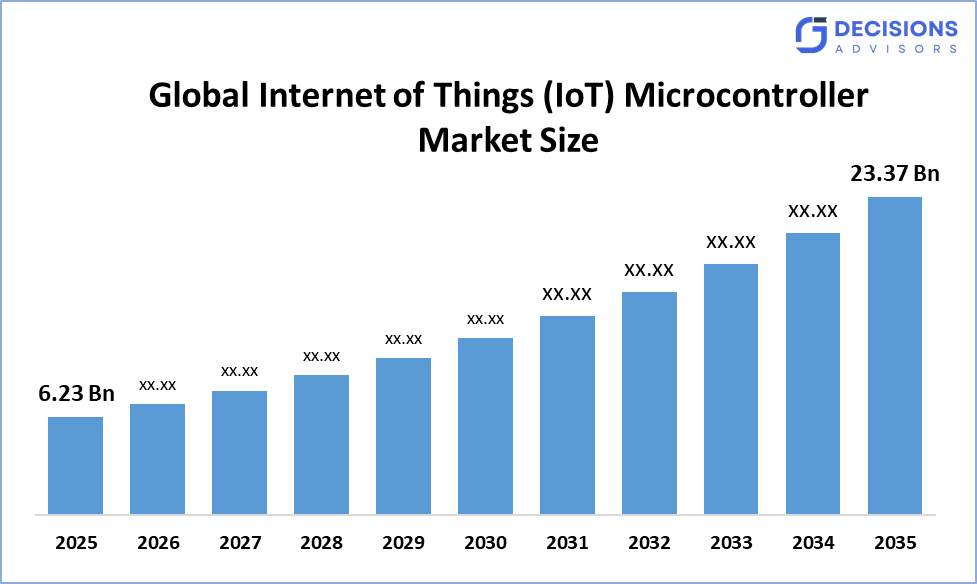
The Global Internet of Things (IoT) Microcontroller Market Size is predicted to grow from USD 6.23 Billion in 2025 and is likely to reach around USD 23.37 Billion by 2035 with a CAGR of 14.13%. According to Decision Advisors, some of the key trends influencing the market include edge computing, artificial intelligence-based IoTs, low power MCUs, cybersecurity, and a higher need for wireless connectivity. 32-bit microcontrollers are becoming popular in applications such as smart homes, industrial automation, consumer electronic devices, and medical IoTs. Infineon Technologies is dominating the entire global microcontroller market with a share of around 23.2% in 2025. Other companies like STMicroelectronics, NXP Semiconductors, Renesas Electronics, Microchip Technology, and Texas Instruments are making significant contributions in the field of IoT MCUs.
Market Snapshot
- Global Internet of Things (IoT) Microcontroller Market Size (2025): USD 6.23 Billion
- Projected Global Internet of Things (IoT) Microcontroller Market Size (2035): USD 23.37 Billion
- Global Internet of Things (IoT) Microcontroller Market Compound Annual Growth Rate (CAGR): 14.13%
- Largest Regional Market: Asia Pacific
- 2nd Largest Region: North America
- Fastest Growing Region: Asia Pacific
- Base Year: 2025
- Historical Period: 2021-2024
- Market Forecast Period: 2026-2035
Market Overview/ Introduction
The Global Internet of Things (IoT) Microcontroller Market consists of microcontroller units (MCUs) that are used in IoT-based devices to control, process, connect, and protect data. The government initiatives like the CHIPS and Science Act in the USA, Digital Decade initiative by the EU, and various initiatives for smart city and Industry 4.0 in respective nations help with semiconductor production, deployment of connected devices, and development of the digital infrastructure. Recent trends include the launch of the Pico 2 W from Raspberry Pi in November 2024 that combines Wi-Fi and Bluetooth functionality with the use of RP2350 MCU. Factors contributing to the market growth include fast adoption of IoT, industry automation, edge computing, growth of smart home markets, and the need for low power consumption and connectivity of MCUs. Asia Pacific continues to be an important region due to growing electronics manufacturing and Industry 4.0 implementation. Another factor is the growing use of AI-powered edge devices and real-time processing.
- India’s $10 billion investment program supports local chip manufacturing, design-linked incentives, and smart metering mandates. It aims to secure domestic wafer capacity and build an independent electronics ecosystem.
- European Union regulations emphasize green transitions and energy efficiency. Public funding and strict compliance mandates require industrial automation updates, driving high adoption rates for advanced 32-bit and secure microcontrollers.
Notable Insights: -
- Asia-Pacific is anticipated to hold approximately 39.88% share of the Global Internet of Things (IoT) Microcontroller Market over the predicted timeframe.
- Europe Pacificis expected to grow at a rapid CAGR in the Global Internet of Things (IoT) Microcontroller Market by holding approximately 20.6% of the share during the forecast period.
- By product, the 32-bit, segment dominated the market and holds approximately 48.3% share in 2025 and is projected to grow at a substantial CAGR during the forecast period.
- By application, the Industrial Automation segment dominated the market and holds approximately 33.5% share in 2025 and is projected to grow at a substantial CAGR during the forecast period.
- The compound annual growth rate of the Global Internet of Things (IoT) Microcontroller Market is 14.13%.
- The market is likely to achieve a valuation of USD 23.37 Billion by 2035.
Market Drivers
The Global Internet of Things (IoT) Microcontroller Market is being propelled by the quick proliferation of interconnected devices in smart homes, industry automation, healthcare, automotive, and consumer electronics industries. Proliferation of IoT-based appliances, smart meters, security solutions, and wearables drives the need for small size and energy-efficient MCUs. Development of Industry 4.0 concept and automation drives the need for microcontrollers in real-time monitoring, robotics, maintenance, and connected manufacturing operations. Further development of smart cities and intelligent infrastructure is boosting the demand through connected lighting, transportation, and utilities. Increasing use of edge computing drives the need for microcontrollers that can process data locally, thus minimizing latency and connectivity requirements. Moreover, growing need for low-power wireless connections, improved cybersecurity, artificial intelligence enabled edge devices, and affordable embedded devices drives the companies to create new IoT microcontrollers.
Restrain
Disruptions in semiconductor supply, cybersecurity threats, complicated integration, high development costs, and growing design complexity are some of the obstacles facing the global IoT microcontroller market. Cybersecurity flaws raise the need for protection, which drives up development costs and makes integrating IoT microcontrollers more difficult.
Competitive Analysis:
The report offers the appropriate analysis of the key organizations/companies involved within the Global Internet of Things (IoT) Microcontroller Market along with a comparative evaluation primarily based on their product offerings, business overviews, geographic presence, enterprise strategies, segment market share, and SWOT analysis. The report also provides an elaborative analysis focusing on the current news and developments of the companies, which includes product development, innovations, joint ventures, partnerships, mergers & acquisitions, strategic alliances, and others. This allows for the evaluation of the overall competition within the market.
Top Companies in the Global Internet of Things (IoT) Microcontroller Market
- Infineon Technologies
- NXP Semiconductors
- Microchip Technology
- STMicroelectronics
- Renesas Electronics
- Texas Instruments
- Silicon Laboratories
- Espressif Systems
- Analog Devices
- Broadcom
Government Initiatives
|
Country |
Key Government Initiatives |
|
United States |
The U.S. government supports domestic semiconductor manufacturing, research, and workforce development, strengthening MCU production and supply chains for IoT and connected-device applications. |
|
European Union |
The EU supports semiconductor research, pilot lines, design platforms, competence centers, and financing, strengthening capabilities relevant to IoT microcontrollers and connected electronics. |
|
India |
India promotes semiconductor manufacturing and design through financial incentives, supporting domestic chip development and expanding capabilities for IoT devices, embedded systems, and connected electronics. |
Market Segmentation
The Global Internet of Things (IoT) Microcontroller Market share is classified into Product, Application and End-User
- The 32-bit microcontroller segment dominated the market and holds approximately 48.3% share in 2025 and is projected to grow at a substantial CAGR during the forecast period.
Based on the product, the Global Internet of Things (IoT) Microcontroller Market is segmented into 8-bit, 16-bit, and 32-bit microcontrollers. Out of all these categories, the 32-bit microcontroller category is a leading market and occupies a market share of around 48.3% in 2025. This leadership can be accredited to its high processing capability, high memory space, energy efficiency, and its capability to support complex IoT applications. The 32-bit microcontroller is highly utilized in industrial automation, smart homes, connected cars, healthcare devices, and consumer electronics.
- The Industrial Automation segment accounted for the largest share of approximately 33.5% in 2025 and is anticipated to grow at a significant CAGR during the forecast period.
Based on the application, the Global Internet of Things (IoT) Microcontroller Market has been segmented as follows: Industrial Automation, Smart Homes, Consumer Electronics, Smartphones, Wearables, and Others. Out of these segments, the Industrial Automation segment leads the market and accounts for about 33.5% of market share in 2025. The growth in the Industrial Automation segment can be attributed to the growing Industry 4.0 trend, automation of factories, robotics, real-time monitoring, and manufacturing systems. IoT microcontrollers help in efficient monitoring, data handling, and connectivity of the equipment used in industries.
- The Consumer Electronics segment accounted for the largest share of approximately 35% in 2025 and is anticipated to grow at a significant CAGR during the forecast period.
Based on end-user, the Global Internet of Things (IoT) Microcontroller Market is segmented into Consumer Electronics, Automotive, Industrial Automation, and Healthcare segments. Out of all, the Consumer Electronics segment is leading the market with around 35% share in 2025. Such leadership is mainly attributed to the increasing demand for smart TVs, smart appliances, smartphones, gaming consoles, and wearable electronics. The factors such as growing integration of the IoT, connectivity, energy efficiency, and smart device adoption further drive the segment’s growth. The IoT microcontroller provides efficient processing and connectivity.
Regional Segment Analysis of the Global Internet of Things (IoT) Microcontroller Market
- Asia-Pacific (China, Japan, South Korea, India, Taiwan, Singapore, and Rest of Asia-Pacific)?
- North America (United States, Canada, Mexico)
- Europe (Germany, UK, France, Italy, Netherlands, Sweden, and Rest of Europe)
- Latin America (Brazil, Mexico, Argentina, Colombia, and Rest of Latin America)?
- The Middle East and Africa (UAE, Saudi Arabia, Israel, South Africa, and Rest of MEA)
Asia-Pacific is anticipated to hold approximately 39.88% share of the Global Internet of Things (IoT) Microcontroller Market over the predicted timeframe.
The Asia Pacific represents about 39.88% of the Global Internet of Things (IoT) Microcontroller Market on account of increasing use of IoT, smart home devices, wearable devices, industrial automation, and a strong presence of electronics manufacturing. Nations like China, Japan, South Korea, and India contribute to the regional demand. The availability of semiconductor companies and electronics supply chain provides further impetus to the market. In addition to that, governments’ efforts to develop smart cities, industry 4.0, digital infrastructure, and connected devices are fueling the growth of the market. Adoption of 32-bit microcontrollers, edge computing, AI-based IoT devices, and low power connected devices provides an additional boost to regional competitiveness.
Europe is expected to grow at a rapid CAGR in the Global Internet of Things (IoT) Microcontroller Market, holding approximately 20.6% of the share during the forecast period
The Europe accounts for around 20.6% share of the Global Internet of Things (IoT) Microcontroller Market owing to growing use of smart home automation, connectivity of household appliances, IoT in industries, smart metering, and digital infrastructure. Nations like Germany, the U.K., France, and Italy are leading players contributing towards the region’s demand. Growing investments in smart cities, Industry 4.0 initiatives, connected cars, and energy management systems are fueling the growth of IoT microcontrollers. Moreover, there is presence of a strong automobile and industrial manufacturing sector, which is driving the use of advanced microcontrollers like 32-bit and low power microcontrollers.
Asia Pacific is the fastest-growing region in the Global Internet of Things (IoT) Microcontroller Market during the period, holding approximately 39.88% share.
The Asia Pacific holds the position of leading about 39.88% share of Global Internet of Things (IoT) Microcontroller Market because of the quick acceptance of IoT technology, development of smart home and wearables, automation industries, and electronics manufacturing capacity. Major contributing countries of the region include China, Japan, South Korea, and India. The role of government on smart city initiatives, digitization, connected technologies, as well as deployment of 5G and Industry 4.0 solutions is also helping the market grow. Furthermore, the semiconductor and electronics supply chain in the region also helps generate demand for microcontrollers.
Future Market Trends in Global Internet of Things (IoT) Microcontroller Market: -
-
- Expansion of Low-Power Microcontrollers
There is an increased use of low-power microcontrollers in IoT devices to increase battery life and improve energy efficiency. These microcontrollers are necessary in wearables, smart sensors, connected appliances, and remote monitoring systems. The rising demand for battery-operated IoT applications, energy-efficient electronics, and sustainable technologies has led to advancements in ultra-low power microcontroller designs globally.
-
- AI-Enabled and Edge Computing Integration
Microcontrollers equipped with AI are becoming significant due to the increasing demand for local processing of data and intelligent decision making in IoT devices. Edge computing enables faster processes, increased security, and lower cloud dependency. The combination of machine learning functions with microcontrollers is leading to smarter industries, predictive maintenance, autonomous devices, and innovative consumer products.
-
- Growth in 32-Bit Microcontroller Adoption
There has been growing demand for 32-bit microcontrollers due to the superior performance, memory, and connectivity that they offer in comparison to conventional designs. Their application is spreading into industry automation, automotive electronics, consumer appliances, and health care gadgets. The growing complexity of IoT and requirements of real-time processing are driving the shift towards sophisticated 32-bit microcontroller technology.
-
- Rising Demand for Secure IoT Microcontrollers
As cybersecurity becomes increasingly essential, more connected devices are proliferating throughout our homes, industries, health care systems, and infrastructure. The microcontrollers that enable Internet of Things technology are now beginning to feature hardware-based encryption, trusted boot processes, authentication, and secure execution to help keep valuable information safe.
Recent Development
- In April 2021, Renesas introduced the RL78/G23 microcontroller, which offers better low-power performance, more memory, and greater security features for battery-powered connected applications, IoT endpoints, sensors, and home electronics.
- In July 2021, Texas Instruments unveiled Sitara AM2x microcontrollers, which offer far greater processing power for robotics, automotive systems, edge computing, industrial automation, real-time control, and Internet of Things applications.
- In June 2022, Raspberry Pi introduced Pico W, which gave its RP2040 microcontroller platform wireless connectivity and let developers to create inexpensive connected gadgets, smart home systems, sensors, and Internet of Things applications.
Market Segment
This study forecasts revenue at global, regional, and country levels from 2020 to 2035. Decision Advisors has segmented the Global Internet of Things (IoT) Microcontroller Market based on the below-mentioned segments:
Global Internet of Things (IoT) Microcontroller Market, By Product
- 8 Bit
- 16 Bit
- 32 Bit
Global Internet of Things (IoT) Microcontroller Market, By Application
- Industrial Automation
- Smart Homes
- Consumer Electronics
- Smartphones
- Wearables
- Others
Global Internet of Things (IoT) Microcontroller Market, By End-User
- Consumer Electronics
- Automotive
- Industrial Automation
- Healthcare
Global Internet of Things (IoT) Microcontroller Market, By Regional Analysis
- Asia-Pacific
- China
- Japan
- South Korea
- India
- Taiwan
- Singapore
- Rest of Asia-Pacific
- North America
- United States
- Canada
- Mexico
- Europe
- Germany
- UK
- France
- Italy
- Netherlands
- Sweden
- Rest of Europe
- Latin America
- Brazil
- Mexico
- Argentina
- Colombia
- Rest of Latin America
- Middle East & Africa
- UAE
- Saudi Arabia
- Israel
- South Africa
- Rest of MEA
Frequently Asked Questions (FAQ)
Q. What is driving the growth of the Global Internet of Things (IoT) Microcontroller Market?
A. Growth is fueled by the need for low-power, secure, and highly integrated microcontrollers as well as growing usage of IoT devices, smart-home applications, industrial automation, connected cars, and edge computing.
Q. Why are microcontrollers important for IoT devices?
A. Microcontrollers give Internet of Things (IoT) devices the processing, control, memory, and communication capabilities they need to gather sensor data, carry out orders, interact with networks, and carry out real-time tasks effectively.
Q. How is edge computing influencing IoT microcontroller development?
A. To enable IoT devices to process data locally with lower latency, edge computing is driving up demand for microcontrollers with increased processing power, integrated AI functionalities, enhanced memory, and low-power architectures.
Q. How is cybersecurity influencing the IoT microcontroller market?
A. Manufacturers are being encouraged to incorporate hardware-based encryption, secure boot, authentication, trusted execution environments, and other security features to safeguard connected devices and sensitive IoT data due to growing cybersecurity risks.
Check Licence
Choose the plan that fits you best: Single User, Multi-User, or Enterprise solutions tailored for your needs.
We Have You Covered
- 24/7 Analyst Support
- Clients Across the Globe
- Tailored Insights
- Technology Tracking
- Competitive Intelligence
- Custom Research
- Syndicated Market Studies
- Market Overview
- Market Segmentation
- Growth Drivers
- Market Opportunities
- Regulatory Insights
- Innovation & Sustainability
Report Details
| Scope | Global |
| Pages | 200 |
| Delivery | PDF & Excel via Email |
| Language | English |
| Release | Aug 2026 |
| Access | Download from this page |