
Global Intracranial Stents Market
 |
Author:
Disha B
|
Pages:
250
|
Author:
Disha B
|
Pages:
250
Global Intracranial Stents Market Size, Share, and COVID-19 Impact Analysis, By Product Type (Balloon Expanding Stents, Self-Expanding Stents, and Stent-Assisted Coil Embolisation), By Disease Indication (Brain Aneurysm and Intracranial Stenosis), and By Region (North America, Europe, Asia-Pacific, Latin America, Middle East, and Africa), Analysis and Forecast 2025-2035
CAGR
5.33%
REVENUE 2024
USD Billion 4.65
FORECAST 2035
USD Billion 8.23
REPORT COVERAGE
Global
Global Intracranial Stents Market Size Insights Forecasts to 2035
- The Global Intracranial Stents Market Size Was Estimated at USD 4.65 Billion in 2024
- The Market Size is Expected to Grow at a CAGR of around 5.33% from 2025 to 2035
- The Worldwide Intracranial Stents Market Size is Expected to Reach USD 8.23 Billion by 2035
- Europe is expected to grow the fastest during the forecast period.
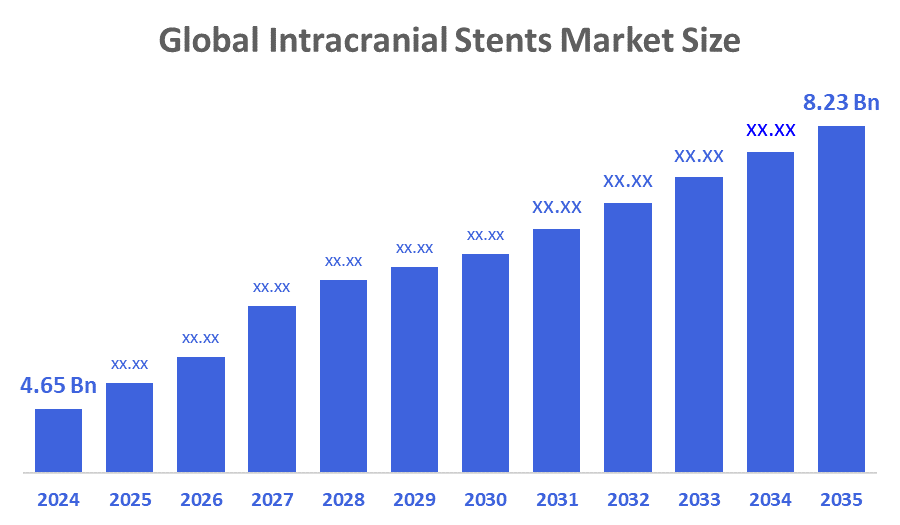
According to a research report published by Decisions Advisors and Consulting, The Global Intracranial Stents Market Size Was Worth Around USD 4.65 Billion In 2024 And Is Predicted To Grow To Around USD 8.23 Billion By 2035 With A Compound Annual Growth Rate (CAGR) Of 5.33% From 2025 To 2035. Some of the major drivers propelling the market are the constantly expanding elderly population, the increasing prevalence of various cerebrovascular illnesses, and the shift in patient and healthcare provider preferences toward non-invasive and minimally invasive procedures.
Market Overview
Intracranial stents are small tubular medical devices made from materials compatible with the human body, such as nitinol or stainless steel. These stents are employed for less invasive treatments of various cerebrovascular disorders. One of the key features of intracranial stents is their enhanced compatibility with different imaging modalities, thus facilitating accurate navigation of blood vessels and deployment of the stent at a precise target site. In addition, they come in a range of sizes and types to suit different anatomical structures. The main use of these devices is to work in combination with blood vessels in the brain that have become narrow or weak. The stents help to keep the vessels open and also allow proper blood flow. Further, they promote a good supply of blood to the brain, which leads to a decreased likelihood of stroke or other ailments linked to the blood vessels that are either blocked or damaged. Intracranial stents are versatile in application and can be used alongside surgical methods like endovascular coiling or angioplasty to treat conditions like intracranial stenosis or aneurysms.
Irish medtech firm Ceroflo raised €6.4 million to advance its novel stent technology for intracranial atherosclerotic disease (ICAD), a leading cause of stroke. The funding will support first-in-human clinical trials of its SubMax device, designed to improve blood flow to the brain while reducing haemorrhage risk.
Oxford Endovascular, a spinout of Oxford University, raised £8 million in a Series A fundraising round to develop its brain aneurysm technology. In the near future, the business intends to conduct human trials. Blood flow is diverted from cerebral aneurysms that are at risk of rupturing using their technology, OXIFLOW technology. The funds raised will be utilised to support additional product development in order to advance clinical research.
Report Coverage
This research report categorises the intracranial stents market based on various segments and regions, forecasts revenue growth, and analyzes trends in each submarket. The report analyses the key growth drivers, opportunities, and challenges influencing the intracranial stents market. Recent market developments and competitive strategies, such as expansion, product launch, development, partnership, merger, and acquisition, have been included to draw the competitive landscape in the market. The report strategically identifies and profiles the key market players and analyzes their core competencies in each sub-segment of the intracranial stents market.
Driving Factors
The global market is mainly influenced by the increasing occurrence of different cerebrovascular disorders, such as cerebral aneurysms and strokes. Besides this, continuous technological advancements in the field of intracranial stents are leading to the development of innovative and advanced products with better flexibility, navigability, and radial strength. Hence, these factors are driving the market growth. Furthermore, the intensive focus on diagnosing and treating neurological disorders at an early stage is increasing the demand for effective treatment solutions, hence causing a greater uptake of intracranial stents. In addition to this, the changing choice of patients and healthcare providers towards non-invasive and minimally invasive procedures with shorter recovery periods is becoming a major factor that drives the market growth. Besides that, the positive impact of favourable reimbursement policies for intracranial stent procedures by government agencies and private insurance companies in various countries is creating a positive market scenario. The market is also driven by various strategic collaborations, mergers and acquisitions (M&As), and partnerships among major players to broaden their market presence.
Restraining Factors
The intracranial stents market is restrained by high device costs and complex regulatory approvals, limiting access in emerging regions. The need for specialised neuro-interventional expertise further restricts widespread adoption. Ongoing concerns over long-term safety, restenosis risks, and limited clinical data slow broader market penetration.
Market Segmentation
The intracranial stents market share is classified into product type and disease.
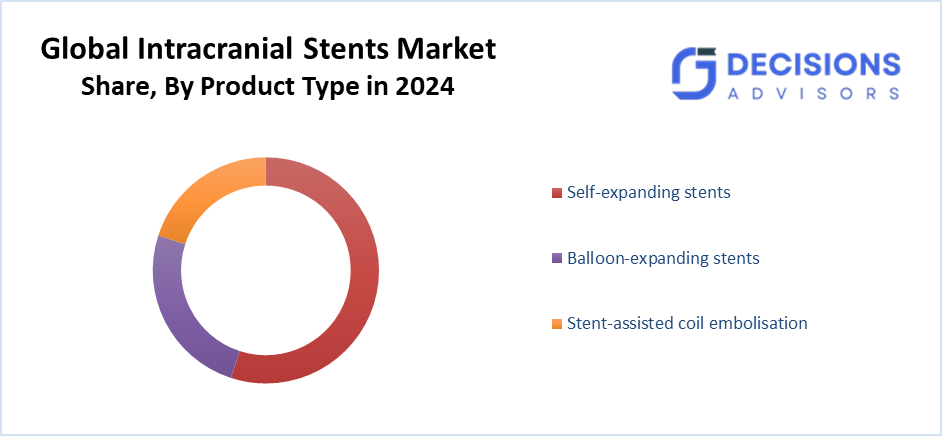
- The self-expanding stents segment accounted for the largest share in 2024 and is anticipated to grow at a significant CAGR during the forecast period.
Based on the product type, the intracranial stents market is segmented into balloon-expanding stents, self-expanding stents, and stent-assisted coil embolisation. Among these, the self-expanding stents segment accounted for the largest share in 2024 and is anticipated to grow at a significant CAGR during the forecast period. This is mainly due to their great clinical adoption in the treatment of intracranial stenosis and aneurysms, superior flexibility, and simplicity of deployment in convoluted cerebral arteries. Excellent adaptability for negotiating intricate cerebral arteries. Reduced risk of vascular damage in contrast to balloon stents. It is frequently used to treat intracranial stenosis and aneurysms.
- The brain aneurysm segment accounted for the highest revenue share in 2024 and is projected to grow at a notable CAGR over the forecast period.
Based on the disease, the intracranial stents market is differentiated into brain aneurysm and intracranial stenosis. Among these, the brain aneurysm segment accounted for the highest revenue share in 2024 and is projected to grow at a notable CAGR over the forecast period. This is because of the increasing frequency of aneurysms, the widespread use of stent-assisted coil embolisation and flow-diverting stents, and ongoing advancements in neurovascular devices; the brain aneurysm segment now dominates the intracranial stent market. Ongoing innovation (such as flow-diverters like growing inclination for less invasive endovascular therapy as opposed to surgical cutting) contributed to segment expansion.
Regional Segment Analysis of the Intracranial Stents Market
- North America (U.S., Canada, Mexico)
- Europe (Germany, France, U.K., Italy, Spain, Rest of Europe)
- Asia-Pacific (China, Japan, India, Rest of APAC)
- South America (Brazil and the Rest of South America)
- The Middle East and Africa (UAE, South Africa, Rest of MEA)
Asia Pacific is anticipated to hold the largest share of the intracranial stents market over the predicted timeframe.
Asia Pacific is anticipated to hold the largest share of the intracranial stents market over the predicted timeframe. The markets for intracranial stents in China and India are projected to grow at the fastest rate of all the intracranial stent markets in Asia. The primary factors behind the growth of the intracranial stents market in these countries include a large and growing population of patients, as well as government-supported funding, funding for research into new technologies, and legislation to support research into new technologies. Increased public awareness of the availability of different options for intracranial stent placement will also contribute to the growing intracranial stent market. Key factors that will continue to support the growth of the global intracranial stents market are: increased public awareness, advances in technology, the introduction of new treatments by the government, and improvements in the reimbursement models employed by payers in the field.
The AIIMS-led GRASSROOT trial confirmed that the Supernova Stent, an advanced brain treatment device, is safe and effective for stroke patients. This marks a breakthrough in India’s neurovascular care. According to preliminary study data published in the esteemed Journal of Neurointerventional Surgery (JNIS), "the Supernova stent has shown excellent safety and efficacy outcomes in the treatment of severe strokes."
Europe is expected to grow at a rapid CAGR in the intracranial stents market during the forecast period. The drive for growth within the European intracranial stents market stems from the combined influence of a growing population suffering from neurologic diseases, as well as a very well-developed healthcare system, and the increasing use of minimally invasive techniques in neurointervention. The presence of favourable reimbursement requirements for advanced endovascular treatment across many countries in Europe, such as Germany, France, and the UK, enhances the interest in these treatments. In addition to favourable reimbursement structures, the rapid development of technology and the growing awareness of clinicians, as well as their patients, about endovascular solutions, are also contributing to the rapid growth of the market throughout the region.
Boston Scientific has launched the Neuroform EZ™ Stent System in both the U.S. and Europe, marking the introduction of its fourth-generation intracranial aneurysm stent designed to treat wide-necked aneurysms in conjunction with endovascular coiling.
Competitive Analysis:
The report offers the appropriate analysis of the key organizations/companies involved within the intracranial stents market, along with a comparative evaluation primarily based on their product offering, business overviews, geographic presence, enterprise strategies, segment market share, and SWOT analysis. The report also provides an elaborative analysis focusing on the current news and developments of the companies, which includes product development, innovations, joint ventures, partnerships, mergers & acquisitions, strategic alliances, and others. This allows for the evaluation of the overall competition within the market.
List of Key Companies
- Abbott Laboratories
- Acandis GmbH
- Admedes Schuessler GmbH
- Balt Extrusion S.A.
- Cardiatis, S.A
- Covidien Ltd
- DePuy Synthes Companies
- Medtronic Public Limited Company
- MicroPort Scientific Corporation
- OBEX Medical Limited
- Penumbra, Inc.
- Phenox GmbH
- Stryker Corporation
- Terumo Corporation
- Others
Key Target Audience
- Market Players
- Investors
- End-users
- Government Authorities
- Consulting and Research Firm
- Venture capitalists
- Value-Added Resellers (VARs)
Recent Development
- In December 2023, the safety of a novel flow-diverting stent device to stop blood flow into brain aneurysms has been verified by researchers from the School of Biomedical Engineering and Imaging Sciences at King's College London (KCL). Researchers demonstrated how the second revised version of the PEDV was safe and effective in halting blood flow into aneurysms for patients with unruptured aneurysms using data from eight institutions.
- In January 2022, MicroPort NeuroTech™ announced the enrollment of the first patient. Its PROMISE Study for the Rebridge® Intracranial Visualised Stent, marking the start of clinical evaluation for this next-generation device aimed at treating intracranial aneurysms.
Market Segment
This study forecasts revenue at global, regional, and country levels from 2020 to 2035. Decisions Advisors has segmented the intracranial stents market based on the below-mentioned segments:
Global Intracranial Stents Market, By Product Type
- Balloon Expanding Stents
- Self-Expanding Stents
- Stent-Assisted Coil Embolisation
Global Intracranial Stents Market, By Application
- Brain Aneurysm
- Intracranial Stenosis
Global Intracranial Stents Market, By Regional Analysis
- North America
- US
- Canada
- Mexico
- Europe
- Germany
- UK
- France
- Italy
- Spain
- Russia
- Rest of Europe
- Asia Pacific
- China
- Japan
- India
- South Korea
- Australia
- Rest of Asia Pacific
- South America
- Brazil
- Argentina
- Rest of South America
- Middle East & Africa
- UAE
- Saudi Arabia
- Qatar
- South Africa
- Rest of the Middle East & Africa
Frequently Asked Questions (FAQ)
- What is the current size of the global intracranial stents market?
The market was valued at USD 4.65 billion in 2024.
- What is the projected market size by 2035?
It is expected to reach USD 8.23 billion by 2035.
- What is the CAGR for the market from 2025 to 2035?
The market is forecasted to grow at a CAGR of 5.33%.
- What are the main product types in the intracranial stents market?
The segments include balloon-expanding stents, self-expanding stents, and stent-assisted coil embolisation.
- Which disease indication leads the market?
The brain aneurysm segment held the highest revenue share in 2024 and is projected to grow notably.
- Why are self-expanding stents the largest product segment?
They dominate due to superior flexibility, ease of deployment in complex arteries, and wide use for aneurysms and stenosis.
- Which region will hold the largest market share?
Asia-Pacific is anticipated to have the largest share, driven by population growth, government funding, and rising awareness in countries like China and India.
- What are the key drivers of market growth?
Rising cerebrovascular diseases, ageing populations, minimally invasive procedure preferences, and technological advancements in stents.
Check Licence
Choose the plan that fits you best: Single User, Multi-User, or Enterprise solutions tailored for your needs.
We Have You Covered
- 24/7 Analyst Support
- Clients Across the Globe
- Tailored Insights
- Technology Tracking
- Competitive Intelligence
- Custom Research
- Syndicated Market Studies
- Market Overview
- Market Segmentation
- Growth Drivers
- Market Opportunities
- Regulatory Insights
- Innovation & Sustainability
Report Details
| Scope | Global |
| Pages | 250 |
| Delivery | PDF & Excel via Email |
| Language | English |
| Release | Jan 2026 |
| Access | Download from this page |