
Global Intraocular Lens (IOL) Market
 |
Author:
Disha B
|
Pages:
268
|
Author:
Disha B
|
Pages:
268
Global Intraocular Lens (IOL) Market Size, Share, and COVID-19 Impact Analysis, By Type (Monofocal IOLs (Spheric Monofocal IOLs), Premium IOLs (Accommodating IOLs)), By Material (Hydrophobic Acrylic IOLs, PolyMethylMethAcrylate, Silicon IOLs) and By Region (North America, Europe, Asia-Pacific, Latin America, Middle East, and Africa), Analysis and Forecast 2025 - 2035
CAGR
6.55%
REVENUE 2024
USD Billion 4.41
FORECAST 2035
USD Billion 8.86
REPORT COVERAGE
Global
Global Intraocular Lens (IOL) Market Size Insights Forecasts to 2035
- The Global Intraocular Lens (IOL) Market Size Was valued at USD 4.41 Billion in 2024
- The Global Intraocular Lens (IOL) Market Size is Expected to Grow at a CAGR of around 6.55% from 2025 to 2035
- The Worldwide Intraocular Lens (IOL) Market Size is Expected to Reach USD 8.86 Billion by 2035
- Asia-Pacific is expected to Grow the fastest during the forecast period.
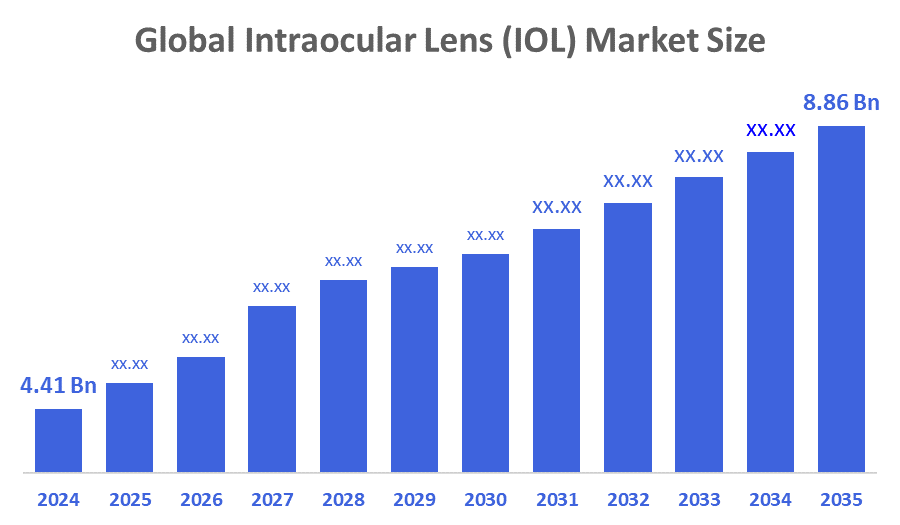
According to a Research Report Published by Decisions Advisors and Consulting, The Global Intraocular Lens (IOL) Market Size was worth around USD 4.41 Billion in 2024 and is predicted to Grow to around USD 8.86 Billion by 2035 with a compound annual growth rate (CAGR) of 6.55% from 2025 to 2035. The factor that attributes to the market growth include the rising number of diabetes patients, better technologies, more people opting for multifocal IOLs, the good properties of acrylic materials, rise in the number of contract surgeries, supportive government policies, and the quickly increasing aged population.
Market Overview
An intraocular lens (IOL) is a miniature manmade lens that is put inside the eye to substitute the natural lens taken out during cataract operation or to remedy the refractive errors. The global intraocular lens market is mainly driven by the rising incidence of cataract, a graying population, and growing need for better quality of vision. Among the technologies that are helping patients improve their conditions and have more options to get treated are multifocal, toric, and extended-depth-of-focus lenses. The market is also benefiting from the increase in the awareness of eye health and the better accessibility to the ophthalmic care. Moreover, the rising healthcare budgets and the growing number of specialized eye hospitals are creating a better environment for the world’s surgical volume. The developing countries are experiencing a higher rate of IOLs adoption as a result of the better medical infrastructure and the lower cost, which is thus making the market more competitive and more reliant on innovation.
Report Coverage
This research report categorizes the intraocular lens (IOL) market based on various segments and regions, forecasts revenue growth, and analyzes trends in each submarket. The report analyses the key growth drivers, opportunities, and challenges influencing the intraocular lens (IOL) market. Recent market developments and competitive strategies such as expansion, type launch, development, partnership, merger, and acquisition, have been included to draw the competitive landscape in the market. The report strategically identifies and profiles the key market players and analyses their core competencies in each sub-segment of the intraocular lens (IOL) market.
Driving Factors
The technology of lenses has been innovated and this has resulted in a significant growth of the market. Premium IOLs have changed the expectations of patients while standard monofocal IOLs offer only a single point of focus. Several types of these advanced lenses like multifocal, toric, and extended depth of focus (EDOF) IOLs are able to correct presbyopia (the need for reading glasses) and astigmatism, thereby, greatly reducing the reliance on spectacles after surgery for the patient. Apart from design, the use of better materials has led to more biocompatible, foldable lenses that can be incised with smaller openings, and features such as blue light filtering for better eye protection have also been introduced. These advances are not just limited to improving the visual quality and satisfaction of patients after surgery, they also increase the extent of the market that can be targeted by providing solutions that are personalized to the different visual needs of the patients.
Restraining Factors
The high-priced premium lenses, lack of reimbursement coverage, scarcity of skilled ophthalmic surgeons in developing areas, postoperative complication risks, and regulatory hurdles that can slow down the adoption and market expansion are among the factors that constrain the intraocular lens market.
Market Segmentation
The intraocular lens (IOL) market share is classified into type and material.
- The premium IOLS segment accounted for the largest share in 2024 and is anticipated to grow at a significant CAGR during the forecast period.
Based on the type, the intraocular lens (IOL) market is divided into monofocal iols (spheric monofocal iols) and premium IOLS (accommodating IOLS). Among these, the premium IOLS segment accounted for the largest share in 2024 and is anticipated to grow at a significant CAGR during the forecast period. The highest CAGR is anticipated for premium IOLs as a result of the increasing patient preference for the vision correction method without glasses, the robust acceptance of multifocal, toric, and EDOF lenses, as well as the development of surgical technologies which make the surgeon more confident. Still, the awareness of refractive benefits, the availability is getting wider in the emerging markets, and the paying capacity of the people is improving which quickens the boom. Not only that, but the demand for luxury lenses also gets a powerful boost during the whole forecast period due to the relentless innovations catering to the customized optics and the better postoperative outcomes.
- The hydrophobic acrylic IOLs segment accounted for the highest market revenue in 2024 and is anticipated to grow at a significant CAGR during the forecast period.
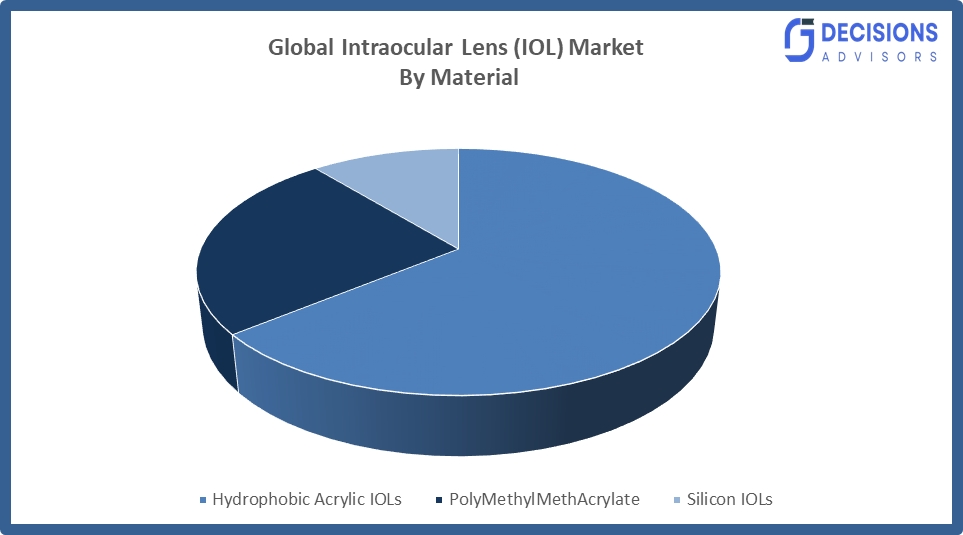
Based on the material, the intraocular lens (IOL) market is divided into hydrophobic acrylic IOLs, polymethylmethacrylate, and silicon IOLs. Among these, the hydrophobic acrylic IOLs segment accounted for the highest market revenue in 2024 and is anticipated to grow at a significant CAGR during the forecast period. The segmental growth due to their excellent biocompatibility, low posterior capsular opacification rates, and superb optical clarity which make them the favorite material of cataract surgeons all over the world. Strong clinical adoption is driven by stability, reduced glistening and long-term performance. The increasing demand for premium and advanced monofocal lenses coupled with the growing availability of such products in emerging markets will continue to boost the growth prospect for hydrophobic acrylic IOLs.
Regional Segment Analysis of the Intraocular Lens (IOL) Market
- North America (U.S., Canada, Mexico)
- Europe (Germany, France, U.K., Italy, Spain, Rest of Europe)
- Asia-Pacific (China, Japan, India, Rest of APAC)
- South America (Brazil and the Rest of South America)
- The Middle East and Africa (UAE, South Africa, Rest of MEA)
North America is anticipated to hold the largest share of the intraocular lens (IOL) market over the predicted timeframe.
North America is anticipated to hold the largest share of the intraocular lens (IOL) market over the predicted timeframe. The aging population has a high incidence of cataracts which is the main reason for the growth of the market. Moreover, the advanced ophthalmic infrastructure, the support of good reimbursement policies, the early adoption of premium IOL technologies, and the presence of leading manufacturers and specialized eye-care centers all contribute to higher procedure volumes and revenues.
Asia-Pacific is expected to grow at a rapid CAGR in the intraocular lens (IOL) market during the forecast period. The factors contributing to this strong demand - a large and aging population, increasing cataract cases, enhanced healthcare infrastructure, the rise of medical tourism, the heightened awareness of vision care, and the widespread availability of affordable surgical treatment, specifically in China, India, and Southeast Asian nations.
Competitive Analysis:
The report offers the appropriate analysis of the key organizations/companies involved within the intraocular lens (IOL) market, along with a comparative evaluation primarily based on their type of offering, business overviews, geographic presence, enterprise strategies, segment market share, and SWOT analysis. The report also provides an elaborative analysis focusing on the current news and developments of the companies, which includes type development, innovations, joint ventures, partnerships, mergers & acquisitions, strategic alliances, and others. This allows for the evaluation of the overall competition within the market.
List of Key Companies
- Alcon, Inc.
- Johnson and Johnson Vision Care, Inc.
- Bausch & Lomb Incorporated
- Carl Zeiss Meditec AG (ZEISS International)
- Rayner
- EyeKon Medical, Inc.
- Lenstec, Inc.
- HumanOptics AG
- STAAR Surgical Company
- HOYA CORPORATION
- Others
Key Target Audience
- Market Players
- Investors
- End-users
- Government Authorities
- Consulting and Research Firm
- Venture capitalists
- Value-Added Resellers (VARs)
Recent Development
- In October 2024, Bausch + Lomb Corporation announced that the U.S. Food and Drug Administration (FDA) had approved the enVista® Envy™ full range of vision intraocular lens (IOL). Built on the widely used enVista IOL platform, this new lens provided a continuous range of vision with excellent dysphotopsia tolerance, enhancing patient outcomes.
Market Segment
This study forecasts revenue at global, regional, and country levels from 2020 to 2035. Decisions Advisors has segmented the intraocular lens (IOL) market based on the below-mentioned segments:
Global Intraocular Lens (IOL) Market, By Type
- Monofocal IOLs
- Spheric Monofocal IOLs
- Premium IOLs
- Accommodating IOLs
Global Intraocular Lens (IOL) Market, By Material
- Hydrophobic Acrylic IOLs
- PolyMethylMethAcrylate
- Silicon IOLs
Global Intraocular Lens (IOL) Market, By Regional Analysis
- North America
- US
- Canada
- Mexico
- Europe
- Germany
- UK
- France
- Italy
- Spain
- Russia
- Rest of Europe
- Asia Pacific
- China
- Japan
- India
- South Korea
- Australia
- Rest of Asia Pacific
- South America
- Brazil
- Argentina
- Rest of South America
- Middle East & Africa
- UAE
- Saudi Arabia
- Qatar
- South Africa
- Rest of the Middle East & Africa
Frequently Asked Questions (FAQ)
- What is the CAGR of the intraocular lens (IOL) market over the forecast period?
A: The global intraocular lens (IOL) market is projected to expand at a CAGR of 6.55% during the forecast period.
- What is the market size of the intraocular lens (IOL) market?
A: The Global Intraocular Lens (IOL) Market Size is estimated to grow from USD 4.41 Billion in 2024 to USD 8.86 Billion by 2035, at a CAGR of 6.55% during the forecast period 2025-2035.
- Which region holds the largest share of the intraocular lens (IOL) market?
A: North America is anticipated to hold the largest share of the intraocular lens (IOL) market over the predicted timeframe.
- Who are the top 10 companies operating in the global intraocular lens (IOL) market?
A: Alcon, Inc., Johnson and Johnson Vision Care, Inc., Bausch & Lomb Incorporated, Carl Zeiss Meditec AG (ZEISS International), Rayner, EyeKon Medical, Inc., Lenstec, Inc., HumanOptics AG, STAAR Surgical Company, HOYA CORPORATION, and Others.
- What are the market trends in the intraocular lens (IOL) market?
A: The market for intraocular lenses is growing and is influenced by several factors like the increase in cataract surgeries, the patients' preference for premium and multifocal lenses, and technological innovations, along with the worldwide increase in availability of eye care services.
Check Licence
Choose the plan that fits you best: Single User, Multi-User, or Enterprise solutions tailored for your needs.
We Have You Covered
- 24/7 Analyst Support
- Clients Across the Globe
- Tailored Insights
- Technology Tracking
- Competitive Intelligence
- Custom Research
- Syndicated Market Studies
- Market Overview
- Market Segmentation
- Growth Drivers
- Market Opportunities
- Regulatory Insights
- Innovation & Sustainability
Report Details
| Scope | Global |
| Pages | 268 |
| Delivery | PDF & Excel via Email |
| Language | English |
| Release | Feb 2026 |
| Access | Download from this page |