
Global Intrinsically Safe Equipment Market
 |
Author:
Pranali P
|
Pages:
220
|
Author:
Pranali P
|
Pages:
220
Global Intrinsically Safe Equipment Market Size, Share By Equipment Type (Communication Devices, Sensors, Lighting Systems, Cameras, Mobile Devices, and Others), By End User (Oil & Gas, Mining, Chemical & Petrochemical, Pharmaceuticals, Manufacturing, and Others), By Protection Technique (Intrinsic Safety, Explosion-Proof Equipment, and Increased Safety, and Encapsulation), and By Region (North America, Europe, Asia-Pacific, Latin America, Middle East & Africa), Analysis and Forecast 2026-2035.
CAGR
6.55%
REVENUE 2025
USD Billion 4.1
FORECAST 2035
USD Billion 7.73
REPORT COVERAGE
Global
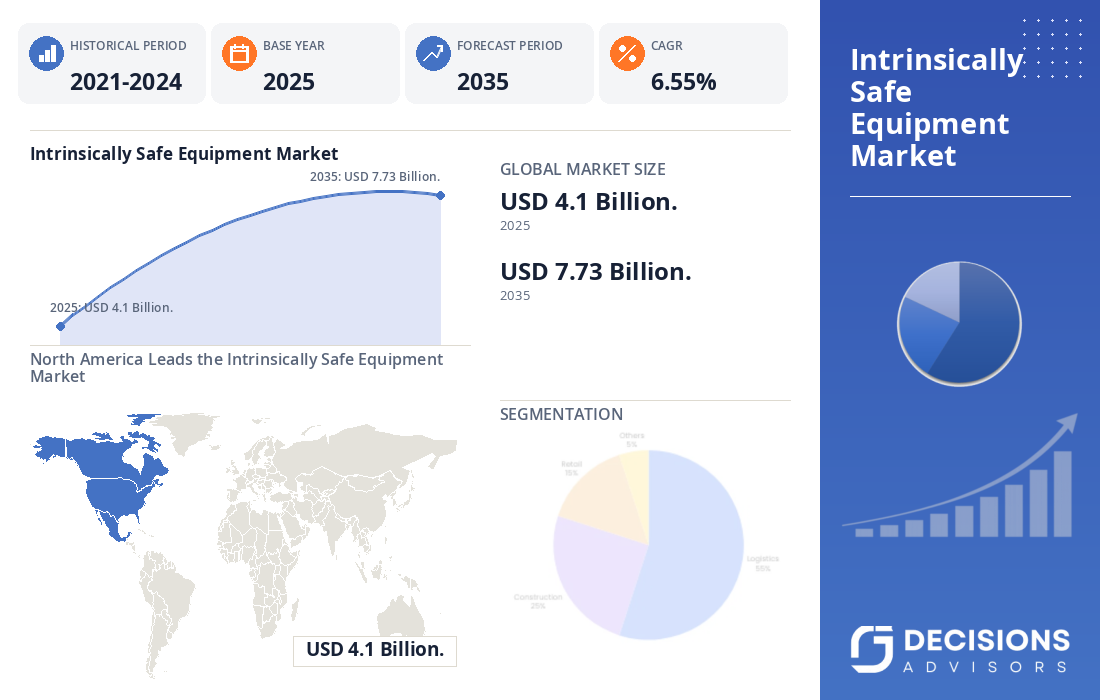
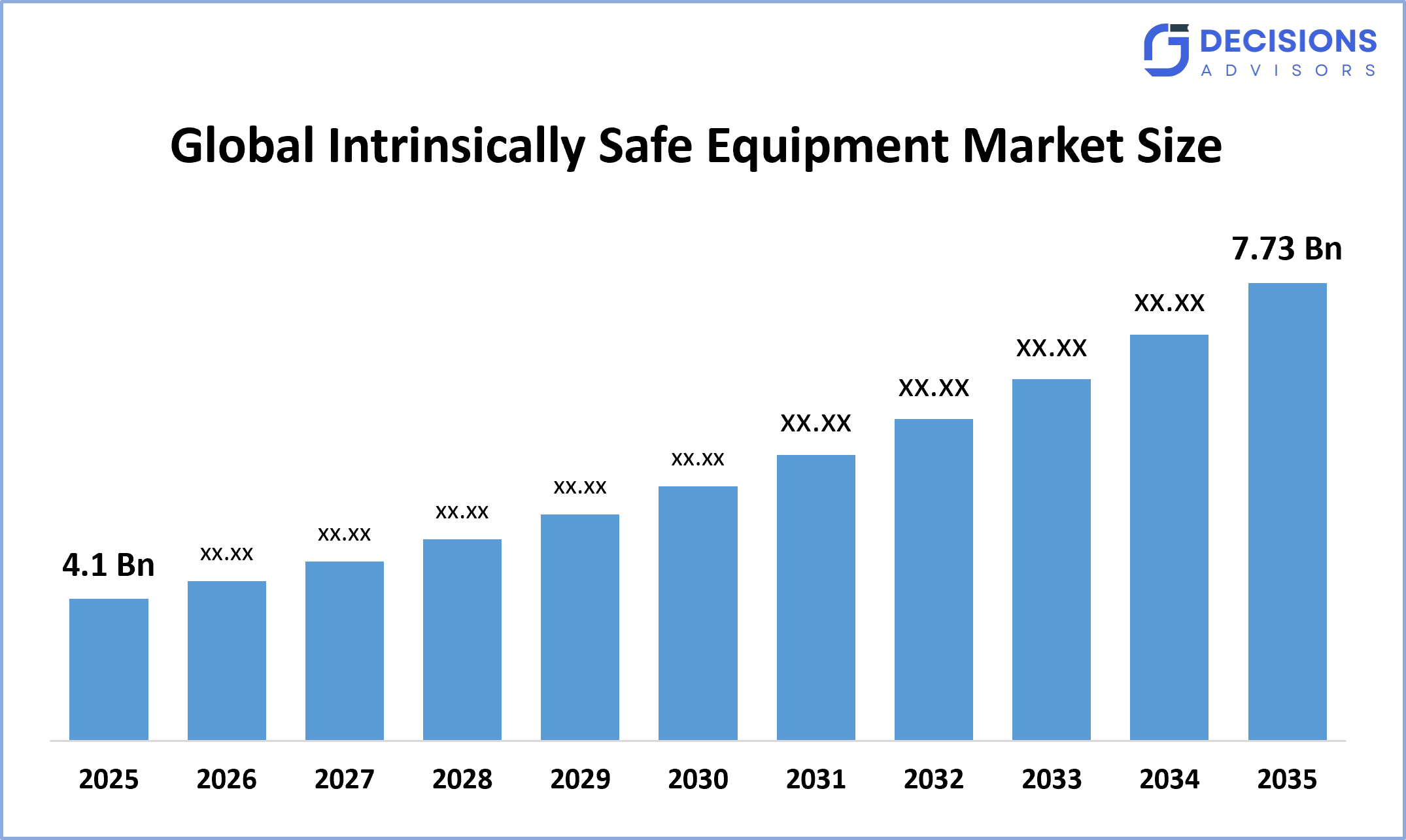
The Global Intrinsically Safe Equipment Market Size is predicted to grow from USD 4.1 Billion in 2025 and is likely to reach around USD 7.73 Billion by 2035 with a CAGR of 6.55%. According to Decision Advisors, a detailed research report on the market reflects that increasing industrial safety compliance and hazardous-area automation dominate the global intrinsically safe equipment market, accounting for approximately 47% of the total share worldwide. Honeywell International Inc. leads the market with annual revenue exceeding USD 36 billion and an estimated 16–19% market share in intrinsically safe industrial safety solutions, making it a key contributor to global market development and growth dynamics.
Market Snapshot
- Global Intrinsically Safe Equipment Market Size (2025): USD 4.1 Billion.
- Projected Global Intrinsically Safe Equipment Market Size (2035): USD 7.73 Billion.
- Global Intrinsically Safe Equipment Market Compound Annual Growth Rate (CAGR): 6.55%.
- Largest Regional Market: North America
- 2nd Largest Region: Europe
- Fastest Growing Region: Asia-Pacific
- Base Year: 2025
- Historical Period: 2021-2024
- Market Forecast Period: 2026-2035
Market Overview/ Introduction
The Global Intrinsically Safe Equipment Market comprises electrical and electronic devices specifically designed to operate safely in hazardous environments where explosive gases, vapors, combustible dust, or fibers may be present. These products limit electrical and thermal energy to levels below the ignition threshold, making them essential across industries such as oil & gas, mining, chemical processing, pharmaceuticals, food processing, and power generation. The market is expanding steadily due to stringent occupational safety regulations, increasing industrial automation, and growing investments in hazardous-area digitalization. The increasing adoption of Industry 4.0 technologies, Industrial Internet of Things (IIoT), wireless monitoring systems, and smart process automation is creating significant demand for intrinsically safe communication devices, sensors, tablets, cameras, and portable instruments. Governments worldwide continue strengthening workplace safety standards through regulations including ATEX, IECEx, OSHA, and NEC requirements. Leading manufacturers including Honeywell International, Eaton Corporation, Pepperl+Fuchs, Emerson Electric, and ABB Ltd. continue investing in advanced explosion-protected technologies that improve worker safety, operational efficiency, and regulatory compliance.
- United States, OSHA and the National Fire Protection Association (NFPA) continue strengthening hazardous-location workplace safety standards, encouraging industries to deploy certified intrinsically safe electrical equipment across manufacturing and energy facilities.
- Japan, Government initiatives promoting smart manufacturing and industrial digitalization are accelerating the deployment of intrinsically safe wireless monitoring systems, industrial communication devices, and hazardous-area automation equipment.
- European Union, ATEX Directives continue driving investments in certified explosion-protected equipment throughout chemical processing, pharmaceutical production, offshore oil & gas, and mining operations across member states.
Notable Insights: -
- North America is anticipated to hold approximately 35% share of the Global Intrinsically Safe Equipment Market over the predicted timeframe.
- Asia Pacific is expected to grow at a rapid CAGR in the Global Intrinsically Safe Equipment Market by holding approximately 29% of the share during the forecast period.
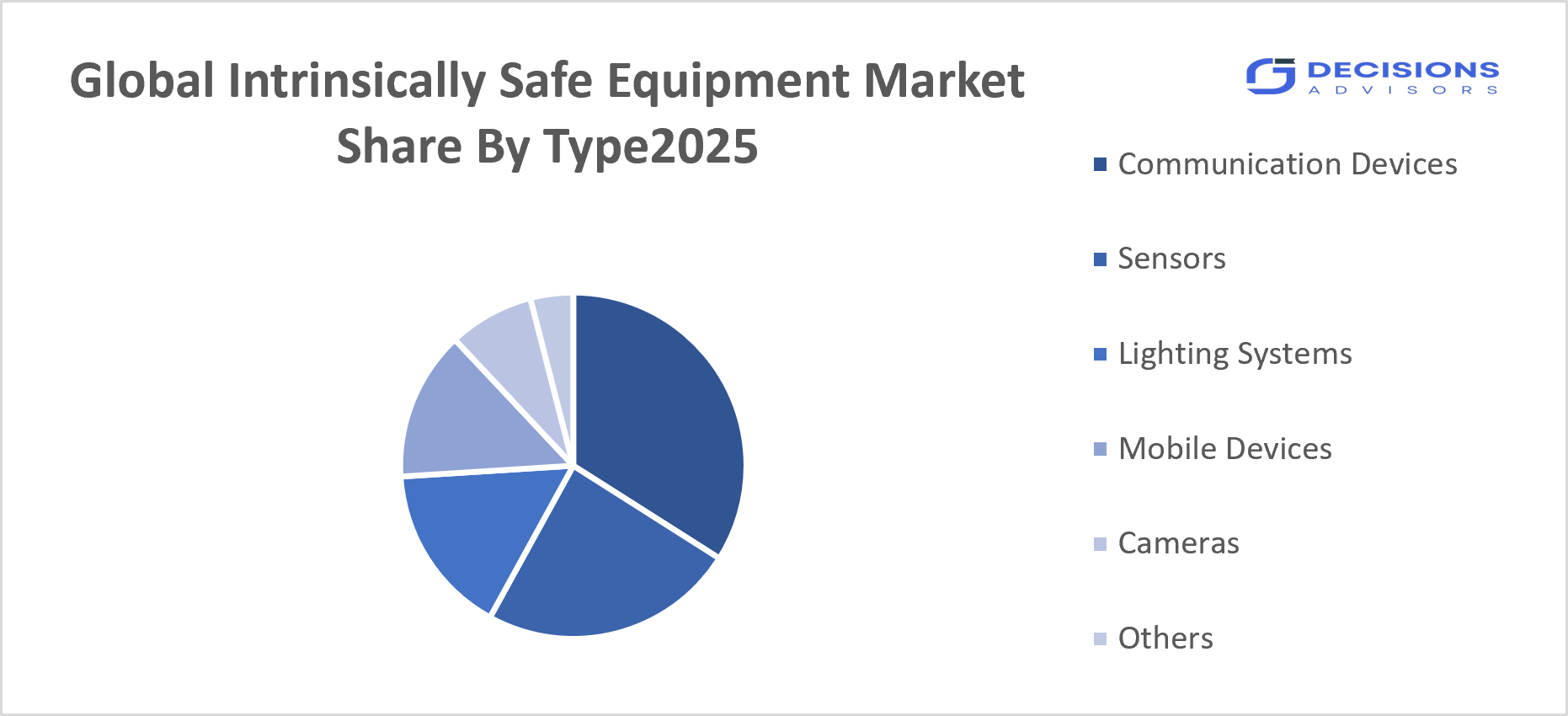
- By Equipment Type, the Communication Devices segment dominated the market and holds approximately 34% share in 2025 and is projected to grow at a substantial CAGR during the forecast period.
- By End User, the Oil & Gas segment dominated the market and holds approximately 38% share in 2025 and is projected to grow at a substantial CAGR during the forecast period.
- The compound annual growth rate of the Global Intrinsically Safe Equipment Market is 6.55%.
- The market is likely to achieve a valuation of USD 7.73 Billion by 2035.
Market Drivers
The global intrinsically safe equipment market is primarily driven by increasingly stringent industrial safety regulations and the need to minimize explosion risks in hazardous environments. The expansion of offshore oil exploration, mining operations, chemical manufacturing, pharmaceutical production, and energy infrastructure has increased demand for certified intrinsically safe devices. Rising adoption of Industrial Internet of Things (IIoT), wireless industrial communication, predictive maintenance, and smart manufacturing further supports market growth as companies require reliable equipment capable of operating safely in explosive atmospheres. Additionally, investments in renewable energy facilities, hydrogen production, battery manufacturing, and industrial automation continue creating new opportunities for intrinsically safe sensors, cameras, handheld devices, and communication systems.
Restrain
Despite strong growth prospects, the market faces several challenges. Intrinsically safe equipment requires rigorous testing and certification under standards such as ATEX, IECEx, UL, and FM approvals, significantly increasing product development costs and extending commercialization timelines. The high purchase price compared to conventional industrial equipment limits adoption among small and medium-sized enterprises. Furthermore, complex maintenance procedures, periodic compliance inspections, and compatibility issues with legacy industrial systems increase implementation costs, particularly in developing economies where awareness of hazardous-area safety standards remains comparatively lower.
Competitive Analysis:
The report offers the appropriate analysis of the key organizations/companies involved within the global intrinsically safe equipment market, along with a comparative evaluation primarily based on their product offerings, business overviews, geographic presence, enterprise strategies, segment market share, and SWOT analysis. The report also provides an elaborative analysis focusing on the current news and developments of the companies, which includes product development, innovations, joint ventures, partnerships, mergers & acquisitions, strategic alliances, and others. This allows for the evaluation of the overall competition within the market.
Top Companies in the Global Intrinsically Safe Equipment Market
- Honeywell International Inc.
- Eaton Corporation plc
- Pepperl+Fuchs SE
- Emerson Electric Co.
- ABB Ltd.
- Siemens AG
- R. Stahl AG
- BARTEC GmbH
- Rockwell Automation Inc.
- MSA Safety Incorporated.
Government Initiatives
|
Country |
Key Government Initiatives |
|
United States |
OSHA hazardous workplace safety regulations and NFPA electrical safety standards continue promoting the adoption of certified intrinsically safe equipment across oil & gas, chemical processing, mining, and industrial manufacturing facilities |
|
Japan |
Japan's industrial safety regulations and Society 5.0 initiatives encourage smart factories to integrate intrinsically safe automation, wireless monitoring, and hazardous-area communication technologies |
|
China |
China's industrial modernization policies and national workplace safety regulations support hazardous-area automation, explosion-proof manufacturing facilities, and deployment of certified industrial safety equipment |
Market Segmentation
The global intrinsically safe equipment market share is classified into equipment type, end user, and protection technique.
- Communication devices segment dominated the market and holds approximately 34% share in 2025 and is projected to grow at a substantial CAGR during the forecast period.
Based on the equipment type, the global intrinsically safe equipment market is divided into communication devices, sensors, lighting systems, cameras, mobile devices, and others. Among these, the communication devices segment dominates the market and holds approximately 34% share in 2025. This dominance is attributed to the increasing deployment of intrinsically safe radios, smartphones, tablets, and communication systems across hazardous industrial environments. Growing workforce mobility, emergency communication requirements, and remote industrial monitoring continue supporting demand across oil & gas, mining, and chemical industries.
- The oil & gas segment accounted for the largest share of approximately 38% in 2025 and is anticipated to grow at a significant CAGR during the forecast period.
Based on end user, the market is divided into oil & gas, mining, chemical & petrochemical, pharmaceuticals, manufacturing, and others. Among these, the Oil & Gas segment accounted for the largest share and holds approximately 38% share in 2025. The segment dominates because exploration, drilling, refining, storage, and offshore operations require certified intrinsically safe equipment to prevent ignition risks in explosive atmospheres. Increasing investments in offshore energy projects and refinery modernization continue driving equipment demand.
- The intrinsic safety segment accounted for the largest share of approximately 46% in 2025 and is anticipated to grow at a significant CAGR during the forecast period.
Based on Protection Technique, the market is divided into intrinsic safety, explosion-proof equipment, increased safety, and encapsulation. Among these, intrinsic safety dominates the market and holds approximately 46% share in 2025. The technology is widely adopted because it prevents ignition by limiting electrical energy rather than containing explosions, making it ideal for portable instruments, field sensors, industrial communication devices, and wireless automation equipment operating in hazardous locations.
Regional Segment Analysis of the Global Intrinsically Safe Equipment Market
- North America (U.S., Canada, Mexico)?
- Europe (Germany, U.K., France, Italy, Spain, Netherlands, Rest of Europe).
- Asia-Pacific (China, Japan, India, Australia, South Korea, Rest of Asia-Pacific).
- South America (Brazil, Argentina, Rest of South America).
- Middle East & Africa (UAE, Saudi Arabia, South Africa, Rest of MEA).
North America is anticipated to hold approximately 35% share of the global intrinsically safe equipment market over the predicted timeframe.
North America dominates the Global Intrinsically Safe Equipment Market owing to its extensive oil & gas, petrochemical, mining, and pharmaceutical industries that require certified hazardous-area equipment. The region benefits from stringent OSHA regulations, NFPA standards, and continuous investments in industrial automation and digital manufacturing. Major manufacturers including Honeywell, Emerson Electric, Rockwell Automation, and MSA Safety have strong operational footprints across the United States and Canada. Increasing deployment of Industrial IoT (IIoT), predictive maintenance solutions, and smart industrial facilities continues supporting sustained market expansion throughout the region.
Asia Pacific is expected to grow at a rapid CAGR in the global intrinsically safe equipment market, holding approximately 29% of the share during the forecast period.
Asia Pacific is expected to witness the fastest growth due to rapid industrialization, expanding manufacturing facilities, and increasing investments in chemical processing, mining, and energy infrastructure across China, India, Japan, South Korea, and Southeast Asia. Governments are strengthening workplace safety regulations while promoting Industry 4.0 adoption, creating higher demand for intrinsically safe communication devices, sensors, lighting systems, and automation equipment. Rising offshore oil & gas exploration and expanding battery manufacturing facilities further contribute to regional growth.
Europe is the second-largest region in the global intrinsically safe equipment market, holding approximately 27% share.
Europe maintains a significant market position due to strict implementation of ATEX regulations governing hazardous-area equipment throughout manufacturing, pharmaceuticals, food processing, and chemical industries. Countries including Germany, the UK, France, and Italy continue investing in industrial automation, hydrogen production, renewable energy infrastructure, and smart manufacturing facilities. Strong presence of leading companies such as Siemens AG, ABB Ltd., Pepperl+Fuchs, R. STAHL, and BARTEC supports technological innovation and regional market development.
Future Market Trends in Global Intrinsically Safe Equipment Market: -
-
- Integration of Industrial IoT and Wireless Connectivity
Manufacturers are increasingly integrating wireless communication, cloud connectivity, and Industrial Internet of Things (IIoT) capabilities into intrinsically safe equipment. Smart monitoring enables predictive maintenance, remote diagnostics, and real-time worker safety while improving operational efficiency in hazardous industrial environments.
-
- AI-Based Predictive Safety Monitoring
Artificial intelligence and machine learning are being integrated with intrinsically safe sensors and monitoring systems to identify abnormal operating conditions before incidents occur. These intelligent systems reduce equipment downtime while improving workplace safety and operational reliability.
-
- Growing Demand for Smart Wearable Safety Devices
Industries are increasingly deploying intrinsically safe wearable technologies including smart helmets, gas detectors, wearable cameras, and connected worker devices. These solutions improve emergency response, workforce communication, and continuous monitoring in hazardous locations.
-
- Expansion of Hydrogen and Clean Energy Infrastructure
Growing investments in hydrogen production, carbon capture facilities, renewable fuels, and battery manufacturing are generating significant demand for certified intrinsically safe electrical equipment capable of operating safely within explosive industrial environments.
Recent Development
- In January 2024, Pepperl+Fuchs SE introduced the Smart-Ex® 03, a next-generation 5G and Wi-Fi 6 intrinsically safe smartphone designed for hazardous environments, enabling secure mobile communication and digital workflows in Zone 1/21 and Division 1 areas.
- In March 2026, Honeywell International Inc. launched the 4-Series NDIR Hydrocarbon Gas Sensor, an advanced industrial gas detection solution for hazardous environments that improves flammable gas monitoring and worker safety across oil & gas, mining, and manufacturing industries.
- In October 2024, R. STAHL AG expanded its portfolio of explosion-protected LED tubular lighting solutions (Series 6036), offering high-efficiency luminaires certified for ATEX and IECEx hazardous areas to improve energy efficiency and operational safety in industrial facilities.
Market Segment
This study forecasts revenue at global, regional, and country levels from 2021 to 2035. Decision Advisors has segmented the Global Intrinsically Safe Equipment Market based on the below-mentioned segment:
Global Intrinsically Safe Equipment Market, By Equipment Type.
- Communication Devices
- Sensors
- Lighting Systems
- Cameras
- Mobile Devices
- Others.
Global Intrinsically Safe Equipment Market, By End User.
- Oil & Gas
- Mining
- Chemical & Petrochemical
- Pharmaceuticals
- Manufacturing
- Others.
Global Intrinsically Safe Equipment Market, By Protection Technique.
- Intrinsic Safety (Ex i)
- Explosion-Proof Equipment
- Increased Safety (Ex e)
- Encapsulation (Ex m).
Global Intrinsically Safe Equipment Market, By Regional Analysis.
- North America
- US
- Canada
- Mexico
- Europe
- Germany
- UK
- France
- Italy
- Spain
- Russia
- Rest of Europe
- Asia Pacific
- China
- Japan
- India
- South Korea
- Australia
- Rest of Asia Pacific
- South America
- Brazil
- Argentina
- Rest of South America
- Middle East & Africa
- UAE
- Saudi Arabia
- Qatar
- South Africa
- Rest of the Middle East & Africa
Frequently Asked Questions (FAQ)
Q. What is intrinsically safe equipment and why is it important?
A. Intrinsically safe equipment is designed to operate in hazardous environments by limiting electrical and thermal energy below ignition levels. It helps prevent explosions in industries such as oil & gas, mining, chemicals, pharmaceuticals, and manufacturing while ensuring compliance with international safety standards.
Q. How does intrinsically safe equipment differ from explosion-proof equipment?
A. Intrinsically safe equipment prevents ignition by restricting electrical energy, whereas explosion-proof equipment contains any internal explosion within a protective enclosure. Intrinsically safe devices are generally preferred for portable instruments, sensors, and communication equipment used in hazardous locations.
Q. Which industries are the primary users of intrinsically safe equipment?
A. Oil & gas remains the largest end-user, followed by mining, chemical & petrochemical, pharmaceuticals, manufacturing, power generation, and food processing industries. These sectors require certified equipment to ensure worker safety and comply with hazardous-area regulations.
Q. What are the major factors driving the Global Intrinsically Safe Equipment Market?
A. Market growth is driven by stringent workplace safety regulations, increasing industrial automation, expansion of Industrial IoT, rising investments in hazardous-area monitoring systems, and growing demand for connected worker safety solutions across energy, mining, and process industries.
Check Licence
Choose the plan that fits you best: Single User, Multi-User, or Enterprise solutions tailored for your needs.
We Have You Covered
- 24/7 Analyst Support
- Clients Across the Globe
- Tailored Insights
- Technology Tracking
- Competitive Intelligence
- Custom Research
- Syndicated Market Studies
- Market Overview
- Market Segmentation
- Growth Drivers
- Market Opportunities
- Regulatory Insights
- Innovation & Sustainability
Report Details
| Scope | Global |
| Pages | 220 |
| Delivery | PDF & Excel via Email |
| Language | English |
| Release | Aug 2026 |
| Access | Download from this page |