
Global Isoflavones Market
 |
Author:
Sayali T
|
Pages:
240
|
Author:
Sayali T
|
Pages:
240
Global Isoflavones Market Size, Share, By Source (Soy, Red Clover, and Others), By Form (Liquid and Dry), By Application (Food & Beverages, Cosmetics, Pharmaceuticals, and Other Applications), and By Region (North America, Europe, Asia-Pacific, Latin America, Middle East, and Africa), Analysis and Forecast 2026 â 2035.
CAGR
6.39%
REVENUE 2025
USD Billion 19.78
FORECAST 2035
USD Billion 36.76
REPORT COVERAGE
Global
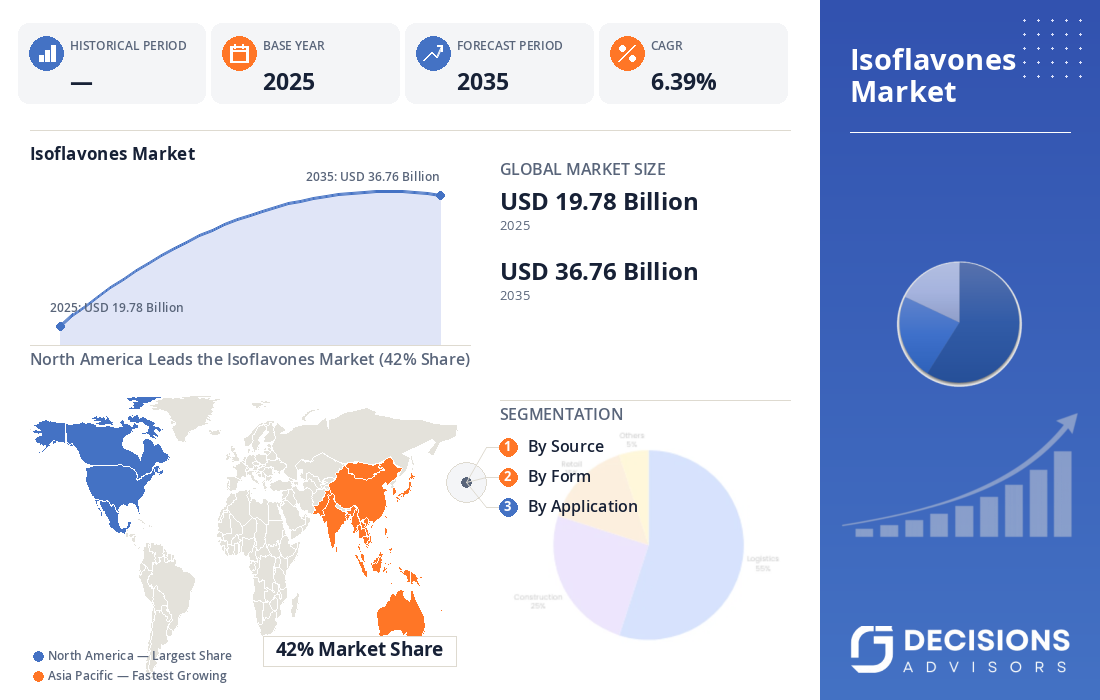
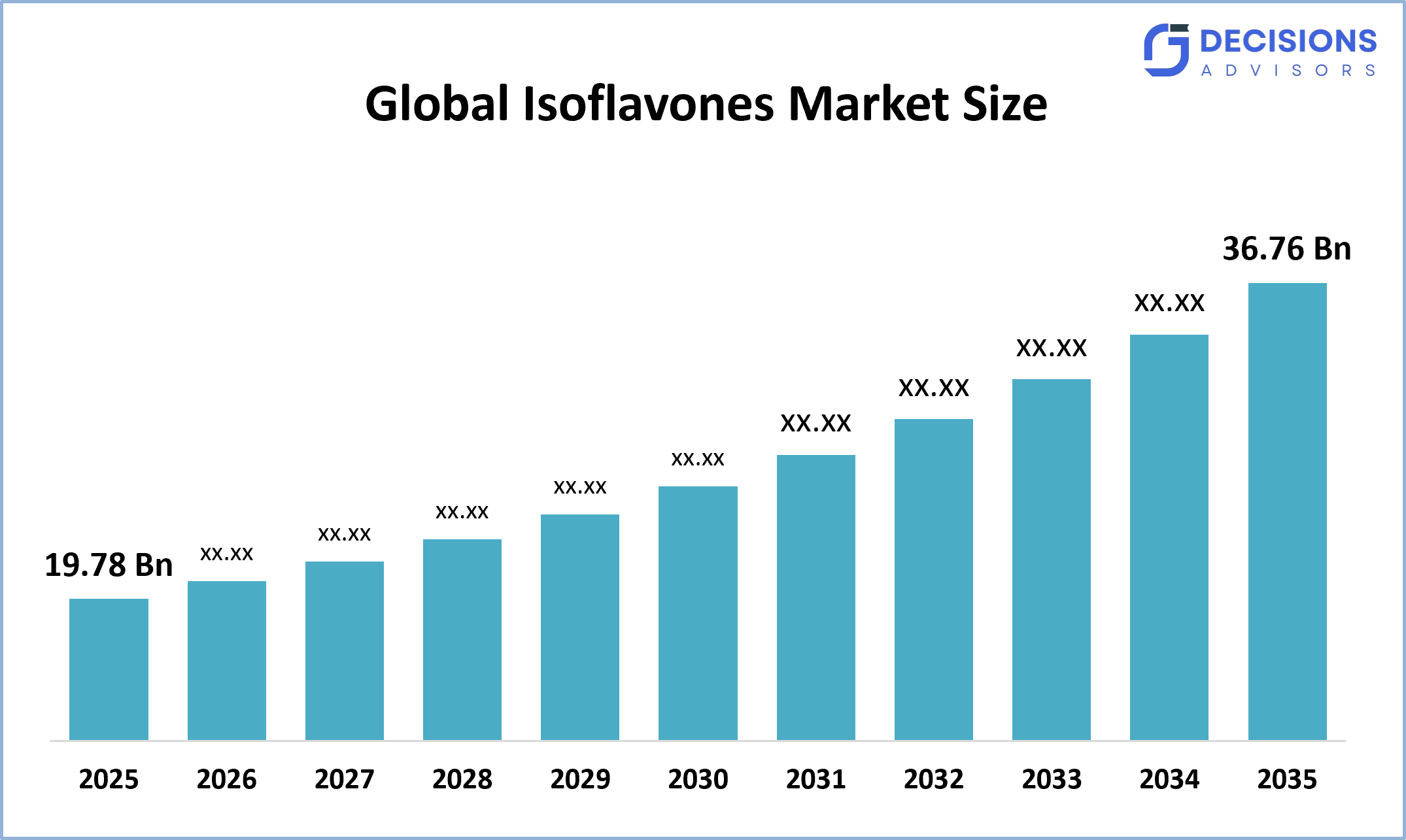
According to Decision Advisors, The Global Isoflavones Market Size was valued at USD 19.78 Billion in 2025 and is anticipated to reach USD 36.76 Billion by 2035, growing at a CAGR of 6.39% during the forecast period 2026-2035. The growing demand for plant-based nutritional supplements is driving the Isoflavones market.
Global Isoflavones Market Insights Forecasts to 2035
- The Global Isoflavones Market Size Was Estimated at USD 19.78 Billion in 2025
- The Market Size is Expected to Grow at a CAGR of around 6.39% from 2026 to 2035
- The Worldwide Isoflavones Size is Expected to Reach USD 36.76 Billion by 2035
- Asia Pacific is expected to grow the fastest during the forecast period.
What is the Isoflavones?
Isoflavones are naturally occurring plant compounds belonging to the polyphenol family and are commonly found in soybeans, soy-based foods, legumes, and other plants. They are classified as phytoestrogens because their chemical structure can interact with estrogen receptors in the body. Isoflavones are widely studied and used in dietary supplements, functional foods, and nutritional products. Common isoflavones include genistein, daidzein, and glycitein. They are associated with potential health benefits related to bone health, cardiovascular wellness, menopausal symptoms, and healthy aging. Growing consumer interest in plant-based nutrition and natural health ingredients is increasing the use of isoflavones across food, beverage, pharmaceutical, and nutraceutical applications.
Report Coverage
This research report categorizes the Isoflavones market based on various segments and regions, forecasts revenue growth, and analyzes trends in each submarket. The report analyses the key growth drivers, opportunities, and challenges influencing the Isoflavones market. Recent market developments and competitive strategies, such as expansion, product launch, development, partnership, merger, and acquisition, have been included to draw the competitive landscape in the market. The report strategically identifies and profiles the key market players and analyses their core competencies in each sub-segment of the Isoflavones market.
Trending Factors
- Increasing Menopause Awareness: Growing awareness of women's health and menopause management is supporting interest in isoflavone-based nutritional products.
- Rising Functional Food Demand: Consumers are increasingly choosing foods with added health benefits, creating opportunities for isoflavones in functional food and beverage products.
- Growing Soy-Based Product Consumption: Increasing consumption of soy foods and beverages is supporting the availability and use of soy-derived isoflavones.
What is the use of AI in the Isoflavones Market?
AI is increasingly used in the Isoflavones market to improve product development, quality control, and production efficiency. AI can analyze data related to plant sources, extraction processes, formulations, and product performance to identify suitable conditions for producing consistent isoflavone ingredients. It can also support the development of new nutraceuticals and functional foods by analyzing consumer preferences and ingredient combinations. AI-based systems can monitor manufacturing processes, identify quality variations, and support predictive maintenance of processing equipment. In addition, AI can help researchers study potential health applications of isoflavones by analyzing large amounts of scientific data. This can improve product quality, reduce production inefficiencies, and support innovation across the isoflavones industry.
Market Dynamics
Driving Factor
The expansion of the nutraceutical industry is driving the Isoflavones market as manufacturers increasingly develop supplements containing naturally derived compounds for specific health applications. Growing investment in functional formulations is encouraging the use of isoflavones in capsules, tablets, powders, and fortified products. Manufacturers are also introducing specialized formulations targeting women's wellness, healthy aging, and cardiovascular health. The availability of different delivery formats is making isoflavone products more accessible to consumers and expanding their applications across nutrition and wellness categories. As nutraceutical companies continue developing innovative products with plant-derived ingredients, demand for isoflavones is expected to increase globally.
In May 2026, according to the U.S. Department of Agriculture’s National Institute of Food and Agriculture (USDA-NIFA), the agency awarded $7.7 million to 14 projects under its Food and Human Health program, supporting research into food, gut microbiota, precision nutrition, and dietary approaches to chronic disease.
Restraining Factors
High production costs, limited availability of suitable raw materials, complex extraction processes, variability in isoflavone concentration, stringent quality standards, regulatory requirements, limited consumer awareness, formulation challenges, potential supply chain disruptions, and competition from alternative plant-based ingredients are the main factors restricting the Isoflavones market.
Opportunities
The growing use of isoflavones in women's health supplements is creating new opportunities for the Isoflavones market. Increasing awareness of menopause, bone health, and healthy aging is encouraging consumers to seek nutritional products containing naturally derived ingredients. Manufacturers are developing capsules, tablets, powders, and functional foods with isoflavones to address specific women's wellness needs. This expansion of targeted nutritional products can increase demand for isoflavone ingredients and encourage companies to develop innovative formulations.
Also, the increasing application of isoflavones in functional foods and beverages is creating another opportunity for the Isoflavones market. Consumers are increasingly interested in foods that provide nutritional and wellness benefits beyond basic nutrition. Food and beverage manufacturers can incorporate isoflavones into soy-based drinks, fortified foods, nutritional bars, and other functional products. The expansion of health-focused food categories can increase the use of isoflavones and create new opportunities for ingredient suppliers and product manufacturers.
Market Segmentation
By Source
The Soy segment held the largest share of the market in 2025. Soybeans are one of the richest and most widely available sources of isoflavones, particularly genistein, daidzein, and glycitein. Soy-derived isoflavones are extensively used in dietary supplements, functional foods, and nutritional products. The established supply of soy and its broad use in food and nutraceutical applications support the segment's leading position.
The Red Clover segment is expected to be the fastest-growing because red clover contains isoflavones such as formononetin and biochanin A that are increasingly used in women's health and nutritional supplements. Growing consumer interest in botanical ingredients and natural wellness products is encouraging manufacturers to develop red-clover-based formulations.
By Form
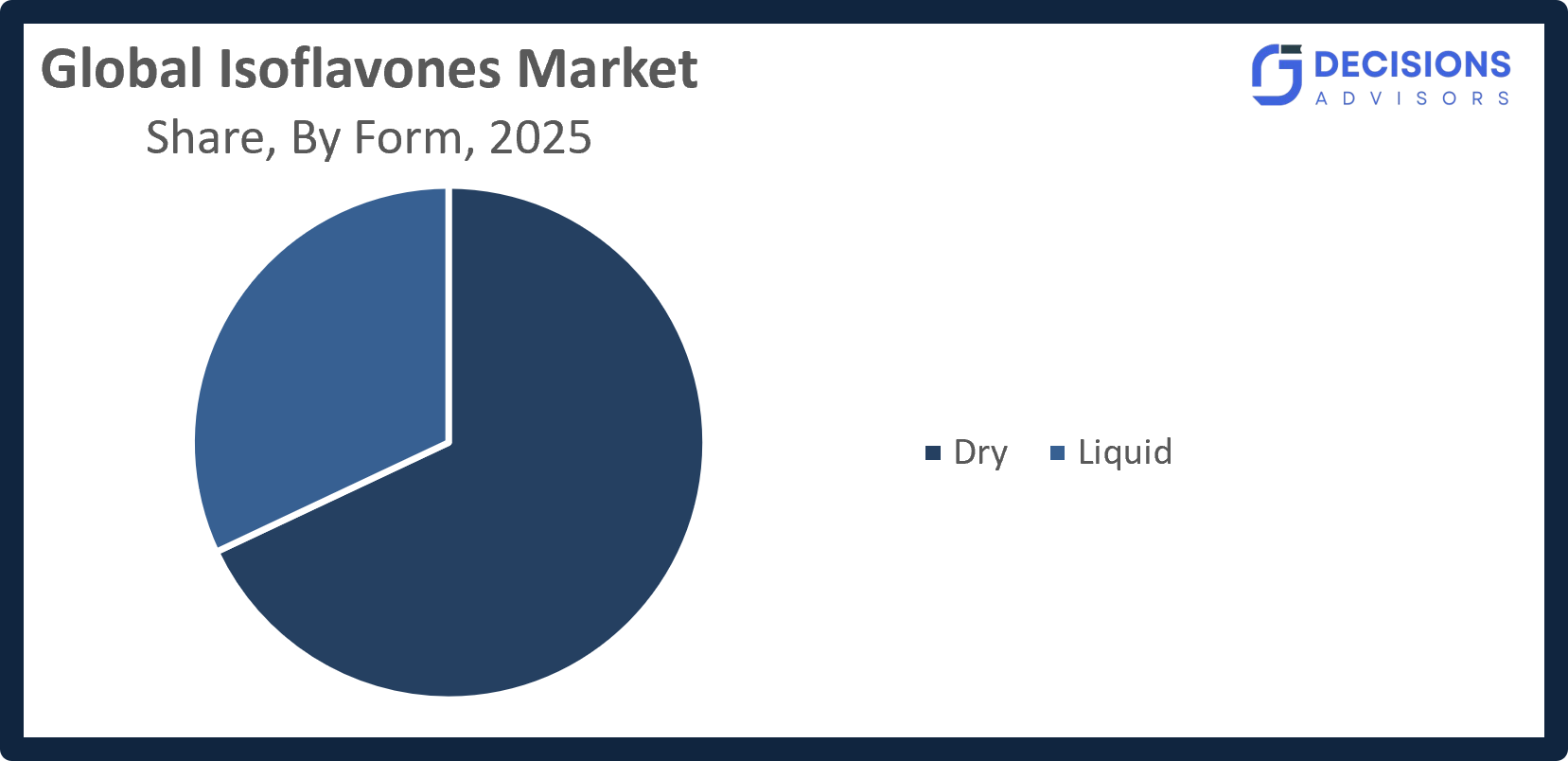
The Dry segment held the largest share of the market in 2025. Dry isoflavones are widely used because they offer convenient handling, storage, transportation, and incorporation into capsules, tablets, powders, and functional food formulations. Their longer shelf stability and compatibility with different manufacturing processes support their widespread use across nutritional and pharmaceutical applications.
The Liquid segment is expected to be the fastest-growing because liquid isoflavone formulations can provide convenient consumption and easier incorporation into beverages and liquid nutritional products. Growing demand for functional beverages and liquid dietary supplements is encouraging manufacturers to develop products using liquid isoflavone ingredients.
By Application
The Food & Beverages segment held the largest share of the market in 2025. Isoflavones are increasingly incorporated into functional foods, soy-based beverages, nutritional products, and fortified foods because of growing consumer interest in health-focused diets. The expansion of functional food categories and increasing demand for plant-derived ingredients are supporting segment growth.
The Pharmaceuticals segment is expected to be the fastest-growing because isoflavones are increasingly studied and incorporated into products targeting women's health, bone health, and cardiovascular wellness. Growing research into the potential health applications of isoflavones is encouraging pharmaceutical and nutraceutical manufacturers to develop specialized formulations.
North America dominated the Isoflavones market in 2025, accounting for approximately 42% of the global market share.
North America dominates the Isoflavones market due to increasing consumer demand for dietary supplements, functional foods, and plant-based nutritional ingredients. Growing awareness of women's health, healthy aging, bone health, and cardiovascular wellness is supporting the use of isoflavone-based products across the region. Companies such as NOW Foods, Nature's Way, and Solgar offer supplements containing soy-derived isoflavones and other botanical ingredients. The region also benefits from a well-developed nutraceutical industry, strong consumer awareness, and extensive availability of health and wellness products. As demand for natural nutritional ingredients continues to increase, manufacturers are expanding isoflavone-based product offerings, supporting market growth in North America.
In September 2026, according to the U.S. Department of Agriculture (USDA), the 2026/27 U.S. soybean production forecast was raised to 4.5 billion bushels, with planted acreage increased to 86.9 million acres and harvested acreage to 85.9 million acres, supporting continued availability of soybean-based raw materials for nutritional ingredients and products.
Asia Pacific is expected to grow at a rapid CAGR of approximately 27% in the Isoflavones market during the forecast period. Growing consumer awareness of functional nutrition, increasing demand for dietary supplements, and expanding soy-based food consumption in countries such as China, India, and Japan are driving the Isoflavones market in Asia Pacific. Consumers are increasingly seeking plant-derived ingredients for women's wellness, healthy aging, and nutritional support. Companies such as Kikkoman Corporation, TSI Group, and Nutra Green Life are involved in the development or supply of isoflavone-based nutritional ingredients and products. The region also benefits from strong soybean production and an expanding nutraceutical industry. As functional foods, dietary supplements, and plant-based nutritional products continue to gain popularity, demand for isoflavones is expected to increase across Asia Pacific.
In June 2026, according to Japan’s Ministry of Agriculture, Forestry and Fisheries, the final statistics for 2025 soybean production were published, providing official data on soybean planted area and harvested production and strengthening transparency around domestic soybean supply for food and ingredient applications.
SWOT Analysis
|
Strength |
Isoflavones offer versatile incorporation across product formats |
|
Weakness |
Natural extraction can result in inconsistent ingredient purity |
|
Opportunity |
Advanced extraction technologies can improve ingredient yield |
|
Threat |
Synthetic estrogen alternatives may reduce isoflavone demand |
List of Key Companies
- Archer Daniels Midland Company (ADM)
- Cargill, Incorporated
- Koninklijke DSM N.V.
- Kikkoman Corporation
- Nutra Green Life
- FutureCeuticals, Inc.
- Sabinsa Corporation
- Gencor Pacific Inc.
- Herbo Nutra
- Indena S.p.A.
- Naturex S.A.
- LGC Standards
- TSI Group
- Novanat Bioresource
- Others
Key Target Audience
- Market Players
- Investors
- End-users
- Government Authorities
- Consulting and Research Firm
- Venture capitalists
- Value-Added Resellers (VARs)
Recent Development
- In June 2026, according to Nichimo Biotics, the company participated in the 26th Japanese Society of Anti-Aging Medicine Congress, presenting research on isoflavone supplementation for endometriosis and fermented soybean-germ extracts, highlighting continued development of isoflavone-based applications.
- In May 2026, according to ADM, the company launched eight new soy and pea protein products across North America and Europe, expanding its plant-based nutrition portfolio and supporting new applications for soy-derived nutritional ingredients in functional food and beverage formulations.
Market Segment
This study forecasts revenue at global, regional, and country levels from 2020 to 2035. Decision Advisors has segmented the Isoflavones market based on the below-mentioned segments:
Global Isoflavones Market, By Source
- Soy
- Red Clover
- Others
Global Isoflavones Market, By Form
- Liquid
- Dry
Global Isoflavones Market, By Application
- Food & Beverages
- Cosmetics
- Pharmaceuticals
- Other Applications
Global Isoflavones Market, By Regional Analysis
- North America
- US
- Canada
- Mexico
- Europe
- Germany
- UK
- France
- Italy
- Spain
- Russia
- Rest of Europe
- Asia Pacific
- China
- Japan
- India
- South Korea
- Australia
- Rest of Asia Pacific
- South America
- Brazil
- Argentina
- Rest of South America
- Middle East & Africa
- UAE
- Saudi Arabia
- Qatar
- South Africa
- Rest of the Middle East & Africa
Frequently Asked Questions (FAQ)
- What is the market size of the Global Isoflavones Market?
The Global Isoflavones Market Size was valued at USD 19.78 billion in 2025 and is anticipated to reach USD 36.76 billion by 2035, to grow with a CAGR of 6.39% during the forecast period 2026-2035.
- What is the Global Isoflavones Market?
The Global Isoflavones Market includes the production and sale of plant-derived isoflavone ingredients used in food, beverages, cosmetics, pharmaceuticals, and nutritional products.
- Which source dominates the Isoflavones market?
The Soy segment held the largest share of the market in 2025.
- Which source is expected to grow fastest?
The Red Clover segment is expected to be the fastest-growing source segment.
- Which form dominates the Isoflavones market?
The Dry segment held the largest share of the market in 2025.
- Which region is expected to grow fastest?
Asia Pacific is expected to be the fastest-growing region in the Isoflavones market.
Check Licence
Choose the plan that fits you best: Single User, Multi-User, or Enterprise solutions tailored for your needs.
We Have You Covered
- 24/7 Analyst Support
- Clients Across the Globe
- Tailored Insights
- Technology Tracking
- Competitive Intelligence
- Custom Research
- Syndicated Market Studies
- Market Overview
- Market Segmentation
- Growth Drivers
- Market Opportunities
- Regulatory Insights
- Innovation & Sustainability
Report Details
| Scope | Global |
| Pages | 240 |
| Delivery | PDF & Excel via Email |
| Language | English |
| Release | Oct 2026 |
| Access | Download from this page |