
Global Jam, Jelly and Preserves Market
 |
Author:
Sayali T
|
Pages:
200
|
Author:
Sayali T
|
Pages:
200
Global Jam, Jelly and Preserves Market Size, Share By Product Type (Jam, Jelly, Preserves, Marmalade, and Others), By Distribution Channel (Supermarkets & Hypermarkets, Convenience Stores, Online Stores, and Specialty Stores), By Packaging Type (Glass Jars, PET Containers, Polypropylene Containers, and Others), and By Region (North America, Europe, Asia-Pacific, Latin America, Middle East & Africa), Analysis and Forecast 2026-2035
CAGR
4.25%
REVENUE 2025
USD Billion 4.45
FORECAST 2035
USD Billion 6.75
REPORT COVERAGE
Global
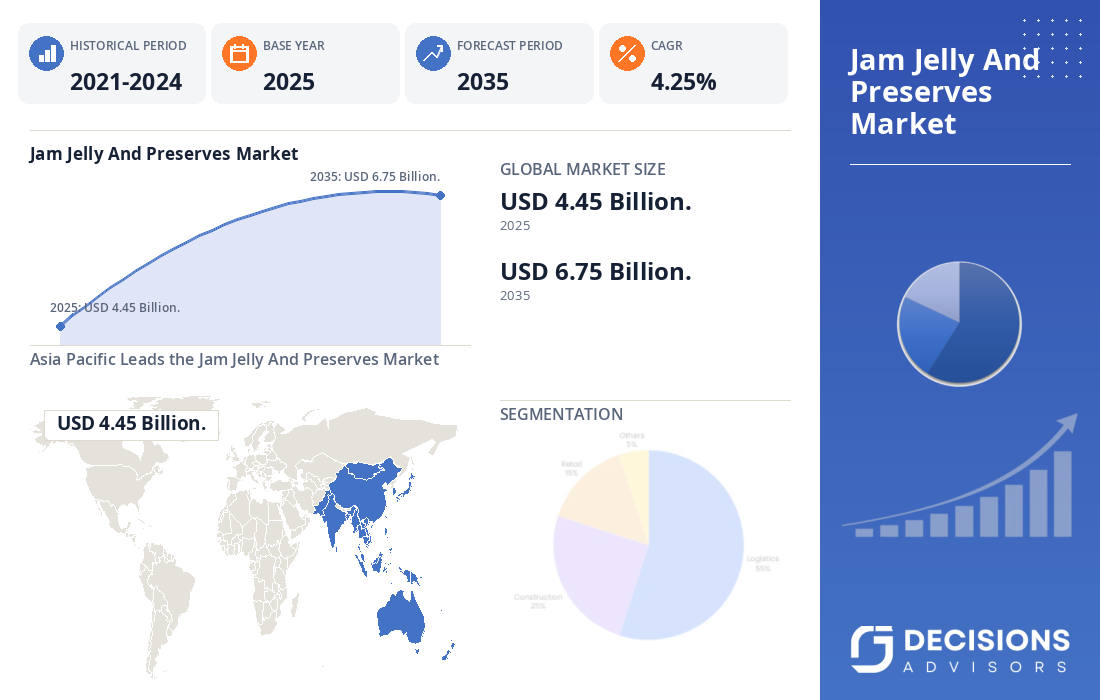
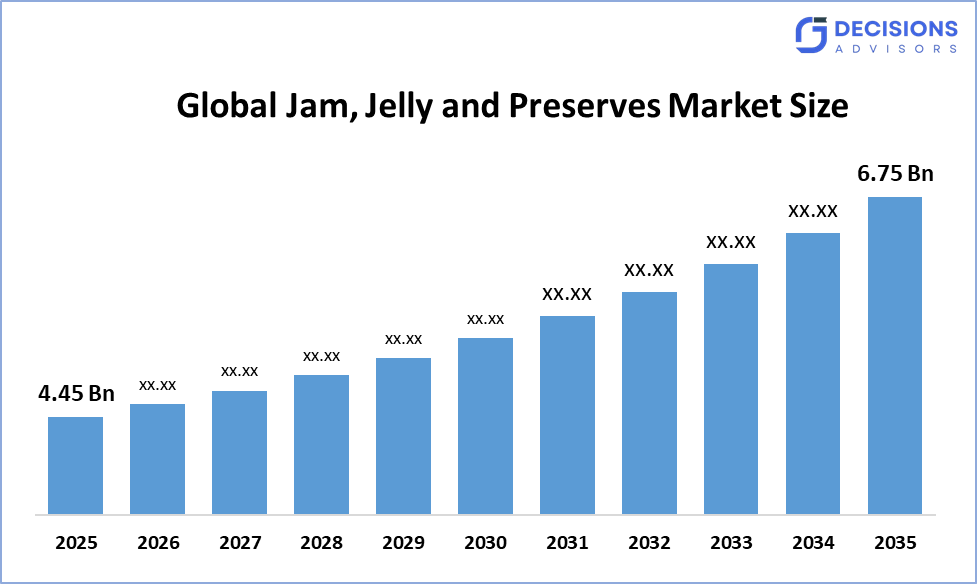
The global jam, jelly and preserves market size is predicted to grow from USD 4.45 Billion in 2025 and is likely to reach around USD 6.75 Billion by 2035, with a CAGR of 4.25%. According to Decision Advisors, the market is supported by rising demand for convenient breakfast foods, premium fruit spreads, reduced-sugar formulations, diverse flavors, and expanding online grocery distribution. Jam leads the product mix with approximately 48% share, making it the key contributor to global category revenues.
Market Snapshot
- Global Jam, Jelly and Preserves Market Size (2025): USD 4.45 Billion.
- Projected Global Jam, Jelly and Preserves Market Size (2035): USD 6.75 Billion.
- Global Jam, Jelly and Preserves Market CAGR: 4.25%.
- Largest Regional Market: Asia Pacific
- 2nd Largest Region: North America
- Fastest Growing Region: Asia-Pacific
- Base Year: 2025
- Historical Period: 2021-2024
- Market Forecast Period: 2026-2035
Market Overview/ Introduction
The global jam, jelly and preserves market includes fruit-based spreads prepared from fruits, fruit pulp or juice, sweeteners, pectin, acids and other functional ingredients. The category serves household breakfast consumption as well as bakery, foodservice and food-processing applications. Growth is being supported by demand for convenient foods, premium and artisanal spreads, fruit-forward flavors, reduced-sugar products and products positioned around natural ingredients. Market research estimates indicate a global market of USD 4.45 billion in 2025, with continued growth through 2035. Consumer preferences are gradually shifting toward cleaner labels, lower-sugar alternatives, organic fruit ingredients and differentiated flavor combinations. Supermarkets and hypermarkets remain important because of their broad assortment and strong brand visibility, while online grocery is increasing product accessibility. Major companies competing across the category include The J.M. Smucker Co., Andros, The Kraft Heinz Company, Conagra Brands, Hero Group, Ferrero, Unilever, Orkla, Wilkin & Sons, and Bonne Maman.
- United States, FDA nutrition-labeling requirements provide consumers with information on added sugars, while FDA standards of identity cover fruit butters, jellies, preserves and related products.
- Japan, The country's food-loss reduction framework encourages measures across the food supply chain, supporting better management of perishable fruit inputs and processed-food waste.
- China, Recent food-safety measures emphasize stronger full-chain supervision of agricultural products and food processing, increasing compliance requirements for food manufacturers.
Notable Insights: -
- Asia-Pacific is anticipated to hold approximately 34% share of the Global Jam, Jelly and Preserves Market over the predicted timeframe.
- North America is expected to hold approximately 29% share during the forecast period, supported by high household penetration and established branded fruit-spread consumption.
- By Product Type, the Jam segment dominated the market and holds approximately 48% share in 2025 and is projected to grow at a substantial CAGR during the forecast period.
- By Distribution Channel, Supermarkets & Hypermarkets dominated the market and holds approximately 52% share in 2025 and is projected to grow at a substantial CAGR during the forecast period.
- The compound annual growth rate of the Global Jam, Jelly and Preserves Market is 4.25%.
- The market is likely to achieve a valuation of approximately USD 6.75 Billion by 2035.
Market Drivers
The market is primarily driven by continued household consumption of fruit spreads and the convenience associated with ready-to-use breakfast and snack products. Demand for premium products is increasing as consumers explore artisanal recipes, specialty fruits, organic ingredients and differentiated flavor combinations. Reduced-sugar and no-added-sugar formulations are also becoming important as consumers pay greater attention to nutrition labels and added-sugar content. FDA nutrition labeling requirements specifically emphasize added-sugar disclosure, increasing transparency around packaged food products. Another important driver is the expansion of retail and e-commerce distribution. Supermarkets provide extensive product visibility, while online grocery platforms enable consumers to compare brands, flavors, package sizes and premium products. Demand from bakeries, restaurants, hotels and food manufacturers also expands the addressable market because jams, jellies and preserves can be used as fillings, toppings, flavor ingredients and dessert components.
Restrain
The global jam, jelly and preserves market faces several constraints, including fluctuations in fruit, sugar and packaging costs. Seasonal availability of berries and other fruits can create raw-material price volatility and affect production margins. The category also faces increasing consumer concern about added sugar, creating pressure on manufacturers to reformulate products without compromising taste, texture and shelf stability. In addition, glass packaging can increase transportation weight and logistics costs, while food-safety, labeling and product-definition requirements increase compliance responsibilities. FDA standards of identity specifically address fruit butters, jellies, preserves and related products, illustrating the regulatory requirements surrounding standardized food categories.
Competitive Analysis:
The report offers the appropriate analysis of the key organizations/companies involved within the global jam, jelly and preserves market, along with a comparative evaluation primarily based on their product offerings, business overviews, geographic presence, enterprise strategies, segment market share, and SWOT analysis. The report also provides an elaborative analysis focusing on the current news and developments of the companies, which includes product development, innovations, joint ventures, partnerships, mergers & acquisitions, strategic alliances, and others. This allows for the evaluation of the overall competition within the market.
Top Companies in the Global Jam, Jelly and Preserves Market
- The J.M. Smucker Co.
- Andros Group
- The Kraft Heinz Company
- Conagra Brands, Inc.
- Hero Group
- Ferrero Group
- Unilever PLC
- Orkla ASA
- Wilkin & Sons Ltd.
- Bonne Maman.
Government Initiatives
|
Country |
Key Government Initiatives |
|
United States |
FDA nutrition-labeling requirements require added-sugar information on packaged foods, while standards of identity cover fruit butters, jellies, preserves and related products |
|
Japan |
The Act on Promotion of Food Loss and Waste Reduction encourages coordinated national efforts to reduce food loss across the food system |
|
China |
China has strengthened full-chain food-safety supervision covering agricultural products and food-processing businesses, increasing quality-control requirements |
Market Segmentation
The Global Jam, Jelly and Preserves Market share is classified into product type, distribution channel and packaging type.
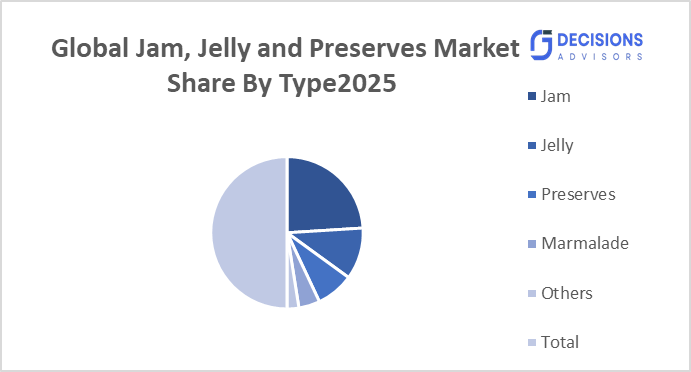
- The Jam segment dominated the market and holds approximately 48% share in 2025 and is projected to grow at a substantial CAGR during the forecast period.
Based on Product Type, the Global Jam, Jelly and Preserves Market is divided into Jam, Jelly, Preserves, Marmalade, and Others. Among these, Jam dominates the market because of its broad household penetration and extensive use in breakfast foods, sandwiches, bakery products and snacks. Strawberry, raspberry, apricot and mixed-fruit formulations remain popular across major consumer markets. Product innovation around premium, organic and reduced-sugar varieties is also helping manufacturers maintain demand.
- The Supermarkets & Hypermarkets segment accounted for the largest share of approximately 52% in 2025 and is anticipated to grow at a significant CAGR during the forecast period.
Based on Distribution Channel, the market is divided into Supermarkets & Hypermarkets, Convenience Stores, Online Stores, and Specialty Stores. Supermarkets and hypermarkets maintain their leading position because consumers frequently purchase jams and preserves during routine grocery shopping. These channels provide broad product assortments, promotional pricing and strong shelf visibility. Private-label products and premium imported brands also benefit from large-format retail environments.
- The Glass Jars segment accounted for the largest share of approximately 58% in 2025 and is anticipated to grow at a significant CAGR during the forecast period.
Based on Packaging Type, the market is divided into Glass Jars, PET Containers, Polypropylene Containers, and Others. Glass jars remain highly popular because they provide strong product visibility and support the premium positioning of fruit spreads. Glass also provides an effective barrier against moisture and oxygen when properly sealed. Premium and traditional brands frequently use glass packaging to communicate quality and authenticity.
Regional Segment Analysis of the Global Jam, Jelly and Preserves Market
- North America (U.S., Canada, Mexico)?
- Europe (Germany, U.K., France, Italy, Spain, Netherlands, Rest of Europe).
- Asia-Pacific (China, Japan, India, Australia, South Korea, Rest of Asia-Pacific).
- South America (Brazil, Argentina, Rest of South America).
- Middle East & Africa (UAE, Saudi Arabia, South Africa, Rest of MEA).
Asia-Pacific is anticipated to hold approximately 34% share of the Global Jam, Jelly and Preserves Market over the predicted timeframe.
Asia-Pacific represents the largest regional opportunity because of its large consumer population, expanding packaged-food sector and growing modern retail infrastructure. China, Japan, India, South Korea and Australia contribute significantly to regional demand. Urbanization and changing breakfast habits are encouraging consumers to purchase convenient packaged spreads. E-commerce expansion is also improving access to imported and premium fruit-spread brands. Increasing bakery consumption and development of café and foodservice channels further support demand.
North America is expected to grow at a steady CAGR in the Global Jam, Jelly and Preserves Market, holding approximately 29% share during the forecast period.
North America benefits from high household penetration and well-established consumption of jams, jellies and preserves. The United States remains a major market, supported by strong branded products, supermarket distribution and growing online grocery sales. Consumers are increasingly interested in reduced-sugar, organic, natural and premium products. The region also benefits from strong product innovation and sophisticated packaging and distribution systems.
Europe is expected to hold approximately 22% share of the Global Jam, Jelly and Preserves Market during the forecast period.
European demand is supported by established breakfast traditions, premium fruit preserves and strong consumer interest in organic and artisanal products. France, Germany, the U.K. and Italy are important markets, with specialized fruit-spread manufacturers maintaining strong brand recognition. Sustainability, recyclable packaging and food-waste reduction are becoming increasingly relevant to purchasing and manufacturing decisions. Premium positioning and specialty fruit flavors are expected to support category value growth.
Future Market Trends in Global Jam, Jelly and Preserves Market: -
-
- Reduced-Sugar and No-Added-Sugar Formulations
Health-conscious consumers are increasingly examining sugar content in packaged foods. Manufacturers are responding with reduced-sugar and no-added-sugar fruit spreads while attempting to maintain familiar taste and texture. This trend is likely to encourage reformulation and the development of new sweetening systems.
-
- Premium and Artisanal Fruit Spreads
Premiumization is expected to remain an important value-growth opportunity. Consumers are showing interest in specialty fruits, small-batch recipes, organic ingredients and unusual flavor combinations. Premium packaging and attractive glass jars can further increase perceived product value.
-
- Expansion of Online Grocery Sales
Online grocery platforms are making jams, jellies and preserves accessible beyond traditional supermarket shelves. Digital retail allows brands to offer larger flavor selections, specialty products and imported products while using direct-to-consumer marketing to reach niche customer groups.
-
- Sustainable and Convenient Packaging
Packaging innovation will increasingly focus on recyclability, lightweight materials and efficient transportation. Glass will continue to support premium positioning, while PET and polypropylene can offer advantages in weight, breakage resistance and logistics. Manufacturers are likely to balance sustainability goals with shelf-life and cost requirements.
Recent Development
- In March 2026, The J.M. Smucker Co.: Smucker’s announced a major redesign of its fruit-spread packaging, the first significant redesign in nearly 30 years, featuring larger fruit imagery, flavor-specific colors and expanded gingham branding.
- In August 2025, Bonne Maman: Bonne Maman launched its new Concord Grape Fruit Spread in the U.S., expanding its premium fruit-spread portfolio with a Concord grape formulation made without high-fructose corn syrup, artificial flavors or colors.
- In September 2025, The J.M. Smucker Co.: The company launched Higher Protein Uncrustables PB&J sandwiches in Bright-Eyed Berry and Up & Apple varieties, combining fruit jam or jelly with 12 grams of protein per serving.
Market Segment
This study forecasts revenue at global, regional, and country levels from 2021 to 2035. Decision Advisors has segmented the global jam, jelly and preserves market based on the below-mentioned segment:
Global Jam, Jelly and Preserves Market, By Product Type.
- Jam
- Jelly
- Preserves
- Marmalade
- Others.
Global Jam, Jelly and Preserves Market, By Distribution Channel.
- Supermarkets & Hypermarkets
- Convenience Stores
- Online Stores
- Specialty Stores
- Others.
Global Jam, Jelly and Preserves Market, By Packaging Type.
- Glass Jars
- PET Containers
- Polypropylene Containers
- Pouches
- Others.
Global Jam, Jelly and Preserves Market, By Regional Analysis.
- North America
- US
- Canada
- Mexico
- Europe
- Germany
- UK
- France
- Italy
- Spain
- Russia
- Rest of Europe
- Asia Pacific
- China
- Japan
- India
- South Korea
- Australia
- Rest of Asia Pacific
- South America
- Brazil
- Argentina
- Rest of South America
- Middle East & Africa
- UAE
- Saudi Arabia
- Qatar
- South Africa
- Rest of the Middle East & Africa
Frequently Asked Questions (FAQ)
Q. What is driving the Global Jam, Jelly and Preserves Market?
A. The market is primarily driven by household demand for convenient breakfast and snack products, premiumization, flavor innovation, modern retail expansion and growing online grocery sales. Reduced-sugar and natural formulations are also creating new product opportunities.
Q. Why are supermarkets and hypermarkets the leading distribution channel?
A. Supermarkets and hypermarkets provide broad brand selection, strong shelf visibility and frequent promotional activity. They are also closely integrated with routine grocery shopping, making them an important purchasing channel for household fruit spreads.
Q. How are health-conscious consumers affecting the jam and preserves industry?
A. Consumers are paying greater attention to added sugar, ingredient lists and nutritional claims. FDA labeling requirements provide clearer added-sugar information, encouraging manufacturers to develop reduced-sugar, organic and no-added-sugar alternatives.
Q. What role does packaging play in the market?
A. Packaging influences shelf life, convenience, transportation and brand positioning. Glass jars remain important for premium and traditional products, while lightweight PET, polypropylene and flexible packaging can provide logistics and convenience advantages.
Check Licence
Choose the plan that fits you best: Single User, Multi-User, or Enterprise solutions tailored for your needs.
We Have You Covered
- 24/7 Analyst Support
- Clients Across the Globe
- Tailored Insights
- Technology Tracking
- Competitive Intelligence
- Custom Research
- Syndicated Market Studies
- Market Overview
- Market Segmentation
- Growth Drivers
- Market Opportunities
- Regulatory Insights
- Innovation & Sustainability
Report Details
| Scope | Global |
| Pages | 200 |
| Delivery | PDF & Excel via Email |
| Language | English |
| Release | Aug 2026 |
| Access | Download from this page |