
Japan 3D Cell Culture Market
 |
Author:
David J
|
Pages:
180
|
Author:
David J
|
Pages:
180
Japan 3D Cell Culture Market Size, Share, and COVID-19 Impact Analysis, By Product Type (Scaffold-Based Platforms, Scaffold-Free Platforms, Microchips, Bioreactors, and Others), By Application (Cancer Research, Stem Cell Research, Drug Discovery, Regenerative Medicine, and Others), By End User (Biotechnology and Pharmaceutical Companies, Contract Research Laboratories, Academic Institutes, and Others), and Japan 3D Cell Culture Market Insights, Industry Trend, Forecasts to 2035
CAGR
12.58%
REVENUE 2025
Million 165.9
FORECAST 2034
Million 610.89
REPORT COVERAGE
Country
Japan 3D Cell Culture Market Insights Forecasts to 2035
- The Japan 3D Cell Culture Market Size Was Estimated at USD 165.90 Million in 2024
- The Market Size is Expected to Grow at a CAGR of Around 12.58% from 2025 to 2035
- The Japan 3D Cell Culture Market Size is Expected to Reach USD 610.89 Million by 2035
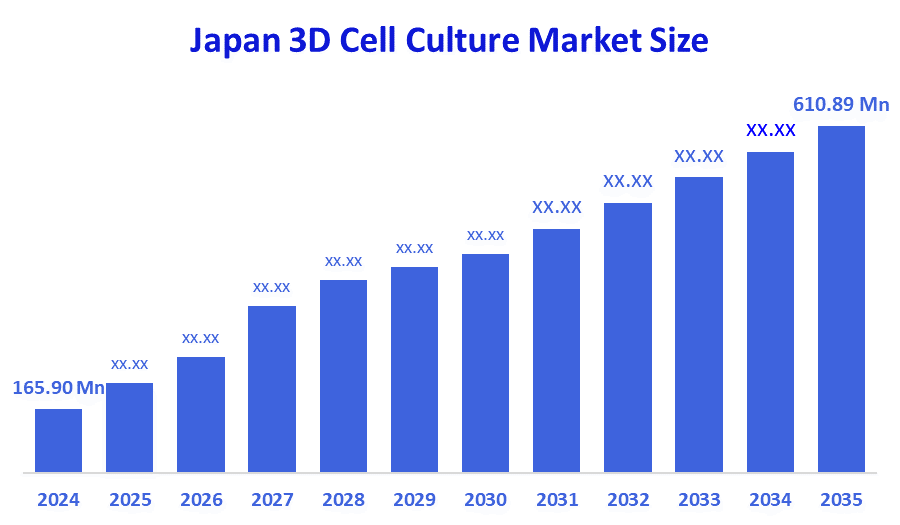
According to a research report published by Decisions Advisors & Consulting, the Japan 3D Cell Culture Market size is anticipated to reach USD 610.89 million by 2035, growing at a CAGR of 12.58% from 2025 to 2035. The Japan 3D cell culture market is driven by growing demand for drug discovery, regenerative medicine, tissue engineering, organoid development, advanced disease modeling, government support, and rising adoption of scaffold-based technologies.
Market Overview
The Japan 3D cell culture market refers to the industry focused on technologies and systems that enable cells to grow in three dimensions, closely mimicking their natural environment for research and therapeutic applications. This approach provides more physiologically relevant models compared to traditional two-dimensional cell cultures, enhancing drug discovery, disease research, and regenerative medicine.?
Key driven factors include the rising demand for accurate in vitro models in pharmaceutical and biotech research, strong government support for regenerative and precision medicine, technological advancements in stem cell research, and increasing investments by both domestic and international companies. Additionally, the adoption of 3D cell culture is driven by the need for better predictive results in drug testing and personalized therapies The government supports this growth through regulatory reforms, early drug approvals, and initiatives to attract both domestic and foreign investment in life sciences and regenerative medicine. In recent years, private investment in biotech clusters in Tokyo and Kansai has reached about 3.3 billion USD (500 billion JPY) from 2021 to 2023, demonstrating strong public-private collaboration and government-backed incentives for innovation in 3D cell culture and related technologies.
Report Coverage
This research report categorizes the market for the Japan 3D cell culture market based on various segments and regions, and forecasts revenue growth and analyses trends in each submarket. The report analyses the key growth drivers, opportunities, and challenges influencing the Japan 3D cell culture market. Recent market developments and competitive strategies, such as expansion, product launch, development, partnership, merger, and acquisition, have been included to draw the competitive landscape in the market. The report strategically identifies and profiles the key market players and analyses their core competencies in each sub-segment of the Japan 3D cell culture market.
Driving Factors
The 3D cell culture markets in Japan are driven by rapidly growing and dynamic sector within the country's life sciences and biotechnology landscape. As a key leader in technological innovation and research, Japan has been at the forefront of advancing 3D cell culture technologies and applications. This market's growth is driven by several key factors, including the need for more physiologically relevant in vitro models for drug discovery and development, as well as the study of disease mechanisms. Japan pharmaceutical and biotechnology companies, as well as research institutions, are actively embracing 3D cell culture to enhance their research capabilities.
The technology offers significant advantages by providing a more accurate representation of cellular behavior, tissue development, and drug responses, compared to traditional 2D cell culture methods. With the country's focus on regenerative medicine and precision medicine, the Japan 3D cell culture market is expected to continue its expansion, playing a pivotal role in advancing healthcare research, drug testing, and personalized medicine.
Restraining Factors
The 3D cell culture market in Japan is restrained by high setup and operational costs, technical complexity, lack of standardization, and challenges in scalability and reproducibility of 3D models. These factors limit widespread adoption, especially among smaller research institutions and emerging biotech firm.
Market Segmentation
The Japan 3D cell culture market share is categorized by product type, application and end user.
- The scaffold-free platforms segment accounted for the largest revenue market share in 2024 and is expected to grow at a significant CAGR during the forecast period.
The Japan 3D cell culture market is segmented by product type into scaffold-based platforms, scaffold-free platforms, microchips, bioreactors, and others. Among these, the scaffold-free platforms segment accounted for the largest revenue market share in 2024 and is expected to grow at a significant CAGR during the forecast period. The segmental growth is driven by its simplicity, cost-effectiveness, and ability to produce more physiologically relevant cell models for drug discovery and research. This approach supports high-throughput screening and is favored for its reproducibility and scalability in pharmaceutical and biotech applications.
- The cancer research segment dominated the market in 2024 and is projected to grow at a substantial CAGR during the forecast period.
The Japan 3D cell culture market is segmented by application into cancer research, stem cell research, drug discovery, regenerative medicine, and others. Among these, the cancer research segment accounted for the largest revenue share in 2024 and is expected to grow at a significant CAGR during the forecast period. The growth of the segment is due to increased R&D investments, rising cancer incidence, and the need for more accurate in vitro models to study disease mechanisms and improve drug screening efficiency. These factors drive the segment’s significant market share and projected growth.
- The biotechnology and pharmaceutical companies segment accounted for the largest revenue market share in 2024 and is expected to grow at a significant CAGR during the forecast period.
The Japan 3D cell culture market is segmented by end user into biotechnology and pharmaceutical companies, contract research laboratories, academic institutes, and others. Among these, the biotechnology and pharmaceutical companies segment accounted for the largest revenue market share in 2024 and is expected to grow at a significant CAGR during the forecast period. The segmental growth is driven by their need for advanced in vitro models to improve drug discovery, disease research, and regenerative medicine. The segment benefits from rising R&D investments, technological advancements, and government support, driving adoption and market expansion.?
Competitive Analysis:
The report offers the appropriate analysis of the key organizations/companies involved within the Japan 3D cell culture market, along with a comparative evaluation primarily based on their product offering, business overviews, geographic presence, enterprise strategies, segment market share, and SWOT analysis. The report also provides an elaborate analysis focusing on the current news and developments of the companies, which includes product development, innovations, joint ventures, partnerships, mergers & acquisitions, strategic alliances, and others. This allows for the evaluation of the overall competition within the market.
List of Key Companies
- Thermo Fisher Scientific Inc.
- Merck KGaA
- Corning Inc.
- Lonza Group Ltd.
- Avantor Inc.
- Tecan Group AG
- ReproCELL
- Others
Key Target Audience
- Market Players
- Investors
- End-users
- Government Authorities
- Consulting and Research Firm
- Venture capitalists
- Value-Added Resellers (VARs)
Recent Developments
- In August 2024, Cell Microsystems, a pioneer in cutting-edge instruments for cell biology, announced the growth of its internal contract research lab services. Using their cutting-edge CellRaft Technology, these services include the generation of cell lines, bespoke organoids, and tests
Market Segment
This study forecasts revenue at the Japan, regional, and country levels from 2020 to 2035. Decisions Advisors has segmented the Japan 3D Cell Culture Market based on the below-mentioned segments:
Japan 3D Cell Culture Market, By Product Type
- Scaffold-Based Platforms
- Scaffold-Free Platforms
- Microchips
- Bioreactors
- Others
Japan 3D Cell Culture Market, By Application
- Cancer Research
- Stem Cell Research
- Drug Discovery
- Regenerative Medicine
- Others
Japan 3D Cell Culture Market, By End User
- Biotechnology and Pharmaceutical Companies
- Contract Research Laboratories
- Academic Institutes
- Others
FAQ’s
Q: What is the Japan 3D cell culture market size in 2024?
A: The market size was estimated at USD 165.90 million in 2024.
Q: What is the expected CAGR of the Japan 3D cell culture market?
A: The market is projected to grow at a CAGR of 12.58% from 2025 to 2035.
Q: Which product type dominates the market?
A: The scaffold-free platforms segment accounted for the largest revenue share in 2024 due to simplicity, cost-effectiveness, and physiological relevance.
Q: Which application segment leads the market?
A: Cancer research dominated the market in 2024, driven by rising R&D investments, cancer incidence, and the need for accurate in vitro models.
Q: Who are the primary end users of 3D cell culture in Japan?
A: Biotechnology and pharmaceutical companies are the largest end users, leveraging 3D models for drug discovery, disease research, and regenerative medicine.
Q: What are the key market drivers?
A: The market is driven by growing demand for drug discovery, regenerative medicine, tissue engineering, organoid development, advanced disease modeling, government support, and scaffold-based technology adoption.
Check Licence
Choose the plan that fits you best: Single User, Multi-User, or Enterprise solutions tailored for your needs.
We Have You Covered
- 24/7 Analyst Support
- Clients Across the Globe
- Tailored Insights
- Technology Tracking
- Competitive Intelligence
- Custom Research
- Syndicated Market Studies
- Market Overview
- Market Segmentation
- Growth Drivers
- Market Opportunities
- Regulatory Insights
- Innovation & Sustainability
Report Details
| Scope | Country |
| Pages | 180 |
| Delivery | PDF & Excel via Email |
| Language | English |
| Release | Dec 2025 |
| Access | Download from this page |