
Japan 3D Rendering Market
 |
Author:
Piya P
|
Pages:
190
|
Author:
Piya P
|
Pages:
190
Japan 3D Rendering Market Size, Share, By Component (Software and Services), By Operating System (Windows, MacOS, and Linux), By End User (Product Design, Architectural & Interior Design, Animation & Visual Effects, and Others), Japan 3D Rendering Market Insights, Industry Trend, Forecasts to 2035
CAGR
20.87%
REVENUE 2025
USD Million 202.6
FORECAST 2035
USD Million 1630.4
REPORT COVERAGE
Country
Japan 3D Rendering Market Insights Forecasts to 2035
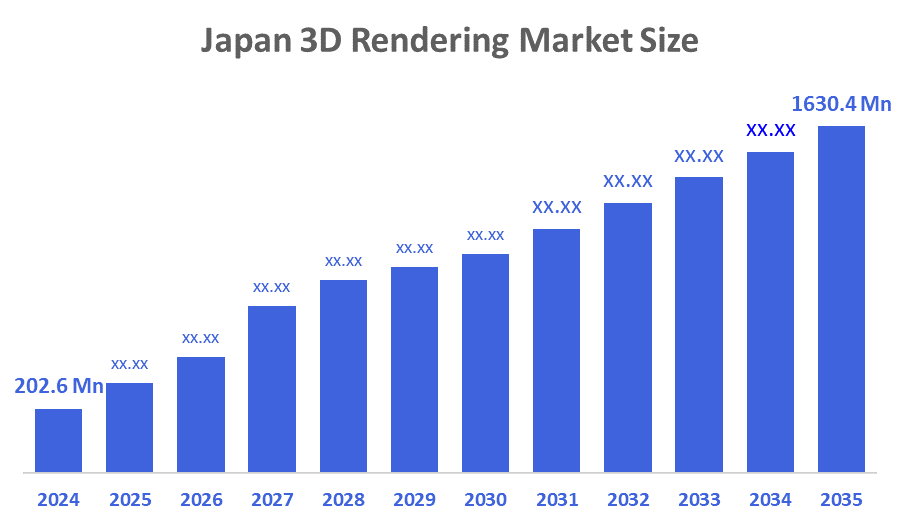
- Japan 3D Rendering Market Size 2024: USD 202.6 Mn
- Japan 3D Rendering Market Size 2035: USD 1630.4 Mn
- Japan 3D Rendering Market CAGR 2024: 20.87%
- Japan 3D Rendering Market Segments: Component, Operating System, and End User.
The 3D rendering market in Japan covers all types of photorealistic three-dimensional images and animations generated by computer, which are used in architecture, product design, media, visualisation, and simulation. This is due to the advanced manufacturing and design culture of Japan, which has led to an increase in the adoption of 3D render workflow for digital prototyping, architectural visualisation, surgical planning, and product demonstrations.
In terms of government initiatives, one of the major components of Japan’s national strategy, Society 5.0, is the integration of cyberspace into the economy using Artificial Intelligence, the Internet of Things, advanced data analytics, and digital model creation, creating a “super-smart” society. The Japanese government’s Digital Agency, as well as cross-ministerial R&D programs, provide support to Digital Transformation (DX), Digital Infrastructure, and Industry-Academic Cooperation to enhance the 3D Render ecosystem and other Related Technologies that use those technologies.
The technological advancement integration of cutting-edge computing, AI-assisted design, real-time rendering engines, and digital twin technologies will enhance visualisation accuracy and speed in Japan. AI-enabled tools make it possible to quickly create 3D models based on 2D images and optimise workflow for both novice and experienced users. Continuous research and development, along with wider industrial application, will continue to create new possibilities for 3D rendering, and consequently, 3D rendering will become the backbone of Japan’s digital economy.
Market Dynamics of the Japan 3D Rendering Market:
The Japanese 3D Rendering market is driven by rapid digital transformation throughout multiple industries, which is generating increased demand for highly accurate visualisations, virtual prototypes, and digital twins, resulting in increased efficiency and lower development costs. In addition, the growth of AR/VR, gaming, and animation, along with the increasing acceptance of cloud-based rendering and AI-assisted design tools, continues to drive market expansion. Furthermore, with Japan’s increased focus on smart manufacturing and Industry 4.0, widespread acceptance of cloud-based and AI-based design tools will occur.
The Japanese 3D Rendering market is restrained by the interest in emerging technologies, which will continue to be large capital investments (hardware and software) and large personnel investments. In addition, very complicated software integration will present a challenge to emerging technologies, as well as the limited availability of skilled talent in 3D rendering.
The Japan's 3D Rendering market is a significant opportunity that includes a growing number of 3D applications in the areas of urban development (smart cities), medical visualisation, metaverse development, and real-time technologies, all of which represent tremendous potential opportunities for future growth. Digital initiatives backed by local, state, and federal governments and ongoing innovation will help to maximise future growth potential.
Market Segmentation
The Japan 3D rendering market share is classified into component, operating system, and end user.
By Component:
The Japan 3D rendering market is divided by component into software and services. Among these, the software segment held the largest market revenue share in 2024 and is anticipated to grow at a remarkable CAGR during the forecast period. This is due to real-time rendering capabilities are becoming increasingly important in 3D rendering systems, boosting industry growth. Customers are increasingly seeking immersive and interactive experiences, whether in product design, entertainment, or real estate.
By Operating System:
The Japan 3D rendering market is divided by operating system into windows, macOS, and Linux. Among these, the windows segment dominated the market in 2024 and is anticipated to grow at a remarkable CAGR during the forecast period. The segment is being driven primarily by increased enterprise use of Windows in corporate IT systems. Large enterprises frequently select Windows due to its centralized administration tools, security capabilities, and enterprise-level support, making it easier to integrate rendering workflows into existing digital ecosystems.
By End User:
The Japan 3D rendering market is divided by end user into product design, architectural & interior design, animation & visual effects, and others. Among these, the product design segment held the largest market revenue share in 2024 and is anticipated to grow at a significant CAGR during the forecast period. This is due to the growing importance of remote and distributed workforces, which drives the usage of 3D rendering in product design.
Competitive Analysis:
The report offers the appropriate analysis of the key organisations/companies involved within the Japan 3D rendering market, along with a comparative evaluation primarily based on their product offering, business overviews, geographic presence, enterprise strategies, segment market share, and SWOT analysis. The report also provides an elaborative analysis focusing on the current news and developments of the companies, which includes product development, innovations, joint ventures, partnerships, mergers & acquisitions, strategic alliances, and others. This allows for the evaluation of the overall competition within the market.
Top Key Companies in Japan 3D Rendering Market:
- Ricoh Company Ltd.
- Canon Inc.
- Shimadzu Corporation
- Fujitsu Limited
- Panasonic Corporation
- Silicon Studio
- Shade 3D Co., Ltd.
- Others
Recent Developments in Japan 3D Rendering Market:
In May 2025, The Ricoh Company, Ltd. has developed a full-color, high-strength 3D inkjet printing technology for custom products (dental products and eyeglass frames, etc.) and has combined new technologies with the traditional way of creating prototypes for visual purposes by creating 3D Models digitally. The development of this new technology is reflective of the trend in digital modelling and rendering becoming part of the overall production process.
Key Target Audience
- Market Players
- Investors
- End-users
- Government Authorities
- Consulting and Research Firm
- Venture capitalists
- Value-Added Resellers (VARs)
Market Segment
This study forecasts revenue at the Japan, regional, and country levels from 2020 to 2035. Decisions Advisors has segmented the Japan 3D Rendering market based on the below-mentioned segments:
Japan 3D Rendering Market, By Component
- Software
- Services
Japan 3D Rendering Market, By Operating System
- Windows
- MacOS
- Linux
Japan 3D Rendering Market, By End User
- Product Design
- Architectural & Interior Design
- Animation & Visual Effects
- Others
FAQ
Q: What is the Japan 3D Rendering Market?
A: The Japan 3D Rendering Market includes software and services used to create photorealistic 3D images and animations for applications such as product design, architecture, animation, visualization, and simulation across multiple industries.
Q: What is the market size and growth outlook of the Japanese 3D Rendering Market?
A: The market was valued at USD 202.6 million in 2024 and is projected to reach USD 1,630.4 million by 2035, growing at a strong CAGR of 20.87% during the forecast period 2025–2035.
Q: What are the key factors driving the Japan 3D Rendering Market?
A: Key drivers include rapid digital transformation, increasing demand for realistic visualization and virtual prototyping, growth of AR/VR and gaming industries, adoption of cloud-based rendering, and Japan’s focus on smart manufacturing and Industry 4.0.
Q: Which segment holds the largest share of components?
A: The software segment holds the largest market share due to rising demand for real-time rendering, immersive visualization, and interactive design solutions across industries.
Q: Which end-user segment leads the market in Japan?
A: The product design segment leads the market, driven by the growing need for digital prototyping, faster product development cycles, and collaboration among remote and distributed teams.
Q: Who are the key companies operating in the Japan 3D Rendering Market?
A: Major players include Ricoh Company Ltd., Canon Inc., Shimadzu Corporation, Fujitsu Limited, Panasonic Corporation, Silicon Studio, Shade 3D Co., Ltd., along with other emerging and regional players.
Q: Who are the target audiences for this market report?
A: The report targets market players, investors, end-users, government authorities, consulting and research firms, venture capitalists, and value-added resellers (VARs).
Check Licence
Choose the plan that fits you best: Single User, Multi-User, or Enterprise solutions tailored for your needs.
We Have You Covered
- 24/7 Analyst Support
- Clients Across the Globe
- Tailored Insights
- Technology Tracking
- Competitive Intelligence
- Custom Research
- Syndicated Market Studies
- Market Overview
- Market Segmentation
- Growth Drivers
- Market Opportunities
- Regulatory Insights
- Innovation & Sustainability
Report Details
| Scope | Country |
| Pages | 190 |
| Delivery | PDF & Excel via Email |
| Language | English |
| Release | Dec 2025 |
| Access | Download from this page |