
Japan 4D Imaging Radar Market
 |
Author:
Kunal M
|
Pages:
167
|
Author:
Kunal M
|
Pages:
167
Japan 4D Imaging Radar Market Size, Share, and COVID-19 Impact Analysis, By Type (Short-Range Radar, Medium-Range Radar, and Long-Range Radar), By Application (Automotive, Aerospace & Defense, Security & Surveillance, Traffic Monitoring & Management, and Others), and Japan 4D Imaging Radar Market Insights, Industry Trend, Forecasts to 2035
CAGR
20.13%
REVENUE 2024
USD Million 212.7
FORECAST 2035
USD Million 212.7
REPORT COVERAGE
country
Japan 4D Imaging Radar Market Insights Forecasts to 2035
- The Japan 4D Imaging Radar Market Size Was Estimated at USD 212.7 Million in 2024
- The Market Size is Expected to Grow at a CAGR of Around 20.13% from 2025 to 2035
- The Japan 4D Imaging Radar Market Size is Expected to Reach USD 212.7 Million by 2035
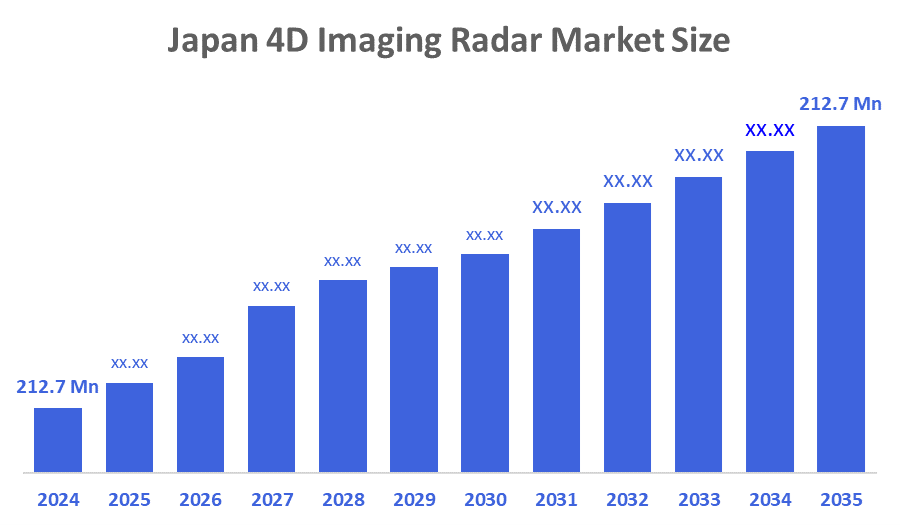
According to a research report published by Decision Advisors & Consulting, The Japan 4D imaging Radar Market size is anticipated to reach USD 1599.4 million by 2035, growing at a CAGR of 20.13% from 2025 to 2035. The 4D imaging radar market in Japan is driven by government support for road-safety technologies, the growing use of high-resolution radar in automotive and industrial applications, the increasing adoption of advanced driver assistance systems (ADAS), and the growing demand for autonomous and connected vehicles.
Market Overview
The 4D imaging radar industry is a sector that manufactures and sells next-generation radar equipment capable of providing 4D images of the Earth, including Speed/Velocity of the target, distance, altitude, and lateral angle. This equipment allows for greater resolution than conventional devices for target recognition, height determination, and motion analysis. Japan is taking an active role in the development of advanced mobility systems, which in turn are driving the demand for 4D imaging radar. The government established the Level-4 System Mobility Acceleration Committee, intending to make fully automated driving services available by 2025, and it has approved the use of Level-4 autonomous vehicles on public roads, along with projects aimed at the validation of these vehicles, such as RoAD to L4. METI’s autonomous mobility development grants (including support for regional automated services, among others) are financing trial deployments and open data initiatives, thus allowing the companies to create Level-4 systems. These regulatory and financial actions are directed towards the proliferation of cutting-edge sensing technologies like 4D radar for safety and automated driving innovation. In addition to commercial growth opportunities being created by the increasing number of robotaxis, smart infrastructure, logistics automation, and defense monitoring applications, collaboration between original equipment manufacturers (OEMs) and suppliers, chipset upgrades, and expanded testing of autonomous driving platforms are adding to the increasing demand for Japanese 4D imaging radars.
Report Coverage
This research report categorizes the market for the Japan 4D imaging radar market based on various segments and regions, and forecasts revenue growth and analyses trends in each submarket. The report analyses the key growth drivers, opportunities, and challenges influencing the Japan 4D imaging radar market. Recent market developments and competitive strategies, such as expansion, product launch, development, partnership, merger, and acquisition, have been included to draw the competitive landscape in the market. The report strategically identifies and profiles the key market players and analyses their core competencies in each sub-segment of the Japan 4D imaging radar market.
Driving Factors
The 4D imaging radar market in Japan is driven by mounting adoption of ADAS and self-driving cars, the necessity for high-resolution sensing in intricate city areas, and the substantial reliance on dependable all-weather perception. Government backing for Level-3 and Level-4 mobility projects, safety technology subsidies, and smart infrastructure schemes are the main factors that make it easier for the technologies to be applied more quickly. Moreover, innovations in mmWave radar chips, sensor fusion algorithms, and in-car computing are also contributing to the expansion of the market, along with the gradual uptake of imaging radar in sectors like automotive, robotics, logistics automation, and public safety.
Restraining Factors
The 4D imaging radar market in Japan is mostly constrained by the high cost of the whole system, the difficult connection to car structures, and the presence of LiDAR and camera-based technologies as competition. The lack of standardization, the need for regulatory validation, and the hurdles faced in the deployment of large-scale autonomous vehicles are all factors that contribute to the slow pace of acceptance in the market.
Market Segmentation
The Japan 4D imaging radar market share is classified into type and application.
- The long-range radar segment accounted for the largest revenue market share in 2024 and is expected to grow at a significant CAGR during the forecast period.
The Japan 4D imaging radar market is segmented by type into short-range radar, medium-range radar, and long-range radar. Among these, the long-range radar segment accounted for the largest revenue market share in 2024 and is expected to grow at a significant CAGR during the forecast period. ADAS and autonomous driving, particularly features like adaptive cruise control, highway pilot, collision avoidance, and Level-3/4 perception, depend on long-range 4D radars. For highway safety, lane keeping, and early obstacle detection, where extended range and good elevation resolution are crucial, Japanese OEMs like Toyota, Nissan, and Honda prioritize long-range radar.
- The automotive segment accounted for the largest revenue share in 2024 and is expected to grow at a significant CAGR during the forecast period.
The Japan 4D imaging radar market is segmented by application into automotive, aerospace & defense, security & surveillance, traffic monitoring & management, and others. Among these, the automotive segment accounted for the largest revenue share in 2024 and is expected to grow at a significant CAGR during the forecast period. The automobile sector is the main user of 4D imaging radar due to Japan's robust automotive industry, quick acceptance of ADAS features, growth of Level-2+ to Level-4 autonomous driving projects, and OEM investment in high-resolution sensing. These radars are widely used in both passenger and commercial cars because they are essential for features like highway pilot, automated parking, collision avoidance, and sensor fusion.
Competitive Analysis:
The report offers the appropriate analysis of the key organizations/companies involved within the Japan 4D imaging radar market, along with a comparative evaluation primarily based on their product offering, business overviews, geographic presence, enterprise strategies, segment market share, and SWOT analysis. The report also provides an elaborate analysis focusing on the current news and developments of the companies, which includes product development, innovations, joint ventures, partnerships, mergers & acquisitions, strategic alliances, and others. This allows for the evaluation of the overall competition within the market.
List of Key Companies
- Denso Corporation
- Denso Ten Ltd.
- Furuno Electric Co., Ltd.
- Vayyar Imaging Japan G.K.
- Ibiden Co., Ltd.
- Meiko Electronics Co., Ltd.
- Nippon Mektron, Ltd.
- Yazaki Corporation
- Hosiden Corporation
- Meisei Electric Co., Ltd.
- Others
Key Target Audience
- Market Players
- Investors
- End-users
- Government Authorities
- Consulting and Research Firm
- Venture capitalists
- Value-Added Resellers (VARs)
Recent Developments:
- In August 2025, Zadar Labs and Cornes Technologies' cooperation marks the start of 4D imaging radar distribution in Japan, thus increasing the accessibility of high-resolution radars for applications in automotive, robotics, and smart infrastructure.
- In August 2025, the zPRIME 4D imaging radar became available in the Japanese market thanks to Cornes Technologies' signing of a distribution agreement with Zadar Labs to start the sale of the domestically produced radar. Thus, the fields of automotive, robotics, AMR/AGV, and smart infrastructure are all gaining more access to the technology.
- In July 2025, Experts significantly remarked on the impact of 4D imaging radar in not only sensing but also in the overall understanding of the design of the autonomous vehicles in Japan.
Market Segment
This study forecasts revenue at the Japan, regional, and country levels from 2020 to 2035. Decision Advisors has segmented the Japan 4D imaging radar market based on the below-mentioned segments:
Japan 4D Imaging Radar Market, By Type
- Short Range Radar
- Medium Range Radar
- Long Range Radar
Japan 4D Imaging Radar Market, By Application
- Automotive
- Aerospace & Defense
- Security & Surveillance
- Traffic Monitoring & Management
- Others
FAQ’s
Q: What is the Japan 4D imaging radar market size?
A: Japan 4d imaging radar market size is expected to grow from USD 212.7 million in 2024 to USD 1599.4 million by 2035, growing at a CAGR of 20.13% during the forecast period 2025-2035.
Q: What are the key growth drivers of the market?
A: Market growth is driven by mounting adoption of ADAS and self-driving cars, the necessity for high-resolution sensing in intricate city areas, and the substantial reliance on dependable all-weather perception. Government backing for Level-3 and Level-4 mobility projects, safety technology subsidies, and smart infrastructure schemes are the main factors that make it easier for the technologies to be applied more quickly. Moreover, innovations in mmWave radar chips, sensor fusion algorithms, and in-car computing are also contributing to the expansion of the market, along with the gradual uptake of imaging radar in sectors like automotive, robotics, logistics automation, and public safety.
Q: What factors restrain the Japan 4D imaging radar market?
A: Constraints include the high cost of the whole system, the difficult connection to car structures, and the presence of LiDAR and camera-based technologies as competition.
Q: How is the market segmented by application?
A: The market is segmented into automotive, aerospace & defense, security & surveillance, traffic monitoring & management, and others.
Q: Who are the key players in the Japan 4D imaging radar market?
A: Key companies include Denso Corporation, Denso Ten Ltd., Furuno Electric Co., Ltd., Vayyar Imaging Japan G.K., Ibiden Co., Ltd., Meiko Electronics Co., Ltd., Nippon Mektron, Ltd., Yazaki Corporation, Hosiden Corporation, Meisei Electric Co., Ltd., and Others.
Q: Who are the target audiences for this market report?
A: The report targets market players, investors, end-users, government authorities, consulting and research firms, venture capitalists, and value-added resellers (VARs).
Check Licence
Choose the plan that fits you best: Single User, Multi-User, or Enterprise solutions tailored for your needs.
We Have You Covered
- 24/7 Analyst Support
- Clients Across the Globe
- Tailored Insights
- Technology Tracking
- Competitive Intelligence
- Custom Research
- Syndicated Market Studies
- Market Overview
- Market Segmentation
- Growth Drivers
- Market Opportunities
- Regulatory Insights
- Innovation & Sustainability
Report Details
| Scope | country |
| Pages | 167 |
| Delivery | PDF & Excel via Email |
| Language | English |
| Release | Dec 2025 |
| Access | Download from this page |