
Japan AC Motor Market
 |
Author:
Omkar J
|
Pages:
245
|
Author:
Omkar J
|
Pages:
245
Japan AC Motor Market Size, Share, By Induction AC Motors (Single Phase, and Poly Phase), By Synchronous AC Motors (DC Excited Rotor, Permanent Magnet, and Hysteresis Motor, Reluctance Motor), By End User (Oil and Gas, Chemical and Petrochemical, Power Generation, Water and Wastewater, Metal and Mining, Food and Beverages, Discrete Industries, Others) Analysis and Forecast 2026-2035
CAGR
3.74%
REVENUE 2025
USD Billion 1.2
FORECAST 2035
USD Billion 1.73
REPORT COVERAGE
Country
Market Snapshot
- Japan AC Motor Market Size (2025): USD 1.20 Billion
- Japan AC Motor Projected Market Size (2035): USD 1.73 Billion
- Japan AC Motor Compound Annual Growth Rate (CAGR): 3.74%
- Base Year: 2025
- Historical Period: 2021–2024
- Forecast Period: 2026–2035
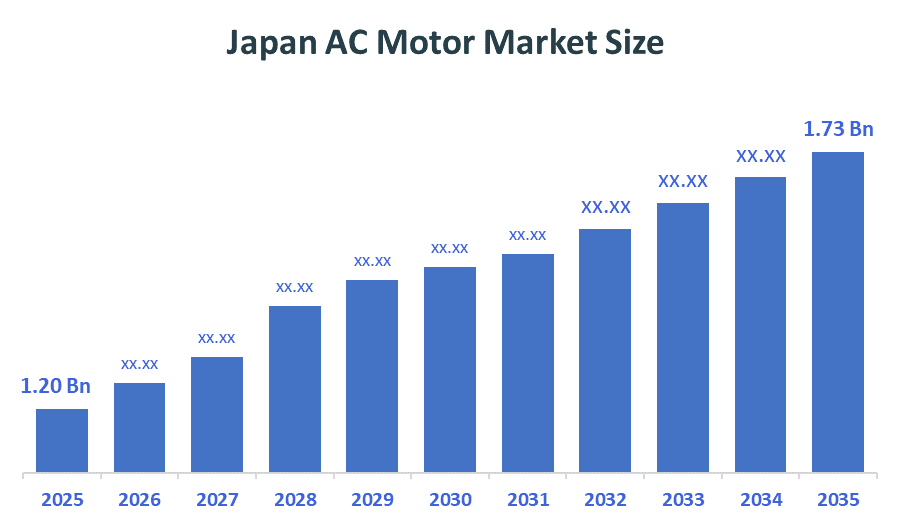
According to Decision Advisors, the Japan AC motors market was projected to grow from USD 1.20 Billion in 2025 to USD 1.73 Billion by 2035, achieving a CAGR of 3.74% during the forecast period of 2026–2035. The market for AC motors in Japan is mainly fuelled by rising industrial automation, robust demand for energy-efficient motors owing to government regulations, and the widespread use of AC motors in industries such as petrochemicals, power generation, and water purification. Regulations that encourage energy savings and plant modernization also contribute to the uptake, while Japan’s position in industrial centres facilitates market growth.
Market Overview/Introduction
The Japan AC Motor Market refers to the commercial and industrial sector involved in the manufacturing, distribution, and application of alternating current (AC) motors in Japan. AC motors are electrical machines that convert alternating current into mechanical energy and are widely used in industries, household appliances, HVAC systems, automotive, and robotics due to their efficiency, reliability, and low maintenance requirements. Uses of AC motors in Japan span manufacturing automation, conveyor systems, pumps, fans, compressors, and electric vehicles, making them crucial for industrial productivity and smart home solutions. The market is primarily driven by factors such as rising industrial automation, increased adoption of energy-efficient solutions, demand for smart appliances, and growth in electric mobility. Additionally, the push for sustainability has led industries to prioritize motors with lower energy consumption and high-performance features. Innovation and technology advancements in the sector include the development of high-efficiency motors, variable frequency drives (VFDs), and smart AC motors integrated with IoT for predictive maintenance and energy optimization. Companies are also focusing on reducing noise, enhancing durability, and integrating eco-friendly materials to meet stringent environmental regulations. Recent developments in the Japan AC motor market include partnerships for smart motor solutions, expansion of manufacturing facilities, and adoption of AI-driven motor diagnostics. The government initiatives, such as incentives for energy-efficient industrial equipment and support for electrification of transport, further stimulate market growth by encouraging sustainable practices.
- February 2026: Japan launches a $75 Billion Agri Marketing Program (2026?2031) to help food processors and exporters diversify markets. While not AC motor-specific, the initiative indirectly supports AC motor-using industries by promoting exports and enhancing competitiveness amid global trade challenges.
- In June 2025, industrial decarbonization initiatives in the EU and globally are encouraging adoption of energy-efficient AC motor systems in HVAC and pumping applications. These programs promote high-efficiency motors, reducing energy use and supporting sustainability and carbon reduction goals.
- In 2024–2025, governments are promoting EV adoption through incentives such as subsidies, tax exemptions, and charging infrastructure investments. Programs like China’s NEV dual-credit system and India’s FAME and PM E-DRIVE schemes are driving demand for AC motors in electric vehicles.
Notable Insights: -
- By Induction AC Motors, the synthetic (artificial) AC motor segment holds a dominant position with an estimated share of over 64.4% in 2025.
- By Synchronous AC Motors, the DC Excited Rotor segment holds a dominant position with an estimated share of over 54.2% in 2025.
- By form, the powder segment holds a dominant position with an estimated share of over 67% in 2025.
- By application, the bakery & confectionery segment holds a dominant position with an estimated share of over 32% in 2025.
- The forecasted CAGR for the Japan AC motor market is expected to be about 3.74% for the period between 2026 and 2035.
- The market is expected to reach a valuation of approximately USD 1.73 Billion by 2035
What is the Role of Technology in Grooming the Market?
Technology plays a pivotal role in shaping the Japan AC motor market by enhancing efficiency, performance, and reliability. Advanced innovations like variable frequency drives (VFDs), high-efficiency motors, and IoT-enabled smart motors enable precise speed control, energy optimization, and predictive maintenance, reducing downtime and operational costs. Automation and AI integration support industrial modernization, while eco-friendly materials and low-noise designs align with sustainability goals. Technological advancements also drive product differentiation, fostering innovation and competitiveness among manufacturers. Overall, technology acts as a growth catalyst, improving functionality, reducing energy consumption, and creating new applications across industrial, commercial, and consumer sectors.
Market Drivers
The market for AC motors in Japan is mainly propelled by the rapid pace of automation and modernization in various industries like manufacturing, automotive, and robotics. The escalating need for energy-efficient and superior performance motors is compelling companies to develop new products, including VFD and intelligent AC motors that enable efficient energy utilization and minimize operating expenses. The rise in EVs and hybrid vehicles is another factor that is contributing to an increase in the number of AC motors, since the motors play a key role in driving the vehicle. Furthermore, the growing use of smart home appliances, HVAC systems, and industrial equipment in both residential and commercial applications is driving the market. Sustainability and reduced carbon emissions are being stressed by industries and governments, thereby promoting the transition towards efficient and environmentally friendly motors. Advances in technology and government initiatives promoting energy-efficient equipment continue to drive the market ahead, establishing Japan as a prominent centre for innovative AC motors.
Restraints
The Japan AC motor market faces challenges such as high initial investment costs for advanced and energy-efficient motors, which can deter small and medium enterprises. Additionally, complex maintenance requirements for smart and high-performance motors, coupled with intense competition from low-cost imports, limit widespread adoption. Fluctuating raw material prices also impact manufacturing costs and market growth.
Study on the Supply, Demand, Distribution, and Market Environment
The Japanese AC motors market exhibits an elaborate supply chain network, featuring local manufacturers and international companies offering a variety of industrial, commercial, and residential AC motors. Demand for the product comes from industrial automation, smart household equipment, heating, ventilation, and air conditioning (HVAC) applications, as well as electric automobiles. Channels of distribution include direct sales, OEM collaboration, and licensed dealerships. The market operates under conditions of rapid technological advancements, strict energy efficiency requirements, and favourable government policies aimed at encouraging environmentally friendly products.
Price Analysis and Consumer Behaviour Analysis
The pricing of AC motors in Japan depends on factors such as motor type, efficiency level, capacity, and technology. The most efficient motors with innovative features tend to attract high premiums due to their benefits in saving energy and offering more features. Consumers in Japan, including industries and Original Equipment Manufacturers (OEMs), are more concerned about the efficiency, longevity, and energy-saving potential of the AC motors than their purchase price. Price sensitivity is prevalent among small and medium-sized industries but not necessarily among larger industries.
Market Segmentation
The Japan AC motors market is categorised by Induction AC Motors, Synchronous AC Motors, and end user
- The poly-phase segment dominated the market in 2025 and is projected to grow at a steady CAGR of approximately 5.7% during the forecast period.
Based on the Induction AC Motors, the AC motors market is divided into single phase, and poly phase. Among these, the poly-phase (three-phase) induction motors dominate the AC motor market, primarily due to their high efficiency, superior torque, and suitability for industrial and commercial applications. These motors are widely used in manufacturing, automation, and electric vehicle systems, capturing approximately 78% of the regional market share. The three-phase segment also benefits from higher power ratings, lower energy losses, and compatibility with smart industrial systems, driving stronger market revenue and a robust CAGR estimated at approximately 5.5% to 6% over 2026–2035, making it the preferred choice for large-scale and high-performance operations.
- The permanent magnet segment accounted for the largest share in 2025 and is anticipated to grow at a significant CAGR of approximately 11.2% during the forecast period.
Based on the Synchronous AC Motors, the AC motor market is divided into DC excited rotor, Permanent magnet, and hysteresis motor, reluctance motor. Among these, permanent magnet synchronous motors (PMSMs) are currently dominating due to their high efficiency, compact size, and excellent torque density, making them ideal for industrial automation, EVs, and robotics key growth industries in Japan and globally. Globally, permanent magnet motors accounted for a large share of motor revenue and are growing rapidly, with the permanent magnet market projected to grow at double?digit CAGR approximately 11.2% globally through 2030. Reluctance motors also hold significant share and show strong growth, but PMSMs lead in market revenue and adoption, supported by ongoing demand for energy?efficient, high?performance motor technologies.
- The oil & gas segment accounted for the largest share in 2025 and is anticipated to grow at a significant CAGR of approximately 3.69% during the forecast period.
Based on the end user, the AC motor market is divided into oil and gas, chemical and petrochemical, power generation, water and wastewater, metal and mining, food and beverages, discrete industries, other. Among these, the oil & gas sector currently holds the largest revenue share approximately 28-32% market share, end?users, owing to extensive use of AC motors in pumps, compressors, and drilling equipment that require robust performance and high uptime. ?Additionally, Power Generation and Chemical & Petrochemical industries are strong contributors due to large?scale industrial motor deployments. The overall Japan AC motor market is projected to grow at approximately 3.69% CAGR from 2025 to 2030, reflecting steady demand across major industrial end?users.
Recent Developments
In October 2025, ABB introduced IE6 SynRM hyper-efficiency motors, magnet-free synchronous AC motors achieving IE6 efficiency levels. The motors reduce energy losses by up to 20% compared to IE5 models, improving industrial energy efficiency, lowering operational costs, and supporting global sustainability and decarbonization goals.
In March 2025, Advanced Electric Machines (AEM) launched the second-generation HDRM300C magnet-free heavy-duty motor. Designed for EV traction applications, it enhances efficiency, durability, and sustainability by eliminating rare-earth magnets, supporting cleaner and cost-effective electrified transport solutions.
Competitive Analysis
The report offers the appropriate analysis of the key organisations/companies involved within the Japan AC motor market, along with a comparative evaluation primarily based on their product offering, business overviews, geographic presence, enterprise strategies, segment market share, and SWOT analysis. The report also provides an elaborate analysis focusing on the current news and developments of the companies, which includes product development, innovations, joint ventures, partnerships, mergers & acquisitions, strategic alliances, and others. This allows for the evaluation of the overall competition within the market.
Top Key Companies in the Japan AC motor Market
- Mitsubishi Electric
- Toshiba Corporation
- Hitachi Ltd.
- Yaskawa Electric Corporation
- Fuji Electric Co., Ltd.
- Nidec Corporation
- Panasonic Corporation
- Sumitomo Electric Industries
- Oriental Motor Co., Ltd.
- Meidensha Corporation
- Others
Key Target Audience
- Market Players
- Investors
- End-users
- Government Authorities
- Consulting and Research Firm
- Venture capitalists
- Value-Added Resellers (VARs)
Market Segmentation
This study forecasts revenue at the national and regional levels from 2021 to 2035. The report segmented the Japan AC motor Market based on the following segments:
Japan AC motor Market, By Induction AC Motors
- Single Phase
- Poly Phase
Japan AC motor Market, By Synchronous AC Motors
- DC Excited Rotor
- Permanent Magnet
- Hysteresis Motor
- Reluctance Motor
Japan AC motor Market, By End User
- Oil and Gas
- Chemical and Petrochemical
- Power Generation
- Water and Wastewater
- Metal and Mining
- Food and Beverages
- Discrete Industries
- Others
Frequently Asked Questions (FAQ)
1. Q: How is digital twin technology influencing AC motor performance in Japan?
A: Digital twin technology enables real-time simulation of AC motor performance, allowing predictive maintenance, fault detection, and efficiency optimization. It reduces downtime and improves operational reliability in industrial applications.
2. Q: What role does robotics expansion play in Japan’s AC motor demand?
A: Japan’s strong robotics industry significantly increases demand for precision AC motors, especially in servo and automation systems, supporting high-speed, accurate motion control in manufacturing and logistics.
3. Q: How are rare-earth material concerns affecting AC motor innovation?
A: Dependence on rare-earth materials is pushing manufacturers to develop magnet-free alternatives like synchronous reluctance motors, reducing supply chain risks and improving cost stability.
4. Q: What impact does smart factory adoption have on AC motor usage?
A: Smart factories increase deployment of IoT-enabled AC motors that support real-time monitoring, energy optimization, and automated production line adjustments, improving efficiency and reducing operational costs.
5. Q: How is noise reduction technology shaping AC motor development in Japan?
A: Advanced acoustic engineering and precision rotor design are being used to develop low-noise AC motors, particularly for residential HVAC, healthcare, and high-precision industrial environments.
Check Licence
Choose the plan that fits you best: Single User, Multi-User, or Enterprise solutions tailored for your needs.
We Have You Covered
- 24/7 Analyst Support
- Clients Across the Globe
- Tailored Insights
- Technology Tracking
- Competitive Intelligence
- Custom Research
- Syndicated Market Studies
- Market Overview
- Market Segmentation
- Growth Drivers
- Market Opportunities
- Regulatory Insights
- Innovation & Sustainability
Report Details
| Scope | Country |
| Pages | 245 |
| Delivery | PDF & Excel via Email |
| Language | English |
| Release | Apr 2026 |
| Access | Download from this page |