
Japan Air Conditioning Systems Market
 |
Author:
Pranali P
|
Pages:
210
|
Author:
Pranali P
|
Pages:
210
Japan Air Conditioning Systems Market Size, Share, By Product Type (Split AC, Window AC, Portable AC, Centralized HVAC Systems, VRF/VRV Systems), By Technology (Conventional, Inverter-Based Systems, Smart/IoT-Enabled AC Systems, Energy-Efficient Systems), By End Use (Residential, Commercial, Industrial, Institutional), By Region (North America, Europe, Asia-Pacific, Latin America, Middle East, and Africa) Analysis and Forecast 2025 ? 2035.
CAGR
4.08%
REVENUE 2025
USD Million 272.9
FORECAST 2035
USD Million 407.1
REPORT COVERAGE
Coutry
Market Snapshot
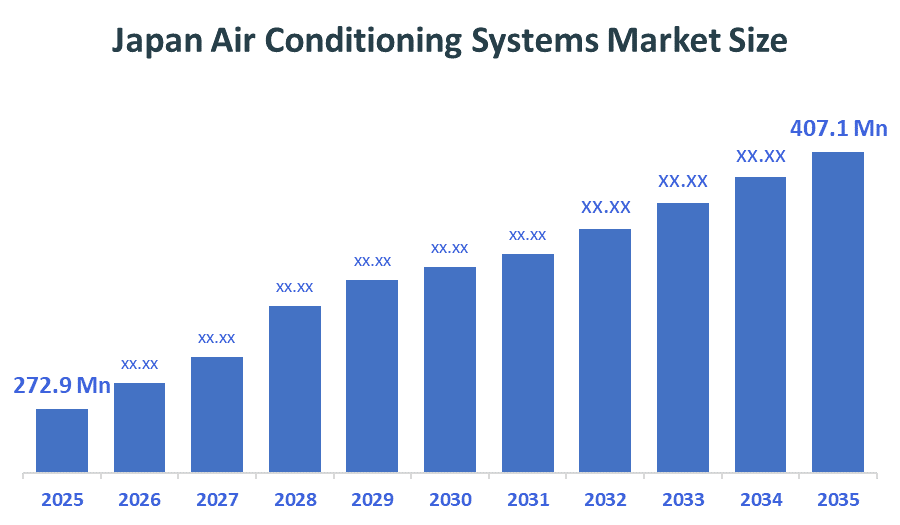
- Market Size (2025): USD 272.9Million
- Projected Market Size (2035): USD 407.1Million
- Compound Annual Growth Rate (CAGR): 4.08%
- Base Year: 2025
- Historical Period: 2021–2025
- Forecast Period: 2026–2035
Market Overview/Introduction
The Japan Air Conditioning Systems Market refers to the industry focused on manufacturing and deployment of cooling systems designed to regulate indoor temperature, humidity, and air quality across residential, commercial, and industrial environments. The systems used in this system include split air conditioners and centralized HVAC systems and advanced VRF/VRV technologies which people use in high-density urban areas. Japan is one of the most technologically advanced HVAC markets globally because the country adopts inverter-based and energy-efficient cooling systems at a high rate. Approximately 45–50% of new installations now include inverter technology which results in energy savings that reach 30–40%. The market has experienced increased adoption because of rising temperatures and the need for comfort by the aging population and the enforcement of energy efficiency standards. The market for IoT-enabled smart air conditioning systems is expanding because these systems permit users to control their systems from remote locations and perform predictive maintenance and optimize their energy usage.
Notable Insights: -
- By product type, the split AC held a dominant position with 4.8 % in terms of market share in 2025.
- By technology, inverter-based air conditioning systems is the dominating accounting for over 5.4% of the United Kingdom market share in 2025.
- The compound annual growth rate of the Japan Air Conditioning Systems Market is 4.08%.
- The market is likely to achieve a valuation of USD 407.1Million by 2035.
What is role of Technology in grooming the market?
Technology plays a critical role in transforming Japan’s air conditioning systems market through energy-efficient inverter compressors, IoT connectivity, and AI-based climate control systems. Modern systems can reduce energy consumption by up to 35% compared to conventional units. Smart AC systems allow real-time monitoring of temperature, humidity, and energy usage, improving comfort and efficiency. Around 30% of new residential systems now include smart home integration features compatible with mobile apps and voice assistants. Advanced technologies such as refrigerant optimization, variable speed compressors, and AI-driven predictive cooling are improving performance while reducing carbon emissions. Additionally, eco-friendly refrigerants and low-noise compressor designs are enhancing adoption in dense urban areas.
Market Drivers
The Japan Air Conditioning Systems Market is driven by rising urban temperatures, increasing demand for energy-efficient cooling, and strong government regulations on carbon emissions. Japan’s high population density and compact housing structures increase reliance on efficient cooling systems. Growing adoption of smart homes and IoT-based building management systems is boosting demand for connected AC systems. The residential sector accounts for nearly 55% of total demand due to continuous usage in apartments and urban homes. Additionally, commercial expansion in offices, retail spaces, and healthcare facilities supports market growth. Government energy-efficiency programs promoting inverter-based systems further accelerate adoption.
Restrain
High installation and maintenance costs of advanced HVAC systems limit adoption in price-sensitive households. Complex installation requirements for VRF systems also restrict small-scale adoption.
Japan’s aging housing infrastructure increases retrofit costs, making upgrades expensive. Additionally, seasonal demand fluctuations impact consistent market growth. High electricity costs also discourage excessive usage of air conditioning systems in residential sectors.
Study on the Supply, Demand, Distribution, and Market Environment Japan Air Conditioning Systems Market
The Japan Air Conditioning Systems Market operates through a well-structured supply chain involving global manufacturers, local distributors, electrical contractors, and utility companies. Demand is primarily driven by utilities, mining operations, renewable energy projects, and commercial infrastructure, which collectively account for a major share of total consumption. Australia’s strong focus on grid modernization and renewable integration is increasing the need for advanced protection systems. Distribution is dominated by electrical equipment wholesalers and EPC contractors, while imports play a significant role due to limited domestic manufacturing of high-voltage components. Rising investments in smart grid infrastructure and energy storage projects are further strengthening market demand. Additionally, maintenance and aftermarket services contribute significantly to long-term revenue generation, especially in industrial and utility segments, supporting steady market expansion across the country.
Price Analysis and Healthcare Facilities Behaviour Analysis
Basic split air conditioners in Japan typically range between USD 400–900 per unit, while advanced inverter-based and smart AC systems range from USD 1,200–3,500 depending on capacity and features.
VRF/VRV systems used in commercial buildings can exceed USD 10,000 due to high installation complexity. Despite high costs, energy savings of up to 30–40% make them highly attractive for long-term use. Consumers in Japan prioritize energy efficiency, noise reduction, and compact design over price. Approximately 60% of buyers prefer inverter-based systems due to lower long-term electricity consumption.
Strategies to Implement for Growth of the Market
Market growth can be accelerated through promotion of ultra-energy-efficient inverter systems, expansion of smart HVAC adoption, and development of eco-friendly refrigerants. Increasing awareness of energy savings can boost residential demand. Manufacturers can focus on compact, low-noise systems suitable for Japan’s dense urban housing. Partnerships with construction companies can improve integration in new smart buildings. Government incentives for energy-efficient appliances and carbon reduction programs can further accelerate adoption. Expanding IoT-based HVAC solutions will also enhance efficiency and long-term cost savings.
Market Segmentation
The Japan Air Conditioning Systems Market share is classified into product type, technology, and end-user
- The split AC dominated the market in 2018, and is projected to grow at a substantial CAGR of approximately 4.8 % during the forecast period.
Based on the product type, the Japan air conditioning systems market is divided into split ac, window ac, portable ac, centralized HVAC systems, VRF/VRV systems. Among these, the miniature circuit breakers dominated the market in 2018, and is projected to grow at a substantial CAGR of approximately 4.8 % during the forecast period. The split AC dominated the market due to its affordability, easy installation, and high energy efficiency in compact Japanese homes. Strong demand from residential apartments, rising inverter technology adoption, and suitability for urban housing layouts further support its steady CAGR growth of approximately 4.8%.
- The inverter-based air conditioning systems accounted for the largest share in 2018, and is anticipated to grow at a significant CAGR of approximately 5.4% during the forecast period.
Based on the Technology, the Japan Air Conditioning Systems Market is divided into Conventional, Inverter-Based Systems, Smart/IoT-Enabled AC Systems, Energy-Efficient Systems. Among these, the inverter-based air conditioning systems accounted for the largest share in 2018, and is anticipated to grow at a significant CAGR of approximately 5.4% during the forecast period. Inverter-based systems dominate the Japan air conditioning market because they are highly energy-efficient, cost-saving, and suitable for Japan’s dense urban housing. They adjust compressor speed automatically, reducing electricity consumption by up to 30–40% compared to conventional ACs. They also offer stable cooling, quieter operation, and longer lifespan, making them ideal for residential apartments and commercial buildings. Strong government energy-efficiency policies and high electricity costs in Japan further accelerate their adoption, supporting steady CAGR growth.
The residential segment dominated the market in 2018, and is projected to grow at a substantial CAGR approximately 5.1% during the forecast period.
Based on the end use, the Japan air conditioning systems market is divided into residential, commercial, industrial, institutional. Among these, the residential segment dominated the market in 2018, and is projected to grow at a substantial CAGR approximately 5.1% during the forecast period. The residential segment dominates the Japan air conditioning systems market because most demand comes from households in densely populated urban areas where split AC and inverter systems are widely used. Japan has a large number of compact apartments and small homes, which require individual room cooling rather than centralized systems. Rising temperatures, high electricity prices, and strong focus on energy-efficient inverter ACs further increase residential adoption.
Recent Development
- In March 2025, Japanese HVAC manufacturers expanded smart inverter AC systems with AI-based cooling optimization.
- In July 2024, IoT-enabled air conditioning systems were introduced for smart homes and commercial buildings.
Competitive Analysis
The report offers the appropriate analysis of the key organisations/companies involved within the Japan Air Conditioning Systems Market, along with a comparative evaluation primarily based on their technology offering, business overviews, geographic presence, enterprise strategies, segment market share, and SWOT analysis. The report also provides an elaborative analysis focusing on the current news and developments of the companies, which includes technology development, innovations, joint ventures, partnerships, mergers & acquisitions, strategic alliances, and others. This allows for the evaluation of the overall competition within the market.
Top Key Companies in Japan Air Conditioning Systems Market
- Daikin Industries Ltd.
- Mitsubishi Electric Corporation
- Panasonic Corporation
- Toshiba Carrier Corporation
- Hitachi Air Conditioning
- Fujitsu General Ltd.
- Sharp Corporation
- LG Electronics Japan
- Johnson Controls-Hitachi
- Toshiba Corporation
- Samsung Electronics
- Others
Key Target Audience
- Market Players
- Investors
- End-users
- Government Authorities
- Consulting and Research Firm
- Venture capitalists
- Value-Added Resellers (VARs)
Market Segment
This study forecasts revenue at the India, regional, and country levels from 2020 to 2035. Decision Advisors has segmented the Japan Air Conditioning Systems Market based on the below-mentioned segments
Japan Air Conditioning Systems Market, By Product Type
- Split AC
- Window AC
- Portable AC
- Centralized HVAC Systems
- VRF/VRV Systems
Japan Air Conditioning Systems Market, By Technology
- Conventional
- Inverter-Based Systems
- Smart/IoT-Enabled AC Systems
- Energy-Efficient Systems
Japan Air Conditioning Systems Market, By End Use
- Residential
- Commercial
- Industrial
- Utilities
- Institutional
Frequently Asked Questions (FAQ)
1. What drives the Japan air conditioning systems market?
Rising temperatures, energy efficiency demand, and smart home adoption.
2. Which segment dominates the market?
Residential segment due to high apartment-based living.
3. What is the key technology trend?
Inverter-based and IoT-enabled smart AC systems.
4. Why is Japan important in HVAC innovation?
Due to advanced technology adoption and strict energy regulations.
5. What is the future trend?
Smart, energy-efficient, and eco-friendly air conditioning systems.
Check Licence
Choose the plan that fits you best: Single User, Multi-User, or Enterprise solutions tailored for your needs.
We Have You Covered
- 24/7 Analyst Support
- Clients Across the Globe
- Tailored Insights
- Technology Tracking
- Competitive Intelligence
- Custom Research
- Syndicated Market Studies
- Market Overview
- Market Segmentation
- Growth Drivers
- Market Opportunities
- Regulatory Insights
- Innovation & Sustainability
Report Details
| Scope | Coutry |
| Pages | 210 |
| Delivery | PDF & Excel via Email |
| Language | English |
| Release | Apr 2026 |
| Access | Download from this page |