
Japan Battery Energy Storage Systems Market
 |
Author:
Somesh R
|
Pages:
169
|
Author:
Somesh R
|
Pages:
169
Japan Battery Energy Storage Systems Market Size, Share, and COVID-19 Impact Analysis, By Battery Type (Flywheel Battery, Lead Acid Battery, Lithium-ion Battery, and Others), By Application (Telecommunication, Data Center, Medical, Industrial, Marine, Medical, and Others), and Japan Battery Energy Storage Systems Market Insights, Industry Trend, Forecasts to 2035
CAGR
35.08%
REVENUE 2024
USD Million 353.2
FORECAST 2035
USD Million 9650.6
REPORT COVERAGE
Country
Japan Battery Energy Storage Systems Market Insights Forecasts to 2035
- The Japan Battery Energy Storage Systems Market Size Was Estimated at USD 353.2 Million in 2024
- The Market Size is Expected to Grow at a CAGR of around 35.08% from 2025 to 2035
- The Japan Battery Energy Storage Systems Market Size is Expected to Reach USD 9650.6 Million by 2035
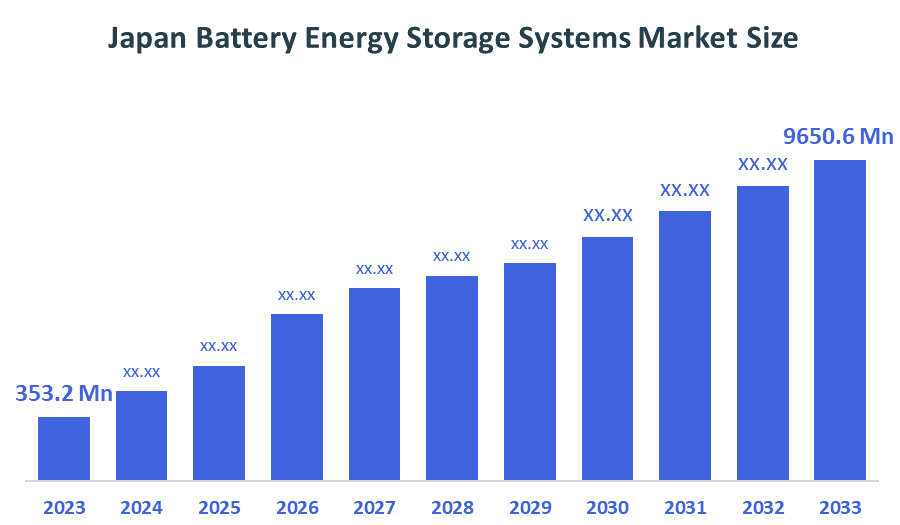
According to a Research Report Published by Decision Advisior & Consulting, the Japan Battery Energy Storage Systems market?is anticipated to reach USD 9650.6 million by 2035, growing at a CAGR of 35.08% from 2025 to 2035. The Japanese battery energy storage systems market is driven by the quick electrification of energy systems, growing integration of renewable energy, and the worldwide movement toward net-zero emissions.
Market Overview
Battery energy storage systems (BESS) in Japan are devices & technologies that take advantage of rechargeable batteries, including lithium-ion batteries, sodium sulphur batteries, and also newer types such as solid-state batteries & flow battery systems, and that store electrical energy for later use. Through these methods, it’s possible to implement battery storage systems in residential homes as well as in commercial buildings, industrial facilities, and utility-scale systems. In Japan, battery energy storage systems are becoming an essential part of Japan's future in providing a dependable source of electricity with a reduced dependence on imported fuels and enhanced resiliency to natural disasters through increased use of battery storage. Battery energy storage systems also offer the Japanese market great growth potential based on the rapid increase in demand for renewable power sources, including solar power generation and offshore wind power generation, both of which need a reliable power storage system to manage their variability. The Japanese government’s green growth strategy 2050 promotes the development and use of clean, renewable energy sources supported by battery storage systems to achieve carbon neutrality by 2050. Funding is available to support the installation of residential, commercial, and scale battery storage systems, as well as storage systems that are coupled with renewables. in addition, the government also supports R&D for next-generation battery technologies, including solid-state batteries and long-duration storage.
Report Coverage
This research report categorizes the Japan battery energy storage systems market based on various segments and regions, and forecasts revenue growth and analyzes trends in each submarket. The report analyses the key growth drivers, opportunities, and challenges influencing the Japan battery energy storage systems market. Recent market developments and competitive strategies, such as expansion, Protein launch, development, partnership, merger, and acquisition, have been included to draw the competitive landscape in the market. The report strategically identifies and profiles the key market players and analyses their core competencies in each sub-segment of the Japan battery energy storage systems market.
Driving Factor
The Japanese battery energy storage systems market is driven by the rapid renewable energy integration, rising electricity demand, frequent natural disasters, expansion of electric vehicles, grid modernization, declining battery costs, advancements in lithium-ion and solid-state batteries, corporate decarbonization targets, and strong government support for carbon neutrality, energy security, and storage deployment.
Restraining Factor
The Japanese battery energy storage systems market is restrained by high upfront investment costs, limited availability of critical raw materials, battery recycling and disposal challenges, safety and fire risks, long permitting processes, land constraints for large installations, and technological limitations in long-duration energy storage solutions.
Market Segmentation
The Japan battery energy storage systems market share is classified into battery and application.
- The lithium-ion battery segment held the largest revenue share t in 2024 and is expected to grow at a remarkable CAGR during the forecast period.
The Japanese battery energy storage systems market is segmented by battery into flywheel battery, lead acid battery, lithium-ion battery, and others. Among these, the lithium-ion battery segment held the largest revenue share in 2024 and is expected to grow at a remarkable CAGR during the forecast period. This dominance is due to increasing adoption across utility-scale renewable energy storage, commercial and industrial backup systems, microgrids, and EV charging infrastructure reflects the maturity and scalability of lithium-ion technology.
- The data center segment held the largest revenue share in 2024 and is expected to grow at a substantial CAGR during the predicted period.
The Japanese battery energy storage systems market is segmented by application into telecommunication, data center, medical, industrial, marine, medical, and others. Among these, the data center segment held the largest revenue share in 2024 and is expected to grow at a substantial CAGR during the predicted period. This is due to battery energy storage systems being increasingly deployed in data centers to provide backup power, enhance power quality, reduce reliance on diesel generators, and support peak load management.
Competitive Analysis:
The report offers the appropriate analysis of the key organizations/companies involved within the Japan Battery Energy Storage Systems market, along with a comparative evaluation primarily based on their Protein offering, business overviews, geographic presence, enterprise strategies, segment market share, and SWOT analysis. The report also provides an elaborate analysis focusing on the current news and developments of the companies, which includes Protein development, innovations, joint ventures, partnerships, mergers & acquisitions, strategic alliances, and others. This allows for the evaluation of the overall competition within the market.
List of Key Companies
- Panasonic Corporation
- GS Yuasa Corporation
- NGK Insulators, Ltd.
- Toshiba Energy Systems & Solutions Corporation
- Hitachi Energy / Hitachi Ltd.
- NEC Corporation
- Mitsubishi Electric Corporation
- Others
Key Target Audience
- Market Players
- Investors
- End-users
- Government Authorities?
- Consulting and Research Firm
- Venture capitalists
- Value-Added Resellers (VARs)
Market Segment
This study forecasts revenue at the Japan, regional, and country levels from 2020 to 2035. Decision Advisior has segmented the Japan Battery Energy Storage Systems market based on the below-mentioned segments:
Japan Battery Energy Storage Systems Market, By Battery
- Flywheel Battery
- Lead Acid Battery
- Lithium-ion Battery
- Others
Japan Battery Energy Storage Systems Market, By Application
- Telecommunication
- Data Center
- Medical
- Industrial
- Marine
- Medical
- Others
FAQ’s
Q: What is the current size and future growth outlook of the Japan Battery Energy Storage Systems Market?
A: The Japan Battery Energy Storage Systems Market was valued at USD 353.2 million in 2024 and is projected to reach USD 9,650.6 million by 2035, growing at a robust CAGR of 35.08% during the forecast period from 2025 to 2035.
Q: What are battery energy storage systems and why are they important in Japan?
A: Battery energy storage systems store electrical energy using rechargeable batteries for later use. In Japan, they are essential for renewable energy integration, grid stability, disaster resilience, energy security, and reducing dependence on imported fossil fuels.
Q: What are the key factors driving the growth of the Japan Battery Energy Storage Systems Market?
A: Market growth is driven by rapid renewable energy integration, rising electricity demand, expansion of electric vehicles, grid modernization, declining battery costs, advancements in lithium-ion and solid-state batteries, corporate decarbonization goals, and strong government support.
Q: Which battery type dominates the Japan Battery Energy Storage Systems Market?
A: The lithium-ion battery segment dominated the market in 2024 and is expected to grow at a remarkable CAGR due to its high energy density, scalability, efficiency, and widespread use in utility-scale storage, microgrids, data centers, and EV infrastructure.
Q: Who are the major players in the Japan Battery Energy Storage Systems Market?
A: Key companies operating in the market include Panasonic Corporation, GS Yuasa Corporation, NGK Insulators, Toshiba Energy Systems & Solutions Corporation, Hitachi Energy / Hitachi Ltd., NEC Corporation, and Mitsubishi Electric Corporation, along with other players
Check Licence
Choose the plan that fits you best: Single User, Multi-User, or Enterprise solutions tailored for your needs.
We Have You Covered
- 24/7 Analyst Support
- Clients Across the Globe
- Tailored Insights
- Technology Tracking
- Competitive Intelligence
- Custom Research
- Syndicated Market Studies
- Market Overview
- Market Segmentation
- Growth Drivers
- Market Opportunities
- Regulatory Insights
- Innovation & Sustainability
Report Details
| Scope | Country |
| Pages | 169 |
| Delivery | PDF & Excel via Email |
| Language | English |
| Release | Dec 2025 |
| Access | Download from this page |