
Japan Buprenorphine Market
 |
Author:
David J
|
Pages:
210
|
Author:
David J
|
Pages:
210
Japan Buprenorphine Market Size, Share, By Application (Analgesic, Opioid Antagonist), By Route of Administration (Injectables, Sublingual, Transdermal Patches), By Distribution Channel (Hospital Pharmacies, Retail Pharmacies, Online Pharmacies), Analysis and Forecast 2026 ? 2035
CAGR
11.31%
REVENUE 2025
USD Million 126.6
FORECAST 2035
USD Million 369.5
REPORT COVERAGE
Country
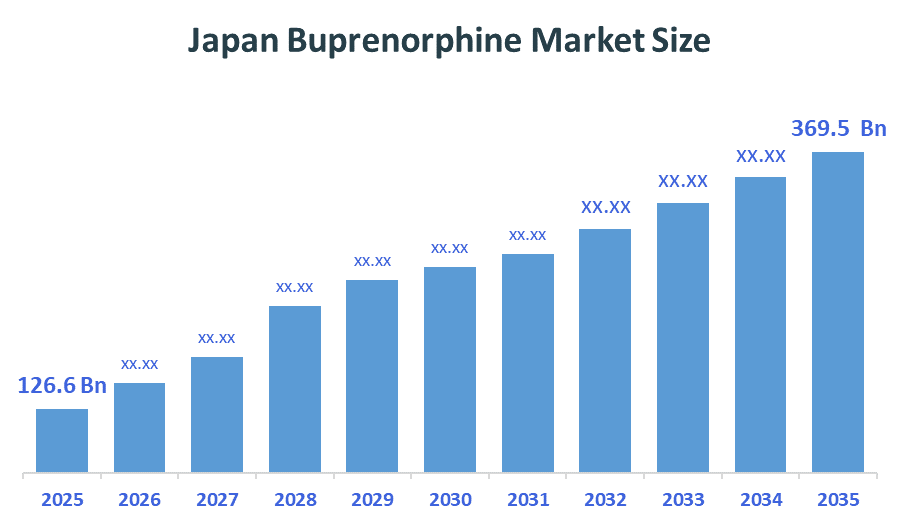
The Japan Buprenorphine Market size is forecast to grow from approximately USD 126.6 Million in 2025 to around USD 369.5Million by 2035. According to Decision Advisors, a detailed research report on the buprenorphine market indicates that the injectable and depot formulations, instead of sublingual tablets, dominate the market, accounting for approximately 30% of the total share in the Japan. Indivior PLC leads the market with an estimated 22-25% Japan market share. The company's annual revenue of approximately USD 905-945 Million is making it one of the most influential forces shaping industry trends and overall market growth.
Market Snapshot
- Japan Buprenorphine Market size (2025): USD 126.6 Million
- Projected Japan Buprenorphine Market Size (2035): USD 369.5 Million
- Japan Buprenorphine Market Compound Annual Growth Rate (CAGR): 11.31%
- Base Year: 2025
- Historical Period: 2021–2024
- Forecast Period: 2026–2035
Market Overview/Introduction
The Japan Buprenorphine Market refers to the regulated pharmaceutical segment that manages the distribution and usage of buprenorphine-based medications that treat opioid use disorder and pain management within Japan's strict narcotics control system. Buprenorphine functions as a partial opioid agonist, which healthcare professionals use to treat opioid addiction and moderate to severe pain through its ability to decrease withdrawal symptoms and cravings while maintaining a reduced potential for misuse. The future of the Japanese market presents opportunities through the introduction of long-acting injectable products together with the development of better addiction treatment methods and the growing use of medication-assisted treatment. The market expands because of two factors which include increasing public knowledge about opioid dependency treatment and the backing of healthcare policies plus technological progress in drug delivery systems and the slowly decreasing societal stigma toward addiction treatment which helps to spread treatment in medical settings and enhance results for patients.
- Japan’s Ministry of Health, Labour and Welfare (MHLW) regulates opioid use under strict narcotics and psychotropic laws. Buprenorphine is controlled as a psychotropic substance and can only be used under medical prescription and licensed institutions. The system indirectly supports OST in hospitals and addiction centers under tight supervision
- Japan’s PKBA scheme allows faster approval of medicines already proven safe and effective overseas, including opioid-related therapies. Buprenorphine-related formulations may benefit from this pathway, reducing regulatory delay and supporting quicker adoption of addiction treatment innovations in the Japanese healthcare system.
Notable Insights: -
- The analgesic segment dominated the market in 2025 and holds the largest market share, accounting for approximately 65% during the forecast period.
- The injectables segment dominated the market in 2025 and holds the largest market share, accounting for approximately 40% during the forecast period.
- The retail pharmacies segment dominated the market in 2025 and holds the largest market share, accounting for approximately 45% during the forecast period.
- The compound annual growth rate of the Japan Buprenorphine Market is 11.31%.
- The market is likely to achieve a valuation of USD 369.5 Million by 2035.
What is the role of technology in grooming the market?
Technology plays a significant role in advancing the Japan buprenorphine market by improving drug formulation, delivery systems, and patient monitoring. Development of long-acting injectable and implantable buprenorphine formulations enhances treatment adherence and reduces misuse risks. Digital health platforms and electronic prescription systems support strict regulatory compliance and controlled dispensing. Telemedicine is gradually improving access to addiction specialists, especially in urban and remote regions. Additionally, data analytics and pharmacovigilance tools help monitor patient outcomes and safety. These technological advancements strengthen treatment efficiency, improve physician confidence, and support the structured growth of medication-assisted therapy in Japan’s highly regulated healthcare environment.
Market Drivers
The Japan buprenorphine market is driven by major forces, which include increased public knowledge about opioid use disorder and wider acceptance of medication-assisted treatment as a safer solution to conventional opioid treatment methods. The market experiences steady growth because governments now prioritize controlled substance monitoring, together with enhanced programs for treating addiction. The increasing need for opioid-based treatments that minimize abuse risk stems from two factors: the growing elderly population and the rise in chronic pain disorders. The development of long-acting buprenorphine products together with hospital treatment programs improves patient treatment adherence. The healthcare sector in urban Japan experiences increased treatment adoption through two factors: extended psychiatric and rehabilitation services and decreased social stigma.
Restrain
The Japan buprenorphine market faces challenges due to strict narcotics regulations, limited physician willingness to prescribe opioid substitution therapies, and strong social stigma around addiction treatment. Additionally, low patient awareness, complex approval procedures, and restricted distribution channels through hospitals significantly hinder broader market expansion and slow overall adoption rates.
Study on the Supply, Demand, Distribution, and Market Environment of the Japan Buprenorphine Market
The Japan buprenorphine market shows a tightly regulated supply structure, where availability is primarily limited to licensed hospitals, specialty addiction clinics, and authorized pharmacies under strict government control. Demand is gradually increasing due to rising awareness of opioid use disorder and adoption of medication-assisted therapy, though overall volumes remain relatively low compared to Western markets. Distribution is highly centralized, with hospital pharmacies dominating due to controlled prescribing rules and monitoring requirements. Retail and online channels play a minimal role because of regulatory restrictions. The market environment is shaped by strict narcotics laws, social stigma toward addiction treatment, and cautious physician prescribing behavior. However, government-supported healthcare frameworks and gradual acceptance of buprenorphine as a safer opioid dependence therapy are improving access and stabilizing long-term demand growth across urban healthcare centers.
Price Analysis and Consumer Behaviour Analysis
In Japan, buprenorphine pricing remains relatively high and tightly regulated, as it is classified under controlled opioid dependence therapies with strict reimbursement policies. Prices are influenced by government healthcare reimbursement systems, limited generic penetration, and hospital-based distribution, keeping overall patient out-of-pocket costs moderate but stable. Hospital procurement contracts also help standardize pricing across regions. From a consumer behaviour perspective, adoption is clinician-driven rather than patient-driven, due to strong regulatory control and stigma associated with opioid dependence treatment. Patients typically access buprenorphine through specialty addiction clinics or hospitals, leading to low retail pharmacy dependence. Demand is increasing gradually as awareness of medication-assisted treatment improves, but reluctance remains due to cultural stigma and strict prescription monitoring. Physicians prioritize safety, adherence, and relapse prevention, making long-acting and supervised therapies more preferred than self-administered forms.
Market Segmentation
The Japan Buprenorphine Market Share is classified into application, route of administration, and distribution channel
- The analgesic segment dominated the market in 2025 and holds the largest market share, accounting for approximately 65% during the forecast period.
Based on the application, the buprenorphine market is divided into analgesic and opioid antagonist. Among these, the analgesic segment dominated the market in 2025 and holds the largest market share, accounting for approximately 65% during the forecast period. The analgesic segment is driven by widespread use in managing acute and chronic pain conditions such as arthritis, post-surgical pain, and injuries. High global disease burden, increasing aging population, and preference for non-opioid pain relief due to addiction risks further boost demand. Broad availability across OTC and prescription channels strengthens its leadership.
- The injectables segment dominated the market in 2025 and holds the largest market share, accounting for approximately 40% during the forecast period.
Based on the route of administration, the buprenorphine market is divided into injectables, sublingual, and transdermal patches. Among these, the injectables segment dominated the market in 2025 and holds the largest market share, accounting for approximately 40% during the forecast period. The injectables segment in the U.K. is attributed to their rapid onset of action in emergency and hospital settings. They are essential in trauma care, surgeries, and severe pain management where immediate relief is required. Strong adoption in inpatient care and critical settings, along with increasing surgical volumes globally, continues to support dominance despite growth in alternative delivery methods.
- The retail pharmacies segment dominated the market in 2025 and holds the largest market share, accounting for approximately 45% during the forecast period.
Based on the distribution channel, the buprenorphine market is divided into hospital pharmacies, retail pharmacies, and online pharmacies. Among these, the retail pharmacies segment dominated the market in 2025 and holds the largest market share, accounting for approximately 45% during the forecast period. The retail pharmacies segment in the U.K. is driven by their accessibility and strong presence in both urban and rural markets. They cater to high demand for over-the-counter pain medications and repeat prescriptions for chronic conditions. Consumer preference for convenience, immediate availability, and lower cost compared to hospital settings drives this segment’s dominance globally.
Recent Development
- In November 2025, TAPI (Teva API) and Antheia announced a strategic partnership to advance the commercialization of biosynthetic pharmaceutical ingredients, combining Antheia’s synthetic biology platform with TAPI’s large-scale fermentation and API manufacturing infrastructure. The collaboration aimed to scale production of key starting materials (KSMs) and APIs, strengthening global pharmaceutical supply chains for opioid-related medicines, including future raw material inputs potentially used in buprenorphine manufacturing.
- In June 2025, Japanese pharmaceutical companies intensified strategic collaborations with international drug developers to accelerate the introduction of specialized therapies for addiction and pain management within Japan’s highly regulated pharmaceutical environment.
- In February 2025, the buprenorphine market witnessed continued pharmaceutical innovation, as manufacturers expanded focus on reformulated and extended-release buprenorphine products to improve treatment adherence and reduce misuse risk. Companies such as Indivior are advancing label updates and long-acting injectable formulations, supporting wider adoption of depot-based therapies.
Competitive Analysis
The report offers the appropriate analysis of the key organisations/companies involved within the Japan Buprenorphine Market, along with a comparative evaluation primarily based on their product offering, business overviews, geographic presence, enterprise strategies, segment market share, and SWOT analysis. The report also provides an elaborative analysis focusing on the current news and developments of the companies, which includes product development, innovations, joint ventures, partnerships, mergers & acquisitions, strategic alliances, and others. This allows for the evaluation of the overall competition within the market.
Top Key Companies in the Japan Buprenorphine Market
- Indivior PLC
- Alkermes plc
- Orexo AB
- Camurus AB
- Titan Pharmaceuticals Inc
- Sun Pharmaceutical Industries Ltd
- Others
Key Target Audience
- Market Players
- Investors
- End-users
- Government Authorities
- Consulting and Research Firm
- Venture capitalists
- Value-Added Resellers (VARs)
Market Segment
This study forecasts revenue at the Japan, regional, and country levels from 2020 to 2035. Decision Advisors has segmented the Japan buprenorphine market based on the below-mentioned segments
Japan Buprenorphine Market, By Application
- Analgesic
- Opioid Antagonist
Japan Buprenorphine Market, By Route of Administration
- Injectables
- Sublingual
- Transdermal Patches
Japan Buprenorphine Market, By Distribution Channel
- Hospital Pharmacies
- Retail Pharmacies
- Online Pharmacies
Frequently Asked Questions (FAQ)
Q. What makes buprenorphine different from other opioid treatments in Japan?
A. Buprenorphine is a partial opioid agonist, meaning it activates opioid receptors but with a ceiling effect that reduces overdose and misuse risk. In Japan, where opioid regulation is extremely strict, this safety profile makes it more acceptable for controlled medical use in pain management and opioid dependence treatment compared to full opioid agonists.
Q. Why is Japan’s buprenorphine market growing slowly compared to Western countries?
A. Japan’s market grows more slowly due to strict narcotics laws, strong stigma around addiction treatment, and cautious prescribing behavior among physicians. Unlike Western markets with broader opioid substitution programs, Japan prioritizes tight hospital-based control, limiting wider outpatient and community-level adoption.
Q. How does Japan’s aging population influence buprenorphine demand?
A. Japan’s rapidly aging population increases cases of chronic pain conditions such as arthritis, cancer pain, and post-surgical complications. This creates steady demand for controlled analgesics like buprenorphine, especially in hospital settings, where safer opioid alternatives are preferred to manage long-term pain with reduced dependency risk.
Q. What role do hospitals play in buprenorphine distribution in Japan?
A. Hospitals are the primary distribution and prescribing centers for buprenorphine in Japan. Due to strict regulatory control, most prescriptions are initiated and monitored in hospital settings or specialized clinics, ensuring controlled access, patient supervision, and compliance with national narcotics regulations
Check Licence
Choose the plan that fits you best: Single User, Multi-User, or Enterprise solutions tailored for your needs.
We Have You Covered
- 24/7 Analyst Support
- Clients Across the Globe
- Tailored Insights
- Technology Tracking
- Competitive Intelligence
- Custom Research
- Syndicated Market Studies
- Market Overview
- Market Segmentation
- Growth Drivers
- Market Opportunities
- Regulatory Insights
- Innovation & Sustainability
Report Details
| Scope | Country |
| Pages | 210 |
| Delivery | PDF & Excel via Email |
| Language | English |
| Release | Apr 2026 |
| Access | Download from this page |