
Japan Cationic Starch Market
 |
Author:
David J
|
Pages:
245
|
Author:
David J
|
Pages:
245
Japan Cationic Starch Market Size, Share, By Type (Corn-Based, Potato-Based, Tapioca-Based, Others), By Application (Paper Industry, Textile Industry, Water Treatment, Oil & Gas, Others), By End User (Packaging, Industrial Manufacturing, Municipal Sector, Others), Analysis and Forecast 2025-2035.
CAGR
27.01%
REVENUE 2025
USD Billion 41.61
FORECAST 2035
USD Billion 4.42
REPORT COVERAGE
Country
Market Snapshot
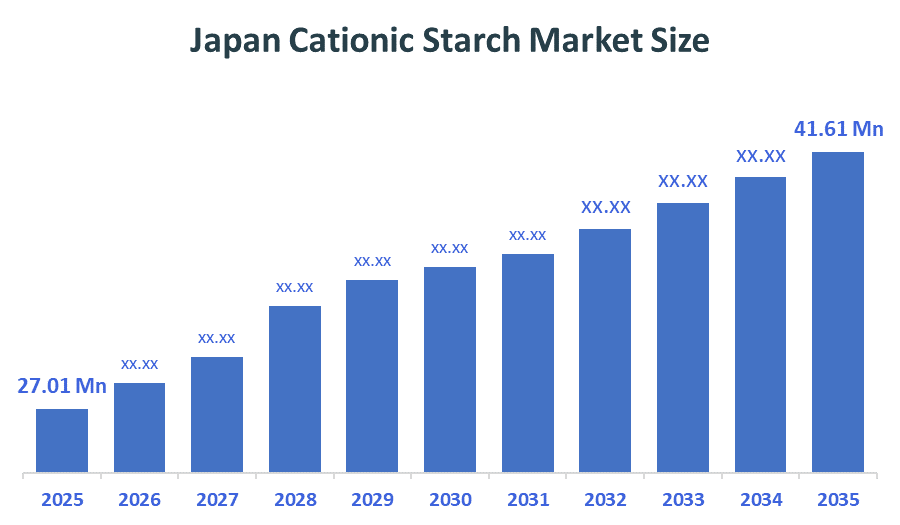
- Japan Cationic Starch Market Size (2025): USD 27.01 Million
- Projected Japan Cationic Starch Market Size (2035): USD 41.61 Million
- Japan Cationic Starch Market Compound Annual Growth Rate (CAGR): 4.42%
- Market Base Year: 2025
- Historical Period: 2021–2024
- Forecast Period: 2026–2035
Market Overview/Introduction
The Japan Cationic Starch Market is a specialized segment of the modified starch industry, defined by the chemical modification of raw starches (typically corn, potato, or tapioca) to carry a positive ionic charge. This unique property allows the starch to bind effectively with negatively charged surfaces like cellulose fibers and wastewater particles, making it an indispensable additive for industrial strength and retention. The market is characterised by a high level of technical integration within Japan’s sophisticated manufacturing landscape. The Japanese government is also a huge part of the story. With the Plastic Resource Circulation Act, they are essentially telling industries to move away from single-use plastics. This has opened the door wide for starch-based bioplastics and high-tech paper packaging. In response, domestic giants like Nihon Shokuhin Kako and Japan Corn Starch aren't just making more starch, they’re getting smarter about it. They are using AI and Green Chemistry to create starches that are more efficient and eco-friendly, cutting down on waste and energy during production.
Notable Insights: -
- By type, the corn-based cationic starch segment dominated the market in 2025, accounting for approximately 45% of market share, and is projected to grow at a substantial CAGR during the forecast period.
- By end user, packaging segment dominated the market in 2025, accounting for approximately 40% of market share, and is projected to grow at a substantial CAGR during the forecast period.
- The compound annual growth rate of the Japan cationic starch market is 4.42%.
- The Market is likely to achieve a valuation of USD 41.61 Million by 2035.
What is the role of technology in grooming the market?
Technology plays a crucial role in advancing the Japan cationic starch market by improving product efficiency, sustainability, and application performance. Innovations in chemical modification and enzyme-based processing have enabled the development of high-charge, high-purity cationic starch that enhances paper strength and retention while reducing chemical waste. For example, companies like Nippon Starch Chemical use advanced processing techniques to produce eco-friendly starch solutions for the paper industry, helping manufacturers reduce water usage and improve recyclability. Additionally, automation and process optimization in production ensure consistent quality and cost efficiency, supporting large-scale industrial demand.
Market Drivers
The growth of Japan’s cationic starch market is really being powered by a perfect storm of modern habits and environmental goals. At the heart of it is our online shopping obsession, the massive surge in e-commerce means we need millions of sturdy cardboard boxes that can survive the trip to our front doors without falling apart. Cationic starch is the secret sauce that makes this lightweight packaging surprisingly strong. At the same time, Japan is a world leader in recycling, but there’s a catch, every time paper is recycled, its fibers get shorter and weaker. This starch acts like a natural glue that binds those tired fibers back together, allowing Japan to hit its high recycling targets without sacrificing quality. Beyond just shipping boxes, there is a major cultural and legal shift happening. With new government rules cracking down on single-use plastics, industries are under pressure to find green alternatives. This has turned a simple plant-based ingredient into a high-tech hero, as companies swap out harsh synthetic chemicals for biodegradable starch. It’s no longer just an industrial additive, it’s a key part of Japan’s mission to build a circular economy where we use less plastic.
Study on the Supply, Demand, Distribution, and Market Environment of the Japan Cationic Starch Market
The Japan cationic starch market operates within a well-established and technologically advanced industrial framework. On the supply side, it is supported by both domestic producers and imports of raw materials such as corn, potato, and tapioca starch. Demand is primarily driven by the paper, packaging, and water treatment industries, with increasing emphasis on sustainable and high-performance solutions. Distribution is carried out through direct supply to manufacturers, as well as via chemical distributors and specialty ingredient suppliers, ensuring efficient market reach. The market environment is highly regulated, with strict environmental and quality standards encouraging innovation while also increasing compliance requirements for producers.
Price Analysis and Consumer Behaviour Analysis
The Japan cationic starch market exhibits a moderately stable pricing structure influenced primarily by fluctuations in raw material costs such as corn, potato, and tapioca. Prices may vary based on supply conditions and agricultural output, but remain relatively balanced due to strong domestic demand. From a consumer behavior perspective, industrial buyers especially in the paper and packaging sectors prioritize product performance, consistency, and environmental compliance over price. There is a growing preference for high-quality, sustainable cationic starch solutions, even at premium pricing, driven by stricter regulations and increasing focus on eco-friendly production processes.
Market Segmentation
The Japan Cationic Starch Market share is classified into type, application, and end user.
- The corn-based cationic starch segment dominated the market in 2025, accounting for approximately 45% of market share, and is projected to grow at a substantial CAGR during the forecast period.
Based on the type, the Japan cationic starch market is divided into corn-based, potato-based, tapioca-based, and others. Among these, the corn-based segment dominated the market in 2025, accounting for approximately 45% of the market share, and is projected to grow at a substantial CAGR during the forecast period. Corn-based cationic starch dominates due to its cost-effectiveness, wide availability, and strong performance in industrial applications such as paper manufacturing. It offers excellent binding and retention properties, making it highly suitable for large-scale production processes. Recent developments in Japan highlight an increasing focus on enhancing starch modification techniques to improve charge density and efficiency. Additionally, tapioca-based starch is gaining traction due to its high purity and performance in specialty applications, while potato-based starch is witnessing steady demand due to its superior viscosity and biodegradability.
- The paper industry segment accounted for the largest share in 2025 and is anticipated to grow at a significant CAGR of approximately 5.5%–6% during the forecast period.
Based on the application, the Japan cationic starch market is divided into paper industry, textile industry, water treatment, oil & gas, and others. Among these, the paper industry segment accounted for the largest share in 2025 and is anticipated to grow at a significant CAGR during the forecast period. This segment dominates due to the extensive use of cationic starch in improving paper strength, retention, and drainage efficiency during manufacturing. In Japan, the demand for high-quality and sustainable paper products, especially in packaging, is driving the adoption of modified starch solutions. Additionally, increasing environmental regulations are encouraging the use of biodegradable additives like cationic starch. The water treatment segment is also expanding steadily due to rising demand for eco-friendly flocculants, while the textile industry continues to adopt starch for sizing and finishing applications.
- The packaging segment dominated the market in 2025, accounting for approximately 40% of market share, and is projected to grow at a substantial CAGR during the forecast period.
Based on the end user, the Japan cationic starch market is divided into packaging, industrial manufacturing, municipal sector, and others. Among these, the packaging segment dominated the market in 2025, accounting for approximately 40% of market share, and is projected to grow at a substantial CAGR during the forecast period. Packaging dominates due to the increasing demand for sustainable and recyclable paper-based packaging solutions driven by the growth of e-commerce and food delivery services in Japan. Cationic starch plays a crucial role in enhancing the strength and printability of packaging materials. The industrial manufacturing sector is also a key contributor, utilizing starch in various processing applications, while the municipal sector supports demand through its use in wastewater treatment and environmental management initiatives.
Recent Development
- In November 2024, Thai Wah Public Company Limited entered into a strategic partnership with Fuji Nihon Corporation to establish a joint venture aimed at accelerating innovation in starch-based products across the Asia-Pacific region.
- In May 2024, KPS Capital Partners completed the acquisition of the remaining stake in Primient, securing full ownership of the business. Primient, which had previously operated as part of Tate & Lyle, was a key global supplier of industrial starch solutions, including cationic starch products widely used in paper manufacturing.
Competitive Analysis
The report offers the appropriate analysis of the key organisations/companies involved within the Japan cationic starch market, along with a comparative evaluation primarily based on their product offering, business overviews, geographic presence, enterprise strategies, segment Market share, and SWOT analysis. The report also provides an elaborative analysis focusing on the current news and developments of the companies, which includes product development, innovations, joint ventures, partnerships, mergers & acquisitions, strategic alliances, and others. This allows for the evaluation of the overall competition within the Market.
Top Key Companies in the Japan Cationic Starch Market
- Nihon Shokuhin Kako Co., Ltd.
- Oji Cornstarch Co., Ltd.
- Sanwa Cornstarch Co., Ltd.
- Matsutani Chemical Industry Co., Ltd.
- J-Oil Mills, Inc.
- Cargill Japan & Roquette Japan
Key Target Audience
- Market Players
- Investors
- End-users
- Government Authorities
- Consulting and Research Firm
- Venture capitalists
- Value-Added Resellers (VARs)
Market Segment
This study forecasts revenue at the Japan, regional, and country levels from 2020 to 2035. Decision Advisors has segmented the Japan cationic starch market based on the below-mentioned segments
Japan Cationic Starch Market, By Type
- Corn-Based
- Potato-Based
- Tapioca-Based
- Others
Japan Cationic Starch Market, By Application
- Adhesives & Sealants
- Rubber Compounding
- Paints & Coatings
- Printing Inks
- Others
Japan Cationic Starch Market, By End User
- Packaging
- Automotive
- Construction
- Consumer Goods
- Others
Frequently Asked Questions (FAQ)
Q. How does Japan’s aging population influence the cationic starch market?
A. Japan’s aging population indirectly drives demand for hygiene products, medical packaging, and pharmaceutical paper applications, which increases the need for high-quality paper materials enhanced by cationic starch.
Q. What impact does import dependency have on the Japan cationic starch market?
A. Japan relies on imports for raw materials like corn and tapioca, making the market sensitive to global supply chain disruptions, trade policies, and currency fluctuations.
Q. How is innovation in biodegradable packaging shaping product development?
A. The shift toward biodegradable packaging is encouraging manufacturers to develop advanced cationic starch formulations that improve recyclability, compostability, and reduce environmental impact.
Q. What challenges do manufacturers face in scaling specialty cationic starch products?
A. Key challenges include high production costs, maintaining consistent quality, and meeting strict regulatory standards while developing customized solutions for niche industrial applications.
Check Licence
Choose the plan that fits you best: Single User, Multi-User, or Enterprise solutions tailored for your needs.
We Have You Covered
- 24/7 Analyst Support
- Clients Across the Globe
- Tailored Insights
- Technology Tracking
- Competitive Intelligence
- Custom Research
- Syndicated Market Studies
- Market Overview
- Market Segmentation
- Growth Drivers
- Market Opportunities
- Regulatory Insights
- Innovation & Sustainability
Report Details
| Scope | Country |
| Pages | 245 |
| Delivery | PDF & Excel via Email |
| Language | English |
| Release | Apr 2026 |
| Access | Download from this page |