
Japan Dangerous Goods Logistics Market
 |
Author:
Atul K
|
Pages:
185
|
Author:
Atul K
|
Pages:
185
Japan Dangerous Goods Logistics Market Size, Share, and COVID-19 Impact Analysis, By Services (Transportation, Warehousing and Distribution, Value-Added Services, and Others), By Destination (Domestic, International), and Japan Dangerous Goods Logistics Market Insights, Industry Trend, Forecasts to 2035
CAGR
4.21%
REVENUE 2024
USD Billion 12.5
FORECAST 2035
USD Billion 19.67
REPORT COVERAGE
Country
Japan Dangerous Goods Logistics Market Size Insights Forecasts to 2035
- The Japan Dangerous Goods Logistics Market Size Was Estimated at USD 12.5 Billion in 2024
- The Market Size is Expected to Grow at a CAGR of Around 4.21% from 2025 to 2035
- The Japan Dangerous Goods Logistics Market Size is Expected to Reach USD 19.67 Billion by 2035
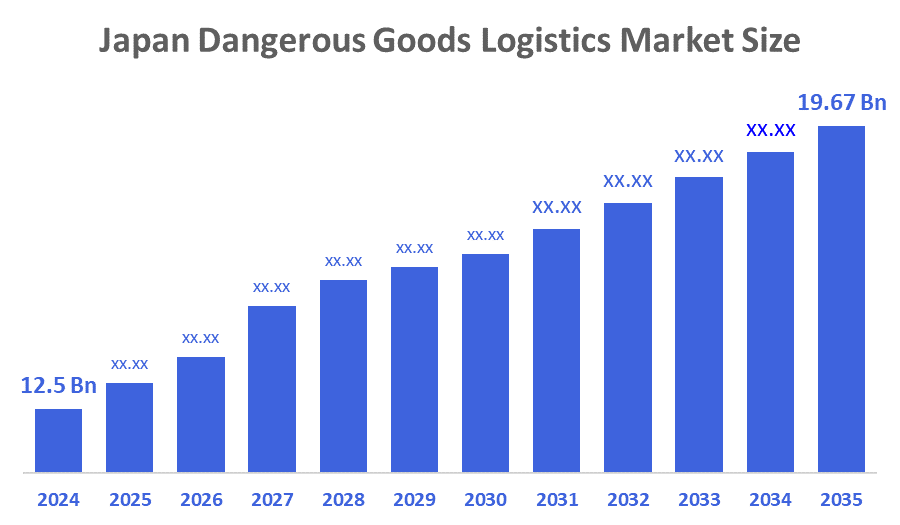
According to a Research Report Published by Decisions Advisors & Consulting, The Japan Dangerous Goods Logistics Market Size is anticipated to Reach USD 19.67 Billion by 2035, Growing at a CAGR of 4.21% from 2025 to 2035. The Japan dangerous goods logistics market is driven by including increased regulatory compliance requirements for chemical and pharmaceutical manufacturers, increased demand for safe transport options, an increase in the use of industrial automation in production processes, as well as a heightened emphasis on risk mitigation and emergency preparedness within supply chain operations.
Market Overview
The logistics of dangerous goods in Japan encompasses the transportation, management and storage of hazardous materials within Japan by using current best safety practices and strict guidelines. dangerous goods include items such as flammable items, explosive items, poisonous items, corrosive items, etc. All these materials have the potential of being a threat to both people and the environment in general. The logistics require a high level of accuracy, precision and care when managing dangerous goods, from the creation of documentation through the labelling and packaging procedures as required by domestic and international law, which includes both the fire service act and industrial safety and health act.
The dangerous goods market serves many different types of customers in Japan, including chemical companies, pharmaceutical companies, manufacturing companies and various types of energy companies. Consequently, the safe transport of dangerous goods is vital to these industries. The emergence of new technologies, such as IoT, Artificial Intelligence and Block chain Technology, are allowing for safer, more regulated transportation of dangerous goods by improving the ability to track the product in real time and identify risks while also increasing compliance with applicable regulations. As Japan becomes more focused on sustainability and technological advancement, as well as increased international trade, The dangerous goods market in Japan will continue to grow, especially since the landscape of the industry will change as new Regulations are introduced and enforced. With this focus on the risk factor, these markets will need to utilize green, efficient and safe methods of transporting dangerous goods.
Report Coverage
This research report categorizes the market for the Japan dangerous goods logistics market based on various segments and regions, and forecasts revenue growth and analyses trends in each submarket. The report analyses the key growth drivers, opportunities, and challenges influencing the Japan dangerous goods logistics market. Recent market developments and competitive strategies, such as expansion, product launch, development, partnership, merger, and acquisition, have been included to draw the competitive landscape in the market. The report strategically identifies and profiles the key market players and analyses their core competencies in each sub-segment of the Japan dangerous goods logistics market.
Driving Factors
The dangerous goods logistics markets in Japan are driven by many of the major contributing factors to the growing market for dangerous goods include an increase in demand for dangerous goods within the different industries, stricter regulatory requirements for transporting and handling dangerous goods, and the growth of e-commerce. Currently, in Japan, the dangerous goods that are being transported consist of many types of hazardous materials including: chemicals; explosives; flammable liquids; and radioactive materials.
As of November 2023, Yamato Transport has teamed up with Yusen Logistics, one of the biggest logistics companies in Japan, to offer specialized services related to the shipping of lithium-ion batteries (a rapidly growing part of the overall dangerous goods industry
Restraining Factors
The dangerous goods logistics market in Japan is restrained by restrained by high operational costs, complex regulatory procedures, limited specialized infrastructure, skilled labor shortages, and rising compliance burdens that slow logistics efficiency and increase overall transportation challenges.
Market Segmentation
The Japan dangerous goods logistics market share is categorized by services and destination.
- The transportation segment accounted for the largest revenue market share in 2024 and is expected to grow at a significant CAGR during the forecast period.
The Japan dangerous goods logistics market is segmented by services into transportation, warehousing and distribution, value-added services, and others. Among these, the transportation segment accounted for the largest revenue market share in 2024 and is expected to grow at a significant CAGR during the forecast period. The segmental growth is driven by increasing levels of hazardous materials and growth in industrial production, legislated increase of safety standards for hazardous materials, growth of demand for specialty fleets, and advancement of technology relating to tracking to improve safety and compliance.
- The domestic segment dominated the market in 2024 and is projected to grow at a substantial CAGR during the forecast period.
The Japan dangerous goods logistics market is segmented by destination into domestic, international. Among these, the domestic segment accounted for the largest revenue share in 2024 and is expected to grow at a significant CAGR during the forecast period. The growth of the segment is due to the growth of local manufacturing through increased use of hazardous materials, increased use of hazardous materials through national safety regulations, increased growth of demand for timely movement of goods.
Competitive Analysis:
The report offers the appropriate analysis of the key organizations/companies involved within the Japan dangerous goods logistics market, along with a comparative evaluation primarily based on their product offering, business overviews, geographic presence, enterprise strategies, segment market share, and SWOT analysis. The report also provides an elaborate analysis focusing on the current news and developments of the companies, which includes product development, innovations, joint ventures, partnerships, mergers & acquisitions, strategic alliances, and others. This allows for the evaluation of the overall competition within the market.
List of Key Companies
- Kokusai Express
- K Line Logistics Limited
- KATO Transport
- DGI (Dangerous Goods International) Global
- ICL Logistics Japan Co Limited
- Yusen Logistics Limited
- Others
Key Target Audience
- Market Players
- Investors
- End-users
- Government Authorities
- Consulting and Research Firm
- Venture capitalists
- Value-Added Resellers (VARs)
Recent Developments
- In December 2023, Imec and Mitsui Chemicals entered a strategic partnership on the commercialization of carbon-nanotube (CNT) based pellicles for extreme ultraviolet (EUV) lithography. Under this partnership, Mitsui Chemicals plans to integrate imec’s fundamental CNT-based pellicle innovation into Mitsui Chemicals’ CNT pellicle technology to achieve full production specifications, targeting its introduction in high-power EUV systems in the 2025-2026 timeframe.
- In April 2023, Nippon Express Ltd received IATA CEIV Pharma certification on April 26, 2023, for its facility at Heathrow Airport. The certification is a quality certificate for pharmaceutical transport established by IATA.
Market Segment
This study forecasts revenue at the Japan, regional, and country levels from 2020 to 2035. Decisions Advisors has segmented the Japan Dangerous Goods Logistics Market based on the below-mentioned segments:
Japan Dangerous Goods Logistics Market, By Services
- Transportation
- Warehousing and Distribution
- Value-Added Services
- Others
Japan Dangerous Goods Logistics Market, By Destination
- Domestic
- International
FAQ’s
Q: What is driving the growth of the Japan dangerous goods logistics market?
A: Strict safety regulations, rising chemical and pharmaceutical production, and increasing demand for secure transport solutions are driving market growth.
Q: What is the market size forecast for 2035?
A: The market is projected to reach USD 19.67 billion by 2035, growing at a CAGR of 4.21%.
Q: Which service segment held the largest market share in 2024?
A: The Transportation segment accounted for the largest share due to rising hazardous materials movement and advanced tracking technologies.
Q: Which destination segment dominated the market in 2024?
A: The Domestic segment dominated, supported by expanding local manufacturing and strict national safety regulations.
Q: What challenges are restraining the market?
A: High operational costs, complex regulations, limited specialized infrastructure, and shortages of skilled personnel are key restraints.
Q: Which industries primarily use dangerous goods logistics in Japan?
A: Major end-use industries include chemicals, pharmaceuticals, manufacturing, and energy, where safe handling of hazardous materials is critical.
Check Licence
Choose the plan that fits you best: Single User, Multi-User, or Enterprise solutions tailored for your needs.
We Have You Covered
- 24/7 Analyst Support
- Clients Across the Globe
- Tailored Insights
- Technology Tracking
- Competitive Intelligence
- Custom Research
- Syndicated Market Studies
- Market Overview
- Market Segmentation
- Growth Drivers
- Market Opportunities
- Regulatory Insights
- Innovation & Sustainability
Report Details
| Scope | Country |
| Pages | 185 |
| Delivery | PDF & Excel via Email |
| Language | English |
| Release | Nov 2025 |
| Access | Download from this page |