
Japan Deep-Cycle Battery Market
 |
Author:
Somesh R
|
Pages:
210
|
Author:
Somesh R
|
Pages:
210
Japan Deep-Cycle Battery Market Size, Share, By Type (Flooded Lead-Acid, AGM, Gel, Lithium-Ion Deep-Cycle), By Application (Renewable Energy Storage, Automotive, Marine, UPS Systems, Telecom, Industrial Backup), By Capacity (Below 100Ah, 100?200Ah, above 200Ah), By Region (North America, Europe, Asia-Pacific, Latin America, Middle East, and Africa) Analysis and Forecast 2026-2035.
CAGR
6.73%
REVENUE 2025
USD Billion 1.1
FORECAST 2035
USD Billion 2.11
REPORT COVERAGE
Country
Market Snapshot
- Market Size (2025): USD 1.1 Billion
- Projected Market Size (2035): USD 2.11 Billion
- Compound Annual Growth Rate (CAGR): 6.73%
- Base Year: 2025
- Historical Period: 2021–2025
- Forecast Period: 2026–2035
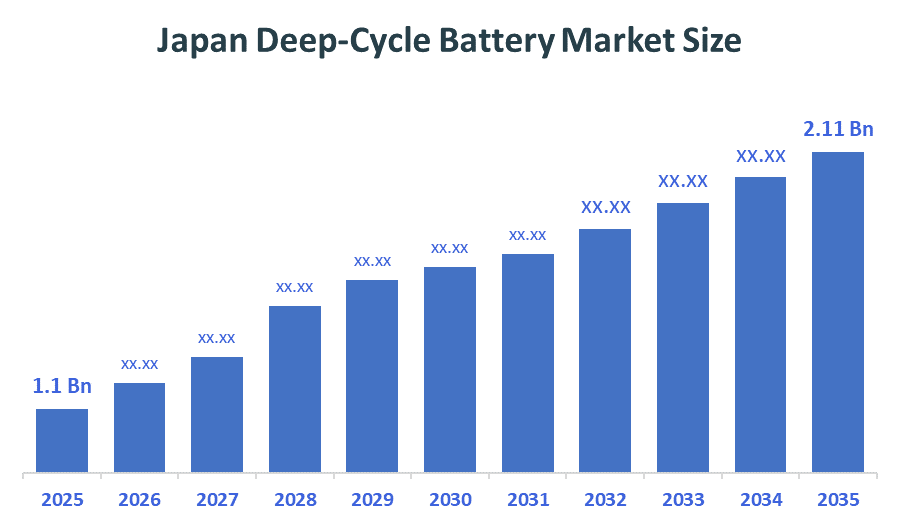
Market Overview/Introduction
The Japan Deep-Cycle Battery Market includes rechargeable battery systems which enable extended energy discharge and multiple deep discharge cycles without performance loss. The batteries find extensive application in renewable energy storage systems, electric vehicles and marine systems, industrial backup power and telecommunications infrastructure. Japan functions as a main center for advanced battery technology development which focuses on lithium-ion systems and hybrid storage technologies. The combination of government support for 2050 carbon neutrality goals and increasing electric vehicle adoption and growing solar and wind energy projects drive market expansion. The Japanese market for deep-cycle batteries demonstrates a rising trend of connecting batteries with smart energy management systems and IoT monitoring systems which achieve efficiency gains between 25 and 35% during lifecycle performance assessment.
- In September 2024, Japan announced JPY 350 billion (USD 2.4B+) in subsidies for 12 EV and energy storage battery projects, supporting Panasonic Energy, Toyota, and Nissan to expand domestic manufacturing and strengthen supply chain resilience.
- In June 2025, Japan is advancing Virtual Power Plants (VPPs) scheduled for fiscal 2026, enabling households with solar panels and deep-cycle batteries to sell excess electricity back to the grid, enhancing distributed energy storage adoption.
Notable Insights: -
- By type, the flooded lead-acid held a dominant position with 4% in terms of market share in 2025.
- By application, UPS systems are the dominating accounting for over 6% of the Japan market share in 2025.
- The compound annual growth rate of the Japan Deep-Cycle Battery Market is 6.73%.
- The market is likely to achieve a valuation of USD 1718.4Million by 2035.
What is role of Technology in grooming the market?
The Japan Deep-Cycle Battery Market is experiencing significant technological progress which aims to enhance efficiency and safety and extend product lifecycle performance. The main market trend currently identifies lithium iron phosphate (LFP) batteries as the preferred option because they provide better safety measures and improved thermal stability and extended cycle life. The integration of AI-based Battery Management Systems (BMS) has become common practice for organizations which use them to enhance charging cycle efficiency and track system health and boost power usage efficiency. The development of fast-charging deep-cycle technologies has begun to attract attention for its usefulness in supporting electric vehicle and industrial system operations. Solid-state battery development has reached its pilot testing phase but it shows potential to become a revolutionary technology for the future. The implementation of smart grid systems together with Internet of Things (IoT) monitoring platforms enables organizations to carry out energy management tasks while conducting predictive maintenance activities.
Market Drivers
The Japan Deep-Cycle Battery Market receives its main impetus from the fast growth of renewable energy installations which develop both solar and wind power facilities that need effective energy storage solutions. The automotive industry is experiencing higher battery usage because electric vehicle (EV) adoption increases and hybrid vehicle demand grows. The market is experiencing growth because governments provide strong backing for energy storage systems through financial support and their carbon neutrality objectives. The demand for commercial and residential uninterrupted power supply (UPS) systems is rising which drives market growth. The market expansion is being driven by industrial automation and the increasing need to maintain grid stability and manage peak energy demands.
Restrain
The market faces several restraints which restrict its growth potential because the high initial cost of lithium-ion deep-cycle batteries prevents price-sensitive users from adopting the technology. The restricted supply of essential raw materials lithium and cobalt creates supply chain challenges which result in fluctuating market prices. The environmental impacts and operational difficulties of used battery recycling and disposal create additional problems. Extreme temperature conditions lead to performance degradation which results in decreased battery efficiency and shorter battery lifespan. The market faces additional expansion difficulties because competing energy storage technologies, including flow batteries and new hybrid systems, provide strong competition.
Study on the Supply, Demand, Distribution, and Market Environment Japan Deep-Cycle Battery Market
The Japan Deep-Cycle Battery Market operates through a well-established supply chain which includes raw material suppliers, battery manufacturers, system integrators, distributors, and end-use industries. The main driver of demand originates from renewable energy projects combined with electric vehicles and telecom infrastructure and industrial backup power systems. Japan's utilities and energy storage developers consume electricity because the country prioritizes grid stability and its commitment to carbon neutrality targets. The distribution system functions through partnerships with original equipment manufacturers and electronics wholesalers and specialized energy solution providers while direct business-to-business sales channels show increasing growth. Japan relies on imported raw materials while its domestic manufacturers control the production of high-value batteries. The market demand for smart grids and electric vehicle infrastructure and renewable energy integration continues to rise because of increasing investments in these technologies.
Price Analysis and Healthcare Facilities Behaviour Analysis
The pricing structure of the Japan Deep-Cycle Battery Market shows significant variation because of differences in chemical composition, battery size, and specific usage needs. Lead-acid deep-cycle batteries typically range from USD 150–600, while advanced lithium-ion deep-cycle batteries range between USD 800–3,000 depending on energy capacity and lifecycle performance. High-capacity systems used in renewable energy storage or industrial backup applications may exceed USD 5,000. End-users choose lithium-ion technologies because these systems require more initial investment yet provide extended operational life and greater power storage capacity and achieve 30 to 40% reduction in total operational expenses. Deep-cycle batteries function as essential power sources that sustain operation of life-support systems and diagnostic equipment and emergency backup systems in hospitals. Hospitals prioritize reliability, fast charging, and low maintenance, leading to increased adoption of advanced lithium-based storage solutions for critical care environments.
Strategies to Implement for Growth of the Market
The Japan Deep-Cycle Battery Market needs to implement dedicated strategic plans which focus on main areas of innovation and local production and sustainable practices. Manufacturers should expand production of lithium-ion and LFP-based batteries to improve safety and efficiency and lifecycle performance. Strengthening partnerships with renewable energy developers will accelerate deployment in solar and wind storage projects. Companies should invest in advanced Battery Management Systems (BMS) and AI-driven energy optimization to enhance performance and predictive maintenance. The establishment of recycling facilities together with circular economy programs will decrease the need for raw materials. The market will achieve sustainable growth through enterprises which collaborate with EV manufacturers and grid operators and industrial users.
Market Segmentation
The Japan Deep-Cycle Battery Market share is classified into product type, technology, and end-user
- The flooded lead-acid dominated the market in 2018, and is projected to grow at a substantial CAGR of approximately 4% during the forecast period.
Based on the type, the Japan deep-cycle battery market is divided into flooded lead-acid, AGM, gel, lithium-ion deep-cycle. Among these, the flooded lead-acid dominated the market in 2018, and is projected to grow at a substantial CAGR of approximately 4% during the forecast period. flooded lead-acid batteries because these batteries offered affordable prices and became available everywhere and showed reliable performance in backup power systems and industrial uses. Advanced technologies are becoming more popular which results in decreasing market share of these technologies. The segment will experience substantial growth because existing applications need budget-friendly solutions which range from automotive starting to small UPS systems and traditional industrial systems, although lithium-ion products now compete with these solutions.
- The UPS systems accounted for the largest share in 2018, and is anticipated to grow at a significant CAGR of approximately 6% during the forecast period.
Based on the application, the Japan deep-cycle battery market is divided into renewable energy storage, automotive, marine, ups systems, telecom, industrial backup. Among these, the UPS systems accounted for the largest share in 2018, and is anticipated to grow at a significant CAGR of approximately 6% during the forecast period. Japanese facilities needed continuous power for their data centers and hospitals and commercial spaces. The segment will experience substantial growth during the forecast period between 6% because of growing digitalization and increasing IT infrastructure development and rising data center investments and the demand for dependable backup power systems in essential business functions and industrial automated processes.
- The 100–200Ah segment dominated the market in 2018, and is projected to grow at a substantial CAGR approximately 7% during the forecast period.
Based on the capacity, the Japan deep-cycle battery market is divided into below 100Ah, 100–200Ah, above 200Ah. Among these, the 100–200Ah segment dominated the market in 2018, and is projected to grow at a substantial CAGR approximately 7% during the forecast period. 100–200Ah segment dominated the market in 2018, primarily due to its balanced performance, cost efficiency, and wide applicability across UPS systems, renewable energy storage, telecom backup, and industrial applications. This segment is expected to grow at a substantial CAGR of approximately 7% during the forecast period, driven by increasing demand for medium-capacity batteries in residential solar systems, commercial backup power, and electric mobility support applications across Japan’s rapidly expanding energy storage infrastructure.
Recent Development
- In January 2025, Grid Storage Expansion: Eurus Energy is developing a 10 MW/27.42 MWh BESS in Hokkaido (2027), while Neoen’s 100 MW/400 MWh Ako Battery in Kansai (2028) supports Japan’s renewable integration, grid stability, and deep-cycle battery demand growth.
- In June 2025, Japan’s Virtual Power Plant (VPP) program scheduled for fiscal 2026 enables households with solar panels and deep-cycle batteries to sell excess electricity back to the grid, accelerating distributed energy storage adoption
- In Nov 2025, Honda and Idemitsu Kosan advanced Japan’s solid-state battery development, with pilot and demonstration lines targeting commercialization of high-energy-density solid electrolytes for EV applications. Toyota collaboration supports next-generation battery innovation.
- In September 2024, The Japanese government allocated approximately USD 2.4 billion in subsidies to support domestic EV battery production expansion to 150 GWh/year by 2030, strengthening supply chains and supporting key players like Panasonic, Toyota, Nissan, and Subaru.
Competitive Analysis
The report offers the appropriate analysis of the key organisations/companies involved within the Japan Deep-Cycle Battery Market, along with a comparative evaluation primarily based on their technology offering, business overviews, geographic presence, enterprise strategies, segment market share, and SWOT analysis. The report also provides an elaborative analysis focusing on the current news and developments of the companies, which includes technology development, innovations, joint ventures, partnerships, mergers & acquisitions, strategic alliances, and others. This allows for the evaluation of the overall competition within the market.
Top Key Companies in Japan Deep-Cycle Battery Market
- Panasonic Energy Co., Ltd.
- GS Yuasa Corporation
- Toshiba Corporation
- Hitachi Energy
- Sony Energy Devices Corporation
- Mitsubishi Electric Corporation
- LG Energy Solution
- Others
Key Target Audience
- Market Players
- Investors
- End-users
- Government Authorities
- Consulting and Research Firm
- Venture capitalists
- Value-Added Resellers (VARs)
Market Segment
This study forecasts revenue at the India, regional, and country levels from 2020 to 2035. Decision Advisors has segmented the Japan Deep-Cycle Battery Market based on the below-mentioned segments
Japan Deep-Cycle Battery Market, By Type
- Flooded Lead-Acid
- AGM Batteries
- Gel Batteries
- Lithium-Ion Deep-Cycle Batteries
Japan Deep-Cycle Battery Market, By Application
- Renewable Energy Storage (fastest growth)
- Automotive (EV & hybrid systems)
- Marine Applications
- UPS Systems
- Telecom Infrastructure
- Industrial Backup Systems
Japan Deep-Cycle Battery Market, By Capacity
- Below 100Ah
- 100–200Ah
- Above 200Ah
Frequently Asked Questions (FAQ)
1. How is Japan’s aging population influencing deep-cycle battery adoption?
Japan’s aging population is increasing demand for reliable backup power in hospitals, residential care, and medical equipment, driving adoption of low-maintenance lithium-based deep-cycle batteries.
2. What role do smart homes play in Japan’s deep-cycle battery market growth?
Smart homes integrated with solar PV systems are increasing residential battery storage demand, enabling energy self-consumption and peak load management through deep-cycle batteries.
3. How are Japanese disaster-preparedness policies affecting battery deployment?
Frequent earthquakes and typhoons are encouraging households and municipalities to install deep-cycle battery systems for emergency backup and grid independence.
4. Why is Japan focusing more on lithium-ion over lead-acid in future deployments?
Lithium-ion batteries offer higher energy density, longer cycle life, and better efficiency, aligning with Japan’s carbon neutrality and electrification goals.
5. How do industrial automation trends influence deep-cycle battery demand?
Automated factories require uninterrupted power systems and energy buffering solutions, increasing demand for high-capacity deep-cycle batteries in industrial backup systems.
Check Licence
Choose the plan that fits you best: Single User, Multi-User, or Enterprise solutions tailored for your needs.
We Have You Covered
- 24/7 Analyst Support
- Clients Across the Globe
- Tailored Insights
- Technology Tracking
- Competitive Intelligence
- Custom Research
- Syndicated Market Studies
- Market Overview
- Market Segmentation
- Growth Drivers
- Market Opportunities
- Regulatory Insights
- Innovation & Sustainability
Report Details
| Scope | Country |
| Pages | 210 |
| Delivery | PDF & Excel via Email |
| Language | English |
| Release | Apr 2026 |
| Access | Download from this page |