
Japan Digital Textile Printing Market
 |
Author:
Aditya G
|
Pages:
180
|
Author:
Aditya G
|
Pages:
180
Japan Digital Textile Printing Market Size, Share, and COVID-19 Impact Analysis, By Printing Method (Roll-to-Roll Printing, and Direct-to-Garment Printing), By Application (Garments and Apparel, Home Furnishing Textiles, Technical Textiles, Display and Signage, and Others), and Japan Digital Textile Printing Market Insights, Industry Trend, Forecasts to 2035
CAGR
9.23%
REVENUE 2025
Million 173.2
FORECAST 2035
Million 457.5
REPORT COVERAGE
Country
Japan Digital Textile Printing Market Insights Forecasts to 2035
- The Japan Digital Textile Printing Market Size Was Estimated at USD 173.2 Million in 2024
- The Market Size is Expected to Grow at a CAGR of Around 9.23% from 2025 to 2035
- The Japan Digital Textile Printing Market Size is Expected to Reach USD 457.5 Million by 2035
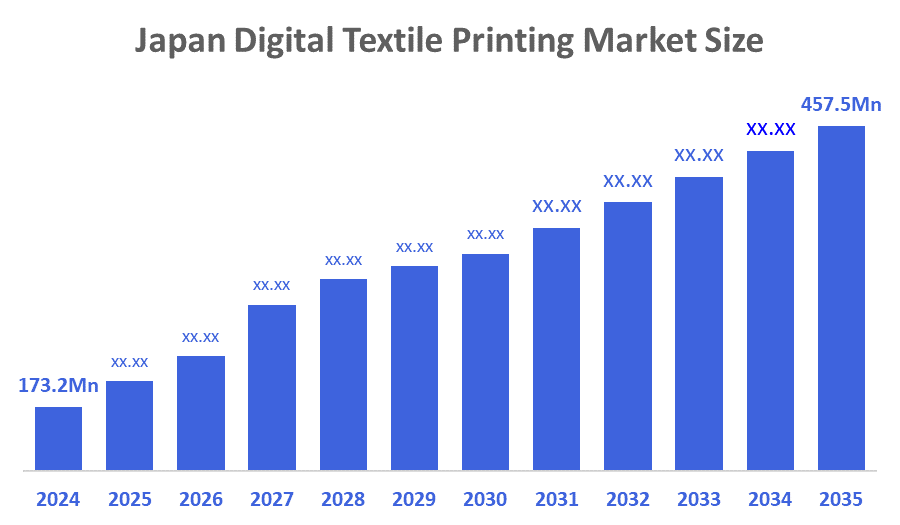
According to a Research Report Published By Decision Advisors & Consulting, The Japan Digital Textile Printing Market Size Is Anticipated To Reach USD 457.5 Million By 2035, Growing At a CAGR of 9.23% From 2025 to 2035. The digital textile printing market in Japan is driven by the growing need for personalized textiles, quick turnaround times for production, environmentally friendly printing techniques, and technological developments in eco-friendly inks and inkjet equipment for use in industrial, fashion, and home decor applications.
Market Overview
The digital textile printing is an industry that uses digital technology (mainly inkjet) to digitally print designs onto fabric. Digital Textile Printing provides high-resolution, custom-made fabrics and printed on demand. In Japan, digital textile printing has been rapidly growing, with a major contributing factor being the growth in demand for small batch fabric printing, fast production times, and the use of environmentally friendly digital printing technologies. The Ministry of Economy, Trade and Industry (METI) has created the Green Innovation Fund, originally ¥2 trillion, expanded to ¥2.7564 trillion as of 2024. The New Energy and Industrial Technology Development Organization (NEDO) provides grants, subsidies, and long-term R&D and implementation support for manufacturing decarbonization under this fund. Textile printing companies could use this framework to upgrade to environmentally friendly digital inkjet systems. In addition, Japanese manufacturers have been introducing new digital textile printing technology (Direct-to-Fabric Printers, Direct-to-Garment Printers, etc), enabling increasing acceptance of digital textile printing among the fashion, home décor, and industrial textiles sectors The digital textile printing market will also see a lot of growth in areas such as premium fashion, on-demand apparel, interior design, and specialized technical fabrics, where quality, speed, and sustainability are of high importance.
Report Coverage
This research report categorizes the market for the Japan digital textile printing market based on various segments and regions, and forecasts revenue growth and analyses trends in each submarket. The report analyses the key growth drivers, opportunities, and challenges influencing the Japan digital textile printing market. Recent market developments and competitive strategies, such as expansion, product launch, development, partnership, merger, and acquisition, have been included to draw the competitive landscape in the market. The report strategically identifies and profiles the key market players and analyses their core competencies in each sub-segment of the Japan digital textile printing market.
Driving Factors
The digital textile printing market in Japan is driven by the increased demand for personalisation by consumers and the rapid growth of high-end, low-volume, boutique-type fabrics. This enables brands to offer unique, one-of-a-kind, limited-edition items without the need for holding large inventories of stock or finishing materials. The development of new technologies for high-speed inkjet printing, as well as eco-friendly pigments and water-based ink systems, has improved the quality, speed, and sustainability of the production process. Furthermore, digital inkjet printer textiles do not require the extensive use of water, chemicals, and extended holding periods for inventory, which are all critical to meeting Japan's growing environmental concerns and increasing government regulations.
Restraining Factors
The digital textile printing market in Japan is mostly constrained by the high cost of owning/maintaining equipment for digital textile printing, limited compatibility to certain types of fabrics, the lack of qualified personnel to operate the equipment, lower throughput and consistency compared to traditional analog printing, resulting in a barrier to adoption for smaller businesses as a result.
Market Segmentation
The Japan digital textile printing market share is classified into printing method and application.
- The roll-to-roll printing segment accounted for the largest revenue market share in 2024 and is expected to grow at a significant CAGR during the forecast period.
The Japan digital textile printing market is segmented by printing method into roll-to-roll printing, and direct-to-garment printing. Among these, the roll-to-roll printing segment accounted for the largest revenue market share in 2024 and is expected to grow at a significant CAGR during the forecast period. Roll-to-roll digital textile printing dominates because it enables high volume, continuous production on wide fabrics, works with various textile materials, and offers lower cost per metre and higher efficiency than garment-by-garment methods, ideal for large batch apparel, home decor, and soft signage manufacturing.
- The garments and apparel segment accounted for the largest revenue share in 2024 and is expected to grow at a significant CAGR during the forecast period.
The Japan digital textile printing market is segmented by application into garments and apparel, home furnishing textiles, technical textiles, display and signage, and others. Among these, the garments and apparel segment accounted for the largest revenue share in 2024 and is expected to grow at a significant CAGR during the forecast period. This is because digital textile printing allows for fast fashion, mass customisation, and on-demand production with great design freedom, quick turnaround, and accurate color quality while lowering waste and costs compared to traditional methods, the apparel and clothing industry leads the market.
Competitive Analysis:
The report offers the appropriate analysis of the key organizations/companies involved within the Japan digital textile printing market, along with a comparative evaluation primarily based on their product offering, business overviews, geographic presence, enterprise strategies, segment market share, and SWOT analysis. The report also provides an elaborate analysis focusing on the current news and developments of the companies, which includes product development, innovations, joint ventures, partnerships, mergers & acquisitions, strategic alliances, and others. This allows for the evaluation of the overall competition within the market.
List of Key Companies
- Seiko Epson Corporation
- Mimaki Engineering Co., Ltd.
- Roland DG Corporation
- Brother Industries, Ltd.
- Konica Minolta, Inc.
- Ricoh Company, Ltd.
- Mutoh Industries Ltd.
- Others
Key Target Audience
- Market Players
- Investors
- End-users
- Government Authorities
- Consulting and Research Firm
- Venture capitalists
- Value-Added Resellers (VARs)
Recent Developments:
- In February 2025, Mimaki Engineering Company Limited introduced two new direct-to-textile ink jet printing machines, named Tx330-1800 and Tx330-1800B. These machines are characterized by superior print quality and an emphasis on reducing water usage, thereby encouraging an increase in the number of Japanese companies adopting sustainable practices in the textile industry.
- In June 2024, Tohoku Epson Corporation (part of Seiko Epson Corporation) began construction of a new factory for inkjet printhead production, with a ¥5.1?billion investment to expand capacity.
- In March 2024, the TRUE-BLUE TEXTILE project launched by Kyocera in Japan promoted its waterless digital inkjet printing using the company's FOREARTH printer technology. The project showcased high-definition sustainable textile printing with 99% reduced water usage and has taken Japan's digital textile printing industry closer to becoming more environmentally conscious and consumer-friendly through greater awareness.
Market Segment
This study forecasts revenue at the Japan, regional, and country levels from 2020 to 2035. Decision Advisors has segmented the Japan digital textile printing market based on the below-mentioned segments:
Japan Digital Textile Printing Market, By Printing Method
- Roll-to-Roll Printing
- Direct-to-Garment Printing
Japan Digital Textile Printing Market, By Application
- Garments and Apparel
- Home Furnishing Textiles
- Technical Textiles
- Display and Signage
- Others
FAQ’s
Q: What is the Japan digital textile printing market size?
A: Japan digital textile printing market size is expected to grow from USD 173.2 million in 2024 to USD 457.5 million by 2035, growing at a CAGR of 9.23% during the forecast period 2025-2035.
Q: What are the key growth drivers of the market?
A: Market growth is driven by the increased demand for personalisation by consumers and the rapid growth of high-end, low-volume, boutique-type fabrics. This enables brands to offer unique, one-of-a-kind, limited-edition items without the need for holding large inventories of stock or finishing materials. The development of new technologies for high-speed inkjet printing, as well as eco-friendly pigments and water-based ink systems, has improved the quality, speed, and sustainability of the production process.
Q: What factors restrain the Japan digital textile printing market?
A: Constraints include the high cost of owning/maintaining equipment for digital textile printing, limited compatibility to certain types of fabrics, the lack of qualified personnel to operate the equipment, lower throughput and consistency compared to traditional analog printing, resulting in a barrier to adoption for smaller businesses as a result.
Q: How is the market segmented by printing method?
A: The market is segmented into roll-to-roll printing, and direct-to-garment printing.
Q: Who are the key players in the Japan digital textile printing market?
A: Key companies include Seiko Epson Corporation, Mimaki Engineering Co., Ltd., Roland DG Corporation, Brother Industries, Ltd., Konica Minolta, Inc., Ricoh Company, Ltd., Mutoh Industries Ltd., and Others.
Q: Who are the target audiences for this market report?
A: The report targets market players, investors, end-users, government authorities, consulting and research firms, venture capitalists, and value-added resellers (VARs).
Check Licence
Choose the plan that fits you best: Single User, Multi-User, or Enterprise solutions tailored for your needs.
We Have You Covered
- 24/7 Analyst Support
- Clients Across the Globe
- Tailored Insights
- Technology Tracking
- Competitive Intelligence
- Custom Research
- Syndicated Market Studies
- Market Overview
- Market Segmentation
- Growth Drivers
- Market Opportunities
- Regulatory Insights
- Innovation & Sustainability
Report Details
| Scope | Country |
| Pages | 180 |
| Delivery | PDF & Excel via Email |
| Language | English |
| Release | Dec 2025 |
| Access | Download from this page |