
Japan Directed Energy Weapons Market
 |
Pages:
150
|
Pages:
150
Japan Directed Energy Weapons Market Size, Share, and COVID-19 Impact Analysis, By Type (Lethal, and Non-Lethal), By End Use (Ship Based, Land Vehicles, Airborne, and Gun Shot), and Japan Directed Energy Weapons Market Insights, Industry Trend, Forecasts to 2035
REPORT COVERAGE
Country
Japan Directed Energy Weapons Market Size Insights Forecasts to 2035
- The Japan Directed Energy Weapons Market Size Was Estimated at USD 529.3 Million in 2024
- The Market Size is Expected to Grow at a CAGR of Around 14.88% from 2025 to 2035
- The Japan Directed Energy Weapons Market Size is Expected to Reach USD 2434.7 Million by 2035
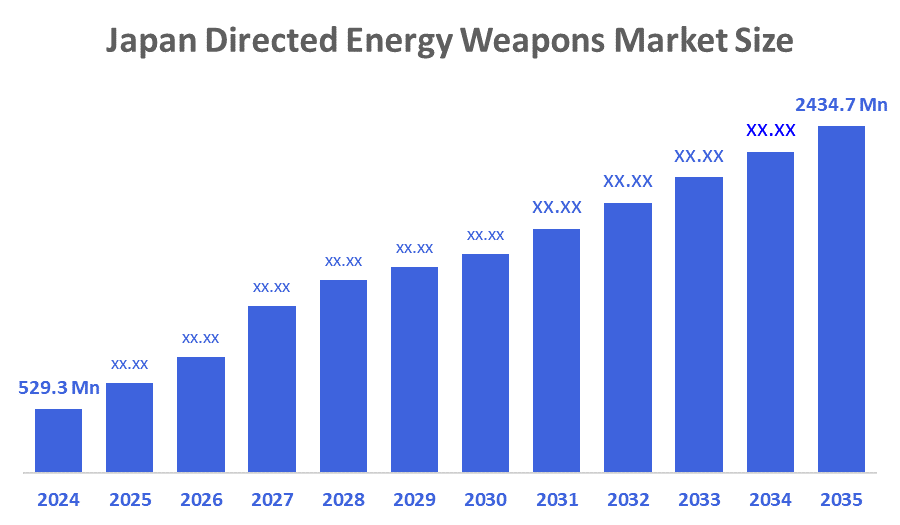
According to a Research Report Published by Decisions Advisors & Consulting, The Japan Directed Energy Weapons Market Size is anticipated to Reach USD 2434.7 Million by 2035, Growing at a CAGR of 14.88% from 2025 to 2035. The directed energy weapons market in Japan is driven by rising defense modernization initiatives, heightened regional security concerns, and increasing government investments in advanced technologies, alongside growing demand for missile defense, counter-drone, and non-lethal weapon systems.
Market Overview
The directed energy weapons market sector develops, manufactures, and supplies weapons that generate and direct concentrated energy in the form of lasers, high-powered microwaves, or particle beams intended for the purpose of damaging, disabling, or destroying targets. The growth of Japan's DEW market will be driven by an increasing need to modernize military defence forces and growing threats to security in the area, and also by continued government support for developing advanced technological capabilities. To achieve these goals, the Ministry of Defence (MoD) and the Acquisition, Technology & Logistics Agency (ATLA) are investing heavily in developing high-energy mobile laser systems for counter-UAS missions and prototyping naval DEW solutions. For instance, ATLA has funded Japan Ground Self Defense Force (JGSDF) trials of a vehicle-mounted laser system capable of disabling small drones, while also supporting Mitsubishi Heavy Industries and Kawasaki in early-stage naval laser concepts designed for shipboard point-defense. Advances in technology, such as higher efficiency compact high-power lasers and improved thermal management systems, along with integrated control systems, are expediting the use of DEWs. In addition, there are emerging opportunities for developing new DEW capabilities (counter-drone defence and shipboard DEW protection) in the international co-development area as export restrictions are being relaxed.
Report Coverage
This research report categorizes the market for the Japan directed energy weapons market based on various segments and regions, and forecasts revenue growth and analyses trends in each submarket. The report analyses the key growth drivers, opportunities, and challenges influencing the Japan directed energy weapons market. Recent market developments and competitive strategies, such as expansion, product launch, development, partnership, merger, and acquisition, have been included to draw the competitive landscape in the market. The report strategically identifies and profiles the key market players and analyses their core competencies in each sub-segment of the Japan directed energy weapons market.
Driving Factors
The directed energy weapons market in Japan is driven by increasing modernization of defence capabilities, heightened security tensions in the region, and increasing need for advanced anti-drone and missile defence capabilities. The Japan Ministry of Defence and the ATLA are making significant investments in DEWs in order to encourage the development of high-energy lasers and microwave systems through increased R&D. The availability of new technologies in the areas of optics, power electronics, and thermal management is also facilitating the rapid deployment of DEW products. Japan's desire to achieve military self-sufficiency, encourage technological innovation, and improve the protection of military facilities and maritime assets will all contribute to the continued growth of the DEW market.
Restraining Factors
The directed energy weapons market in Japan is mostly constrained by high costs and complexity associated with developing DEW technologies, difficulty providing sufficient power and cooling for DEWs, strict regulatory limitations on the use of DEWs, and long timescales required for acquiring DEWs.
Market Segmentation
The Japan directed energy weapons market share is classified into type and end use.
- The non-lethal segment accounted for the largest revenue market share in 2024 and is expected to grow at a significant CAGR during the forecast period.
The Japan directed energy weapons market is segmented by type into lethal and non-lethal. Among these, the non-lethal segment accounted for the largest revenue market share in 2024 and is expected to grow at a significant CAGR during the forecast period. High-energy lasers and high-power microwave (HPM) technologies are mostly employed in non-lethal applications to disable or eliminate drones, sensors, and approaching threats without causing kinetic devastation.
- The land vehicles segment accounted for the largest revenue share in 2024 and is expected to grow at a significant CAGR during the forecast period.
The Japan directed energy weapons market is segmented by end use into ship based, land vehicles, airborne, and gun shot. Among these, the land vehicles segment accounted for the largest revenue share in 2024 and is expected to grow at a significant CAGR during the forecast period. Compared to airborne or naval systems, land platforms provide simpler power supply, cooling capacity, and quick deployment, making them the first real-world use of DEW technology.
Competitive Analysis:
The report offers the appropriate analysis of the key organizations/companies involved within the Japan directed energy weapons market, along with a comparative evaluation primarily based on their product offering, business overviews, geographic presence, enterprise strategies, segment market share, and SWOT analysis. The report also provides an elaborate analysis focusing on the current news and developments of the companies, which includes product development, innovations, joint ventures, partnerships, mergers & acquisitions, strategic alliances, and others. This allows for the evaluation of the overall competition within the market.
List of Key Companies
- Mitsubishi Heavy Industries (MHI)
- Kawasaki Heavy Industries (KHI)
- Mitsubishi Electric
- NEC Corporation
- Fujitsu Limited
- IHI Corporation
- Toshiba (Toshiba Infrastructure Systems)
- SUBARU Corporation
- Hitachi, Ltd.
- Oki Electric Industry
- Others
Key Target Audience
- Market Players
- Investors
- End-users
- Government Authorities
- Consulting and Research Firm
- Venture capitalists
- Value-Added Resellers (VARs)
Recent Developments:
- In May 2025, ATLA and Mitsubishi Heavy Industries demonstrated a 10KW vehicle-mounted laser system during tests performed by the Japan Ground Self-Defense Force (JGSDF) for counter-UAV purposes.
- In May 2025, Kawasaki Heavy Industries unveiled a naval version concept of a high-power laser weapon at DSEI Japan.
- In November 2024, the JGSDF exhibited a 10kW high-powered laser EW vehicle (on 8×8 trucks) at a ceremony, marking a significant public milestone in the digital electronic warfare system (DEWS) fielding process.
Market Segment
This study forecasts revenue at the Japan, regional, and country levels from 2020 to 2035. Decisions Advisors has segmented the Japan directed energy weapons market based on the below-mentioned segments:
Japan Directed Energy Weapons Market, By Type
- Lethal
- Non-Lethal
Japan Directed Energy Weapons Market, By End Use
- Ship Based
- Land Vehicles
- Airborne
- Gun Shot
FAQ’s
Q: What is the Japan directed energy weapons market size?
A: Japan directed energy weapons market size is expected to grow from USD 529.3 million in 2024 to USD 2434.7 million by 2035, growing at a CAGR of 14.88% during the forecast period 2025-2035.
Q: What are the key growth drivers of the market?
A: Market growth is driven by increasing modernization of defence capabilities, heightened security tensions in the region, and the increasing need for advanced anti-drone and missile defence capabilities. The Japan Ministry of Defence and the ATLA are making significant investments in DEWs in order to encourage the development of high-energy lasers and microwave systems through increased R&D. The availability of new technologies in the areas of optics, power electronics, and thermal management is also facilitating the rapid deployment of DEW products.
Q: What factors restrain the Japan directed energy weapons market?
A: Constraints include high costs and complexity associated with developing DEW technologies, difficulty providing sufficient power and cooling for DEWs, strict regulatory limitations on the use of DEWs, and long timescales required for acquiring DEWs.
Q: How is the market segmented by end use?
A: The market is segmented into ship based, land vehicles, airborne, and gun shot.
Q: Who are the key players in the Japan directed energy weapons market?
A: Key companies include Mitsubishi Heavy Industries (MHI), Kawasaki Heavy Industries (KHI), Mitsubishi Electric, NEC Corporation, Fujitsu Limited, IHI Corporation, Toshiba (Toshiba Infrastructure Systems), SUBARU Corporation, Hitachi, Ltd., and Oki Electric Industry.
Q: Who are the target audiences for this market report?
A: The report targets market players, investors, end-users, government authorities, consulting and research firms, venture capitalists, and value-added resellers (VARs).
Check Licence
Choose the plan that fits you best: Single User, Multi-User, or Enterprise solutions tailored for your needs.
We Have You Covered
- 24/7 Analyst Support
- Clients Across the Globe
- Tailored Insights
- Technology Tracking
- Competitive Intelligence
- Custom Research
- Syndicated Market Studies
- Market Overview
- Market Segmentation
- Growth Drivers
- Market Opportunities
- Regulatory Insights
- Innovation & Sustainability
Report Details
| Scope | Country |
| Pages | 150 |
| Delivery | PDF & Excel via Email |
| Language | English |
| Release | Dec 2025 |
| Access | Download from this page |