
Japan Dust Control Solutions Market
 |
Author:
Kunal M
|
Pages:
240
|
Author:
Kunal M
|
Pages:
240
Japan Dust Control Solutions Market Size, Share, By Product Type (Wet Dust Control Systems, and Dry Dust Control Systems), By Application (Construction, Mining, Oil & Gas, Chemical & Petrochemical, Food & Beverage, Power Generation, Metal & Steel Industry, and Others), By Technology (Dust Suppression Systems, Dust Collection Systems, Air filtration & ventilation systems, and Monitoring & smart air quality systems) Analysis and Forecast 2026?2035
CAGR
4.34%
REVENUE 2025
USD Billion 1.02
FORECAST 2035
USD Billion 1.56
REPORT COVERAGE
Country
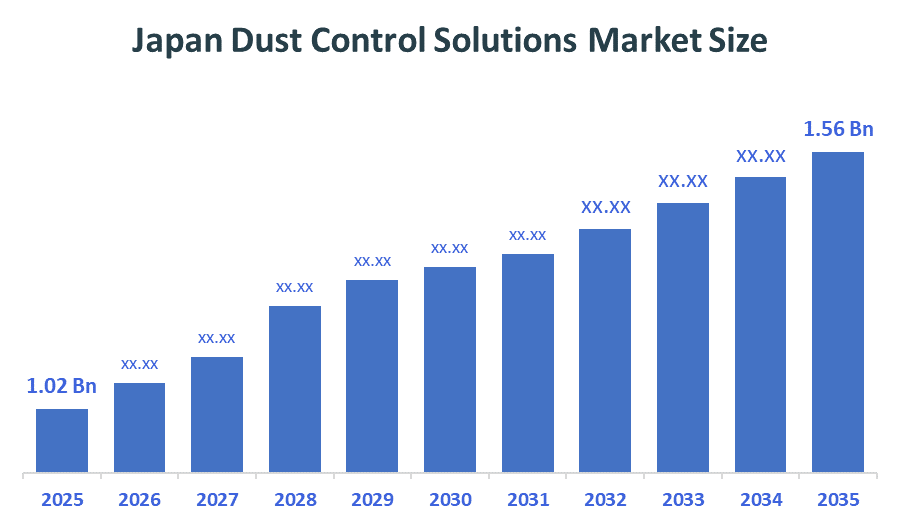
The Japan Dust Control Solutions Market Size is projected USD 1.02 Billion in 2025 and is forecasted to reach around USD 1.56 Billion by 2035. According to Decision Advisors, a detailed report on analysis of the Japan Dust Control Solutions Market indicates that the Adoption of IoT-enabled smart dust monitoring and automated control systems trend dominates the market, accounting for approx. 52–58% of the total Japan demand worldwide. Donaldson Company, Inc. is one of the most dominating companies in Japan’s Dust Control Solutions Market, supported by revenue of approx. USD 10.25 billion, due to strong OTC distribution, trusted global brand presence, wide retail pharmacy access, and growing digestive health demand in Japan.
Market Snapshot
- Japan Dust Control Solutions Market Size (2025): USD 1.02 Billion
- Japan Dust Control Solutions Market Projected Market Size (2035): USD 1.56 Billion
- Japan Dust Control Solutions Market Compound Annual Growth Rate (CAGR): 4.34%
- Base Year: 2025
- Historical Period: 2021–2024
- Forecast Period: 2026–2035
Market Overview/Introduction
The Japan Dust Control Solutions Market consists of technologies that help in controlling, capturing, suppressing, and monitoring the presence of dust particles arising from various industrial processes. This includes dust control and monitoring systems and devices, such as dust suppression systems, dust collectors, air filtration and ventilation systems, as well as intelligent air quality monitoring solutions. The objective of these technologies is the prevention of any form of harm caused to both workers in the environment as well as improving overall air quality within an industrial setting. Factors like increasing environmental regulations within Japan, especially those specified by the Air Pollution Control Act and Industrial Safety and Health regulation, drive growth in this sector. Innovation in technologies like Internet of Things (IoT) based air quality monitoring, automatic filtration techniques, HEPA filters, and electrostatic filters is improving efficiency and compliance. Furthermore, smart dust control systems with real-time monitoring and predictive maintenance functionalities are being adopted by industries. Some factors driving the market growth are increasing industrialization, stringent government regulations regarding emissions, increased awareness about the health impacts of dust at workplaces, and the adoption of eco-friendly industrial operations.
- In 2026, Japan strengthens prefectural anti-pollution ordinances supported by voluntary industry agreements, boosting demand for industrial dust control and air filtration systems across manufacturing and construction sectors nationwide regulatory environment.
- In 2026, Japan’s limited landfill capacity and strict Waste Management and Air Pollution Control regulations drive adoption of advanced waste handling, filtration, and dust control technologies across industrial sectors.
- In 2025, Japan promotes electric arc furnace dust recycling under circular economy and environmental regulations, strengthening resource recovery and pollution control systems across steelmaking industries to improve sustainability and reduce hazardous industrial waste.
Notable Insights: -
- By product type, the wet dust control systems segment holds a dominant position with an estimated share of over 48% in 2025.
- By application, the chemical & petrochemical segment holds a dominant position with an estimated share of over 32% in 2025.
- By technology, the dust collection systems hold a dominant position with an estimated share of over 43% in 2025.
- The forecasted CAGR for the Japan Dust Control Solutions Market is expected to be about 4.34% for the period between 2026 and 2035.
- The market is expected to reach a valuation of approximately USD 1.56 Billion by 2035
What is the Role of Technology in Grooming the Market?
Technology has been found to have a profound impact on the Japan Dust Control Solutions Market in terms of increasing efficiency and compliance, along with continuous monitoring of the environment in real time. Sophisticated dust control solutions that have been integrated with sensors based on Internet of Things (IoT) technology ensure that any deviations from normal air quality can be addressed immediately. Dust collection solutions that have been fitted with automated filtration and predictive maintenance technologies are increasingly being used for minimizing downtime and increasing operational efficiency. Machine learning and artificial intelligence (AI) technology is being used for optimizing airflow management and prediction of dust generation trends in hazardous industries such as construction, mining, and chemicals. Moreover, there are cloud-based systems that monitor the air quality of industrial areas which will facilitate data analysis from different places at the same time. There have also been robots that perform dangerous tasks for humans, while automated cleaning is taking place in such environments. Technological innovation is also receiving government support through digitalization initiatives and Industrial 4.0 solutions. In conclusion, technology is steering the market towards automation, efficiency, and safety.
Market Drivers
Several factors drive the Japan Dust Control Solutions market, including stringent environmental laws, industrial growth, and increased knowledge about workplace safety. The regulations in Japan, such as the Air Pollution Control Act, set tight controls for particulate matter that require companies to use effective dust control solutions. Increased infrastructure developments through construction activities have greatly contributed to the rising amounts of dust, increasing demand for dust suppression solutions. The growth of the manufacturing industries, including chemicals, steel production, and electronics, has contributed to increased usage of industrial air filtration. Respiratory illnesses from dust have created a need for companies to enhance their safety measures through better technology. Aging population in the labour force requires increased automation in workplaces. Further innovations like the use of AI for air sensing, energy-saving filters, and predictive maintenance with IoT are contributing to the faster growth of the market. Policies that encourage carbon neutral development and sustainable business practices are prompting companies to implement green manufacturing processes. Additionally, increased investments in smart factories via Industry 4.0 programs have boosted the demand for dust control solutions in various industries in Japan.
Restraints
Expensive installation and maintenance charges associated with sophisticated dust management systems make it difficult for SMEs to implement such systems. The need for strict adherence to complex regulations and compliance makes the implementation process slower. Moreover, regular upgrades of the system in order to make the solution smarter and more intelligent make the system expensive. Limited technical capacity to handle sophisticated filtration systems poses a challenge to the adoption of dust management systems by small-scale industries.
Study on the Supply, Demand, Distribution, and Market Environment
The supply chain for dust control equipment in Japan is well-developed, involving not only domestic suppliers but also foreign firms. The former specializes in dust collection units and ventilation technologies, and the latter manufacture smart dust control equipment using artificial intelligence. In terms of demand, construction, manufacturing, mining, and chemical enterprises have the highest requirements for environmental regulations. Urban industrial centres of Tokyo, Osaka, and Nagoya are key markets for dust control products, while rural industrial areas are increasingly implementing new technologies related to controlling dust at their enterprises. Main distribution channels include industrial procurement, equipment suppliers, and EPCs. As for the main purchasing organizations, the largest enterprises in industrial centres tend to conclude service agreements for installing, maintaining, and monitoring their facilities. It can be stated that the market environment is highly regulated, with the government having significant control over air pollution levels and industrial emissions. Companies are increasingly emphasizing sustainable production and workplace safety, thus developing advanced filtration and monitoring technologies. Furthermore, the trend towards smart factories contributes to the change in demand-supply balance.
Price Analysis and Consumer Behaviour Analysis
The pricing strategy for the Japan Dust Control Solutions Market depends largely on the complexity of the system. Simple dust control and filtration systems, including portable collectors, are priced low. However, sophisticated industrial dust filtration systems and monitoring systems cost much higher. The implementation and maintenance of large-scale HEPA filtration systems and electrostatic filtration systems in production facilities incur high installation and maintenance costs. The customer behaviour within the Japan Dust Control Solutions Market does not depend on the purchasing cost but rather regulatory compliance and safety of the operations as well as cost efficiency in the long run. There is also an increased preference towards service-oriented approaches that include maintenance and performance contracting instead of buying the machines directly. Environmental issues have influenced buying decisions, with various sectors opting for efficient and green technologies. There is also a trend towards modular solutions and scalability, whereby companies can upgrade depending on production capacity.
Market Segmentation
The Japan Dust Control Solutions Market is categorised by product type, application, and technology
- The Dry Dust Control Systems segment dominated the market in 2025 and is projected to grow at a steady CAGR of approximately 5.1% during the forecast period.
Based on the product type, the Japan Dust Control Solutions Market is divided into wet dust control systems, dry dust control systems, neurostimulation devices, neurosurgical devices, brain monitoring devices. Among these, the Dry Dust Control Systems segment dominates the Japan Dust Control Solutions Market with the highest revenue share of around 45–50% in 2025, driven by widespread industrial usage in manufacturing, construction, and chemical processing. This segment is also expected to grow at a CAGR of approximately 4.5–5.2% due to high efficiency in particulate capture, low water dependency, and compliance with strict environmental regulations. Increasing adoption of baghouse and electrostatic systems further strengthens its dominance.
- The Chemical & Petrochemical segment accounted for the largest share in 2025 and is anticipated to grow at a significant CAGR of approximately 5.3% during the forecast period.
Based on the application, the Japan Dust Control Solutions Market is divided into construction, mining, oil & gas, chemical & petrochemical, food & beverage. Among these, the Chemical & Petrochemical segment dominates the Japan Dust Control Solutions Market with a revenue share of approximately 30–34% in 2025, driven by high emission levels and strict regulatory compliance requirements. This segment is projected to grow at a CAGR of around 4.8–5.5% due to rising industrial output and demand for safer working environments. Increasing adoption of advanced filtration and dust suppression technologies in refineries and chemical plants further supports its strong market position.
- The Dust Collection Systems segment accounted for the largest share in 2025 and is anticipated to grow at a significant CAGR of approximately 5.1% during the forecast period.
Based on the technology, the Japan Dust Control Solutions Market is divided into dust suppression systems, dust collection systems, monitoring & smart air quality systems, air filtration & ventilation systems. Among these, the Dust Collection Systems segment holds the dominant position in the Japan Dust Control Solutions Market with a revenue share of around 40–45% in 2025, supported by strong demand from heavy industries and manufacturing facilities. It is expected to grow at a CAGR of approximately 4.6–5.3% (2026–2035) due to rising automation and stricter workplace air quality regulations. Increasing use of bag filters, cartridge collectors, and electrostatic precipitators is driving efficiency and long-term adoption across industrial sectors.
Recent Developments
In March 2024, Camfil APC launched the Gold Series Timer (GST) with GoldLink cloud monitoring, enhancing industrial dust collector efficiency, predictive maintenance, and compliance in global and Japanese manufacturing environments.
In March 2024, BossTek launched the DB-45 Surge compact mobile mist cannon, enhancing dust suppression efficiency for construction and industrial sites, supporting stricter air quality and dust control needs in Japan.
In January 2023, Donaldson launched the Torit Downflo Ambient Weld Fume Extractor, delivering high-efficiency Ultra-Web filtration for industrial welding operations, improving air quality and supporting dust and fume control compliance in Japan.
Competitive Analysis
The report offers the appropriate analysis of the key organisations/companies involved within the Japan Dust Control Solutions market, along with a comparative evaluation primarily based on their product offering, business overviews, geographic presence, enterprise strategies, segment market share, and SWOT analysis. The report also provides an elaborate analysis focusing on the current news and developments of the companies, which includes product development, innovations, joint ventures, partnerships, mergers & acquisitions, strategic alliances, and others. This allows for the evaluation of the overall competition within the market.
Top Key Companies in the Japan Dust Control Solutions Market
- Donaldson Company, Inc.
- Camfil AB
- Parker Hannifin Corporation
- Schenck Process Holding GmbH
- Nederman Holding AB
- Torit
- FLSmidth & Co. A/S
- Hitachi Industrial Equipment Systems Co., Ltd.
- Panasonic Corporation
- Mitsubishi Heavy Industries, Ltd.
- Others
Key Target Audience
- Market Players
- Investors
- End-users
- Government Authorities
- Consulting and Research Firm
- Venture capitalists
- Value-Added Resellers (VARs)
Market Segmentation
This study forecasts revenue at the national and regional levels from 2021 to 2035. The report segmented the Japan Dust Control Solutions Market based on the following segments:
Japan Dust Control Solutions Market, By Product Type
- Wet Dust Control Systems
- Dry Dust Control Systems
Japan Dust Control Solutions Market, By Application
- Construction
- Mining
- Oil & Gas
- Chemical & Petrochemical
- Food & Beverage
- Power Generation
- Metal & Steel Industry
- Others
Japan Dust Control Solutions Market, By Technology
- Dust Suppression Systems
- Dust Collection Systems
- Monitoring & smart air quality systems
- Air filtration & ventilation systems
Frequently Asked Questions (FAQ)
1. What industries are emerging as new adopters of dust control solutions in Japan?
Industries such as semiconductor manufacturing, battery production, and precision electronics are emerging adopters due to ultra-clean production requirements and stricter micro-particle contamination standards in high-tech facilities.
2. How is workplace automation influencing dust control system demand in Japan?
Increasing automation in factories is driving demand for integrated dust control systems that can operate autonomously, reduce human exposure, and synchronize with robotic production lines for continuous air quality management.
3. What role do energy efficiency concerns play in system selection?
Energy consumption is becoming a key purchasing factor, with companies preferring low-pressure-drop filters and smart airflow systems that reduce electricity usage while maintaining high filtration efficiency.
4. Are rental or subscription-based dust control solutions gaining popularity in Japan?
Yes, equipment-as-a-service models are gradually gaining traction, allowing smaller manufacturers to access advanced dust control systems without high upfront investment, while also including maintenance and upgrades.
5. How are environmental reporting requirements affecting the market?
Companies are increasingly required to digitally monitor and report air quality data, leading to higher adoption of sensor-enabled systems that automatically generate compliance reports for regulatory authorities.
Check Licence
Choose the plan that fits you best: Single User, Multi-User, or Enterprise solutions tailored for your needs.
We Have You Covered
- 24/7 Analyst Support
- Clients Across the Globe
- Tailored Insights
- Technology Tracking
- Competitive Intelligence
- Custom Research
- Syndicated Market Studies
- Market Overview
- Market Segmentation
- Growth Drivers
- Market Opportunities
- Regulatory Insights
- Innovation & Sustainability
Report Details
| Scope | Country |
| Pages | 240 |
| Delivery | PDF & Excel via Email |
| Language | English |
| Release | Apr 2026 |
| Access | Download from this page |