
Japan Graphic Paper Market
 |
Author:
Rahul B
|
Pages:
245
|
Author:
Rahul B
|
Pages:
245
Japan Graphic Paper Market Size, Share, By Type (Coated Paper, Uncoated Paper, Specialty Paper), By Application (Publishing, Commercial Printing, Packaging), and By Format (Sheets, Rolls), Analysis and Forecast 2026-2035
CAGR
1.34%
REVENUE 2025
USD Billion 4.28
FORECAST 2035
USD Billion 4.89
REPORT COVERAGE
Country
Market Snapshot
- Japan Graphic Paper Market Size (2025): USD 4.28 Billion
- Projected Japan Graphic Paper Market Size (2035): USD 4.89 Billion
- Compound Annual Growth Rate (CAGR): 1.34%
- Base Year: 2025
- Historical Period: 2021–2024
- Forecast Period: 2026–2035
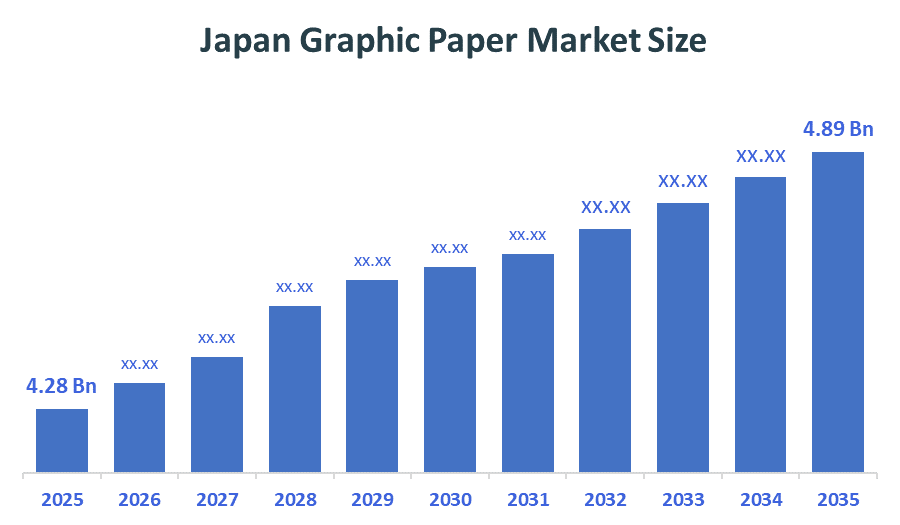
According to Decision Advisors, the Japan Graphic Paper Market Size is expected to grow from USD 4.28 billion in 2025 to USD 4.89 billion by 2035, at a CAGR of 1.34% during the forecast period 2026-2035. Japan Graphic Paper Market is projected to grow significantly over the next decade due to increasing demand for high-quality commercial printing, packaging solutions, specialty paper products, and digitalization-driven printing applications, along with ongoing sustainability initiatives promoting recycled and eco-friendly paper.
Market Overview/Introduction
The Japan Graphic Paper Market includes all coated, uncoated and specialty papers that the publishing industry, commercial printing, packaging and advertising sectors utilize. The market exhibits growth because Japan maintains established print media and needs premium packaging solutions, and new coating, finishing and printing technologies have emerged. The production of environmentally compliant products benefits from the increasing use of digital printing and sustainable practices, and recycled paper materials. To satisfy the need for high-quality papers which possess durability and versatility manufacturers focus on high-grade pulp procurement, energy-efficient manufacturing systems and product development. The demand for specialty papers, which provide luxury packaging solutions and high-resolution printing capabilities drives the market according to changing consumer and corporate sustainability standards. The technological improvements lead to better print clarity, ink absorption and efficiency improvements which result in environmentally friendly manufacturing processes. The market develops paper solutions which provide better performance and sustainability, and digital compatibility that will continue to grow until 2035.
Notable Insights: -
- By type, the coated paper segment held a dominant position with 52% in terms of market share in 2025.
- By format, sheets segment is the dominating accounting for over 58% of the Japan market share in 2025.
- The compound annual growth rate of the Japan Graphic Paper Market is 1.34%.
- The market is likely to achieve a valuation of USD 4.89 Billion by 2035.
What is role of technology in grooming the market?
Technological advancements in Japan’s graphic paper manufacturing, including improved coating, digital printing compatibility, and automated pulp processing, enhance quality, durability, and environmental compliance. Smart drying, calendering, and surface treatments improve print clarity and ink absorption. AI-driven quality control, digital finishing, and energy-efficient production reduce waste, optimize efficiency, and support sustainable manufacturing, driving broader market adoption and meeting evolving printing and packaging demands.
Market Drivers
The demand for premium printing services together with new packaging technologies and sustainable paper products drives business expansion. The rising demand for online shopping and high-end product packaging leads to increased usage of specialty and coated paper materials. The production process achieves sustainable results through technology that creates high-quality products with consistent standards according to environmental regulations and corporate social responsibility requirements. The company maintains its market position by developing new pulp processing methods together with coating techniques and finishing methods which create valuable products for both domestic and international markets.
Restrain
The market faces challenges from declining print media circulation, competition from digital media, rising raw material costs, and environmental regulations. Import dependency for specific high-grade pulp and energy-intensive manufacturing processes increases operational costs. These factors necessitate sustainable sourcing, process optimization, and investment in recycled and eco-friendly paper production to maintain market stability.
Strategies to Implement for Growth of the Market
Companies in Japan’s graphic paper market should invest in advanced coated, digital-print-compatible, and specialty papers while expanding recycled and eco-friendly product lines to meet sustainability regulations. Strategic collaborations with printing and packaging firms enhance distribution and application-specific solutions. Leveraging automation and AI-based production monitoring improves efficiency, product consistency, and quality. Focusing on high-margin niche segments, including luxury packaging and specialty publications, supports profitability and long-term growth. These strategies collectively strengthen competitive positioning, optimize operations, and align with evolving market demands for sustainable, high-performance, and digitally compatible paper products, ensuring steady market expansion through 2035.
Study on the Supply, Demand, Distribution, and Market Environment
Supply in Japan’s graphic paper market is supported by domestic production of coated, uncoated, and specialty papers, supplemented by imported premium pulp. Demand is driven by publishing, commercial printing, packaging, and specialty applications. Distribution occurs through wholesalers, online platforms, and direct B2B channels. Market dynamics are influenced by technological advancements in coating, digital-print compatibility, and sustainability initiatives promoting recycled paper, ensuring quality, efficiency, and environmentally responsible growth, supporting competitiveness across sectors.
Price Analysis and Consumer Behaviour Analysis
In Japan’s graphic paper market, price levels reflect raw material and commodity input trends. Average import prices for graphic papers reached approximately?USD?1,029?per?ton in?2023, up approx. 13?% year?on?year, indicating upward pressure from global pulp and energy costs. Export prices were USD?946?per?ton in?2023, showing comparatively lower pricing pressure for Japanese producers. These import/export price dynamics illustrate that graphic paper pricing is sensitive to global pulp and energy cost fluctuations, with coated and premium grades typically commanding higher prices. Cost inputs such as wood pulp and chemicals directly impact producer price indexes for pulp, paper and related products, which have increased relative to the 2020 base year. These statistical price trends shape production cost pass?through and buyer behavior in printing and packaging sectors.
Market Segmentation
The Japan Graphic Paper Market share is classified into type, application and format.
- The coated paper segment dominated the market in 2025, and is projected to grow at a substantial CAGR of approximately 52% during the forecast period.
Based on the type, the Japan graphic paper market is divided into coated paper, uncoated paper, specialty paper. Among these, the coated paper segment dominates the market in 2025, and is projected to grow at a substantial CAGR of approximately 52% during the forecast period. This is driven by high demand in publishing, commercial printing, and premium packaging applications. Its superior print quality, surface finish, and compatibility with digital and offset printing make it the preferred choice over uncoated and specialty papers.
- The publishing segment dominated the market in 2025, and is projected to grow at a substantial CAGR during the forecast period.
Based on the application, the Japan graphic paper market is divided into publishing, commercial printing, packaging. Among these, the publishing segment dominated the market in 2025, and is projected to grow at a substantial CAGR during the forecast period. The is because Japan has a well-established print media industry with strong demand for books, magazines, newspapers, and educational materials. High-quality print standards require coated and uncoated papers that provide superior ink absorption, color reproduction, and durability. Additionally, consistent circulation and advertising needs maintain steady paper consumption, supporting publishing’s leading market share over commercial printing and packaging.
- The sheets segment accounted for the largest share in 2025, and is anticipated to grow at a significant CAGR of approximately 58% during the forecast period.
Based on the format, the Japan graphic paper market is divided into sheets and rolls. Among these, the sheets segment accounted for the largest share in 2025, and is anticipated to grow at a significant CAGR of approximately 58% during the forecast period. It is dominating because they offer greater flexibility for printing presses and publishing workflows, allowing precise cutting, high-resolution printing, and consistent quality. They are easier to handle in commercial and editorial printing, support a wide range of paper weights and finishes, and meet the requirements of books, magazines, and promotional materials, making them preferred over rolls.
Recent Development
- In April 2025, Graphic launched its seventh edition paper catalogue, introducing new eco-friendly and designer paper stocks for printing and packaging, expanding options and supporting innovation in Japan’s graphic paper market.
- In June 2025, Smurfit Kappa and WestRock introduced advanced digital printing for packaging, enabling faster customization, on-demand production, and eco-friendly coatings, enhancing paper-based packaging efficiency and sustainable graphic solutions
Competitive Analysis
The report offers the appropriate analysis of the key organisations/companies involved within the Japan Graphic Paper Market, along with a comparative evaluation primarily based on their product offering, business overviews, geographic presence, enterprise strategies, segment market share, and SWOT analysis. The report also provides an elaborative analysis focusing on the current news and developments of the companies, which includes product development, innovations, joint ventures, partnerships, mergers & acquisitions, strategic alliances, and others. This allows for the evaluation of the overall competition within the market.
Top Key Companies in Japan Graphic Paper Market
• Oji Holdings Corporation
• Nippon Paper Industries Co., Ltd.
• Maruzen Paper Manufacturing Co., Ltd.
• Sumitomo Forestry Co., Ltd.
• Tokushu Tokai Paper Co., Ltd.
Key Target Audience
- Paper & Packaging Manufacturers
- Commercial Printing Companies
- Publishing Houses
- E-commerce Packaging Providers
- Government Agencies & Regulatory Bodies
Market Segment
This study forecasts revenue at the India, regional, and country levels from 2020 to 2035. Decision Advisors has segmented the Japan Graphic Paper Market based on the below-mentioned segments
Japan Graphic Paper Market, By Type
- Coated Paper
- Uncoated Paper
- Specialty Paper
Japan Graphic Paper Market, By Application
- Publishing
- Commercial Printing
- Packaging
Japan Graphic Paper Market, By Format
- Sheets
- Rolls
Frequently Asked Questions (FAQ)
Q. How is the shift toward digital media affecting Japan’s graphic paper demand?
Digital media reduces traditional publishing volumes, lowering demand for standard printing paper. However, it drives the need for specialty, high-quality papers for packaging, luxury printing, and marketing materials. This shift balances overall market demand, encouraging manufacturers to focus on premium and niche paper products with higher performance and added value.
Q. How is automation affecting Japan’s graphic paper production?
Automation in pulp processing, coating, and finishing increases production efficiency, consistency, and quality. AI-driven monitoring and precision equipment reduce waste, optimize energy usage, and support sustainable manufacturing, allowing manufacturers to meet high-volume demand for publishing, packaging, and specialty papers while controlling costs.
Q. How do technological innovations improve paper quality?
Advanced coating, surface treatments, and digital-print-compatible formulations enhance ink absorption, print clarity, durability, and finish quality. These innovations enable higher-performance papers for publishing, packaging, and specialty applications, supporting premium pricing, increased adoption, and competitiveness in Japan’s graphic paper market.
Q. How is sustainability shaping Japan’s graphic paper market?
Sustainability initiatives drive demand for recycled and eco-friendly papers. Manufacturers adopting energy-efficient production, responsible pulp sourcing, and environmentally compliant coatings gain market preference. These practices support regulatory compliance, appeal to environmentally conscious consumers, and encourage long-term adoption of coated, uncoated, and specialty paper products.
Check Licence
Choose the plan that fits you best: Single User, Multi-User, or Enterprise solutions tailored for your needs.
We Have You Covered
- 24/7 Analyst Support
- Clients Across the Globe
- Tailored Insights
- Technology Tracking
- Competitive Intelligence
- Custom Research
- Syndicated Market Studies
- Market Overview
- Market Segmentation
- Growth Drivers
- Market Opportunities
- Regulatory Insights
- Innovation & Sustainability
Report Details
| Scope | Country |
| Pages | 245 |
| Delivery | PDF & Excel via Email |
| Language | English |
| Release | Apr 2026 |
| Access | Download from this page |