
Japan Healthcare Analytics Market
 |
Author:
David J
|
Pages:
207
|
Author:
David J
|
Pages:
207
Japan Healthcare Analytics Market Size, Share, By Type (Descriptive Analysis, Diagnostic Analytics, Predictive Analysis, and Prescriptive Analysis), By End Use (Healthcare Payers, Healthcare Providers, and Life Science Companies), Japan Healthcare Analytics Market Insights, Industry Trend, Forecasts to 2035
CAGR
22.21%
REVENUE 2025
USD Billion 136.8
FORECAST 2035
USD Billion 1242.2
REPORT COVERAGE
Country
Japan Healthcare Analytics Market Insights Forecasts to 2035
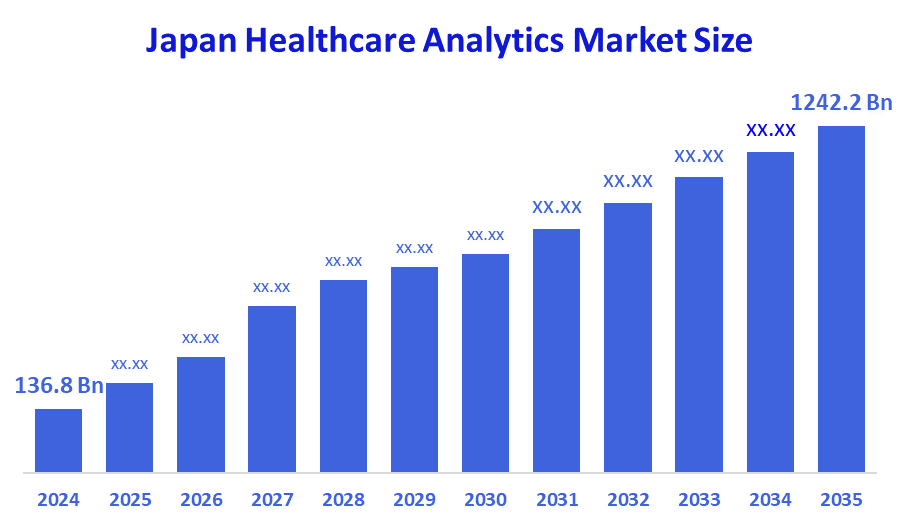
- Japan Healthcare Analytics Market Size 2024: USD 136.8 Bn
- Japan Healthcare Analytics Market Size 2035: USD 1242.2 Bn
- Japan Healthcare Analytics Market CAGR 2024: 22.21%
- Japan Healthcare Analytics Market Segments: Type and End Use
The healthcare analytics market includes healthcare providers, payers, government agencies, and other organisations that systematically use data, statistical analysis, predictive modelling, and artificial intelligence (AI) to gain insights into the use of health-related data. Using healthcare analytics, which improve patient experience, lower costs, streamline operations, and enable data-driven decision-making, will allow organisations to be more resource-efficient and provide better care. The use of health care analytics is growing rapidly as healthcare systems continue to gather and process a vast amount of data, such as that produced by hospitals, diagnostic labs, insurance companies, and sports technology, across Japan’s highly developed healthcare infrastructure.
Japan's Government has been proactive in facilitating the provision of healthcare data using national digital health policies and national data integration policies as means of supporting a foundation for the use of data health analytics. Society 5.0 is one way to combine the capabilities of artificial intelligence (AI), big data, and Internet of things (IoT) technologies with health care data to form an integrated patient centric, data driven health care system. Medical digital transformation vision supports the digitization of health records, adds the ability to verify insurance coverage via the internet, and promotes interoperability across health care data systems. Also, MHLW supports the utilization of real-world data (RWD) and Claim databases such as the national database of health insurance claims to assist with policy development, clinical research and cost management.
AI & ML are quickly growing in usage for predicting disease, analyzing medical images, & creating individualised treatment plans. Large-scale population health & epidemiology studies are supported by large amounts of data that are analyzed using Big Data Analytics Platforms. IoT devices and wearables allow the continuous tracking of patients and the collection of real-time data. NLP has enabled the extraction of information from unstructured notes and documents written by medical professionals.
Market Dynamics of the Japan Healthcare Analytics Market:
The Japan Healthcare Analytics market is driven by an ageing population, an increase in the number of chronic illnesses, and growing costs for the delivery of care. Healthcare analytics is needed to provide data-informed decisions. With the rise in the medical digital transformation (DX) initiatives from both the Government and the growing number of electronic health records (EHR) being adopted, the demand for healthcare analytics is increasing. Additionally, as the need grows for improved clinical outcomes, operational efficiencies, and population health management, more hospitals, insurers, and pharmaceutical companies will be using healthcare analytics.
The Japanese healthcare analytics market is restrained by data privacy and security issues, regulatory compliance issues, and challenges with data interoperability in the fragmented healthcare system, the adoption of healthcare analytics. Additionally, many of the smaller healthcare providers may not be able to adopt healthcare analytics due to the high costs of implementation and a lack of skilled data analytics professionals.
Future Growth in the healthcare analytics market in Japan will be AI-powered predictive analytics, personalised medicine, fraud detection, and remote patient monitoring, as well as the continued expansion of cloud-based analytics platforms, the integration of data from wearables and IoT devices, and the increased use of healthcare analytics within clinical research and drug development.
Market Segmentation
The Japan Healthcare Analytics Market share is classified into type and end use.
By Type:
The Japan healthcare analytics market is divided by type into descriptive analysis, diagnostic analytics, predictive analysis, and prescriptive analysis. Among these, the descriptive analysis held the largest market share in 2024 and is anticipated to grow at a significant CAGR during the forecast period. Descriptive analytics has shown to be an effective approach for comprehending what occurred by accessing historical data and transforming it into actionable insights. In addition, hospitals use it to track the performance of insurance claims by detecting abnormalities and inaccuracies.
By End Use:
The Japan healthcare analytics market is divided by end use into healthcare payers, healthcare providers, and life science companies. Among these, the life science companies dominated in 2024 and is anticipated to grow at a significant CAGR during the forecast period. Life-science enterprises employ analytical tools and platforms the most to reduce product costs, increase profit margins, provide superior goods, and accelerate segment adoption and growth.
Competitive Analysis:
The report offers the appropriate analysis of the key organisations/companies involved within the Japan Healthcare Analytics market, along with a comparative evaluation primarily based on their product offering, business overviews, geographic presence, enterprise strategies, segment market share, and SWOT analysis. The report also provides an elaborative analysis focusing on the current news and developments of the companies, which includes product development, innovations, joint ventures, partnerships, mergers & acquisitions, strategic alliances, and others. This allows for the evaluation of the overall competition within the market.
Top Key Companies in Japan Healthcare Analytics Market:
- McKesson Corporation
- Inovalon
- CitiusTech Inc.
- IBM (IBM Japan Ltd.)
- SAS Institute Inc.
- Oracle Inc.
- Verisk Analytics, Inc.
- Arcadia Solutions, LLC
- Others
Key Target Audience
- Market Players
- Investors
- End-users
- Government Authorities
- Consulting and Research Firm
- Venture capitalists
- Value-Added Resellers (VARs)
Market Segment
This study forecasts revenue at the Japan, regional, and country levels from 2020 to 2035. Decisions Advisors has segmented the Japan Healthcare Analytics market based on the below-mentioned segments:
Japan Healthcare Analytics Market, By Type
- Descriptive Analysis
- Diagnostic Analytics
- Predictive Analysis
- Prescriptive Analysis
Japan Healthcare Analytics Market, By End Use
- Healthcare Payers
- Healthcare Providers
- Life Science Companies
FAQ
Q: What is healthcare analytics and how is it used in Japan?
A: Healthcare analytics in Japan refers to the systematic use of healthcare data, statistical methods, and AI-driven tools to improve clinical outcomes, operational efficiency, cost control, and policy planning. It is widely used by hospitals, insurers, government agencies, and life science companies to support data-driven healthcare delivery.
Q: What is driving the growth of the Japanese healthcare analytics market?
A: The market is driven by Japan’s ageing population, rising chronic disease burden, increasing healthcare costs, and strong government support for digital health transformation, including the adoption of electronic health records (EHRs) and real-world data utilisation.
Q: Which analytics type dominates the Japanese healthcare analytics market?
A: Descriptive analytics dominates the market, as it helps healthcare organizations analyze historical data to monitor performance, manage insurance claims, detect anomalies, and improve operational transparency.
Q: Which end-user segment leads the market in Japan?
A: Life science companies lead the market due to their extensive use of analytics for drug discovery, clinical trials, cost optimisation, regulatory compliance, and accelerating time-to-market for new therapies.
Q: How is the Japanese government supporting healthcare analytics adoption?
A: The government supports healthcare analytics through initiatives such as Society 5.0, medical digital transformation (DX), national health insurance databases, and policies promoting interoperability, AI adoption, and real-world data usage.
Q: Who are the target audiences for this market report?
A: The report targets market players, investors, end-users, government authorities, consulting and research firms, venture capitalists, and value-added resellers (VARs).
Check Licence
Choose the plan that fits you best: Single User, Multi-User, or Enterprise solutions tailored for your needs.
We Have You Covered
- 24/7 Analyst Support
- Clients Across the Globe
- Tailored Insights
- Technology Tracking
- Competitive Intelligence
- Custom Research
- Syndicated Market Studies
- Market Overview
- Market Segmentation
- Growth Drivers
- Market Opportunities
- Regulatory Insights
- Innovation & Sustainability
Report Details
| Scope | Country |
| Pages | 207 |
| Delivery | PDF & Excel via Email |
| Language | English |
| Release | Dec 2025 |
| Access | Download from this page |