
Japan Human Chorionic Gonadotropin Market
 |
Author:
David J
|
Pages:
210
|
Author:
David J
|
Pages:
210
Japan Human Chorionic Gonadotropin Market Size, Share, By Product Type (a-Subunit (?-hCG), ?-Subunit (?-hCG)), By Application (Female Infertility Treatment, Male Hypogonadism, Oligospermic Treatment), By End User (Research Institutions, Pharmaceutical & Biotechnology Companies), Analysis and Forecast 2026 ? 2035
CAGR
7.85%
REVENUE 2025
USD Million 620.0
FORECAST 2035
USD Million 1320.0
REPORT COVERAGE
Country
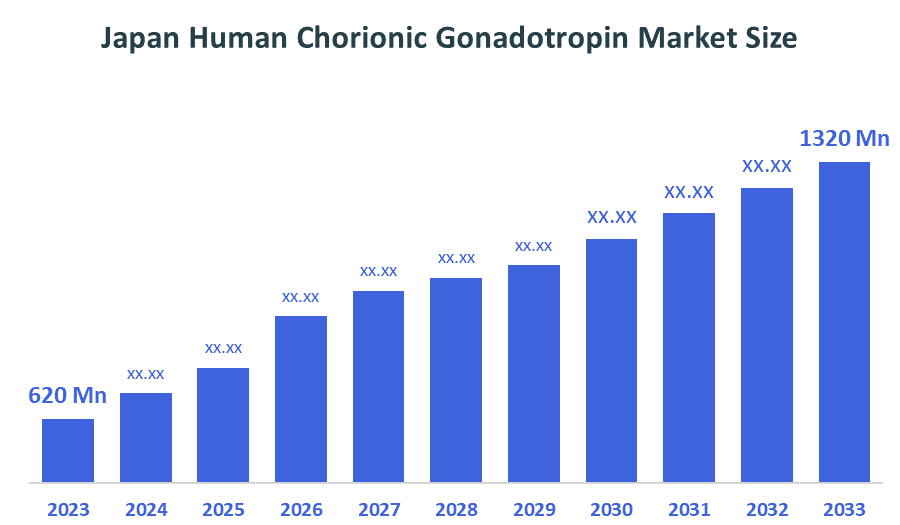
The Japan Human Chorionic Gonadotropin Market size is forecast to grow from approximately USD 620 Million in 2025 to around USD 1320Million by 2035. According to Decision Advisors, a detailed research report on the human chorionic gonadotropin market indicates that the hCG in fertility treatments and IVF procedures dominates the market, accounting for approximately 51.9% of the total share in Japan. Ferring Pharmaceuticals leads the market with an estimated 15-22% Japan market share. The company's annual revenue of approximately USD 2-2.5 billion is making it one of the most influential forces shaping industry trends and overall market growth.
Market Snapshot
- Japan Human Chorionic Gonadotropin Market size (2025): USD 620 Million
- Projected Japan Human Chorionic Gonadotropin Market Size (2035): USD 1320 Million
- Japan Human Chorionic Gonadotropin Market Compound Annual Growth Rate (CAGR): 7.85%
- Base Year: 2025
- Historical Period: 2021–2024
- Forecast Period: 2026–2035
Market Overview/Introduction
The Japan Human Chorionic Gonadotropin (hCG) Market refers to the production, distribution, and clinical use of hCG-based therapies across fertility clinics, hospitals, and research settings in Japan, primarily driven by assisted reproductive technologies. Human Chorionic Gonadotropin (hCG) is a hormone produced during pregnancy that supports ovulation and is widely used in infertility treatments and hormonal therapies. The market is expected to witness strong future opportunities due to increasing IVF adoption, technological advancements in recombinant hCG products, and supportive government fertility initiatives. Growth is further driven by rising maternal age, declining birth rates, and improved access to reproductive healthcare, making hCG a critical component in Japan’s evolving fertility treatment landscape.
- Japan expanded its public health insurance to cover advanced fertility treatments such as IVF and related hormone therapies, including hCG-based drugs. Patients typically pay around 30% of costs, significantly improving access and increasing demand for fertility hormones across clinics and hospitals.
- Japan’s Children and Families Agency introduced a subsidy program offering up to 200,000 per cycle for egg freezing procedures. This initiative supports fertility preservation and future IVF usage, indirectly boosting demand for hCG hormones used in ovulation induction and assisted reproductive treatments.
Notable Insights: -
- The β-subunit (β-hCG) segment dominated the market in 2025 and holds the largest market share, accounting for approximately 68% during the forecast period.
- The female infertility treatment segment dominated the market in 2025 and holds the largest market share, accounting for approximately 57% during the forecast period.
- The pharmaceutical & biotechnology companies segment dominated the market in 2025 and holds the largest market share, accounting for approximately 62% during the forecast period.
- The compound annual growth rate of the Japan Human Chorionic Gonadotropin Market is 7.85%.
- The market is likely to achieve a valuation of USD 1320 Million by 2035.
What is the role of technology in grooming the market?
Technology plays a crucial role in shaping the Japan Human Chorionic Gonadotropin (hCG) market by enhancing the safety, efficacy, and accessibility of fertility treatments. Advances in recombinant DNA technology have enabled the development of highly purified recombinant hCG, improving consistency compared to urine-derived products. Innovations in assisted reproductive technologies (ART), including precision ovulation monitoring, AI-based embryo selection, and minimally invasive procedures, have increased the success rates of IVF cycles, thereby boosting demand for hCG. Digital health platforms and telemedicine further support patient management, treatment adherence, and remote consultations. Additionally, improved cold-chain logistics and drug delivery systems ensure better distribution and storage of hormone therapies. These technological advancements collectively strengthen treatment outcomes, expand patient access, and drive sustained growth in Japan’s fertility-focused pharmaceutical market.
Market Drivers
The Japan Human Chorionic Gonadotropin (hCG) market is primarily driven by rising infertility rates, increasing maternal age, and declining birth rates, which are accelerating demand for assisted reproductive technologies such as IVF. Expanded insurance coverage for fertility treatments has improved affordability and patient access to hCG therapies. Growing awareness of reproductive health and wider acceptance of fertility procedures further support market growth. Additionally, advancements in recombinant hCG products and improved clinical outcomes are encouraging adoption among healthcare providers. The presence of specialized fertility clinics and supportive government initiatives aimed at boosting birth rates continue to strengthen demand for hCG-based treatments across Japan.
Restrain
The Japan Human Chorionic Gonadotropin (hCG) market faces restraints due to high treatment costs despite insurance coverage, strict regulatory requirements for hormone therapies, and potential side effects such as ovarian hyperstimulation syndrome. Limited awareness in certain populations and emotional and physical burdens associated with fertility treatments may also hinder broader adoption of hCG-based therapies.
Study on the Supply, Demand, Distribution, and Market Environment of the Japan Human Chorionic Gonadotropin Market
The Japan Human Chorionic Gonadotropin (hCG) market demonstrates a well-structured balance between supply, demand, and distribution, supported by an advanced healthcare system. Demand is primarily driven by increasing infertility rates and rising utilization of assisted reproductive technologies such as IVF, where hCG is essential for ovulation induction. Supply is ensured by both multinational and domestic pharmaceutical companies producing recombinant and urine-derived hCG formulations under strict regulatory standards. Distribution occurs through hospital pharmacies, specialty fertility clinics, and authorized drug wholesalers, ensuring controlled and reliable access. The market environment is shaped by government-backed insurance coverage, favorable reimbursement policies, and strong clinical infrastructure. However, pricing pressures, regulatory compliance, and competition among key players influence market dynamics. Overall, Japan offers a stable and growth-oriented environment for hCG therapies, driven by medical need and policy support.
Price Analysis and Consumer Behaviour Analysis
Price analysis in the Japan Human Chorionic Gonadotropin (hCG) market reflects a moderately high-cost structure due to advanced manufacturing processes, particularly for recombinant hCG products, which are priced higher than urine-derived alternatives. Despite this, national insurance coverage and local subsidies significantly reduce patient out-of-pocket expenses, stabilizing demand. Consumer behavior is strongly influenced by treatment success rates, physician recommendations, and clinic reputation rather than price sensitivity alone. Patients undergoing fertility treatments tend to prioritize quality, safety, and efficacy of hCG therapies over cost considerations. Additionally, increasing awareness, delayed parenthood trends, and emotional investment in successful outcomes drive consistent demand. Brand trust, product availability, and integrated fertility care services further shape purchasing decisions in Japan’s highly regulated and quality-focused healthcare environment.
Market Segmentation
The Japan Human Chorionic Gonadotropin Market Share is classified into product type, application, and end user
- The β-subunit (β-hCG) segment dominated the market in 2025 and holds the largest market share, accounting for approximately 68% during the forecast period.
Based on the product type, the human chorionic gonadotropin market is divided into α-subunit (α-hCG) and β-subunit (β-hCG). Among these, the β-subunit (β-hCG) segment dominated the market in 2025 and holds the largest market share, accounting for approximately 68% during the forecast period. The β-subunit (β-hCG) segment is driven by its high specificity in diagnostic and therapeutic applications. It is widely used in pregnancy detection and fertility treatments, as it uniquely identifies hCG without cross-reactivity, making it essential for accurate clinical outcomes and driving higher adoption in Japan.
- The female infertility treatment segment dominated the market in 2025 and holds the largest market share, accounting for approximately 57% during the forecast period.
Based on the application, the human chorionic gonadotropin market is divided into female infertility treatment, male hypogonadism, and oligospermic treatment. Among these, the female infertility treatment segment dominated the market in 2025 and holds the largest market share, accounting for approximately 57% during the forecast period. The female infertility treatment segment in Japan is attributed to rising maternal age and increasing adoption of assisted reproductive technologies (ART) such as IVF in Japan. HCG is critical for ovulation induction, making it a cornerstone therapy in fertility protocols and sustaining its dominant share.
- The pharmaceutical & biotechnology companies segment dominated the market in 2025 and holds the largest market share, accounting for approximately 62% during the forecast period.
Based on the end user, the human chorionic gonadotropin market is divided into research institutions and pharmaceutical & biotechnology companies. Among these, the pharmaceutical & biotechnology companies segment dominated the market in 2025 and holds the largest market share, accounting for approximately 62% during the forecast period. The pharmaceutical & biotechnology companies segment in Japan is driven by their role in manufacturing, R&D, and commercialization of HCG products. Strong investments in recombinant technologies and fertility drugs, along with partnerships and regulatory approvals in Japan, contribute to their leading position in the market.
Recent Development
- In April 2025, Japan advanced its pharmaceutical logistics infrastructure as companies initiated drone-based delivery systems capable of transporting temperature-sensitive medicines under controlled conditions. For instance, regular drone deliveries of pharmaceuticals were launched in Shizuoka Prefecture to improve supply reliability and accessibility, particularly in challenging or semi-urban regions.
- In March 2025, Technology companies and specialized fertility centers in Japan introduced AI-powered injection assistance tools for patients undergoing assisted reproductive technology (ART). These solutions were designed to guide accurate self-administration of fertility drugs, including hormone therapies such as human chorionic gonadotropin (hCG), improving dosing precision and patient adherence.
- In July 2024, advanced diagnostic innovations in pregnancy testing gained momentum as manufacturers introduced highly sensitive human chorionic gonadotropin (hCG) test kits, including smartphone-connected devices and rapid point-of-care solutions. These next-generation tests enabled early and more precise pregnancy detection, with digital integration allowing users to interpret results via mobile applications.
Competitive Analysis
The report offers the appropriate analysis of the key organisations/companies involved within the Japan Human Chorionic Gonadotropin Market, along with a comparative evaluation primarily based on their product offering, business overviews, geographic presence, enterprise strategies, segment market share, and SWOT analysis. The report also provides an elaborative analysis focusing on the current news and developments of the companies, which includes product development, innovations, joint ventures, partnerships, mergers & acquisitions, strategic alliances, and others. This allows for the evaluation of the overall competition within the market.
Top Key Companies in the Japan Human Chorionic Gonadotropin Market
- Merck & Co., Inc.
- Ferring Pharmaceuticals
- Fresenius Kabi AG
- EMD Serono, Inc.
- Bristol Myers Squibb
- Others
Key Target Audience
- Market Players
- Investors
- End-users
- Government Authorities
- Consulting and Research Firm
- Venture capitalists
- Value-Added Resellers (VARs)
Market Segment
This study forecasts revenue at the Japan, regional, and country levels from 2020 to 2035. Decision Advisors has segmented the Japan human chorionic gonadotropin market based on the below-mentioned segments
Japan Human Chorionic Gonadotropin Market, By Product Type
- a-Subunit (α-hCG)
- β-Subunit (β-hCG)
Japan Human Chorionic Gonadotropin Market, By Application
- Female Infertility Treatment
- Male Hypogonadism
- Oligospermic Treatment
Japan Human Chorionic Gonadotropin Market, By End User
- Research Institutions
- Pharmaceutical & Biotechnology Companies
Frequently Asked Questions (FAQ)
Q. How is Japan’s aging population influencing the demand for hCG therapies?
A. Japan’s aging population is indirectly increasing demand for hCG therapies, as many individuals delay parenthood due to career and lifestyle factors. This leads to higher infertility rates, particularly among women over 35, thereby boosting reliance on fertility treatments such as IVF where hCG plays a critical hormonal role.
Q. What role do fertility clinics play in the Japan hCG market ecosystem?
A. Fertility clinics serve as the primary point of care for administering hCG treatments in Japan. They are responsible for diagnosis, hormone therapy planning, and IVF procedures, making them key demand generators. Their growing presence and specialization significantly contribute to increased adoption of hCG-based therapies across the country.
Q. How does competition among pharmaceutical companies impact pricing and innovation?
A. Competition among domestic and international pharmaceutical companies in Japan drives innovation in recombinant hCG products and improves drug quality. At the same time, it creates moderate pricing pressure, encouraging companies to enhance efficiency, invest in R&D, and offer differentiated products to maintain market share.
Q. What future opportunities exist for new entrants in the Japan hCG market?
A. New entrants can benefit from opportunities in recombinant hormone development, biosimilars, and advanced fertility solutions. Increasing government support, expanding fertility awareness, and technological integration in reproductive healthcare create a favorable environment for innovation, partnerships, and market expansion in Japan’s evolving fertility sector.
Check Licence
Choose the plan that fits you best: Single User, Multi-User, or Enterprise solutions tailored for your needs.
We Have You Covered
- 24/7 Analyst Support
- Clients Across the Globe
- Tailored Insights
- Technology Tracking
- Competitive Intelligence
- Custom Research
- Syndicated Market Studies
- Market Overview
- Market Segmentation
- Growth Drivers
- Market Opportunities
- Regulatory Insights
- Innovation & Sustainability
Report Details
| Scope | Country |
| Pages | 210 |
| Delivery | PDF & Excel via Email |
| Language | English |
| Release | Apr 2026 |
| Access | Download from this page |