
Japan Industrial Oxygen Market
 |
Author:
Aditya G
|
Pages:
210
|
Author:
Aditya G
|
Pages:
210
Japan Industrial Oxygen Market Size, Share, By Type (Gaseous Oxygen, Liquid Oxygen, High-Purity Oxygen), By Application (Steel & Metallurgy, Healthcare, Chemicals, Electronics, Wastewater Treatment, Others), By Supply Mode (On-site Generation, Merchant Liquid, Pipeline Supply), Analysis and Forecast 2025-2035
CAGR
5.83%
REVENUE 2025
USD Million 1316.85
FORECAST 2035
USD Million 2320.85
REPORT COVERAGE
country
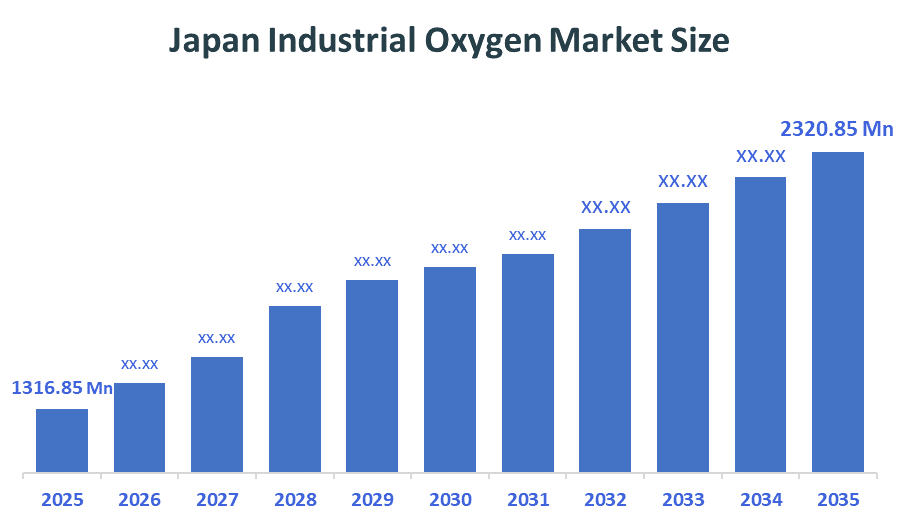
The Japan Industrial Oxygen Market size is forecasted to grow from USD 1316.85 Million in 2025 and going to reach approx. USD 2320.85 Million by 2035. According to Decision Advisors, there is a detailed research report on the Japan Industrial Oxygen Market highlights that steel and metallurgy application dominate the global market, accounting for approximately 35–40% of the total share worldwide. Taiyo Nippon Sanso Corporation generates strong revenue through its industrial gases segment, which accounts for approximately 30–40% market share, thus acting as a main driver of innovation in high-purity oxygen supply, air separation technologies, and semiconductor-grade gas solutions across Japan.
Market Snapshot
- Market Size (2025): USD 1316.85 Million
- Projected Market Size (2035): USD 2320.85 Million
- Compound Annual Growth Rate (CAGR): 5.83%
- Base Year: 2025
- Historical Period: 2021–2025
- Forecast Period: 2026–2035
Market Overview/Introduction
The Japan Industrial Oxygen Market includes the production, distribution, and application of oxygen used across industrial and medical sectors. Oxygen is a fundamental industrial gas for Japan because it supports multiple applications in steelmaking, oxy-fuel combustion, wastewater treatment, semiconductor manufacturing, and chemical processing. The market estimates show that oxygen makes up 28 to 33% of Japan's industrial gases needs which total over USD 6 billion for the industrial gases industry. The market is evolving because semiconductor manufacturing requires purer oxygen while steel and metal processing facilities expand and healthcare demands increase because of an older population. Japan also holds about 7% share of the global industrial gases market which demonstrates its strong manufacturing capabilities. Industrial gas companies are increasingly focusing on on-site oxygen generation systems and advanced air separation units (ASUs) for efficiency and purity control.
- Japan’s Green Growth Strategy promotes carbon neutrality by 2050 through subsidies and incentives, supporting hydrogen infrastructure, CCUS deployment, and industrial decarbonization to achieve sustainable, low-carbon economic transformation.
- METI Transition Finance promotes private investment in low-carbon technologies, supporting hydrogen, CCUS, and clean industrial gas systems, encouraging oxygen suppliers to adopt sustainable and energy-efficient production solutions.
- Society 5.0 & Digital Transformation (DX) in Japan promotes AI-driven automation and smart industrial systems, accelerating adoption of high-precision on-site oxygen generation technologies to improve efficiency, reduce labor costs, and optimize industrial energy use.
Notable Insights: -
- By type, the liquid oxygen held a dominant position with 4.5% in terms of market share in 2025.
- By application, steel and metallurgy is the dominating accounting for over 5% of the Japan market share in 2025.
- The compound annual growth rate of the Japan Industrial Oxygen Market is 5.83%.
- The market is likely to achieve a valuation of USD 2320.85 Million by 2035.
What is role of technology in grooming the market?
The Japanese oxygen production and usage processes depend on technological advancements which enhance their efficiency and purity and reliability. Advanced air separation units (ASUs) operate as the primary technology which enables industrial facilities to produce 70 to 75% of their oxygen needs through efficient gas separation methods. The deployment of PSA (Pressure Swing Adsorption) systems for on-site oxygen generation has become more common in mid-sized facilities which results in supply dependency reductions that reach 25 to 30%. High-purity oxygen systems exceeding 99.5% purity are essential for semiconductor fabrication, which contributes nearly 15% of Japan’s industrial oxygen demand. The implementation of oxygen-enriched combustion systems results in a 15 to 25% energy efficiency improvement for industrial operations which includes steel and chemical production processes. Digital monitoring systems enable organizations to optimize gas flow in real time which results in enhanced safety measures and a 10 to 15% reduction of operational losses. Taiyo Nippon Sanso Corporation and Air Liquide lead the development of high-purity oxygen delivery systems and advanced industrial gas technologies in Japan.
Market Drivers
Industrialization and technological advances and population growth all drive the Japan Industrial Oxygen Market. The steel and heavy manufacturing industries account for nearly 35–40% of total oxygen consumption, making them the largest end-use segment. The semiconductor and electronics industry produce 15 to 20% of its output because Japan maintains its status as a worldwide leader in advanced manufacturing. The healthcare system requires more oxygen because Japan's elderly population continues to grow with more than 29% of its citizens reaching 65 years or older. Oxygen-enriched combustion technologies provide energy efficiency improvements between 15 and 25% which helps industrial facilities reduce operational costs. Japan aims to achieve carbon neutrality by 2050 which drives industries to adopt environmentally friendly industrial gases. The chemical processing industry and wastewater treatment facilities require high-purity oxygen which continues to grow as industrial infrastructure undergoes modernization and expansion.
Restrain
The Japan Industrial Oxygen Market faces multiple structural barriers which will prevent its expansion despite existing industrial demand. The need for substantial financial resources to build air separation units ASUs and oxygen generation systems creates a critical obstacle which particularly affects small and medium-sized businesses. The process of oxygen production requires substantial energy resources which leads to high operational expenses and decreases business profits when electricity rates are high. Organizations face increased operational challenges because they need to meet strict gas safety regulations while maintaining their compliance with safety standards. The market experiences consumption variations because it relies heavily on the steel and manufacturing industries which follow a cyclical pattern of demand. The presence of competing technologies for process optimization and efficiency solutions will lead to decreased industrial oxygen demand in specific applications over the long term.
Study on the Supply, Demand, Distribution, and Market Environment Japan Industrial Oxygen Market
The Japan Industrial Oxygen Market operates through a structured supply chain which large industrial gas companies and their advanced distribution networks control. Major suppliers control approximately 70% of total market supply which ensures that industrial hubs will have stable supply availability. The steel and chemical industries show increasing adoption of on-site oxygen generation systems which now represent approximately 25% of their new installation projects. Large industrial clusters use merchant liquid oxygen and pipeline supply systems which provide them with ongoing supply delivery. The steel manufacturing plants supply 35 to 40% of their total demand while semiconductor fabrication facilities and chemical industries and healthcare institutions supply 15 to 20%, 10 to 15% and 10 to 12% respectively. Long-term supply contracts dominate procurement strategies which account for 60 to 65% of total industrial agreements because they provide price stability and supply security. The industrial gas ecosystem of Japan shows improved supply chain efficiency together with reduced logistics delays through the implementation of automated systems and digital procurement method=s.
Price Analysis and Healthcare Facilities Behaviour Analysis
The price of industrial oxygen in the Japanese market depends on three factors which include purity standards, delivery methods, and specific uses of the product. The industry standard price for gaseous oxygen ranges from USD 0.10 to USD 0.30 per cubic meter which makes it economically viable for use in extensive industrial operations. The price of liquid oxygen varies between USD 100 and 250 per ton based on two factors which include shipping distance and required purity standards. Semiconductor production facilities pay high costs for high-purity oxygen because the industry requires them to meet quality standards that demand more than 99.5% purity making this oxygen more expensive than standard industrial oxygen. The high upfront costs of onsite oxygen generation systems become more appealing to large manufacturing companies because these systems decrease their operational expenses between 20 and 35% throughout their operational life. ASU and PSA systems need large amounts of power to create oxygen but their efficiency gains have enabled production costs to decrease between 10 and 15% which has strengthened market competition while maintaining stable industrial gas prices throughout Japan.
Strategies to Implement for Growth of the Market
The Japan Industrial Oxygen Market through strategic technology investments develops infrastructure projects and industrial partnerships program. The industrial sector will boost its use of on-site oxygen generation systems which will increase by 25 to 30% according to industry predictions. Semiconductor manufacturing requires high-purity oxygen technologies because its oxygen demand will grow 15 to 20 % during the forecast period. Industrial gas companies establish strategic partnerships with steel and electronics manufacturers to enhance supply chain operations which results in operational cost savings between 10 and 15%. The implementation of digital gas monitoring systems improves operational efficiency and safety by 10 to 20% whereas air separation technologies which consume less energy lead to decreased production expenses. The healthcare oxygen distribution networks require expansion because medical demand increases and Japan's aging population creates higher healthcare needs.
Market Segmentation
The Japan Industrial Oxygen Market share is classified into type, application, and supply mode
- The liquid oxygen dominated the market in 2024, and is projected to grow at a substantial CAGR of approximately 4.5% during the forecast period.
Based on the type, the Japan industrial oxygen market is divided into gaseous oxygen, liquid oxygen, high-purity oxygen. Among these, the liquid oxygen dominated the market in 2024, and is projected to grow at a substantial CAGR of approximately 4.5% during the forecast period. The material is mainly utilized because its efficient storage capacity and its ability to transport goods and its industrial applications in steelmaking and chemical processing and healthcare sectors. The liquid oxygen market is expected to experience significant growth during the forecast period because industrial manufacturing and metallurgy demand for the product will increase and Japanese industrial gas infrastructure will adopt cryogenic storage and bulk supply systems.
- The steel and metallurgy accounted for the largest share in 2024, and is anticipated to grow at a significant CAGR of approximately 5% during the forecast period.
Based on the application, the Japan industrial oxygen market is divided into steel and metallurgy, healthcare, chemicals, electronics, wastewater treatment, Others. Among these, the steel and metallurgy accounted for the largest share in 2024, and is anticipated to grow at a significant CAGR of approximately 5% during the forecast period. The basic oxygen furnace (BOF) steel production process together with metal processing industries requires extensive oxygen consumption. The segment will experience growth through the forecast period because steel production demand and industrial automation and oxygen-enriched combustion technology adoption will increase.
- The medium-scale PIC segment dominated the market in 2024, and is projected to grow at a substantial CAGR approximately 6% during the forecast period.
Based on the supply mode, the Japan industrial oxygen market is divided into on-site generation, merchant liquid, pipeline supply. Among these, the on-site generation segment dominated the market in 2024, and is projected to grow at a substantial CAGR approximately 6% during the forecast period. The industrial users which include steel and chemical and electronics manufacturers or industrial users benefits from this solution because it provides continuous supply at a lower cost and requires fewer transportation and storage operations. The on-site generation segment is expected to expand at a significant compound annual growth rate 6% throughout the upcoming forecast period because industrial facilities in Japan increasingly adopt Pressure Swing Adsorption systems while they seek reliable supply and decentralized oxygen production.
Recent Development
- In January–February 2026, Medical Excellence Japan plans to send a delegation to YEIDA Medical Device Park to strengthen India–Japan collaboration in MedTech, focusing on high-end medical equipment partnerships and innovation.
- In February 2025, Air Liquide announced a new advanced Air Separation Unit in Japan, scheduled for 2027 operations, strengthening industrial and healthcare gas supply with efficient, low-carbon oxygen production infrastructure.
- In March 2025, Compact oxygen concentrators are gaining strong adoption, with next-generation lightweight, quiet, and energy-efficient devices designed for continuous home and office use, supporting growing demand for portable respiratory care solutions.
- In June 2024, Smart oxygen systems incorporating ambient air sensing technology are being integrated into advanced oxygen delivery devices, enabling automatic flow adjustment based on real-time environmental air quality and usage demand efficiency.
- In June 2024, The Government of Japan committed US$ 6.7 million to Unitaid to expand medical oxygen access in developing countries, in collaboration with WHO and PATH to strengthen healthcare infrastructure.
Competitive Analysis
The report offers the appropriate analysis of the key organisations/companies involved within the Japan Industrial Oxygen Market, along with a comparative evaluation primarily based on their integration type offering, business overviews, geographic presence, enterprise strategies, segment market share, and SWOT analysis. The report also provides an elaborative analysis focusing on the current news and developments of the companies, which includes integration type development, innovations, joint ventures, partnerships, mergers & acquisitions, strategic alliances, and others. This allows for the evaluation of the overall competition within the market.
Top Key Companies in Japan Industrial Oxygen Market
- Taiyo Nippon Sanso Corporation
- Air Liquide
- Linde plc
- Air Water Inc.
- Mitsubishi Chemical Group
- Iwatani Corporation
- Messer Group
- Showa Denko
- Matheson Tri-Gas
- Gulf Cryo
- SOL Group
- INOX Air Products
- Universal Industrial Gases Inc.
- Air Products and Chemicals
- Others
Key Target Audience
- Market Players
- Investors
- End-users
- Government Authorities
- Consulting and Research Firm
- Venture capitalists
- Value-Added Resellers (VARs)
Market Segment
This study forecasts revenue at the Japan, regional, and country levels from 2020 to 2035. Decision Advisors has segmented the Japan Industrial Oxygen Market based on the below-mentioned segments
Japan Industrial Oxygen Market, By Type
- Gaseous Oxygen
- Liquid Oxygen
- High-Purity Oxygen
Japan Industrial Oxygen Market, By Application
- Steel and Metallurgy
- Healthcare
- Chemicals
- Electronics
- Wastewater Treatment
- Others
Japan Industrial Oxygen Market, By Supply Mode
- On-site Generation
- Merchant Liquid
- Pipeline Supply
Frequently Asked Questions (FAQ)
1. How is Japan’s semiconductor industry reshaping oxygen purity requirements?
Japan’s semiconductor manufacturing is driving demand for ultra-high purity oxygen (>99.5%), pushing suppliers to invest in advanced purification and contamination-free delivery systems.
2. Why is on-site oxygen generation gaining faster adoption than merchant supply in Japan?
On-site generation reduces dependency on logistics, improves supply stability, and lowers long-term costs for steel and chemical industries operating in continuous production cycles.
3. How does Japan’s aging population indirectly influence industrial oxygen demand?
Aging demographics increase healthcare oxygen consumption, leading to expansion of medical oxygen infrastructure and boosting overall demand stability in the industrial gas ecosystem.
4. What role does oxygen play in Japan’s hydrogen economy development?
Oxygen is increasingly used in hydrogen production processes, fuel cell systems, and CCUS technologies, supporting Japan’s transition toward a low-carbon energy ecosystem.
5. How are Japanese industrial gas companies improving supply chain resilience?
Companies are integrating digital monitoring, predictive maintenance, and decentralized oxygen production systems to reduce supply disruptions and improve delivery efficiency.
6. Why is oxygen-enriched combustion becoming important in Japan’s steel industry?
It enhances furnace efficiency, reduces fuel consumption, and lowers emissions, aligning with Japan’s carbon neutrality and industrial decarbonization targets
Check Licence
Choose the plan that fits you best: Single User, Multi-User, or Enterprise solutions tailored for your needs.
We Have You Covered
- 24/7 Analyst Support
- Clients Across the Globe
- Tailored Insights
- Technology Tracking
- Competitive Intelligence
- Custom Research
- Syndicated Market Studies
- Market Overview
- Market Segmentation
- Growth Drivers
- Market Opportunities
- Regulatory Insights
- Innovation & Sustainability
Report Details
| Scope | country |
| Pages | 210 |
| Delivery | PDF & Excel via Email |
| Language | English |
| Release | Apr 2026 |
| Access | Download from this page |