
Japan Insulin Market
 |
Pages:
210
|
Pages:
210
Japan Insulin Market Size, Share, By Product Type (Insulin Analogues, Human Insulin, Premixed Insulin, and Biosimilar Insulin), By Administration Method (Insulin Pens, Insulin Syringes, Insulin Pumps, Jet Injectors, and Others), By Indication (Type 1 Diabetes, Type 2 Diabetes, and Gestational Diabetes) By Distribution Channel (Hospital Pharmacies, Retail & Drug Stores, Online Pharmacies / Providers, and Specialty Pharmacies) Analysis and Forecast 2026-2035
REPORT COVERAGE
Country
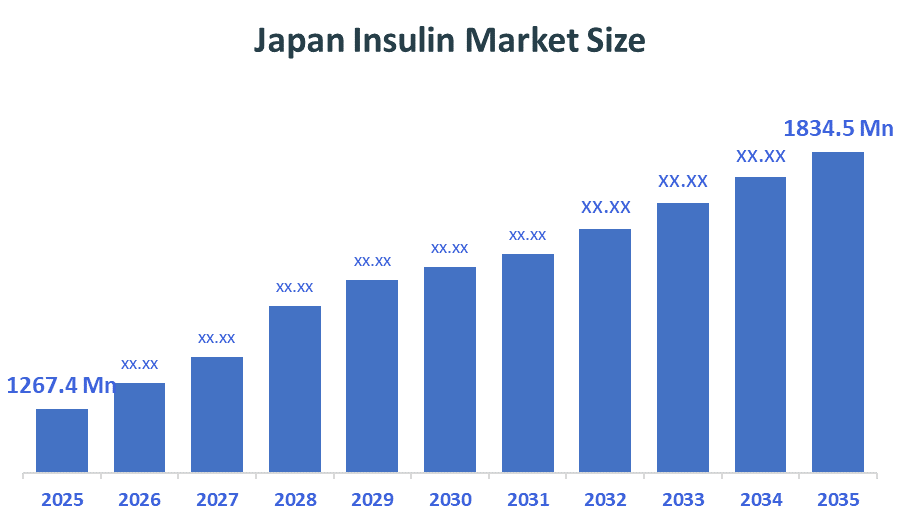
The Japan Insulin Market Size is projected USD 1267.4 Million in 2025 and is forecasted to reach around USD 1834.5 Million by 2035. According to Decision Advisors, a detailed report on analysis of the Japan Insulin Market indicates that the Insulin Analogues trend dominates the market, accounting for approx. 73% of the total Japan demand worldwide. Novo Nordisk is one of the most dominating companies in Japan’s Insulin Market, supported by revenue of approx. USD 400–500 million, driven by strong distribution network, product innovation, and growing demand for energy-efficient appliances across urban households.
Market Snapshot
- Japan Insulin Market Size (2025): USD 1267.4 Million
- Japan Insulin Market Projected Market Size (2035): USD 1834.5 Million
- Japan Insulin Market Compound Annual Growth Rate (CAGR): 3.77%
- Base Year: 2025
- Historical Period: 2021–2024
- Forecast Period: 2026–2035
Market Overview/Introduction
The insulin market refers to one of the important segments within the worldwide diabetes care market. This market encompasses the creation, manufacturing, and delivery of insulin therapies aimed at regulating the blood sugar level in diabetic individuals. Specifically, insulin can be described as a vital peptide hormone secreted by the pancreas and controlling carbohydrate, fat, and protein metabolism processes. Medicinally, it is injected artificially when there is not enough insulin secretion or effective insulin utilization within the body. Types of insulin include human insulin, insulin analogues, premixed insulin, and biosimilar insulin, as well as different delivery modes, like insulin pens, pumps, and syringes. The importance of the insulin market lies in its significance for the treatment of type I diabetes, more advanced cases of type II diabetes, and gestational diabetes. Factors driving the growth of the market include an increase in the world prevalence of diabetes, particularly in aged population, as well as obesity, a sedentary lifestyle, and enhanced disease diagnosis. The transition towards insulin analogues providing enhanced glycaemic control with no increased hypoglycaemia risk is additionally propelling market expansion. New technologies are transforming the industry, with smart insulin pens, pump with CGM, and artificial pancreas systems being introduced. Insulin use is encouraged by governments, especially the Japanese government, through universal healthcare insurance, diabetes testing schemes, and assistance with chronic illness treatment costs. Early diagnosis and healthy living campaigns also play an important role in market growth.
- In September 2024, Japan’s DNAPP initiative focused on preventing diabetic nephropathy progression, improving glycaemic control, and optimizing healthcare costs, indirectly supporting better insulin management and diabetes care outcomes nationwide.
- In December 2022, Japan’s MHLW expanded reimbursement for Continuous Glucose Monitoring devices to all insulin users, enhancing diabetes management and boosting adoption of advanced insulin therapy technologies nationwide.
Notable Insights: -
- By product type, the Insulin Analogues segment holds a dominant position with an estimated share of over 72% in 2025.
- By technology, the insulin pens segment holds a dominant position with an estimated share of over 62% in 2025.
- By distribution channel, the Hospital Pharmacies segment holds a dominant position with an estimated share of over 53% in 2025.
- By Indication, the Type 1 Diabetes segment holds a dominant position with an estimated share of over 88% in 2025.
- The forecasted CAGR for the Japan Insulin market is expected to be about 3.77% for the period between 2026 and 2035.
- The market is expected to reach a valuation of approximately USD 1834.5 Million by 2035
What is the Role of Technology in Grooming the Market?
Technology acts as an important player in shaping the Japan insulin market through increased efficiency in diabetes management, patient compliance, and better therapy results. Modern methods of insulin delivery including insulin pens, insulin pumps, and advanced connected technology solutions have increased the accuracy and convenience of drug administration. Integration of CGM into insulin pumps makes it possible to monitor the glucose level and adjust the amount of insulin on a regular basis, which contributes to the creation of closed-loop artificial pancreas. Moreover, digital health services and mobile apps facilitate the monitoring process and provide additional options for cooperation with physicians. Finally, the production of biosimilars leads to decreased cost of treatment.
Market Drivers
The major drivers in the Japanese insulin market are the rising incidence of diabetes, specifically Type 2 diabetes, due to the aging population and the changing trends in life styles. Japan is one of the fastest aging countries in the world, which makes patients dependent on the use of insulin. Sedentary behaviour, improper diet and obesity rates are additional causes for rising diabetes cases. Furthermore, rising awareness among people about advanced insulin treatment is driving the adoption of insulin analogues, which are associated with greater efficacy, less hypoglycaemia and ease of administration. This trend plays an important role in market growth. Innovation in technology concerning devices that can administer the drug efficiently, like insulin pens, smart pens and insulin pump with CGM, is boosting adoption. Besides, Japan being covered under universal healthcare system, reimbursement plays an important role in market growth. Moreover, government-led efforts for increasing awareness regarding diabetes along with regular screening tests also helps to propel market growth.
Restraints
High treatment costs of advanced insulin analogues and delivery devices act as a major restraint. Strict regulatory approval processes delay product launches. Dependence on lifelong insulin therapy increases patient burden and reduces adherence in some cases. Additionally, availability of alternative antidiabetic drugs and growing preference for non-insulin therapies in early Type 2 diabetes also limit market expansion in Japan.
Study on the Supply, Demand, Distribution, and Market Environment
The Japan Insulin market demonstrates stability in terms of supply owing to the participation of major players like Novo Nordisk, Eli Lilly, and Sanofi, as well as the involvement of biosimilar makers. There is a continuous increase in demand due to the demographic nature of Japan, presence of a high number of cases with Type 2 diabetes, and increased reliance on insulin products. The demand emanates mainly from hospitals and clinics, while the demand arising from homecare has been on the rise with the help of insulin pens and digitization tools. The distribution channels have been well defined with the dominance of hospital pharmacies, followed by retail pharmacies and specialty pharmacies. There is gradual development in online channels due to the adoption of digital healthcare.
Price Analysis and Consumer Behaviour Analysis
Insulin in Japan is associated with high prices and stable pricing levels because of insulin analogues and stringent regulations. Insulin analogues have a higher price compared to human insulin because of their effectiveness, longevity, and low risk of causing hypoglycaemia. Nevertheless, the universal health care coverage of Japan and its reimbursement policy ensure lower costs incurred by individuals and help in stabilizing demand levels. Consumer behaviour in the insulin market is greatly affected by physicians' recommendations and prescription practices from hospitals, besides the quality of branded insulins. Patients in Japan prefer insulin pens to insulin syringes because of their ease of use, accuracy, and comfort. Consumers above the age of 50 are more inclined to self-administration through devices that monitor blood sugar levels.
Market Segmentation
The Japan insulin market is categorised by product type, administration method, indication and distribution channel
- The insulin analogues segment dominated the market in 2025 and is projected to grow at a steady CAGR of approximately 8.6% during the forecast period.
Based on the product type, the insulin market is divided into insulin analogues, human insulin, premixed insulin, and biosimilar insulin. Among these, insulin analogues dominate the insulin market by product type due to superior glycaemic control, lower hypoglycaemia risk, and better dosing convenience compared to human insulin. They are widely preferred in developed markets like Japan and account for the largest revenue share 65%–75%. The segment is also the fastest-growing, with an estimated CAGR of around 7–9% during the forecast period. Rising adoption among Type 2 diabetes patients and strong innovation from key pharmaceutical companies continue to support its leading position globally.
- The insulin pens segment accounted for the largest share in 2025 and is anticipated to grow at a significant CAGR of approximately 7.6% during the forecast period.
Based on the technology, the insulin market is divided into insulin pens, insulin syringes, insulin pumps, jet injectors, and others. Among these, insulin pens dominate the insulin delivery market, accounting for approximately 55–65% of total market revenue. Their leadership is driven by ease of use, accurate dosing, portability, and higher patient compliance compared to syringes and pumps. Insulin pens are also the fastest-growing segment, with an estimated CAGR of around 6–8% during the forecast period. Rising preference for self-administration in diabetes care and increasing adoption of prefilled and smart insulin pens further strengthen their dominant position globally.
- The Type 1 Diabetes segment accounted for the largest share in 2025 and is anticipated to grow at a significant CAGR of approximately 4.6% during the forecast period.
Based on the indication, the insulin market is divided into type 1 diabetes, type 2 diabetes, and gestational diabetes. Among these, Type 1 Diabetes is the dominant segment in terms of insulin dependency and contributes a significant share of market revenue, accounting for approximately 85–90% of insulin usage revenue due to lifelong insulin requirement. Overall, Type 1 Diabetes shows a stable CAGR of approximately 3–5%.
- The Hospital Pharmacies sector segment accounted for the largest share in 2025 and is anticipated to grow at a significant CAGR of approximately 4.7% during the forecast period.
Based on the distribution channel, the insulin market is divided into hospital pharmacies, retail & drug stores, online pharmacies / providers, and specialty pharmacies. Among these, the hospital pharmacies dominate the insulin market, accounting for approximately 45–55% of total market revenue, as insulin is largely prescription-driven and initiated in clinical settings. This segment shows a steady CAGR of around 3–5%, supported by high diabetes hospital visits and reimbursement systems.
Recent Developments
- In January 2025, Novo Nordisk launched Awiqli (insulin icodec) in Japan, the world’s first once-weekly basal insulin, enhancing patient convenience and advancing diabetes management innovation in the insulin market.
- In March 2025, Japan’s Sysmex launched the HISCL C-Peptide Assay Kit, improving diabetes diagnosis by enabling accurate measurement of insulin secretion levels, supporting better clinical decision-making and strengthening insulin-based treatment planning in diabetes care.
Competitive Analysis
The report offers the appropriate analysis of the key organisations/companies involved within the Japan Insulin market, along with a comparative evaluation primarily based on their product offering, business overviews, geographic presence, enterprise strategies, segment market share, and SWOT analysis. The report also provides an elaborate analysis focusing on the current news and developments of the companies, which includes product development, innovations, joint ventures, partnerships, mergers & acquisitions, strategic alliances, and others. This allows for the evaluation of the overall competition within the market.
Top Key Companies in the Japan Insulin Market
- Novo Nordisk
- Eli Lilly and Company
- Sanofi
- Astellas Pharma
- Takeda Pharmaceutical Company
- Pfizer
- Merck & Co.
- Biocon Biologics
- Wockhardt
- Julphar Diabetes Care
- Others
Key Target Audience
- Market Players
- Investors
- End-users
- Government Authorities
- Consulting and Research Firm
- Venture capitalists
- Value-Added Resellers (VARs)
Market Segmentation
This study forecasts revenue at the national and regional levels from 2021 to 2035. The report segmented the Japan Insulin Market based on the following segments:
Japan Insulin Market, By Product Type
- Insulin Analogues
- Human Insulin
- Premixed Insulin
- Biosimilar Insulin
Japan Insulin Market, By Administration Method
- Insulin Pens
- Insulin Syringes
- Insulin Pumps
- Jet Injectors
- Others
Japan Insulin Market, By Indication
- Type 1 Diabetes
- Type 2 Diabetes
- Gestational Diabetes
Japan Insulin Market, By Distribution Channel
- Industrial sector
- Retail & Drug Stores
- Online Pharmacies / Providers,
- Specialty Pharmacies
Frequently Asked Questions (FAQ)
1. What future innovations are expected to reshape insulin therapy in Japan?
Future insulin therapy in Japan is expected to be shaped by fully automated closed-loop systems (artificial pancreas), ultra-long-acting insulin formulations, and AI-driven diabetes management platforms. These innovations aim to minimize manual intervention and improve long-term glycaemic stability for patients.
2. How is patient lifestyle influencing insulin demand in Japan?
Modern lifestyle changes such as increased stress, irregular eating habits, and reduced physical activity are significantly impacting metabolic health in Japan. These behavioural shifts are increasing insulin dependency even among younger diabetic populations, expanding long-term treatment requirements.
3. What role do healthcare professionals play in insulin adoption in Japan?
Healthcare professionals play a critical role in insulin adoption as treatment decisions are highly physician-guided. Endocrinologists and hospital specialists determine insulin initiation, dosage adjustment, and therapy switching, making clinical trust a key factor in market behaviour.
4. How does Japan’s healthcare structure influence diabetes management practices?
Japan’s healthcare system promotes structured and continuous diabetes management through regular medical checkups, early detection programs, and standardized treatment protocols. This system encourages consistent monitoring and long-term disease control strategies among diabetic patients.
5. What are the emerging patient preferences in insulin usage behaviour?
Patients in Japan are increasingly preferring simplified and less invasive treatment experiences, focusing on convenience, reduced injection frequency, and better integration with digital health tracking tools that support self-management and lifestyle flexibility.
Check Licence
Choose the plan that fits you best: Single User, Multi-User, or Enterprise solutions tailored for your needs.
We Have You Covered
- 24/7 Analyst Support
- Clients Across the Globe
- Tailored Insights
- Technology Tracking
- Competitive Intelligence
- Custom Research
- Syndicated Market Studies
- Market Overview
- Market Segmentation
- Growth Drivers
- Market Opportunities
- Regulatory Insights
- Innovation & Sustainability
Report Details
| Scope | Country |
| Pages | 210 |
| Delivery | PDF & Excel via Email |
| Language | English |
| Release | Apr 2026 |
| Access | Download from this page |