
Japan Motor Insurance Market
 |
Author:
Sanket C
|
Pages:
210
|
Author:
Sanket C
|
Pages:
210
Japan Motor Insurance Market Size, Share, By Insurance Type (Third-Party Liability Insurance, Comprehensive Insurance, Collision Insurance, Personal Accident Insurance, Others), By Vehicle Type (Passenger Cars, Commercial Vehicles, Motorcycles, Electric & Hybrid Vehicles), and By Premium Range (Low Premium, Medium Premium, High Premium), and Analysis and Forecast 2025-2035
CAGR
3.47%
REVENUE 2025
USD Billion 54.9
FORECAST 2035
USD Billion 77.2
REPORT COVERAGE
country
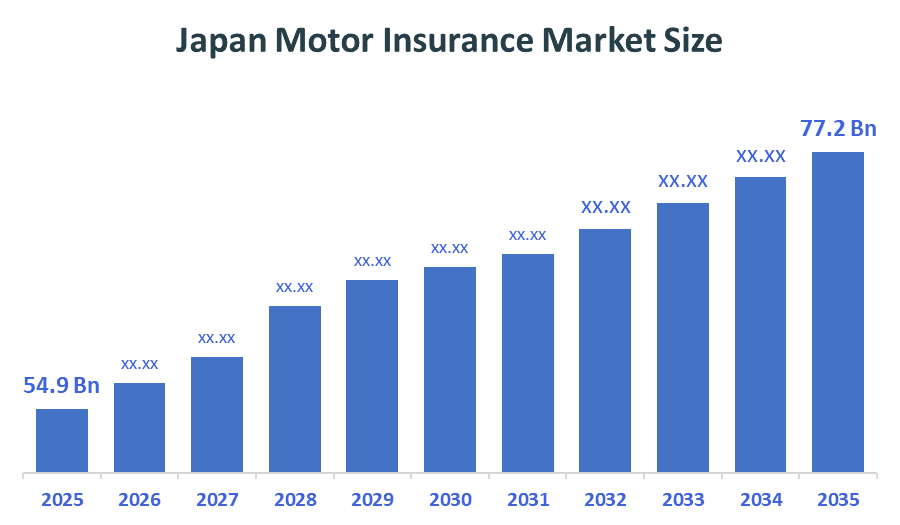
The Japan Motor Insurance Market Size is anticipated to grow from USD 54.9 billion in 2025 and is expected to reach around USD 77.2 billion by 2035. According to Decision Advisors, market insights point to digitalization as the core force redefining Japan motor insurance sector, holding an estimated 70-75% share globally. Tokio Marine holds a leading position with nearly USD 37-39 Billion in annual revenue and a 25-30% Japan market share, impacting growth momentum and strategic orientation across the Japan market.
Market Snapshot
- Japan Motor Insurance Market Size (2025): USD 54.9 billion
- Projected Japan Motor Insurance Market Size (2035): 77.2 billion
- Japan Motor Insurance Market Compound Annual Growth Rate (CAGR): 3.47%
- Base Year: 2025
- Historical Period: 2021–2024
- Forecast Period: 2026–2035
Market Overview/Introduction
The Japan motor insurance market exists as a developed non-life insurance market which shows its maturity through its total gross written premium with Compulsory Automobile Liability Insurance (CALI) (Jibaiseki) mandatory requirements and voluntary policies that protect property and passengers and vehicle damage. The system provides services to both private and commercial fleets while telematics-based usage-based insurance (UBI) systems create new underwriting practices which use behavior data to establish pricing models that improve risk assessment and cost efficiency and enable personalized digital policy solutions across Japan's developing mobility system. The innovations such as telematics-enabled UBI, AI-driven claims automation, and regulatory-backed digital distribution. The drive agent personal solution demonstrates how organizations can evaluate risks in real time. The future of business expansion depends on three factors, which include electric vehicle insurance coverage and autonomous vehicle risk assessment and embedded insurance systems. The predictive analytics will enhance customized solutions for small, medium-sized enterprises, and different regional markets, which will result in better business results and customer-focused product development.
- In April 2025, Japan’s motor insurance market, valued at approximately JPY 4.8 trillion, is dominated by compulsory third-party liability coverage, ensuring universal penetration, while insurers invest heavily in digitalization and risk management to enhance operational efficiency and profitability.
Notable Insights: -
- By insurance type, the third-party liability insurance segment held a dominant position with 31.7% in terms of market share in 2025.
- By vehicle type, passenger cars segment is the dominating accounting for over 68.1% of the Japan market share in 2025.
- The compound annual growth rate of the Japan Motor Insurance Market is 3.47%.
- The market is likely to achieve a valuation of USD 77.2 billion by 2035.
What is role of technology in grooming the market?
Japanese motor insurance market growth depends on technology which improves underwriting practices and claims processing efficiency and distribution networks. Telegmatics and usage-based insurance systems improve actuarial precision by providing actual driving information whereas AI-driven claims processing systems decrease both loss adjustment costs and processing time. The digital ecosystems which receive support from regulatory bodies such as the Financial Services Agency result in increased online policy adoption.
Market Drivers
The Japanese motor insurance market operates through two main drivers which include regulatory requirements and changing transportation patterns. The mandatory nature of Compulsory Automobile Liability Insurance (CALI) secures a stable premium base, while rising vehicle utilization sustains incremental demand. The current insurance policies face dual challenges because electrification and ADAS systems force companies to develop new risk assessment methods. The digital transformation process through which AI-based underwriting and telematics-driven usage-based insurance systems operate results in improved pricing methods together with greater customer acquisition success. The combination of increasing repair expenses from advanced vehicle parts together with rising claims costs from climate hazards creates financial pressure which drives up insurance premiums and boosts revenue growth. The market stays intact through these structural factors which create operational stability and drive business growth and strategic development for the long term.
Restrain
The Japan motor insurance market faces some limitations because all drivers have to obtain Compulsory Automobile Liability Insurance (CALI) which serves as an essential requirement. The underwriting margins experience compression due to the escalating repair costs result from electric vehicles complex systems and their advanced technological components. The combination of adverse demographic trends and population decline results in decreased driver recruitment and lessened demand for insurance policies. The combination of these elements leads to decreased premium growth while creating greater challenges for long-term volume development in an insurance market that has reached its saturation point.
Strategies to Implement for Growth of the Market
The Japan's motor insurance market should achieve growth through data-driven underwriting that uses telematics, AI for improved risk pricing, customer retention. The company will expand its offerings through usage-based products and electric vehicle-specific solutions which will help it reach new mobility markets. The company will establish new distribution pathways through embedded auto insurance products which will operate within automotive ecosystems. The company will speed up its digital transformation by aligning its business operations with financial services agency regulatory requirements. The company will create new income sources through tailored products that will be offered to small, medium-sized enterprises and regional markets which will also help establish its market position for future business expansion.
Market Segmentation
The Japan Motor Insurance Market share is classified into Insurance, vehicle, and premium range
- The third-party liability insurance segment dominated the market in 2024, and is projected to grow at a substantial CAGR of approximately 9.1% during the forecast period.
Based on the insurance type, the motor insurance market is divided into third-party liability insurance, comprehensive insurance, collision insurance, personal accident insurance, others. Among these, the third-party liability insurance segment dominated the market in 2024, and is projected to grow at a substantial CAGR of approximately 9.1% during the forecast period. It is due to the rising vehicle ownership, and heightened awareness of legal obligations, reinforcing its dominance over comprehensive and optional coverage.
- The passenger cars segment accounted for the largest share in 2024, and is anticipated to grow at a significant CAGR of approximately 7.3% during the forecast period.
Based on the vehicle type, the motor insurance market is divided into passenger cars, commercial vehicles, motorcycles, electric & hybrid vehicles. Among these, the passenger cars segment accounted for the largest share in 2024, and is anticipated to grow at a significant CAGR of approximately 7.3% during the forecast period. It is dominating because the high private vehicle penetration, growing urban mobility demand, and increased consumer expenditure on insurance products, underscoring its economic significance.
- The low premium segment dominated the market in 2024, and is projected to grow at a substantial CAGR during the forecast period.
Based on the premium range, the motor insurance market is divided into low premium, medium premium, high premium. Among these, the low premium segment dominated the market in 2024, and is projected to grow at a substantial CAGR during the forecast period. The cost-sensitive consumers, intensified competition among insurers, and a focus on affordability, reflecting market strategies aimed at maximizing penetration and sustaining policyholder retention.
Recent Development
- In April 2026, Japan’s motor insurance market, valued at JPY 4.9 trillion, reflects universal compulsory liability coverage, optional premium hikes averaging 5.7%, and substantial insurer investments in digitalization and risk management to sustain profitability and market resilience.
- In December 2025, Japan’s motor insurance market, valued at JPY 4.9 trillion, witnessed insurers investing over JPY 120 billion in digitalization, including Fujitsu’s SAP Fioneer Cloud, enhancing regulatory compliance, AI-driven claims, and operational efficiency.
Competitive Analysis
The report offers the appropriate analysis of the key organisations/companies involved within the Japan motor insurance market, along with a comparative evaluation primarily based on their product offering, business overviews, geographic presence, enterprise strategies, segment market share, and SWOT analysis. The report also provides an elaborative analysis focusing on the current news and developments of the companies, which includes product development, innovations, joint ventures, partnerships, mergers & acquisitions, strategic alliances, and others. This allows for the evaluation of the overall competition within the market.
Top Key Companies in Japan Motor Insurance Market
- Tokio Marine & Nichido Fire Insurance Co., Ltd.
- Sompo Japan Insurance Inc.
- Mitsui Sumitomo Insurance Co., Ltd.
- Aioi Nissay Dowa Insurance Co., Ltd.
- MS&AD Insurance Group Holdings, Inc.
- Rakuten General Insurance Co., Ltd.
- SBI Insurance Co., Ltd.
- Sony Assurance Inc.
- AXA General Insurance (Japan)
- Zurich Insurance Company Ltd (Japan Branch)
- Chubb Insurance Japan
- Japan Post Insurance Co., Ltd.
Key Target Audience
- Market Players
- Investors
- End-users
- Government Authorities
- Consulting and Research Firm
- Venture capitalists
- Value-Added Resellers (VARs)
Market Segment
This study forecasts revenue at the Japan, regional, and country levels from 2020 to 2035. Decision Advisors has segmented the Japan motor insurance market based on the below-mentioned segments
Japan Motor Insurance Market, By Insurance Type
- Third-Party Liability Insurance
- Comprehensive Insurance
- Collision Insurance
- Personal Accident Insurance
- Others
Japan Motor Insurance Market, By Vehicle Type
- Passenger Cars
- Commercial Vehicles
- Motorcycles
- Electric & Hybrid Vehicles
Japan Motor Insurance Market, By Premium Range
- Low Premium
- Medium Premium
- High Premium
Frequently Asked Questions (FAQ)
- What is driving growth in the Japan motor insurance market?
The Japan motor insurance market is expanding due to rising vehicle ownership, mandatory third-party liability insurance, and digital transformation. In 2026, insurers in Japan are investing heavily in AI-based underwriting, telematics, and automated claims processing to improve efficiency and profitability.
- How important is compulsory insurance in Japan’s motor insurance sector?
Compulsory automobile liability insurance is the backbone of Japan’s motor insurance market. It ensures 100% penetration for basic coverage, protecting third-party injury victims. This regulatory framework stabilizes premium inflows and strengthens long-term insurance sector resilience in Japan’s economy.
with new methods to monetize their content through digital platforms which operate outside of standard domestic TV distribution.
- What role does digitalization play in Japan motor insurance?
Digitalization is reshaping Japan’s motor insurance market through AI-driven claims, telematics-based risk assessment, and automated underwriting. In 2026, insurers are adopting cloud platforms and fraud detection systems to reduce operational costs and enhance customer experience and claim accuracy.
- What is the impact of telematics on Japan motor insurance?
Telematics is transforming Japan’s motor insurance industry by enabling real-time driving data collection, risk-based pricing, and faster accident reconstruction. This technology reduces fraud, improves underwriting accuracy, and supports personalized premium models across passenger car insurance segments
Check Licence
Choose the plan that fits you best: Single User, Multi-User, or Enterprise solutions tailored for your needs.
We Have You Covered
- 24/7 Analyst Support
- Clients Across the Globe
- Tailored Insights
- Technology Tracking
- Competitive Intelligence
- Custom Research
- Syndicated Market Studies
- Market Overview
- Market Segmentation
- Growth Drivers
- Market Opportunities
- Regulatory Insights
- Innovation & Sustainability
Report Details
| Scope | country |
| Pages | 210 |
| Delivery | PDF & Excel via Email |
| Language | English |
| Release | May 2026 |
| Access | Download from this page |