
Japan Nanotechnology Market
 |
Author:
Kunal M
|
Pages:
200
|
Author:
Kunal M
|
Pages:
200
Japan Nanotechnology Market Size, Share, and COVID-19 Impact Analysis, By Type (Nanosensors, Nano Devices, Nanomaterials, and Others), By Application (Electronics, Energy, Chemical Manufacturing, Aerospace and Defense, Healthcare, and Others), and Japan Nanotechnology Market Insights, Industry Trend, Forecasts to 2035
CAGR
26.2%
REVENUE 2024
USD Million 615.5
FORECAST 2035
USD Million 7956.5
REPORT COVERAGE
Country
Japan Nanotechnology Market Insights Forecasts to 2035
- The Japan Nanotechnology Market Size Was Estimated at USD 615.50 Million in 2024
- The Market Size is Expected to Grow at a CAGR of Around 26.2% from 2025 to 2035
- The Japan Nanotechnology Market Size is Expected to Reach USD 7956.50 Million by 2035
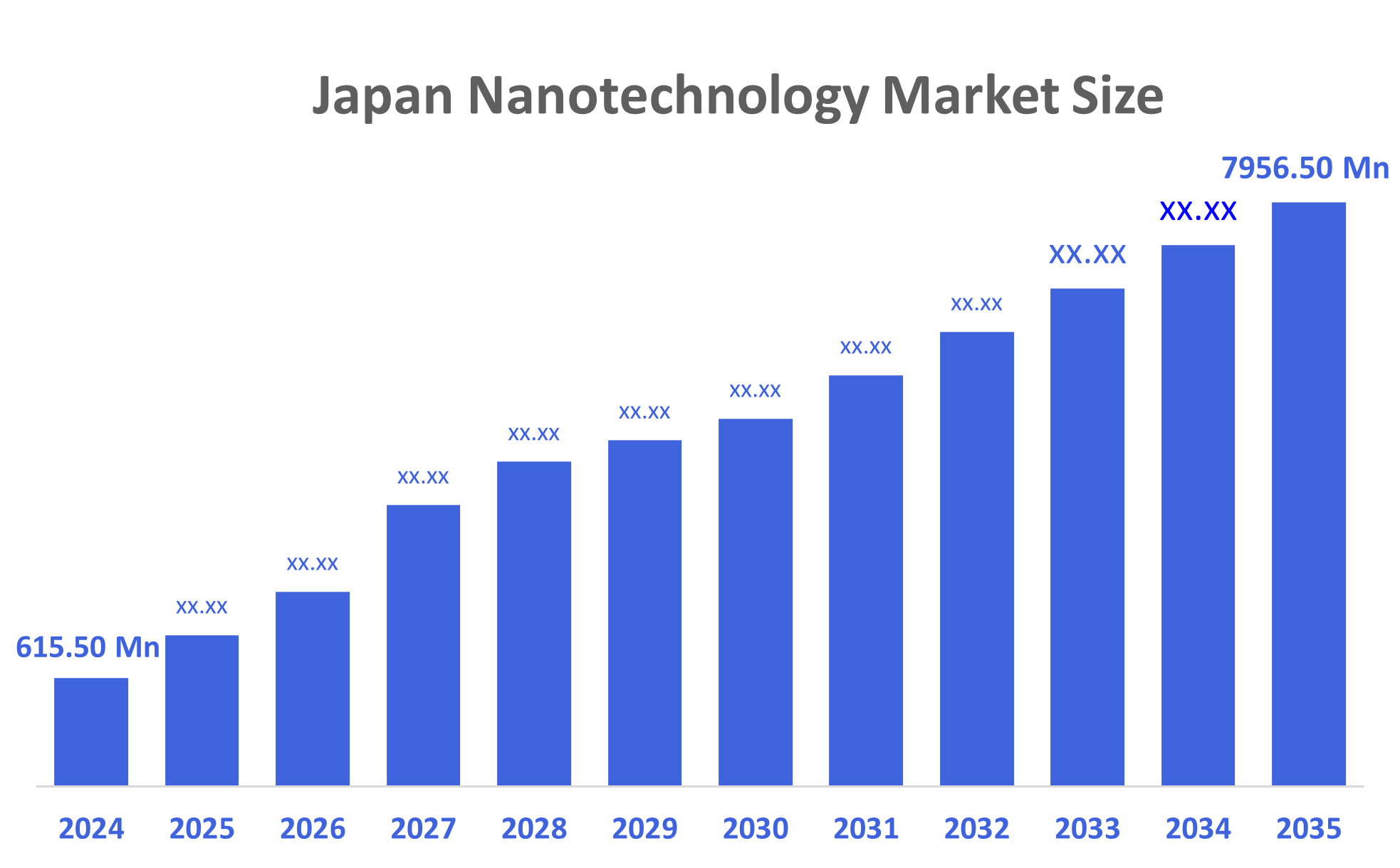
According to a research report published by Decisions Advisors, The Japan Nanotechnology Market Size is Anticipated to Reach USD 7956.50 Million by 2035, growing at a CAGR of 26.2% from 2025 to 2035. The Japan nanotechnology market is driven by increasing R&D in electronics, healthcare, and energy, government support, advanced materials innovation, rising industrial applications, and growing demand for precision devices and sensors.
Market Overview
The Japan nanotechnology market refers to the industry focused on the research, development, and commercialisation of materials, devices, and systems at the nano scale. It encompasses applications in electronics, healthcare, energy, and manufacturing, driven by technological innovation, government initiatives, and increasing demand for high-performance, miniaturised, and efficient solutions. Its uses in healthcare are fuelling the growth of the Japanese nanotechnology market. Nanotechnology is revolutionizing drug delivery systems such that drugs are delivered more precisely with fewer side effects and greater therapeutic efficacy. Japan is at the forefront of developing nanoparticles and nanomaterials for targeted drug delivery, particularly cancer treatment. Japanese firms are employing nanocarriers and liposomes to enhance the solubility and bioavailability of drugs, leading to improved treatments. Besides, Japan's shrinking population is pushing the demand for innovative medical technologies, and nanotechnology can fulfil the demand by making the healthcare solutions more efficient and more targeted, placing Japan in the lead in nanomedicine.
In Japan, the government has been actively promoting the growth of the nanotechnology market through various policies and initiatives. The government has established the National Nanotechnology Initiative to coordinate research and development efforts in the field, providing funding and support to universities, research institutions, and companies engaged in nanotechnology. Additionally, Japan has implemented regulations to ensure the safe and ethical use of nanotechnology, such as the Nanotechnology Safety Guidelines and the Act on the Safety of Nanomaterials and Nanoproducts. These policies aim to drive innovation, enhance competitiveness, and address the potential environmental and health impacts of nanotechnology, positioning Japan as a global leader in this rapidly advancing sector.
Report Coverage
This research report categorizes the market for the Japan nanotechnology market based on various segments and regions, and forecasts revenue growth and analyses trends in each submarket. The report analyses the key growth drivers, opportunities, and challenges influencing the Japan nanotechnology market. Recent market developments and competitive strategies, such as expansion, product launch, development, partnership, merger, and acquisition, have been included to draw the competitive landscape in the market. The report strategically identifies and profiles the key market players and analyses their core competencies in each sub-segment of Japan nanotechnology market.
Driving Factors
The nanotechnology markets in Japan are driven by growing demand for smaller, faster, and more energy-efficient electronic devices is propelling the Japan nanotechnology market growth. Japanese firms are employing nanomaterials such as carbon nanotubes and nanowires to improve semiconductors and electronic devices. These materials allow for the creation of smaller, faster chips, needed in the newest consumer electronics innovations, such as smartphones, wearable technology, and computers. Japan's powerful semiconductor sector is rapidly embracing nanotechnology to meet miniaturisation and performance needs, providing it with a competitive advantage in the international electronics marketplace. This industry's ongoing advancement will propel Japan dominance of the international nanotechnology market.
For instance, in January 2025, NIMS exhibited at Nanotech 2025, the 24th International Nanotechnology Exhibition & Conference at Tokyo Big Sight. The event showcased NIMS & MEXT initiatives, featuring presentations on innovative technologies, including magnetic refrigerators, next-gen cooling systems, and hydrogen production. NIMS also presented cutting-edge research on materials science, energy, and nanotechnology. The National Institute for Materials Science (NIMS) is a leading research organization in Japan, known for its advancements in materials science, energy storage, electronics, and nanotechnology.
Restraining Factors
The nanotechnology market in Japan is restrained by faces several challenges, including the need for significant investment in research and development to maintain its competitive, as well as the risk of potentially harmful environmental and health impacts associated with nanomaterials. Additionally, there are concerns about the regulation and standardisation of nanotechnology products to ensure consumer safety and trust in the market.
Market Segmentation
The Japan nanotechnology market share is categorized by type and application.
- The nanomaterials segment accounted for the largest revenue market share in 2024 and is expected to grow at a significant CAGR during the forecast period.
The Japan nanotechnology market is segmented by type into nanosensors, nano devices, nanomaterials, and others. Among these, the nanomaterials segment accounted for the largest revenue market share in 2024 and is expected to grow at a significant CAGR during the forecast period. The segmental growth is driven by high demand in electronics, healthcare, energy, and coatings, driven by superior properties, versatility, technological advancements, and increasing industrial and research applications.
- The electronics segment dominated the market in 2024 and is projected to grow at a substantial CAGR during the forecast period.
The Japan nanotechnology market is segmented by application into electronics, energy, chemical manufacturing, aerospace and defense, healthcare, and others. Among these, the electronics segment accounted for the largest revenue share in 2024 and is expected to grow at a significant CAGR during the forecast period. The growth of the segment is due to rising demand for miniaturised devices, advanced semiconductors, wearable technology, high-performance sensors, and innovative nanomaterial applications enhancing efficiency, durability, and functionality in consumer and industrial electronics.
Competitive Analysis:
The report offers the appropriate analysis of the key organizations/companies involved within the Japan nanotechnology market, along with a comparative evaluation primarily based on their product offering, business overviews, geographic presence, enterprise strategies, segment market share, and SWOT analysis. The report also provides an elaborate analysis focusing on the current news and developments of the companies, which includes product development, innovations, joint ventures, partnerships, mergers & acquisitions, strategic alliances, and others. This allows for the evaluation of the overall competition within the market.
List of Key Companies
- Hitachi High Tech Corporation
- JEOL, Ltd
- Tokyo Electron Limited
- Shin Etsu Chemical Co
- Toray Industries
- Showa Denko
- Others
Key Target Audience
- Market Players
- Investors
- End-users
- Government Authorities
- Consulting and Research Firm
- Venture capitalists
- Value-Added Resellers (VARs)
Recent Developments
- In May 2025, researchers from the Institute of Science Tokyo developed a large, hollow dodecahedral metal-peptide nanostructure through self-assembly. The 6.3-nanometer structure, created using geometric principles from knot and graph theory, features a stable inner cavity capable of encapsulating macromolecules. This advancement in molecular engineering opens doors for creating complex artificial virus capsids. The structure's stability and modifiability make it a promising platform for applications in drug delivery, molecular transportation, and materials chemistry.
Market Segment
This study forecasts revenue at the Japan, regional, and country levels from 2020 to 2035. Decisions Advisors has segmented the Japan Nanotechnology Market based on the below-mentioned segments:
Japan Nanotechnology Market, By Type
- Nanosensors
- Nano Devices
- Nanomaterials
- Others
Japan Nanotechnology Market, By Application
- Electronics
- Energy
- Chemical Manufacturing
- Aerospace and Defense
- Healthcare
- Others
Check Licence
Choose the plan that fits you best: Single User, Multi-User, or Enterprise solutions tailored for your needs.
We Have You Covered
- 24/7 Analyst Support
- Clients Across the Globe
- Tailored Insights
- Technology Tracking
- Competitive Intelligence
- Custom Research
- Syndicated Market Studies
- Market Overview
- Market Segmentation
- Growth Drivers
- Market Opportunities
- Regulatory Insights
- Innovation & Sustainability
Report Details
| Scope | Country |
| Pages | 200 |
| Delivery | PDF & Excel via Email |
| Language | English |
| Release | Nov 2025 |
| Access | Download from this page |