
Japan permanent magnet motor market
 |
Author:
Pranali P
|
Pages:
210
|
Author:
Pranali P
|
Pages:
210
Japan permanent magnet motor market Size, Share, By Type (Surface Permanent Magnet Synchronous Motor, Interior Permanent Magnet Synchronous Motor), By Material Composition (Aluminium, Iron, Nickel, Copper, Cobalt, Others), By End-user (Industrial, Commercial, Residential), Analysis and Forecast 2026-2035
CAGR
9.79%
REVENUE 2025
USD Billion 4.95
FORECAST 2035
USD Billion 12.6
REPORT COVERAGE
country
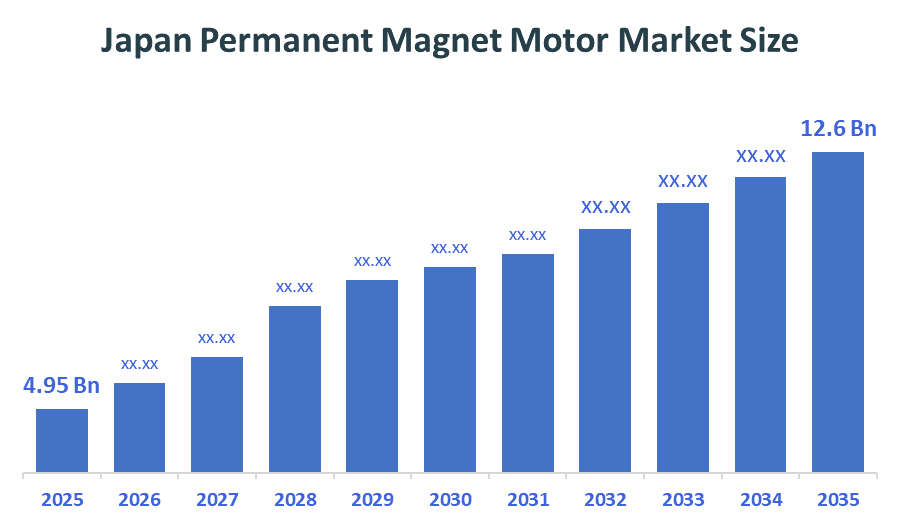
The Japan permanent magnet motor market size is forecasted to grow from USD 4.95 Billion in 2025 and going to reach approx. USD 12.6 Billion by 2035. According to Decision Advisors, there is a detailed research report on the Japan permanent magnet motor market highlights that Interior permanent magnet motors dominate the global market, accounting for approximately 55–60% of the total share worldwide. Nidec Corporation generate strong revenue through its motor and driver influencing product innovation, high-efficiency motor development, and overall market expansion in Japan.
Market Snapshot
- Market Size (2025): USD 4.95 Billion
- Projected Market Size (2035): USD 12.6 Billion
- Compound Annual Growth Rate (CAGR): 9.79%
- Base Year: 2025
- Historical Period: 2021–2025
- Forecast Period: 2026–2035
Market Overview/Introduction
The Japan Permanent Magnet Motor Market includes high-efficiency electric motors which use permanent magnets to create magnetic fields without needing external power sources. These motors are widely used in electric vehicles and robotics and HVAC systems and industrial machinery. Japan’s leadership in automation and robotics and hybrid/electric vehicle manufacturing creates strong market demand. The government programs which support energy efficiency and carbon neutrality and electrification initiatives are driving faster technology adoption. Moreover, increasing investments in smart manufacturing and Industry 4.0 are boosting demand for precision motors with integrated digital control systems. The rising focus on miniaturization, lightweight design, and high-speed performance is encouraging innovation in motor materials and designs. Growing adoption in renewable energy systems and next-generation mobility solutions is also expected to strengthen long-term market expansion in Japan.
- In April 2026, Japan continued strengthening its EV ecosystem through advanced motor technologies and battery innovation initiatives, supported by policies promoting electrification and battery supply chain development led by the Ministry of Economy, Trade and Industry
- In February 2025, industrial automation investments increased significantly, boosting demand for high-efficiency motor systems, driven by Japan’s focus on smart manufacturing and robotics-led industrial transformation.
Notable Insights: -
- By Type, the Interior Permanent Magnet Synchronous Motor held a dominant position with 6.5% in terms of market share in 2025.
- By Material Composition, Iron is the dominating accounting for over 6% of the Japan market share in 2025.
- The compound annual growth rate of the Japan permanent magnet motor market is 9.79%.
- The market is likely to achieve a valuation of USD 12.6 Billion by 2035.
What is role of technology in grooming the market?
Technological advancements are significantly enhancing permanent magnet motor performance in Japan. High-efficiency designs improve energy savings by 20–30% compared to conventional motors. Advanced materials such as rare-earth magnets increase torque density by nearly 25–35%, making motors more compact and powerful. Integration with IoT and smart control systems enables predictive maintenance and improves operational efficiency by 15–20%. Additionally, developments in cooling systems and lightweight motor structures enhance durability and reduce energy losses. These innovations are critical in EVs, robotics, and precision manufacturing, supporting Japan’s leadership in advanced industrial technologies.
Market Drivers
The Japan Permanent Magnet Motor Market is primarily driven by the rapid growth of electric vehicles, increasing demand for energy-efficient industrial systems, and expansion of robotics and automation industries. Government regulations promoting energy efficiency and carbon neutrality are encouraging adoption across sectors. Rising investments in smart manufacturing and Industry 4.0 technologies further accelerate demand. Additionally, the growing need for compact, lightweight, and high-performance motors in consumer electronics and HVAC systems supports market growth.
Restrain
Despite strong growth potential, the market faces challenges such as high dependency on rare-earth materials, which increases production costs and supply chain risks. Fluctuating prices of neodymium and other key materials impact overall profitability. Additionally, the complexity of manufacturing advanced motors and the need for specialized technologies can limit adoption among smaller manufacturers. Competition from alternative motor technologies also presents a challenge.
Study on the Supply, Demand, Distribution, and Market Environment Japan permanent magnet motor market
The Japan Permanent Magnet Motor Market operates through a highly integrated supply chain involving raw material suppliers (rare-earth magnets), motor manufacturers, OEMs, and end-use industries such as automotive, industrial automation, and consumer electronics. Demand is primarily driven by electric vehicles, robotics, and advanced manufacturing, with EVs and industrial automation accounting for a significant share due to their need for high-efficiency, compact motors. On the supply side, Japan benefits from strong domestic manufacturing capabilities and global export networks, supplying high-performance motors and components worldwide. Distribution is dominated by OEM partnerships, industrial suppliers, and direct contracts with automotive and equipment manufacturers. The market environment is shaped by government policies promoting energy efficiency, electrification, and carbon neutrality, along with continuous innovation in motor design and materials. Increasing automation and renewable energy adoption further strengthen long-term demand, positioning Japan as a technologically advanced and export-oriented market.
Price Analysis and Healthcare Facilities Behaviour Analysis
The pricing of permanent magnet motors in Japan varies significantly based on motor type, power rating, efficiency level, and application. Small motors used in consumer electronics typically range from low-cost units, while high-performance motors used in electric vehicles and industrial automation systems command premium pricing due to advanced materials such as rare-earth magnets and precision engineering. Interior permanent magnet motors are generally priced higher due to superior efficiency and torque density. Fluctuations in rare-earth material costs directly impact pricing structures. From an end-user perspective, industries such as automotive and robotics prioritize energy efficiency, durability, and compact design over initial cost. Nearly 60% of buyers focus on lifecycle cost and performance reliability, while around 50% emphasize energy savings and compliance with efficiency regulations. Increasing adoption of automation and electrification is also influencing purchasing decisions.
Strategies to Implement for Growth of the Market
Companies should prioritize reducing dependence on rare-earth materials by investing in alternative magnet technologies and developing efficient recycling systems to ensure long-term supply stability. Strengthening partnerships with electric vehicle manufacturers and industrial automation firms can enhance market penetration and create steady demand pipelines. Expanding local manufacturing capabilities and building resilient supply chains will help mitigate raw material price volatility and geopolitical risks. Additionally, increased investment in research and development for high-efficiency, compact, and lightweight motor designs will improve competitiveness. Integrating advanced technologies such as IoT and AI can enable smart monitoring and predictive maintenance. Collaborating with government initiatives focused on energy efficiency, electrification, and sustainability will further accelerate adoption and support long-term market growth.
Market Segmentation
The Japan permanent magnet motor market share is classified into type, Material Composition, and end-user
- The Interior Permanent Magnet Synchronous Motor dominated the market in 2024, and is projected to grow at a substantial CAGR of approximately 6.5% during the forecast period.
Based on the Type, the Japan permanent magnet motor market is divided into Surface Permanent Magnet Synchronous Motor, Interior Permanent Magnet Synchronous Motor. Among these, the Interior Permanent Magnet Synchronous Motor dominated the market in 2024, and is projected to grow at a substantial CAGR of approximately 6.5% during the forecast period. This dominance is driven by its higher efficiency, superior torque density, and better performance at high speeds compared to surface-type motors, making it highly suitable for electric vehicles, robotics, and advanced industrial automation applications in Japan.
The Iron accounted for the largest share in 2024, and is anticipated to grow at a significant CAGR of approximately 6% during the forecast period.
Based on the Material Composition, the Japan permanent magnet motor market is divided into Aluminium, Iron, Nickel, Copper, Cobalt, Others. Among these, the Iron dominated the market in 2024, and is projected to grow at a substantial CAGR of approximately 6% during the forecast period. This dominance is attributed to iron’s critical role in motor cores and magnetic circuits, offering high magnetic permeability, cost-effectiveness, and structural strength. Its widespread use across electric vehicles, industrial machinery, and automation systems in Japan further supports its leading position and steady growth trajectory.
- The Industrial segment dominated the market in 2024, and is projected to grow at a substantial CAGR approximately 6.2% during the forecast period.
Based on the End-user, the Japan permanent magnet motor market is divided into Industrial, Commercial, Residential. Among these, the Industrial segment dominated the market in 2024, and is projected to grow at a substantial CAGR approximately 6.2% during the forecast period. This dominance is driven by Japan’s strong industrial automation, robotics, and manufacturing sectors, where permanent magnet motors are widely used for their high efficiency, precision control, and energy savings. Increasing adoption of Industry 4.0 technologies and smart manufacturing systems further supports steady growth in the industrial segment.
Recent Development
- In June 2025, ABB Ltd introduced the AMXE250 motor with HES580 inverter package for electric buses, reducing motor losses by up to 12% and improving energy efficiency and operational performance.
- In December 2024, Danfoss A/S launched the Editron EM-PMI375 motor using synchronous reluctance-assisted permanent magnet technology, delivering up to 96% efficiency for industrial and mobile electrification applications.
- In March 2023, Siemens AG expanded its SIMOTICS SD motor series, enhancing industrial energy efficiency, reliability, and integration within smart manufacturing and digital automation environments.
Competitive Analysis
The report offers the appropriate analysis of the key organisations/companies involved within the Japan permanent magnet motor market, along with a comparative evaluation primarily based on their integration type offering, business overviews, geographic presence, enterprise strategies, segment market share, and SWOT analysis. The report also provides an elaborative analysis focusing on the current news and developments of the companies, which includes integration type development, innovations, joint ventures, partnerships, mergers & acquisitions, strategic alliances, and others. This allows for the evaluation of the overall competition within the market.
Top Key Companies in Japan permanent magnet motor market
- Nidec Corporation
- Toshiba Infrastructure Systems & Solutions Corporation
- Yaskawa Electric Corporation
- Oriental Motor Co., Ltd.
- Sumitomo Electric Industries, Ltd.
- Shin-Etsu Chemical Co., Ltd.
- ABB Ltd
- Siemens AG
- Rockwell Automation Inc.
- Kollmorgen Corporation
- Franklin Electric Co., Inc.
- Magna Co., Ltd.
- Others
Key Target Audience
- Market Players
- Investors
- End-users
- Government Authorities
- Consulting and Research Firm
- Venture capitalists
- Value-Added Resellers (VARs)
Market Segment
This study forecasts revenue at the Japan, regional, and country levels from 2020 to 2035. Decision Advisors has segmented the Japan permanent magnet motor market based on the below-mentioned segments
Japan permanent magnet motor market, By Type
- Surface Permanent Magnet Synchronous Motor
- Interior Permanent Magnet Synchronous Motor
Japan permanent magnet motor market, By Material Composition
- Aluminium
- Iron
- Nickel
- Copper
- Cobalt
- Others
Japan permanent magnet motor market, By End-user
- Industrial
- Commercial
- Residential
Frequently Asked Questions (FAQ)
1. What is driving the growth of the Japan Permanent Magnet Motor Market?
Growth is primarily driven by increasing adoption in electric vehicles, rapid expansion of industrial automation, and strong demand for energy-efficient motor systems supported by government electrification initiatives.
2. Why are Interior Permanent Magnet Synchronous Motors widely used in Japan?
Interior motors offer higher efficiency, better torque density, and improved high-speed performance, making them ideal for EVs, robotics, and precision industrial applications.
3. How does Japan’s robotics industry influence the market?
Japan’s leadership in robotics significantly boosts demand for high-precision motors, as permanent magnet motors are essential for accurate motion control and energy-efficient automation systems.
4. What role do rare-earth materials play in this market?
Rare-earth materials such as neodymium are critical for high-performance magnets, but their cost volatility and supply risks pose challenges for manufacturers.
5. Which end-user segment contributes the most demand?
The industrial segment dominates due to extensive use in manufacturing, robotics, and automation systems requiring reliable and efficient motor performance.
Check Licence
Choose the plan that fits you best: Single User, Multi-User, or Enterprise solutions tailored for your needs.
We Have You Covered
- 24/7 Analyst Support
- Clients Across the Globe
- Tailored Insights
- Technology Tracking
- Competitive Intelligence
- Custom Research
- Syndicated Market Studies
- Market Overview
- Market Segmentation
- Growth Drivers
- Market Opportunities
- Regulatory Insights
- Innovation & Sustainability
Report Details
| Scope | country |
| Pages | 210 |
| Delivery | PDF & Excel via Email |
| Language | English |
| Release | Apr 2026 |
| Access | Download from this page |