
Japan Smart Factory Market
 |
Author:
Achal E
|
Pages:
172
|
Author:
Achal E
|
Pages:
172
Japan Smart Factory Market Size, Share, And COVID-19 Impact Analysis, By Field Devices (Sensors, Industrial Robots, Machine Vision Systems, and Others), By Application (Aerospace & Defense, Automotive, Energy & Power, Food and Beverages, Healthcare, and Others), And Japan Smart Factory Market Insights, Industry Trend, Forecasts To 2035
CAGR
12.53%
REVENUE 2024
USD Billion 12.2
FORECAST 2035
USD Billion 44.7
REPORT COVERAGE
country
Japan Smart Factory Market Insights Forecasts to 2035
- The Japan Smart Factory Market Size Was Estimated at USD 12.2 Billion in 2024
- The Market Size is Expected to Grow at a CAGR of around 12.53% from 2025 to 2035
- The Japan Smart Factory Market Size is Expected to Reach USD 44.7 Billion by 2035
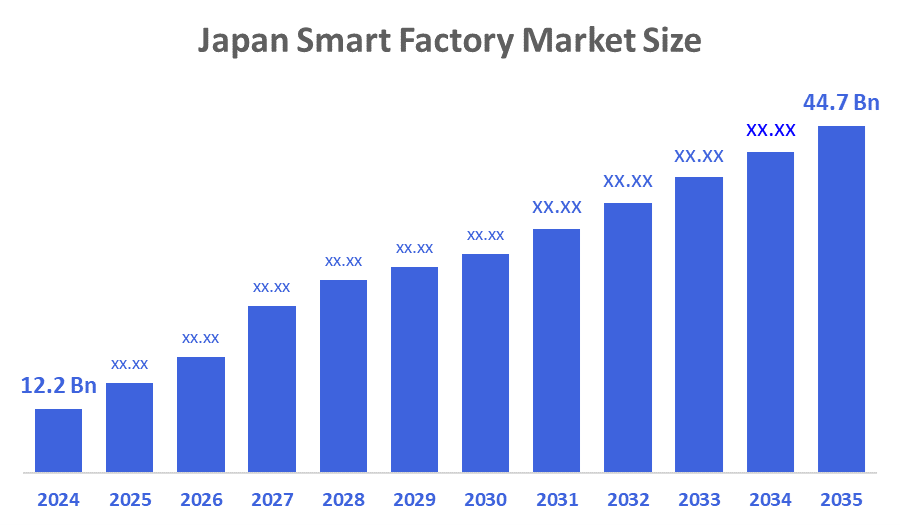
According to a research report published by Decision Advisors & Consulting, The Japan smart factory market Size?is anticipated to reach USD 44.7 Billion by 2035, Growing at a CAGR of 12.53% from 2025 to 2035. The Japanese smart factory market is driven by the growing need for digital transformation and automation, which improves operational effectiveness and lowers manufacturing costs.
Market Overview
The Japanese smart factory market is defined as the collection of products, services, and technology that allow Japanese manufacturers to implement digital transformation in their factories. Smart factories are defined as those that utilize advanced methods of automation in conjunction with IoT sensors, artificial intelligence/machine learning, robotics, software for industrial applications, cloud computing, and real-time data analysis to create highly efficient, flexible, and interconnected manufacturing environments. The trend towards increasing numbers of organizations in Japan adopting smart factory solutions is increasing as companies are looking to improve productivity and their competitive position. Therefore, the increase in demand for smart factory solutions across all sectors will continue, due to the critical factors mentioned above. The increase in smart factory solutions development and implementation has created a significant increase in demand for robots, machinery systems, and autonomous systems, due to the decrease in the availability of human workers in Japan. This trend and the growing adoption of Industry 4.0 by many manufacturing companies in Japan provide opportunities for future growth in digital twin technology, cloud-based manufacturing execution systems (MES), and predictive analysis.
Report Coverage
This research report categorizes the Japan smart factory market based on various segments and regions, and forecasts revenue growth and analyzes trends in each submarket. The report analyses the key growth drivers, opportunities, and challenges influencing the Japan smart factory market. Recent market developments and competitive strategies, such as expansion, Protein launch, development, partnership, merger, and acquisition, have been included to draw the competitive landscape in the market. The report strategically identifies and profiles the key market players and analyses their core competencies in each sub-segment of the Japan smart factory market.
Driving Factor
The Japanese smart factory market is driven by acute labour shortages, growing need for automation, and the drive for increased productivity in the electronics and automobile industries. Real-time monitoring and operational efficiency are improved by the growing use of IoT, AI, robotics, and 5G. Investments in intelligent industrial systems are increased by government initiatives like society 5.0 and connected industries, which further accelerate digital transformation.
Restraining Factor
The Japanese smart factory market is restrained by expensive initial investment costs, difficult system integration, and a lack of digital expertise. Implementation is also hampered by resistance to operational changes and cybersecurity concerns. Additionally, budgetary restrictions affect small and medium-sized firms, slowing the adoption of smart factories throughout Japan.
Market Segmentation
The Japan smart factory market share is classified into field devices and applications.
- The sensors segment is anticipated to grow at the highest CAGR during the forecast period.
The Japanese Smart Factory market is segmented by field devices into sensors, industrial robots, machine vision systems, and others. Among these, the sensors segment is anticipated to grow at the highest CAGR during the forecast period. This is due to the growing use of IoT and automation technologies, as well as the need for sophisticated sensor solutions that allow for data collection and real-time monitoring. Also, the sensors are crucial for guaranteeing accurate equipment control and operation, strengthening safety procedures, and raising overall operational effectiveness.
- The automotive segment accounted for the largest revenue share in 2024 and is expected to grow at a substantial CAGR during the predicted period.
The Japanese smart factory market is segmented by application into aerospace & defence, automotive, energy & power, food and beverages, healthcare, and others. Among these, the automotive segment accounted for the largest revenue share in 2024 and is expected to grow at a substantial CAGR during the predicted period. Automation and modern production technologies are being rapidly adopted by industry. Investments in robots, IoT, and data analytics are becoming crucial as automakers incorporate smart factory solutions to increase production efficiency, lower costs, and improve product quality.
Competitive Analysis:
The report offers the appropriate analysis of the key organizations/companies involved within the Japan smart factory market, along with a comparative evaluation primarily based on their Protein offering, business overviews, geographic presence, enterprise strategies, segment market share, and SWOT analysis. The report also provides an elaborate analysis focusing on the current news and developments of the companies, which includes Protein development, innovations, joint ventures, partnerships, mergers & acquisitions, strategic alliances, and others. This allows for the evaluation of the overall competition within the market.
List of Key Companies
- Fanuc
- Yaskawa
- Mitsubishi Electric
- Yaskawa Electric Corporation
- Daifuku Co., Ltd.
- Keyence Corporation
- Omron
- Others
Key Target Audience
- Market Players
- Investors
- End-users
- Government Authorities?
- Consulting and Research Firm
- Venture capitalists
- Value-Added Resellers (VARs)
Market Segment
This study forecasts revenue at the Japan, regional, and country levels from 2020 to 2035. Decision Advisors has segmented the Japan Smart Factory market based on the below-mentioned segments:
Japan Smart Factory Market, By Field Devices
- Sensors
- Industrial Robots
- Machine Vision Systems
- Others
Japan Smart Factory Market, By Application
- Aerospace & Defense
- Automotive
- Energy & Power
- Food and Beverages
- Healthcare
- Others
FAQ’s
Q: What is the Japan Smart Factory Market?
A: The Japan Smart Factory Market refers to the integration of IoT, AI, robotics, machine vision, automation software, cloud platforms, and real-time analytics to enhance manufacturing efficiency, productivity, and flexibility in Japanese factories.
Q: What is the market size and growth outlook?
A: The market is valued at USD 12.2 billion in 2024 and is expected to reach USD 44.7 billion by 2035, growing at a CAGR of 12.53% during 2025–2035.
Q: What is driving the growth of the smart factory market in Japan?
A: Growth is driven by labor shortages, rising automation demand, Industry 4.0 adoption, and government initiatives such as Society 5.0 and Connected Industries, which accelerate digital transformation and investments in intelligent manufacturing systems.
Q: Which field device segment holds the largest market share?
A: Industrial robots hold the largest revenue share in 2024 due to rapid adoption of AI-enabled automation, improved productivity, and rising reliance on robotics across manufacturing industries.
Q: Which application segment dominates the market?
A: The automotive sector accounts for the largest share due to high automation levels, increasing investments in robotics, IoT, and advanced production technologies to enhance output and quality.
Q: Who are the key players in the Japan Smart Factory Market?
A: Key companies include Fanuc, Mitsubishi Electric, Omron, Yaskawa Electric, Daifuku, Keyence Corporation, and others involved in robotics, automation, and digital industrial solutions.
Check Licence
Choose the plan that fits you best: Single User, Multi-User, or Enterprise solutions tailored for your needs.
We Have You Covered
- 24/7 Analyst Support
- Clients Across the Globe
- Tailored Insights
- Technology Tracking
- Competitive Intelligence
- Custom Research
- Syndicated Market Studies
- Market Overview
- Market Segmentation
- Growth Drivers
- Market Opportunities
- Regulatory Insights
- Innovation & Sustainability
Report Details
| Scope | country |
| Pages | 172 |
| Delivery | PDF & Excel via Email |
| Language | English |
| Release | Dec 2025 |
| Access | Download from this page |